The Zagori region ( Slavic name for Place Behind the Mountain) in northern Greece is one of the most untouched, remote and thrilling landscapes we have ever encountered. Surrounded by mountain ranges and rivers, 46 small stone villages were built during the Ottoman period between the 17th and 19th centuries. The early settlers were loggers, ranchers, blacksmiths, tradespeople and merchants who set up a road network with stone paths and bridges and during that period enjoyed wealth and prosperity.
However, by the mid-20th-century, the effects of four wars and the industrial revolution had created a steady decline in population and today, many of the villages are like ghost towns. Tourism and the interest in the historic towns, stone bridges and fascinating geology have helped to prevent the villages from becoming entirely abandoned.
We stayed at Gaia Guesthouse in the tiny village of Dilofo (pop. 10).
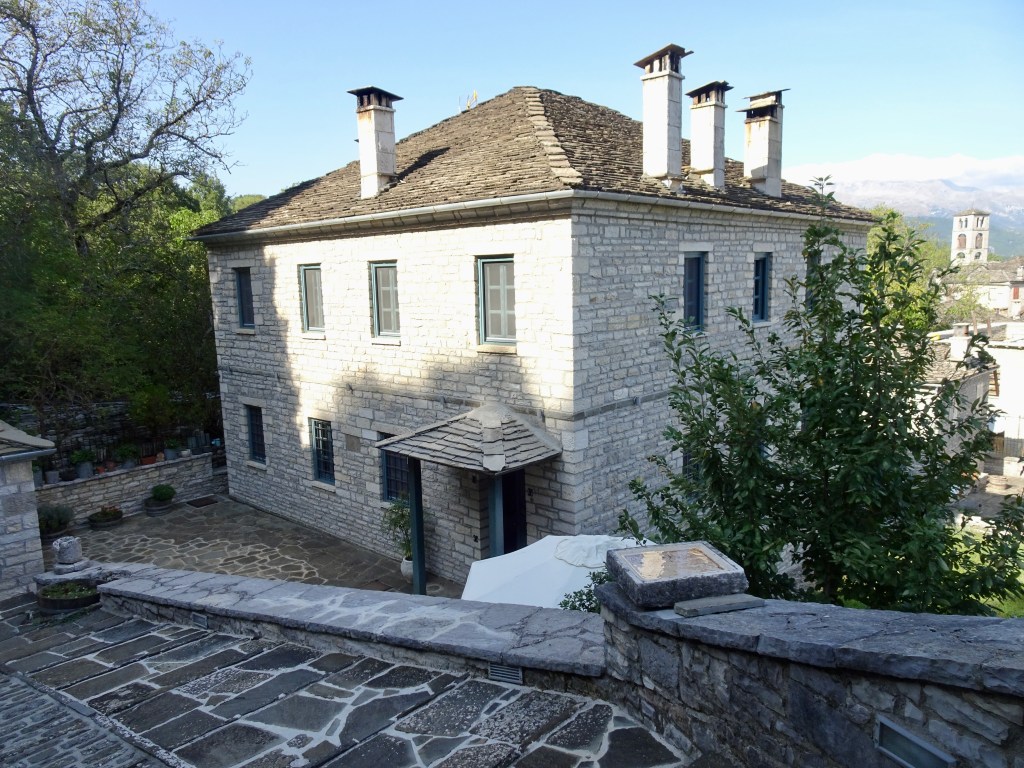
This was the view of sunrise from our bedroom window.

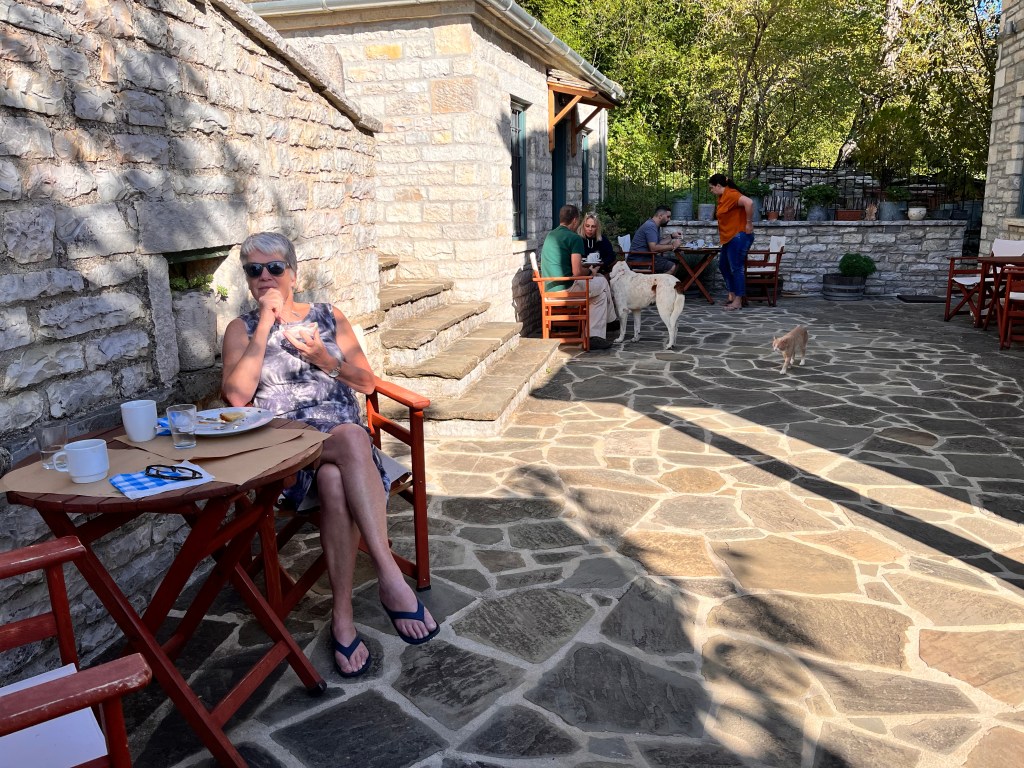
This was where we ate our breakfast every morning. The dog and the cats belong to the neighbours – they have figured out that tourists are a soft touch.
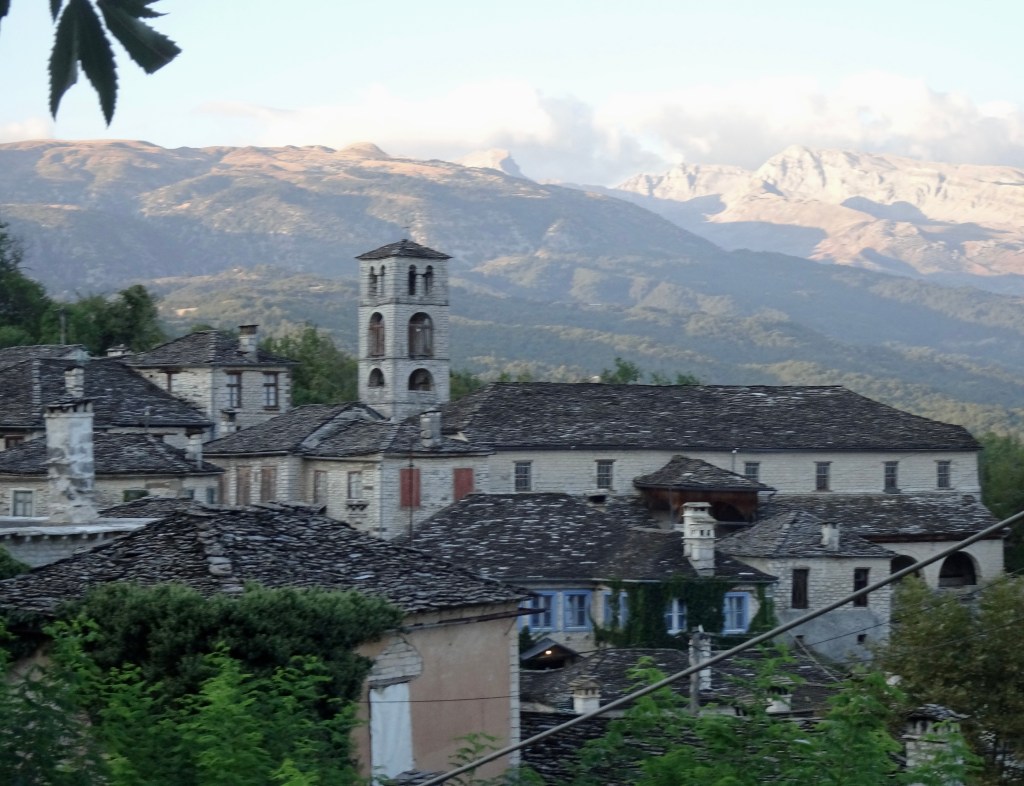
The view of Dilofo – note the many shuttered windows. Many of these buildings are vacation residences, but remain closed for much of the year. In our little village, there were two guesthouses and one very good restaurant. That’s it – no stores, no groceries. Nearby villages had one small “mini-market”, but for everything else, it was necessary to go to Ioannina, a small city 35 km. away.
What attracted us to this region was the Vikos Gorge, which is listed as being the “world’s deepest canyon in relation to its width“. This claim is apparently somewhat in dispute, but whatever its standing as deep canyons go, it is mightily impressive.

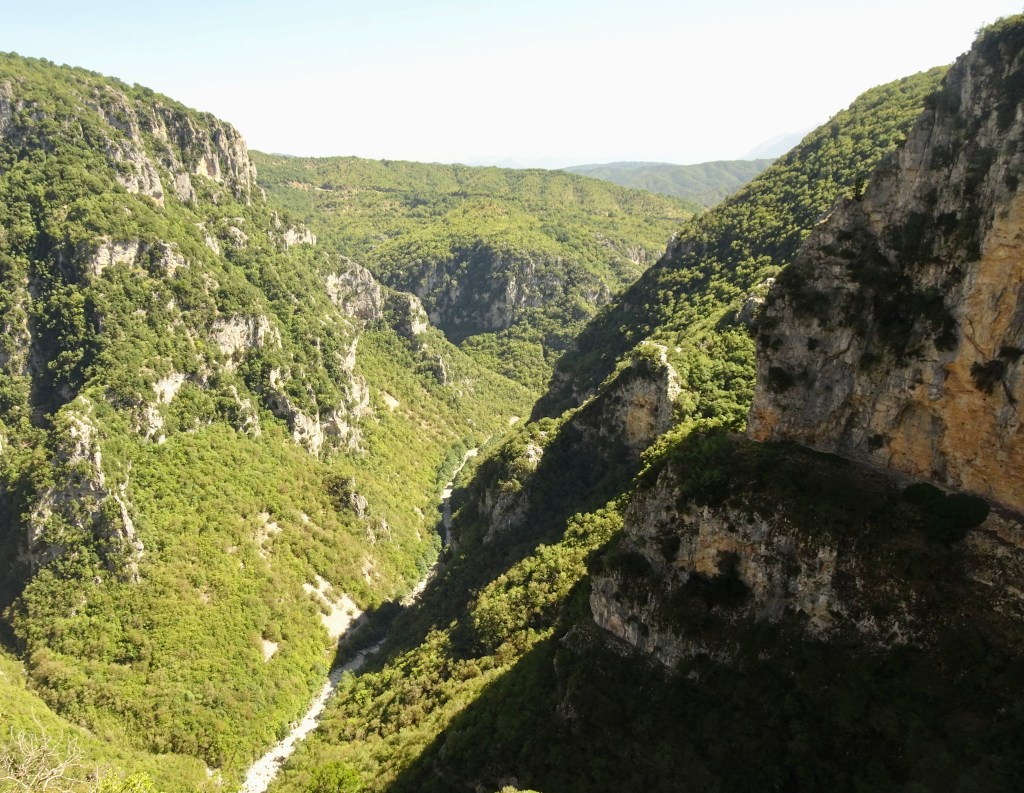
The view looking straight down.

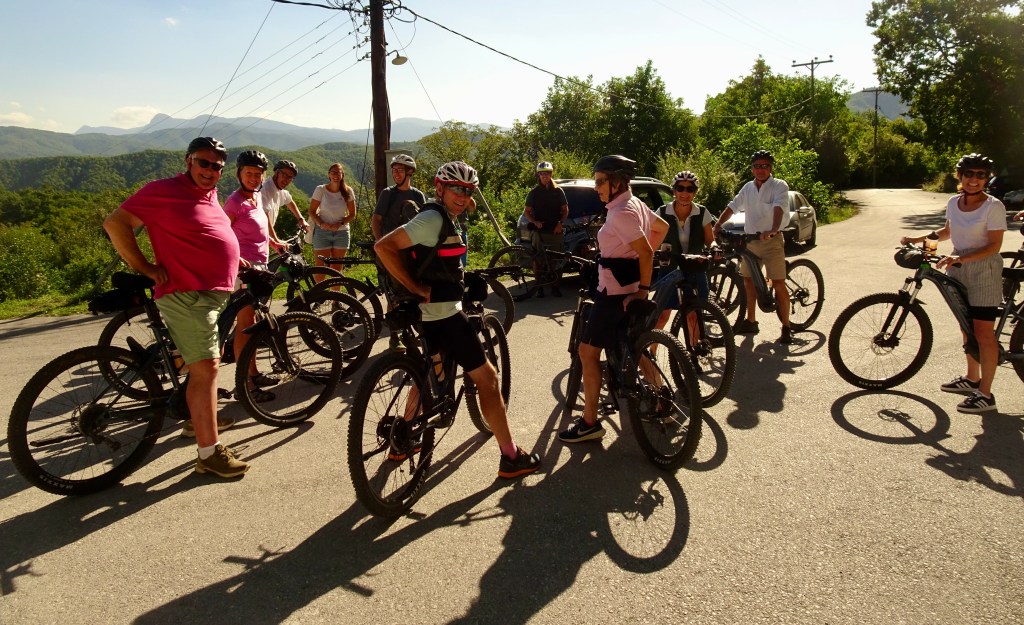
There are a number of reasons to visit the Vikos Gorge and region. Hiking is the big thing – long, sweaty strenuous hikes that attract legions of people who are more athletic than us. Biking is another draw. I talked to this cheery crew from Scotland who were getting final instructions from their group leader before tearing down switchback roads on their e-bikes. I’d be screaming – those roads were scary to drive.
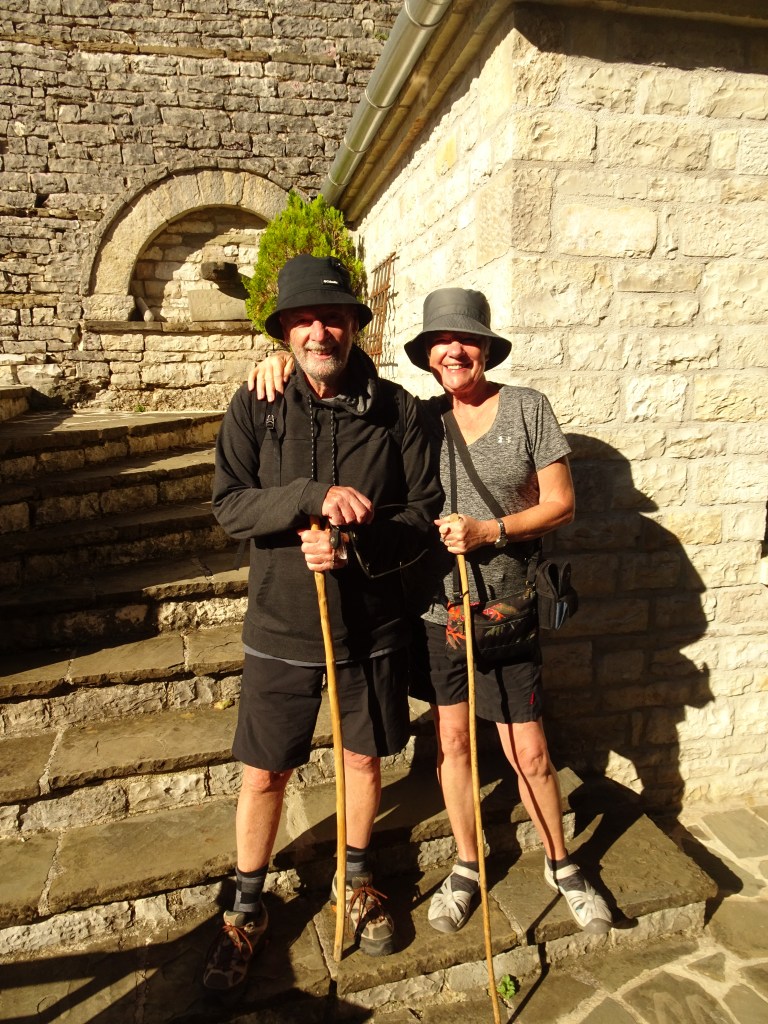
Here we are: equipped to tackle a hike that our charming host Elsa described as “easy.”
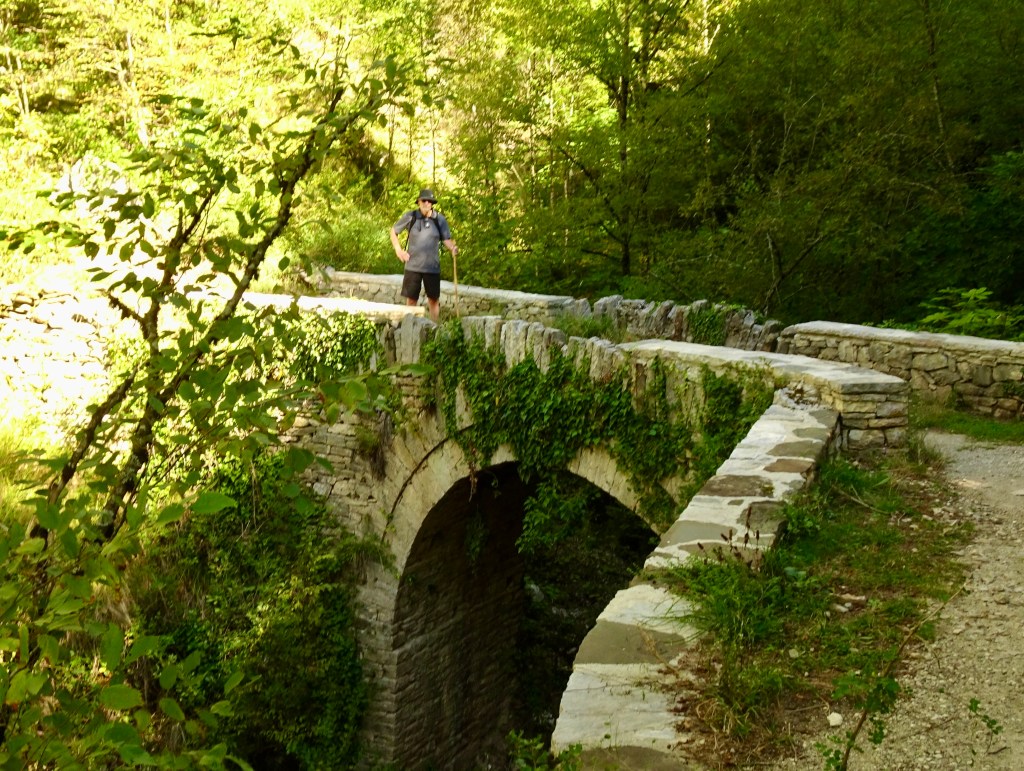
We started off our hike on the Vradeto Steps easily enough – a shady path leading downhill toward a bridge. So far, so good.
Then, out of the shade and into the unforgiving Greek sun, up and up and up (1200 steps, to be exact.)
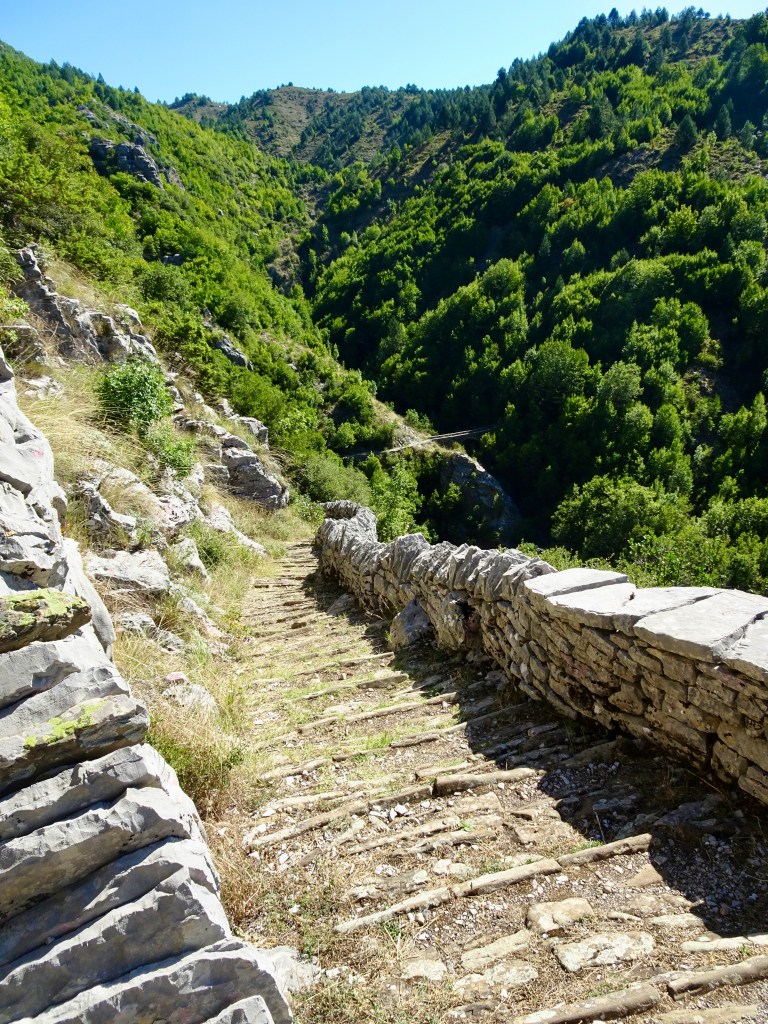
Still, the views were glorious and eventually, as is the case with all hikes, we reached the top.
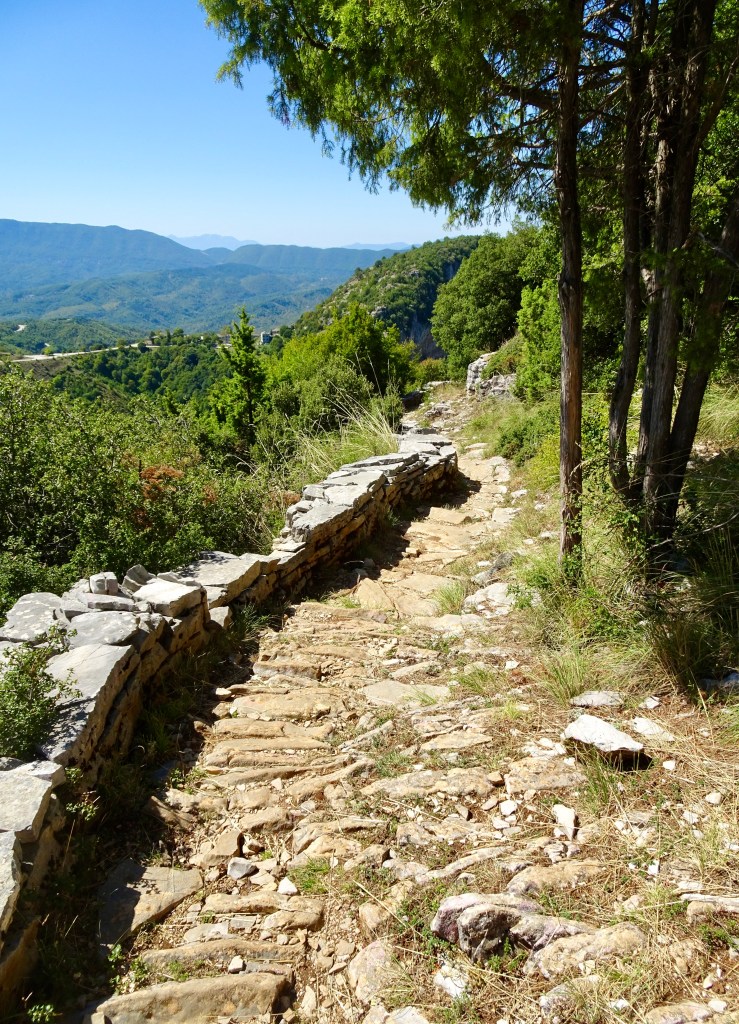
Stone bridges figure very prominently here – they were important links between villages until paved roads went in. It is possible to hike between the villages for 12 km. and see many of these bridges, (and then you have to return), but we took the hikes in more manageable steps.
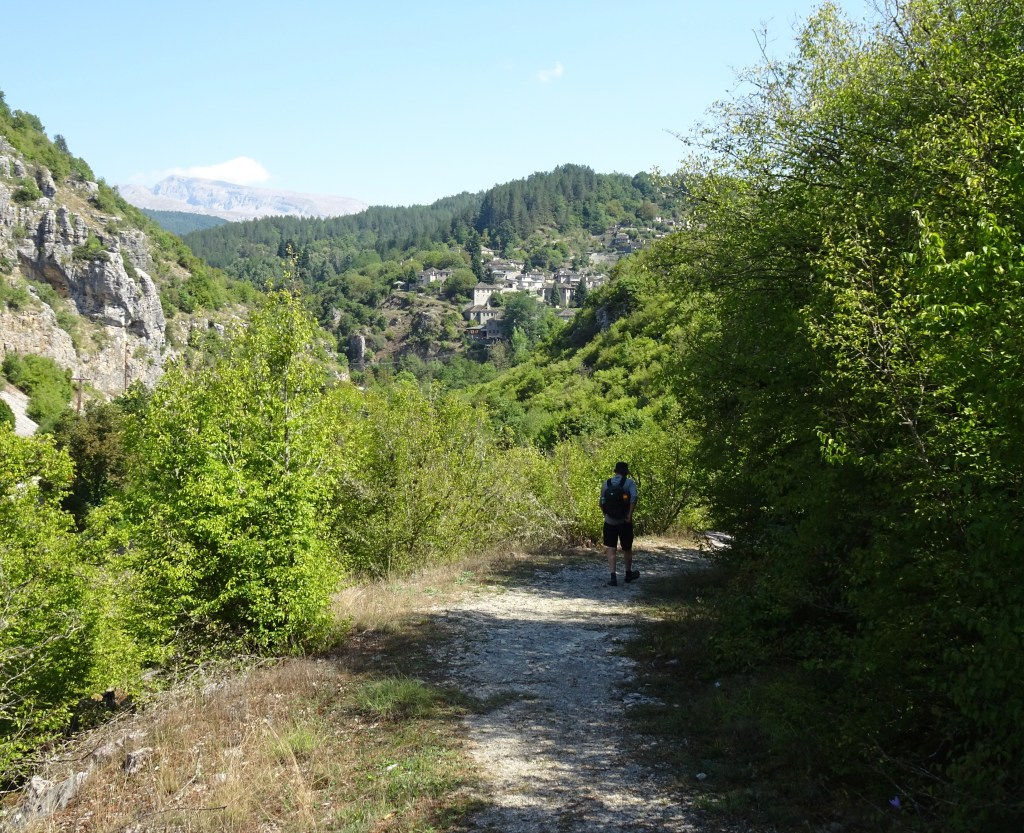
Our first hike was out of our village to the village of Kipi – a total of 10 km. return. We figured it would be a challenge, but we were unprepared for how tough it was – heat, sun, altitude, age – any and all of the above conspired against us. Uneven footing, swarms of pesky flies, walking past fresh piles of bear poo (the woods are filled with brown bears) and paths that ranged from boulders to scree to slippery cobblestone.
Stephen on the path at the early, optimistic stage.
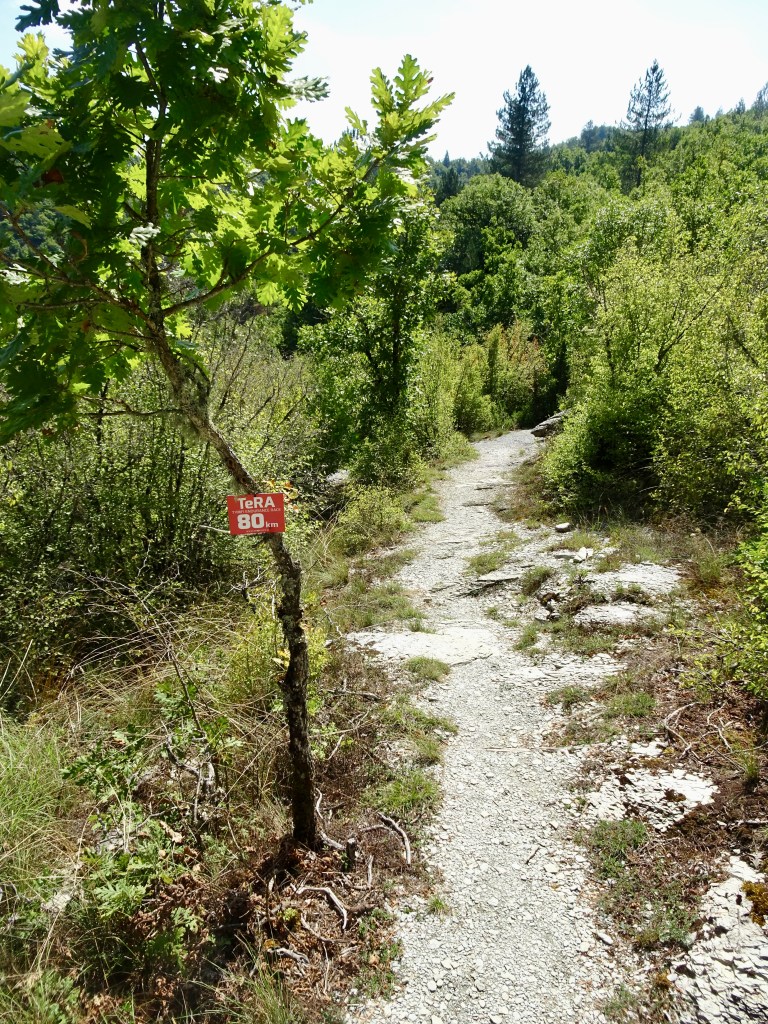
And then we ran into this – a marker for the 80 km. race. 80 Km.! There are shorter races as well, but this is the ne plus ultra of marathons, and it attracts runners from all over Greece. It is held every July (hottest month of the year), but this year the 80 km. race was shortened to 60 km., since as our host Elsa pointed out, “This was a very hot summer.” I cannot begin to wrap my head around being able to run for 80 km. anywhere, but to fling my body down steep, rocky hills, and up slippery gravel paths for hour after hour in 35+ degree heat?
Visiting stone bridges was way more appealing. I have read there are anywhere from 45 to 140 bridges. They were often built by a wealthy resident or a local monastery, and over the years repairs have been made, but the look remains intact.
This bridge, the Noutsos or Kokkoris bridge was first built in 1750, and has been rebuilt since then.
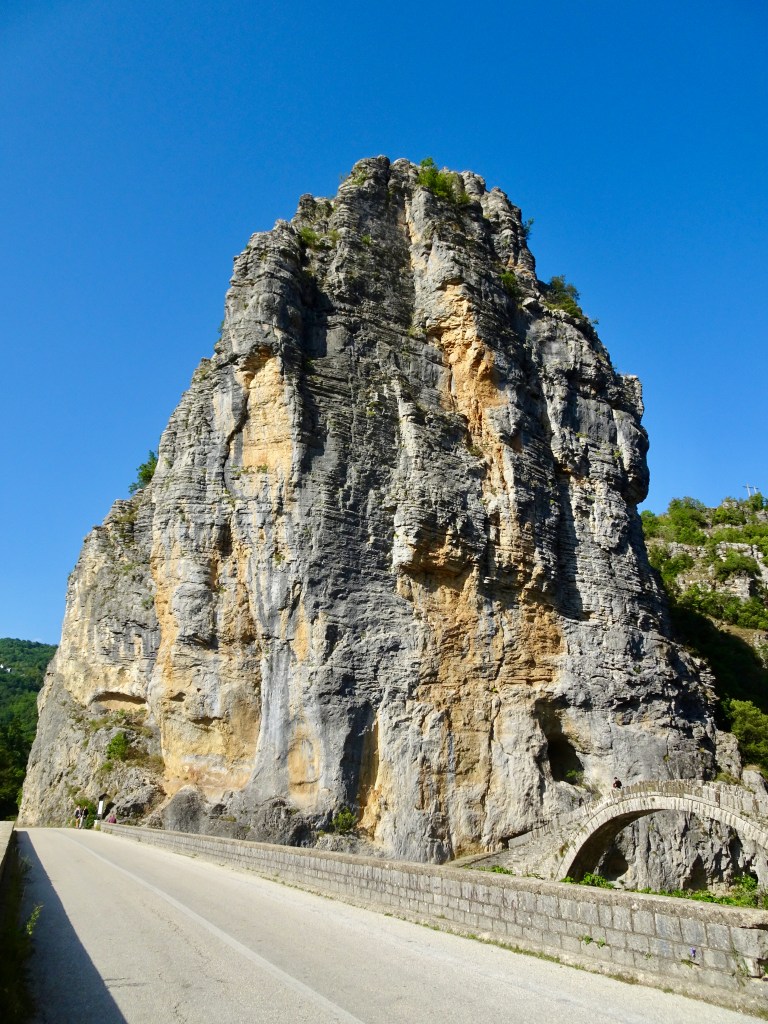
Another view of the bridge.
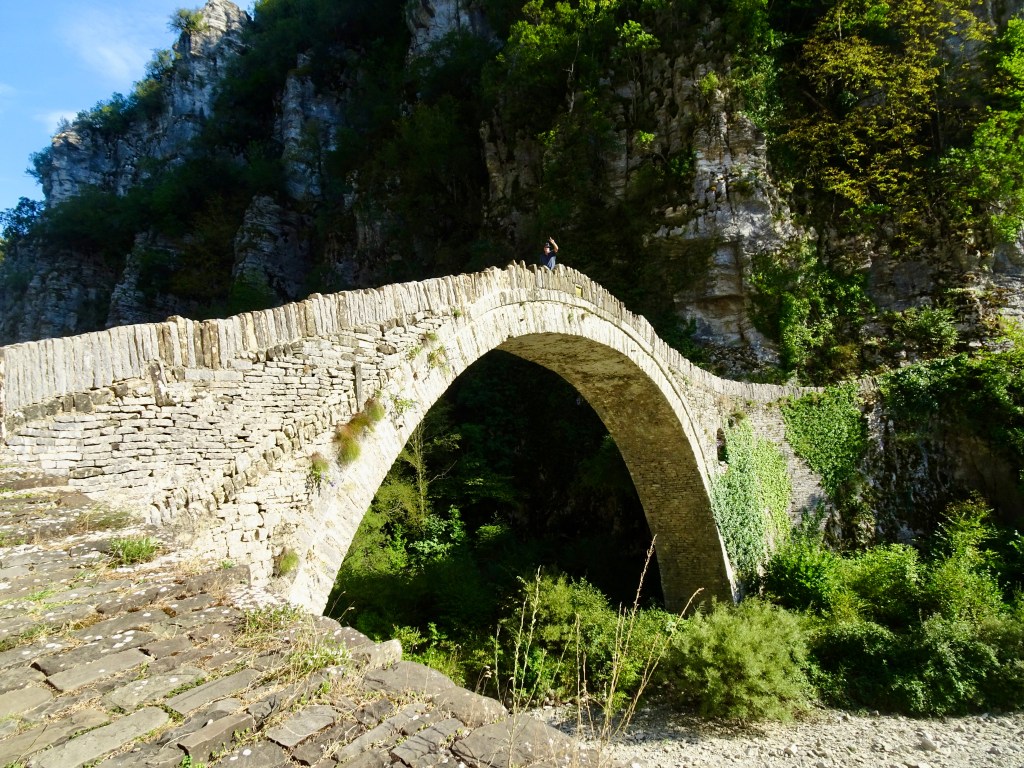
The Plakadis Bridge was first built in 1814 of wood, but shortly after that, was rebuilt in stone. It has a somewhat Turkish look of three semi-circular arches.
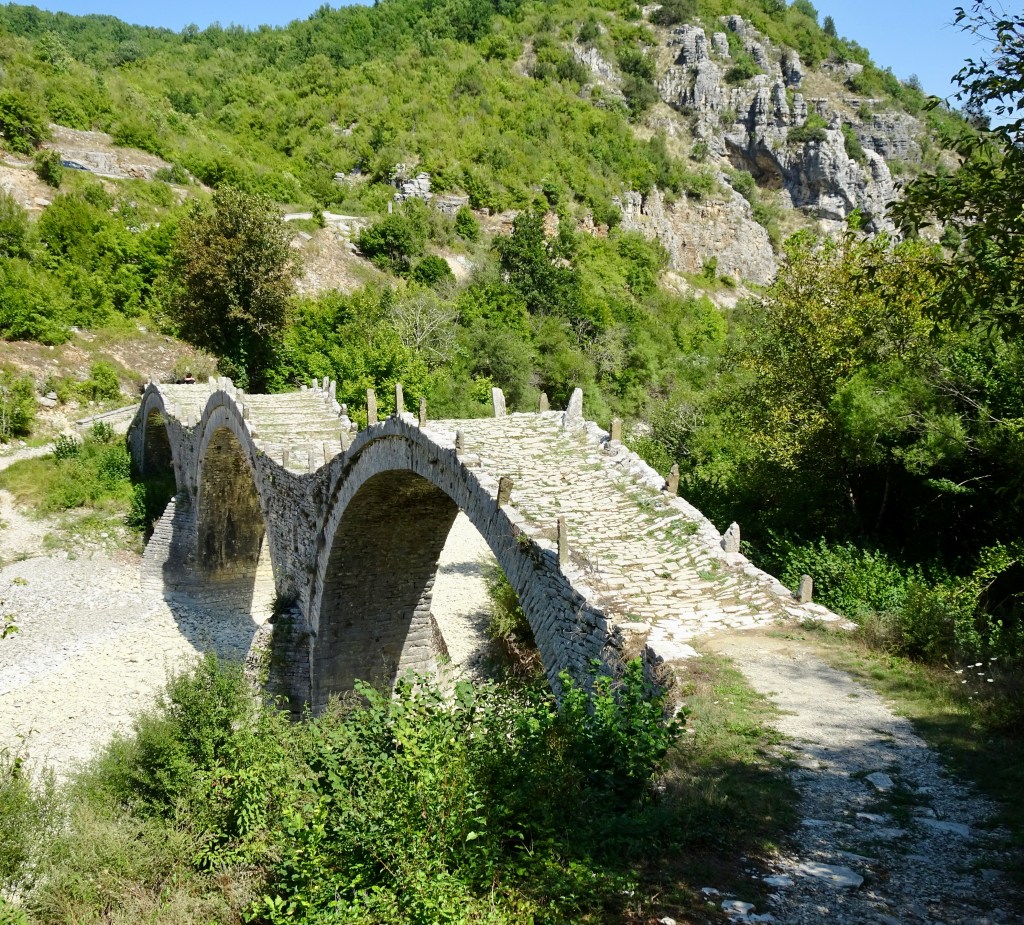
In the spring and summer, the Voidomatis River is a magnet for white-water rafting. This time of year, the water has slowed right down to a trickle in spots, but there were still a few rafting companies trying to eke out the last bit of business.
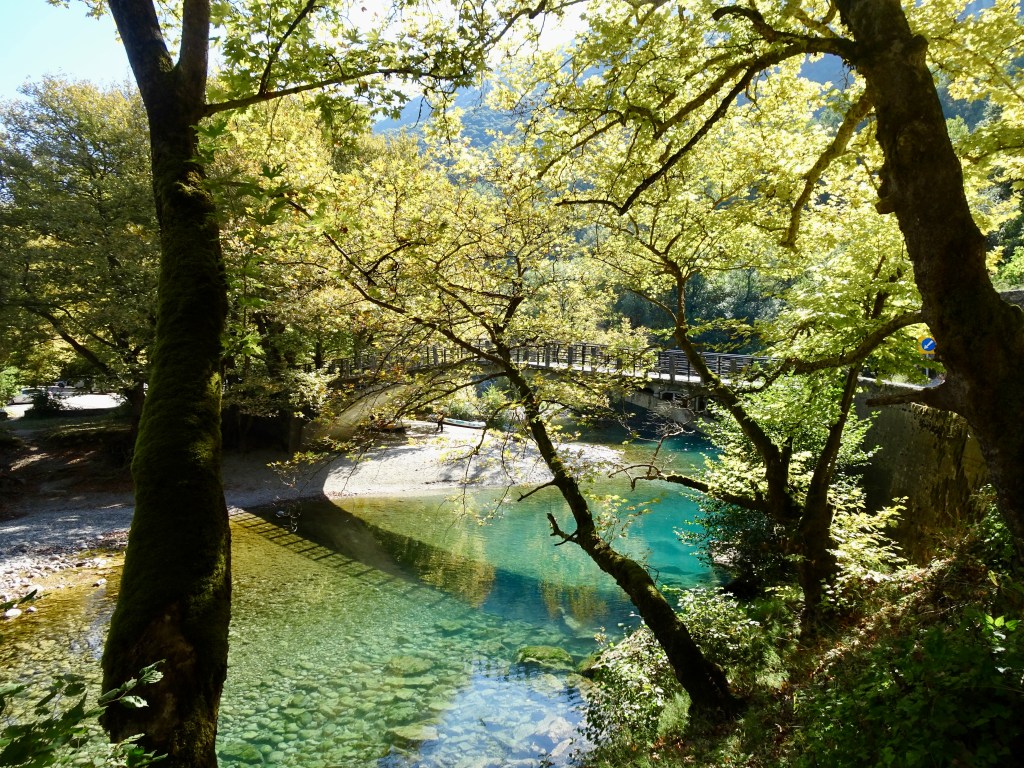
There are 46 stone-built villages in Zagori, with just a handful big enough to have restaurants or hotels. It used to be an expedition to travel between villages, but now they are all linked with good roads. Tourism here is still very low-key, which is fortunate, since the endless switchbacks would be a challenge in any kind of traffic. We encountered this goatherd and his flock on a straightaway.
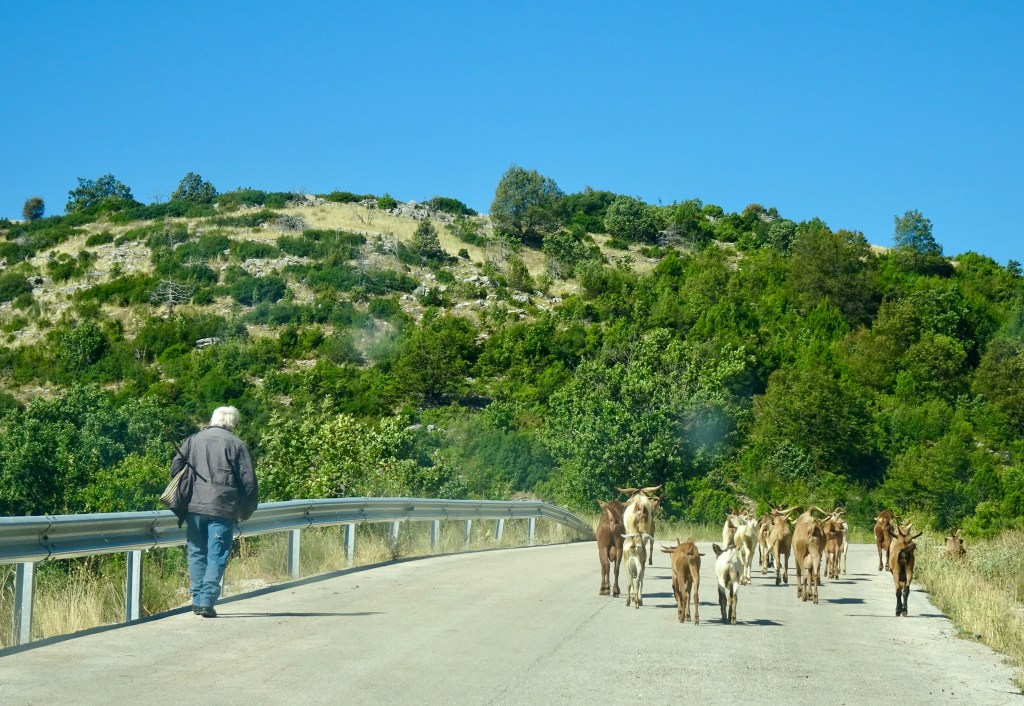
The villages are all of a type, although some are more beautiful than others. It is mystifying to me how they were built in such difficult conditions, but they are also of such fine quality and finishes. Obviously the building materials are easily found – everything here is stone – the buildings, the walls, the roads. This would be a tough place to be a toddler – no soft place to land.
Some examples:
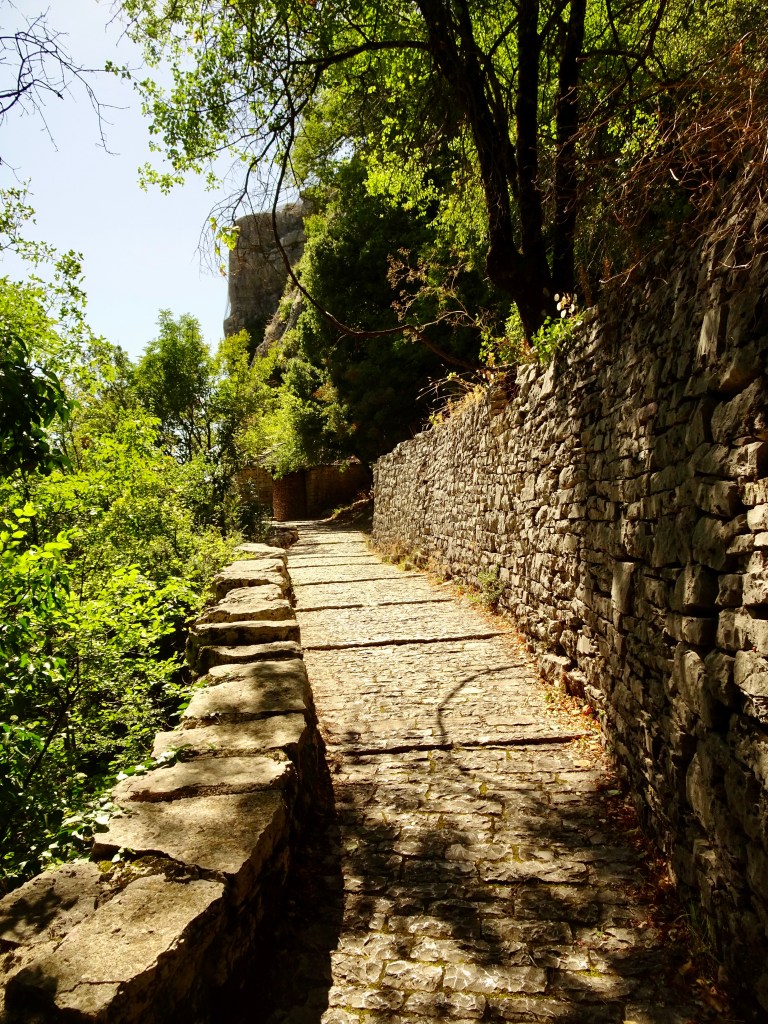
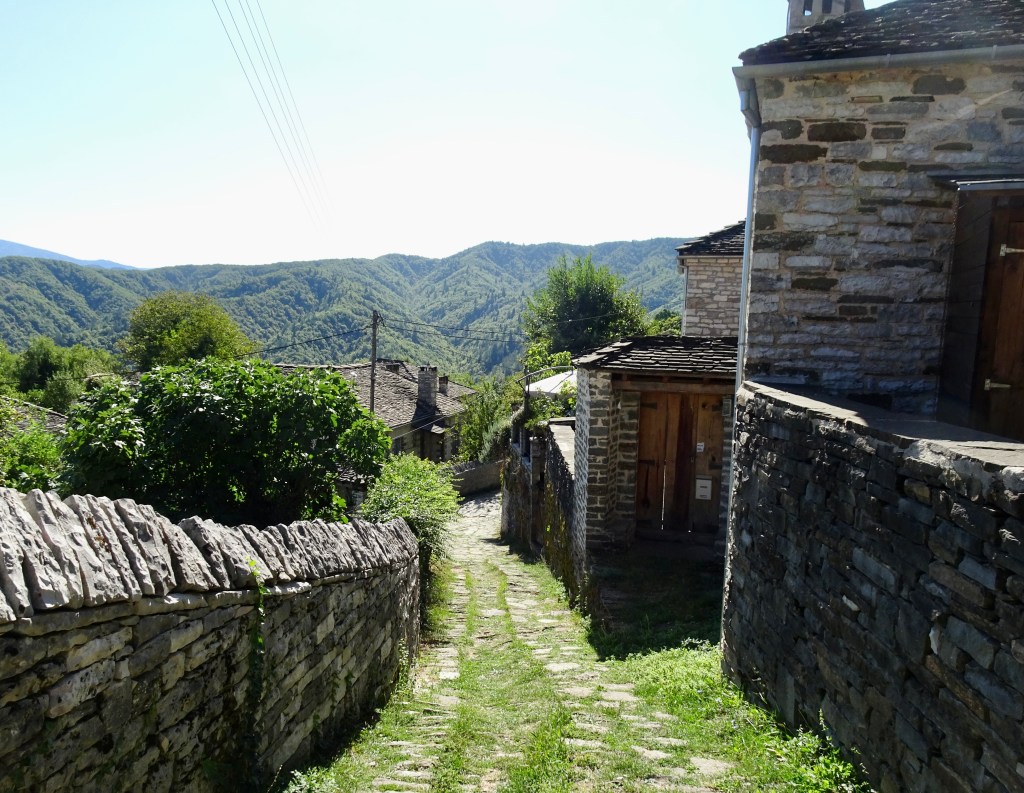
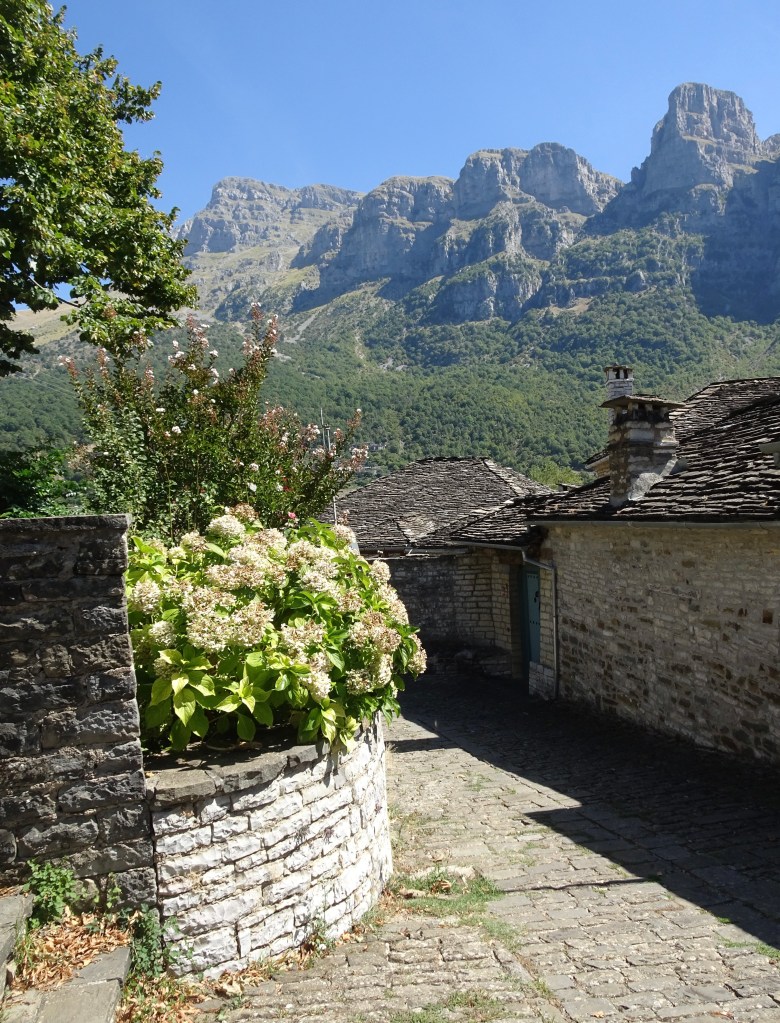
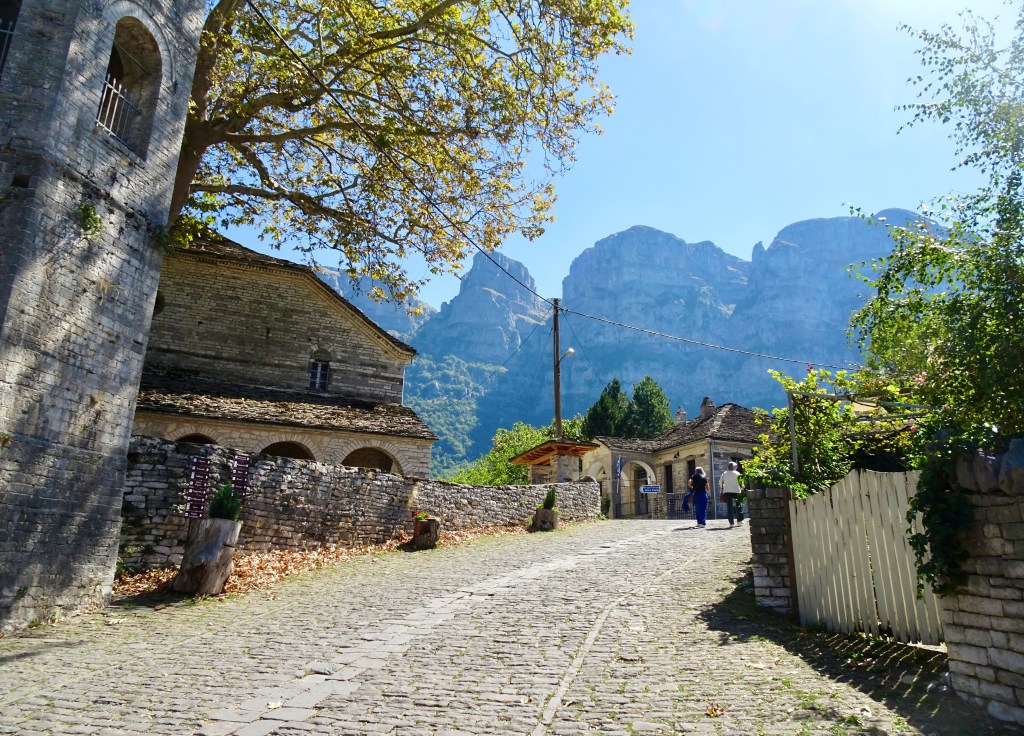
Another thing I found quite fascinating was how restaurants in these tiny villages managed to stock supplies. May of them would be an hour away at least from the city of Ioannina, and we did not once see delivery trucks. Still, we managed to eat very well – Greek salad, grilled meats, phyllo veggie pies, etc. The ambiance of the outdoor cafes really added to our enjoyment.
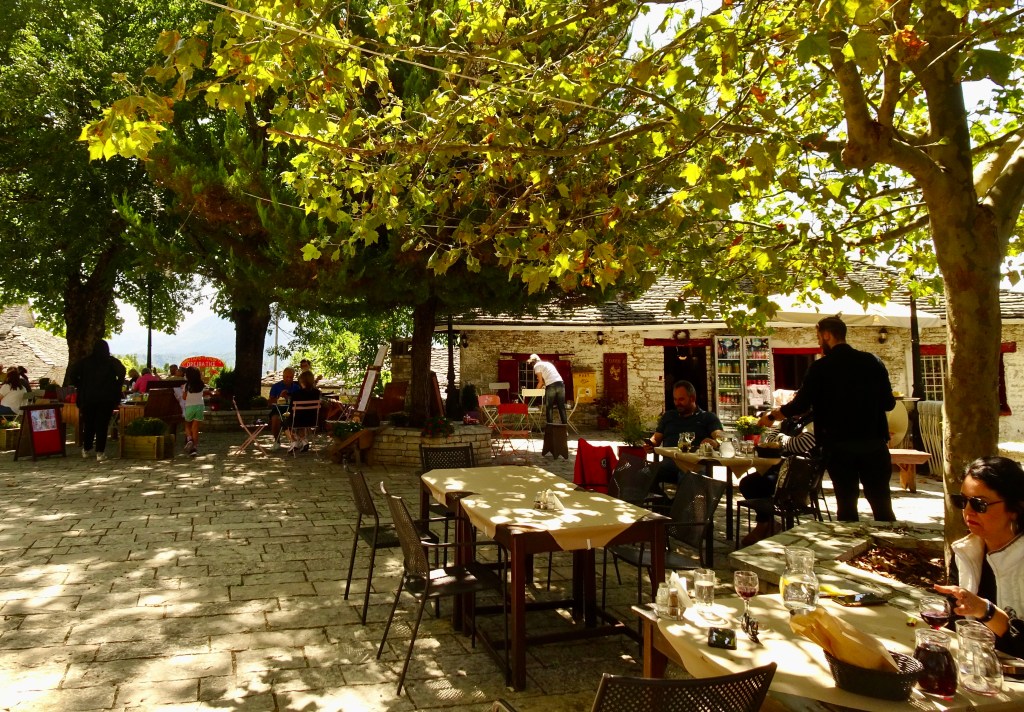
We stopped by this cafe for an iced coffee, and were soon joined by a group of hikers who had been hiking for four hours already, and had another two hours to go. They had spent the night before in a mountain refuge, where, as one of the hikers pointed out to me, “there were no showers.”
So far, we have met no Canadians, and just one American couple. Tourists are largely Greek, Israeli, German, Scottish or English. These little cafes are ideal for exchanging a few words with fellow tourists – always a highlight of travel for us.
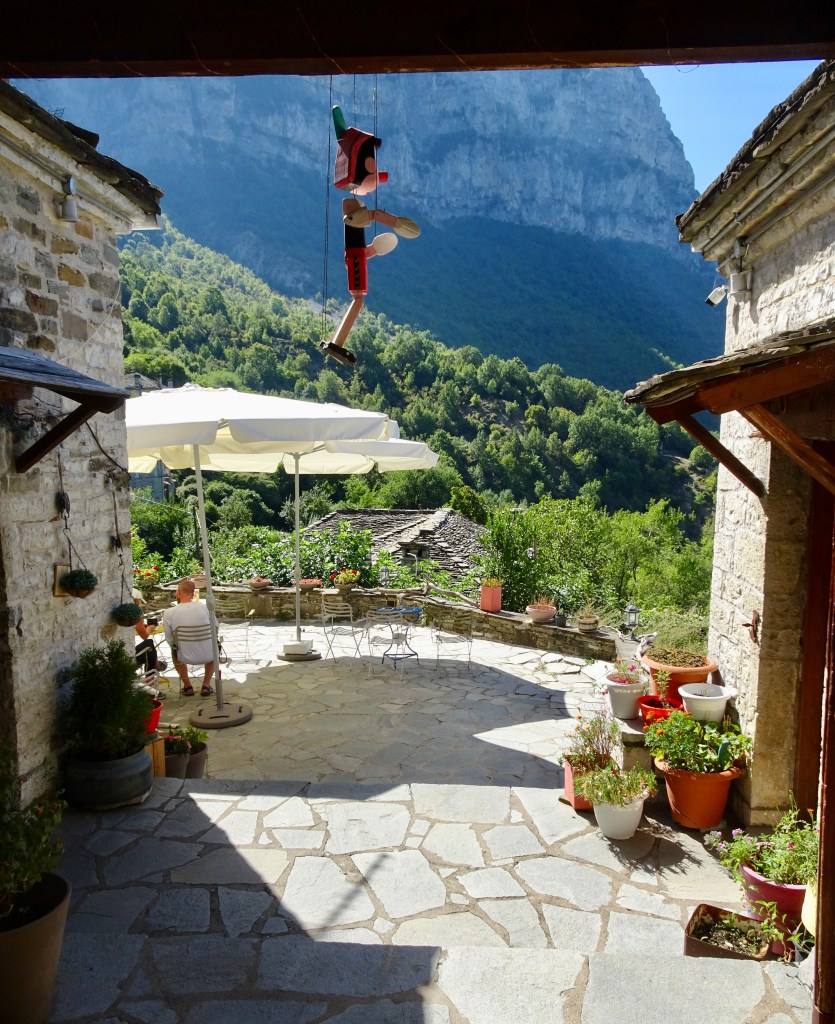
Stephen took this shot of a church and the classic tree found in Greece – the plane tree. Apparently, the month of October is the high season in this area, as the hillsides are transformed into a blaze of autumn colour. It would be an ideal time to come for hiking as well, with lower daytime temperatures.
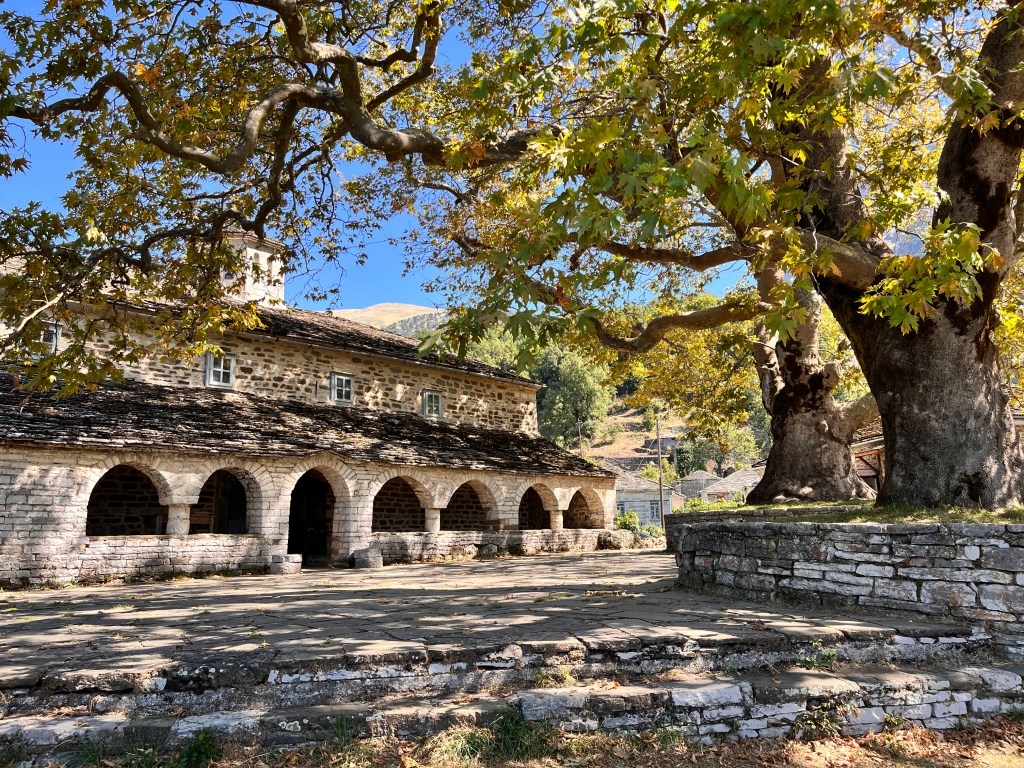
A shot of the ancient monastery, the Agia Paraskevi, built in 1412. It is tucked right into the mountain, overlooking the gorge. It no longer functions as a monastery, but is open to the public to walk around the exterior. We reached this monastery by walking down a one-km. path from the village of Monodendri.
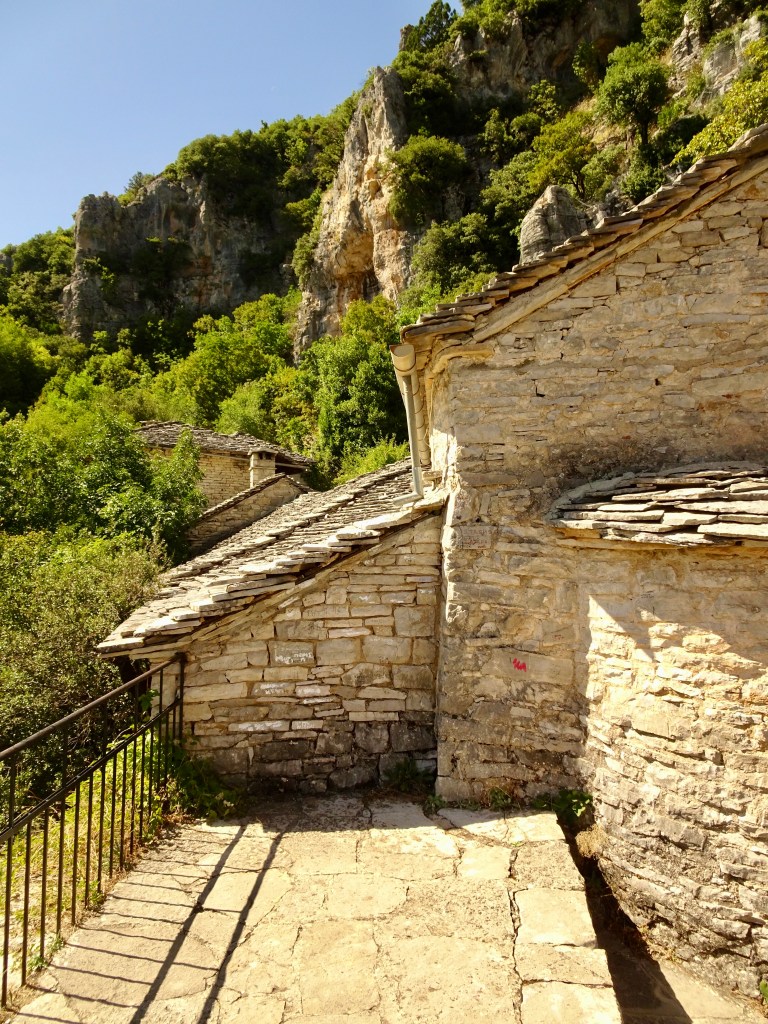
Back to the future. We feel privileged to have spent a few days here, and selfishly hope that tourism is kept at a sustainable level. It would be heartbreaking to imagine chain hotels and rows of tourist shops.
The Zagori region will be one of our cherished memories of this trip.

 Leaving Ourselves Behind
What a wonderful discovery was the Zagori region….unspoilt and uncluttered with glorious challenging hikes ( I especially liked the photo of you two intrepid hikers setting off on your Vradetto Steps hike) Thank you for giving us a taste of this hidden gem. Pippa
LikeLike
We’re sad to leave today! This is truly unspoilt, and I think there are very few places left like this, so it was a lucky find.
LikeLike
I love all the rock/brick buildings. Not sure if I could walk on all the cobblestones though. Keep up the amazing stories, love the reads.
LikeLiked by 1 person
I didn’t bring great footwear for this part of the trip – proper hiking boots would have been ideal. I was definitely feeling the stone paths with just my Keens.
LikeLike
So great to get a closeup view of the Zagori experience! Loved this! May I ask how did you get to this region? And are you just on foot while you’re there?
No other Canadians? We have that same experience when in Greece. Too expensive for the young folks, too far for the older? They’re really missing out!
LikeLike
Hi Joan – so nice to hear from you. I was wondering if you were at your Greek home now. It is so lovely to be back here, and actually nice to be among European tourists, who, for the most part, all speak English anyway.
We’re in northern Greece for 3 1/2 weeks, and we got our rental car at the Thessaloniki airport – about $2oo per week. It is a bit of a challenge to explore Zagori without a car, as buses are few and far between. There are taxis to take you between villages, but they aren’t plentiful and are crazily expensive – $30-$50 per ride.
As for the hikes, we just did one from our village – Dilofo to Kipi and back, but for the rest, you’d need a car. the roads are good, albeit switchbacks for many of them, but the upside is there is very little traffic.
We stayed in that region for one week, but you could easily stay longer – it is a dreamy place and we were sad to leave.
LikeLike
Hello intrepid travellers – on the road again! Such dramatic, beautiful landscapes in the Zagori region, a place completely unknown to us until now. Hiking heaven – how I wish the knees were up to it! Thanks for bringing it to us with your lovely photos and interesting text. Looking forward to your posts to follow.
LikeLike
Thanks Shelley – good to hear from you! Yes, the knees – how they hate the downhill especially. I took a nice tumble coming down the steps – slid out on gravel and only hurt my pride, but my knees were protesting the whole way.
LikeLike
A hidden gem! You guys are so good at finding those special spots on earth. Nice to learn a bit about the “other” Greece away from the white washed village tourism.
Looking forward to hearing more 🙏
LikeLike
We would never have known about this area, but it kept showing up in travel blogs. Actually that is pretty much our research method – Lonely Planet and half a dozen travel blogs and voila – the tourist trail emerges.
LikeLike
Hi Ginny & Steve. The area sort of reminded me of Croatia. Stone, stone and more stone ! You will sure build up leg muscles walking on those cobblestones. What beautiful scenery and so untouched by hordes of tourists. You are experiencing it at it’s best, Thanks for sharing such an amazing place with me.
Love Lyn
LikeLike
Lyn, we were talking about this very thing, you and I – the shortage of places in the world that aren’t overrun. Hopefully this area can keep its character for a good while yet.
LikeLike
Makes me want to change course and head to
Greece. Someday doesn’t always happen. Gorgeous!
LikeLike
Next year…
LikeLike
What a beautiful, untouched region. I agree that you two manage to find some wonderful places to explore.
LikeLike
We met an American couple here, who had been to this region and stayed in this same guesthouse 8 years ago. So I guess it is not that off-the-beaten-track!
LikeLike
Another fascinating blog about another area almost no one has heard of. The plumbing is rudimentary and there’s no wifi, but every stone in every house, path and bridge shows its long-ago builder’s commitment to living there. Amazing – how do you find these places?
LikeLike
Actually, the plumbing is great – modern (toilets and hot water!), and the wifi and cell service are terrific. We used our AllTrails app while on the trails and never lost the signal. In spite of that, though, the villages probably look exactly as they did 300 years ago, and that’s the great attraction to the area.
LikeLike
I have to agree with the two of you – judging by your pictures, the Zamora region is a sight to behold. Your photos do a great job of capturing its beauty. In addition, I’m a sucker for ancient stone bridges and buildings!
LikeLike
Oops, my fingers are not cooperating this early in the morning! I meant to type Zagori!
LikeLike
Thanks Heather – it is a very unique place and it’s impossible to photograph badly!
LikeLike
Wow, your photos certainly makes this place look appealing. A real hidden gem!
LikeLike
It was unbelievably beautiful Sheila. I only wish we had visited it 10 years ago, with more cooperative knees and higher energy levels. It was fun to compare notes each morning with the 30-something Germans!
LikeLike
Wonderful and so unspoiled. I would like Sari to see your blog. How can we add her back on -swsimkins@aol.com
Enjoy the rest of your trip.
LikeLike
I just added Sari – for some reason I thought she was already on, but now she’s there.
We’re having a wonderful time – pretty hard to find fault with Greece!
LikeLike