We had no idea. We thought we were visiting the remains of what was once the most important ancient Greek city and trading centre between Europe and Asia. We had also read that many of the ruins were built during Augustus’ rule during the Roman Empire and that they were still in remarkably good condition. In other words, we would not subject ourselves to staring thoughtfully at outlines of rubble. Ephesus was in fact still standing and it would be easy to visualize it in its former glory.
What we didn’t know was that Ephesus played a significant role in early Christianity. So significant that while it began as a mecca for pagan worshippers, by the mid-1st century, it was once an important hub for Christian teachings, taught by no less a luminary that Apostle Paul.
It is also rumoured that the Virgin Mary is buried in Ephesus since she spent her latter years there, although that is under dispute.
The excavation of the site began 125 years ago, and only 20% of it has been unearthed.
Today, Ephesus is visited by 1.5 million people a year, and is described as being “a hotbed for evangelical Christians“. We had been warned to arrive early, since dozens of buses would be bringing tourists from cruise ships. At 9:00 am, this was our entrance to the site.
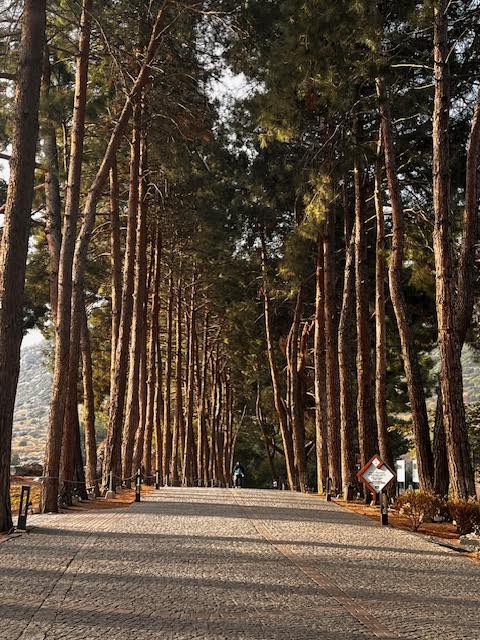
There are two entrances – the lower (where we parked) and the upper (where most of the buses park). The idea is to begin at the top of the site and work your way downhill, about an hour and a half in total).
Within a half hour, this is what one of the main streets in Ephesus looked like.
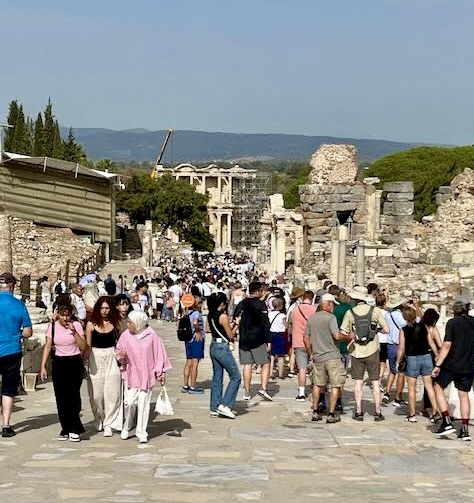
By 8:00 a.m. at the upper level, the buses had arrived and were disgorging passengers by the hundreds. As we were walking up, they were flooding down. We never stood a chance.
There were several Europeans in our hotel who were in town for a Christian symposium, but apparently Ephesus is always packed with the faithful.
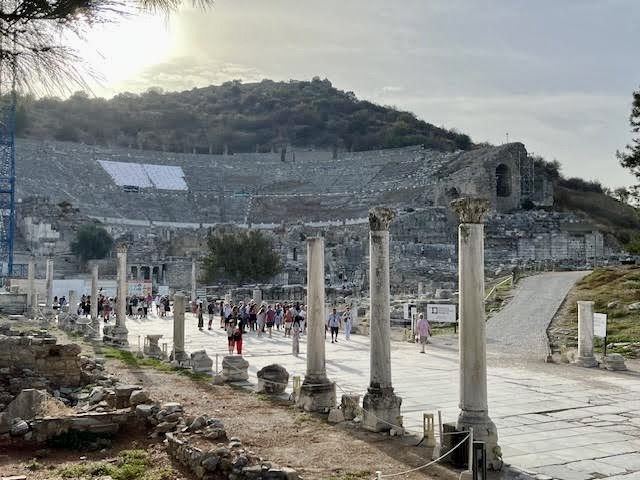
As we entered The Great Theatre, there was a group of women (on the bottom left of the photo) who somewhat dominated the scene with their prayers and singing. Although I am not religious, it was obvious that the pilgrimage to this site was immensely moving to them and to many who visited it.
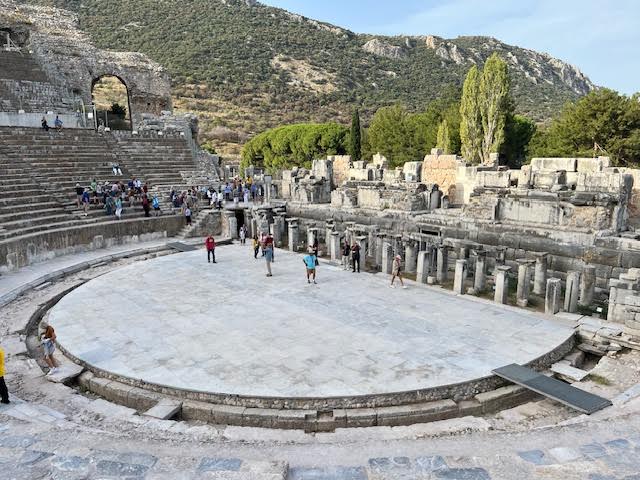
Unfortunately, trying to see this city was challenging due to the huge crowds. I love to get lost visiting ancient sites; sitting quietly and trying to reflect on what happened so many millennium before. But thousands of people, competing guides and endless selfie-takers, all under a hot sun with little shade, made it a bit frustrating.
Still – lots to admire and marvel at.
Library of Celcus – built in 117 AD, held up to 12,000 scrolls. The third biggest library of the ancient world.
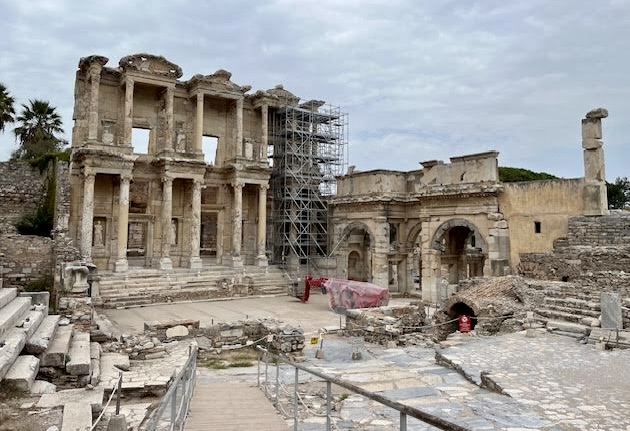
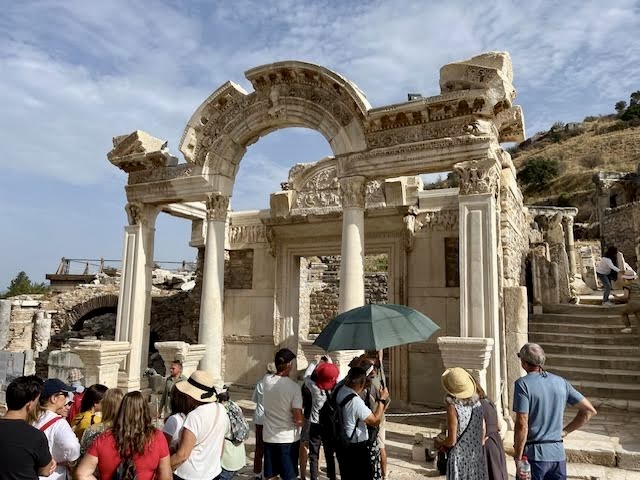
Temple of Hadrian. Built in 138 AD and re-erected from pieces from the 4th century.
Curetes Street – one of the three main streets in Ephesus, leading to the Grand Theatre.
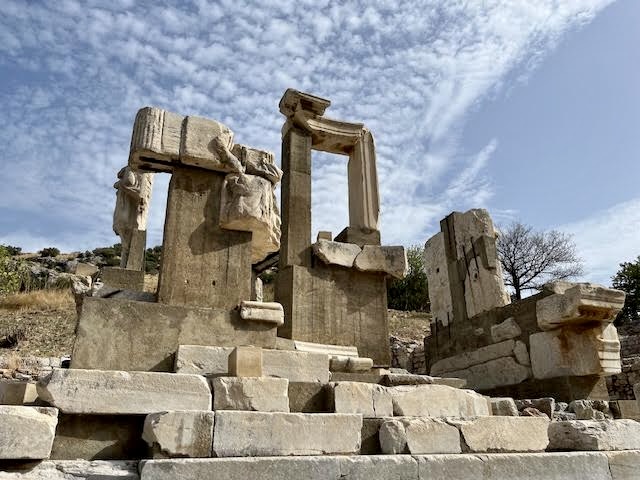
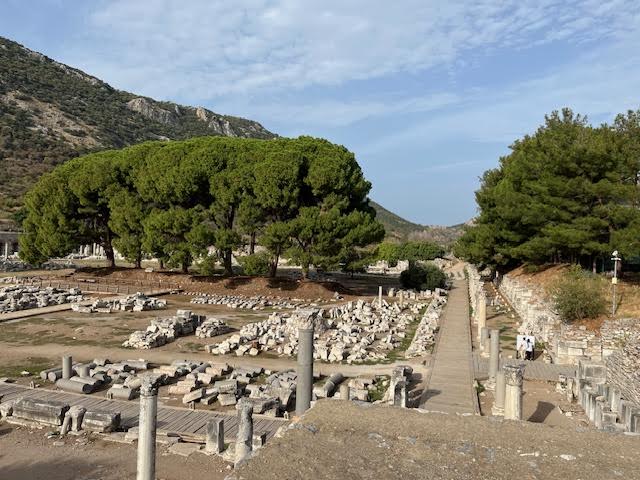
Forgive me, but I have a few photos muddled up and can no longer properly identify them.
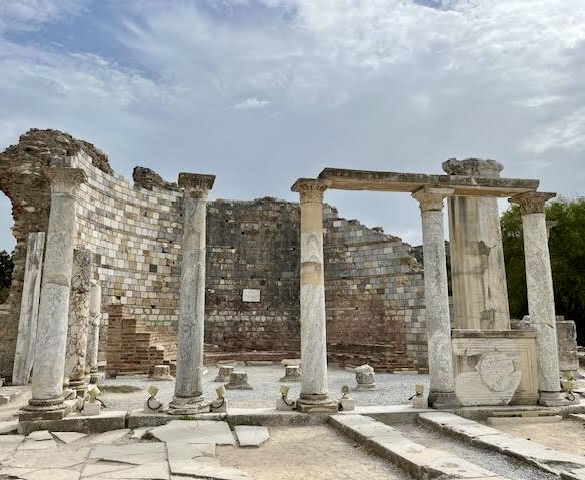
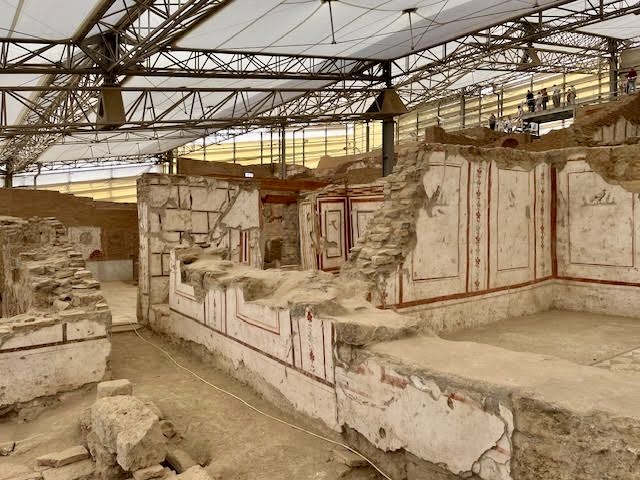
We also visited The Terrace Houses, the homes of the wealthiest citizens. The entire structure is under cover, to protect it from the elements and to protect the restoration work that is being done of the mosaics and frescoes.
Work tables set up to piece together tiles.
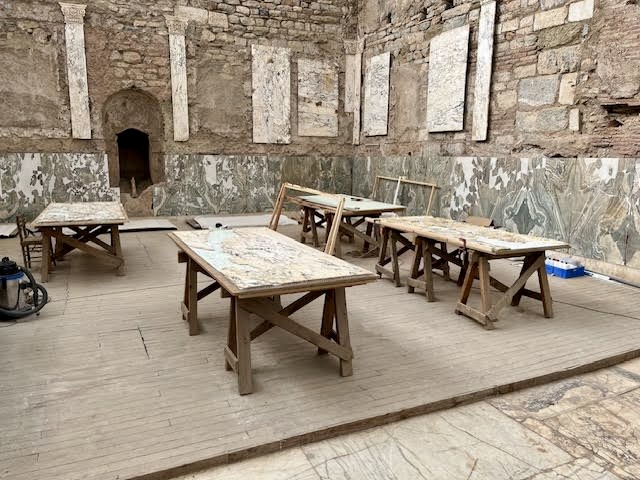
Intricate frescoes still intact on many of the walls.
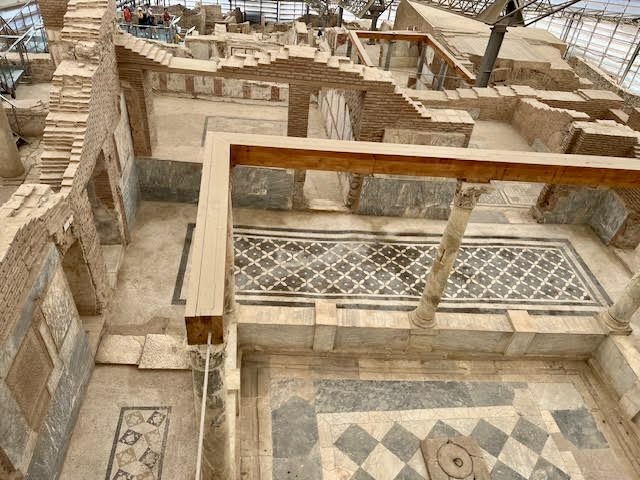
Original mosaic tile floors.
We were in Ephesus for over three hours and could have spent longer, but there is always a time limit for both sore feet and distracted energy.
May I say something that is going to sound a bit off-putting and snotty? Snotty as in, “Ephesus wasn’t my favourite archaeological site.” Does that sound rude? Am I humble-bragging when I when I say that I was blown away by Angkor Wat, brought to tears by Machu Picchu and thrilled by most of the Mexican ruins I’ve seen?
Ephesus, for its historical relevance, its religious importance and its remarkable condition, did not affect either Stephen or me the same way.
We’re not one bit sorry we came – it was well worth the visit and showed off yet another side of Turkiye.
We stayed in the small town of Selcuk, just a few kilometres from Ephesus, at the Ave Maria Hotel! Modest but comfortable, and met our two requirements – parking and breakfast. I want to show you our car – our little Fiat Fioreno. It looks like a mini bread truck and is cute and comfortable.
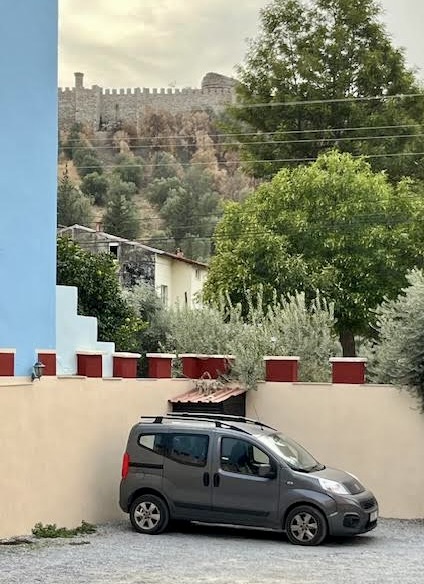
Stephen has been the sole driver (stick shift), and I think we are both in agreement when we say the roads in Turkiye are great. However, when you get up into the mountains, you need to pay attention, as there must have been a shortage of guardrails back in the day.
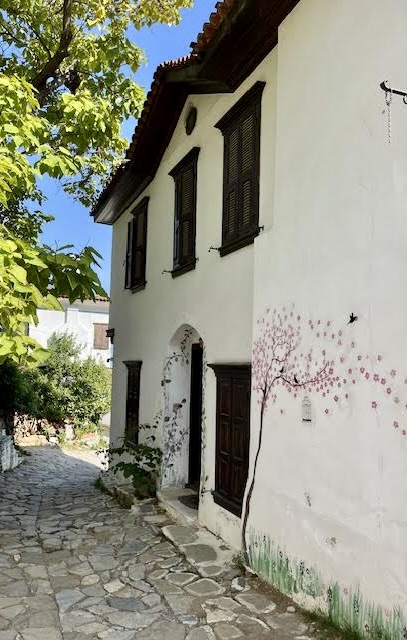
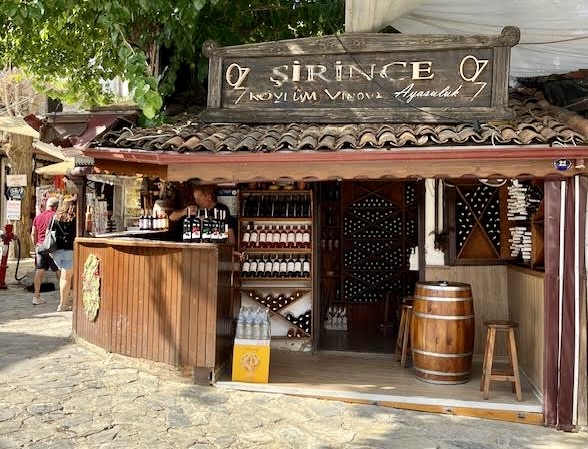
We took a quite exciting and beautiful drive up to the tiny perfect village of Sirince, just 8 km. from Selcuk, home to 456 people and known as the “Tuscany of Turkiye.”
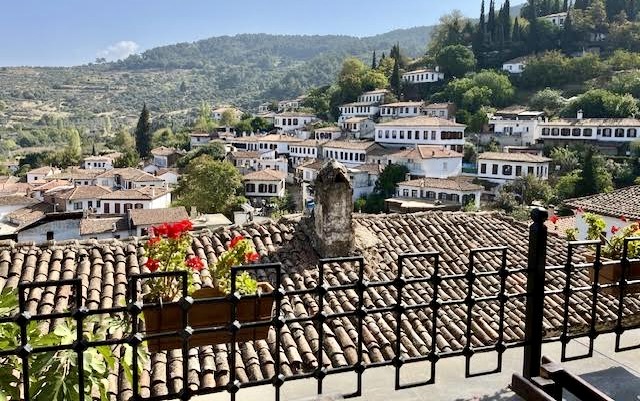
This car-free village is designed to just stroll, eat, drink, shop, enjoy the glorious views and maintain your balance on the steep, cobblestoned streets..
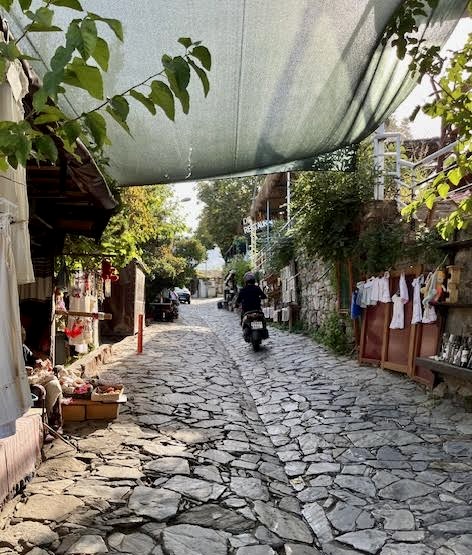
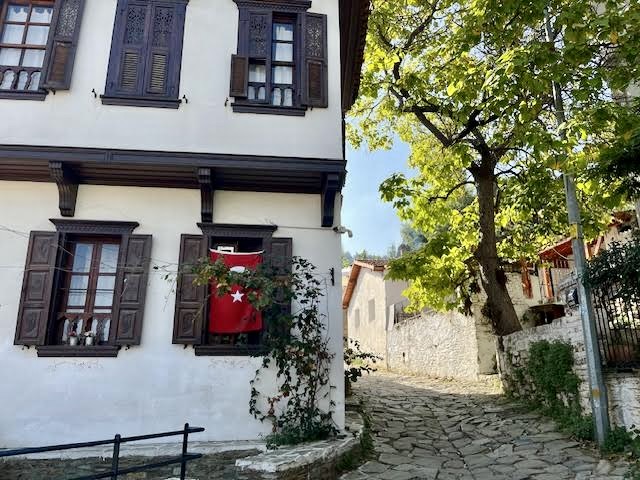
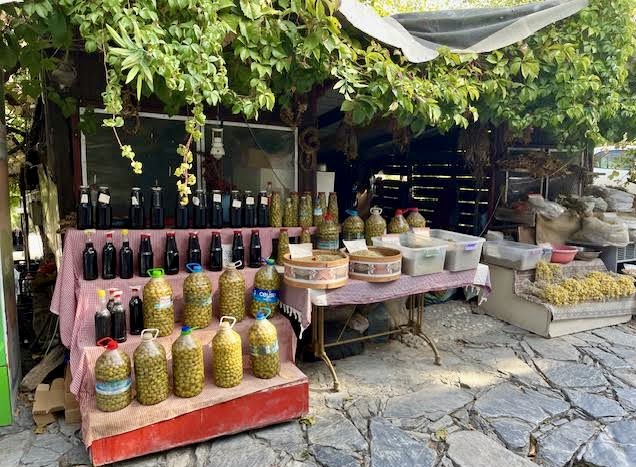
Sirince specializes in a number of local products.
Olives, spices and fruit.
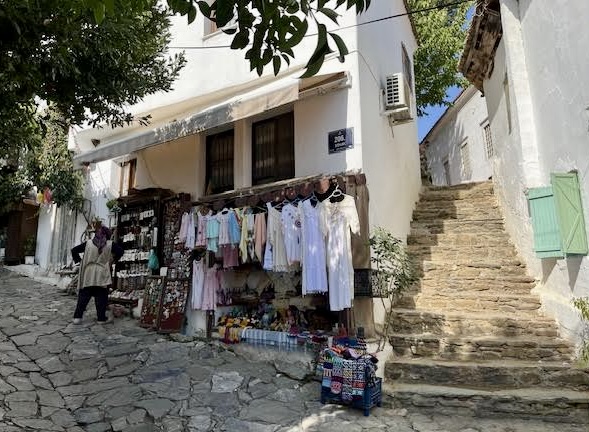
Knitting.
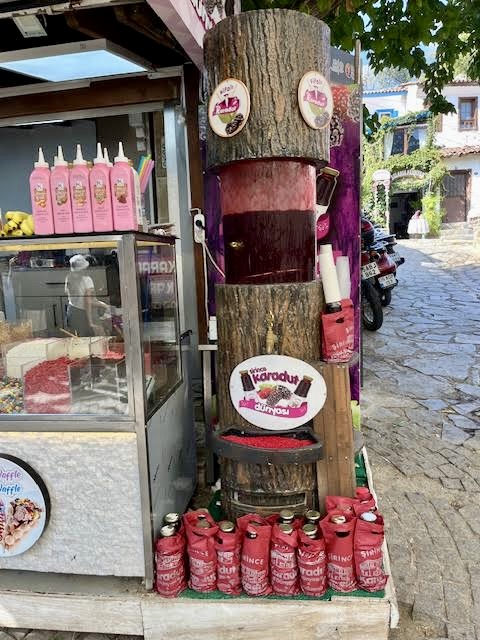
Black mulberry juice.
Fruit wines.
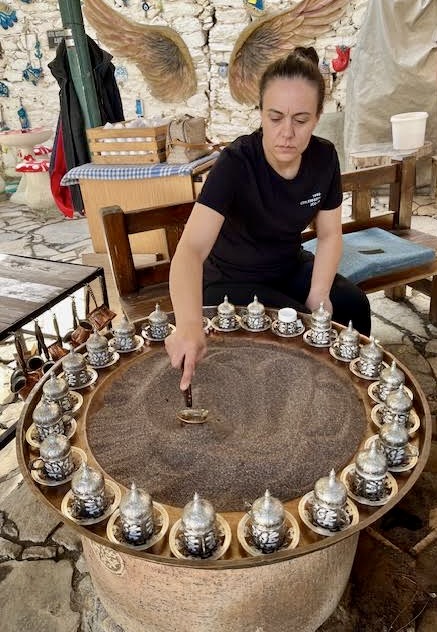
And… Turkish coffee – prepared the local and traditional way. Coffee grounds and water are poured into the holder, and then lowered into a bed of sand. The sand is heated from a flame below, and as the holder is slowly turned in the sand, the water is brought to a boil. All this – the show and the coffee for less than $2!
Fun fact about Sirince: on December 21, 2012, the Mayan calendar predicted that the apocalypse would originate in Sirince. Believers flocked to the town in anticipation, but had to accept that life continued on. Perhaps they consoled themselves with a cup or Turkish coffee.
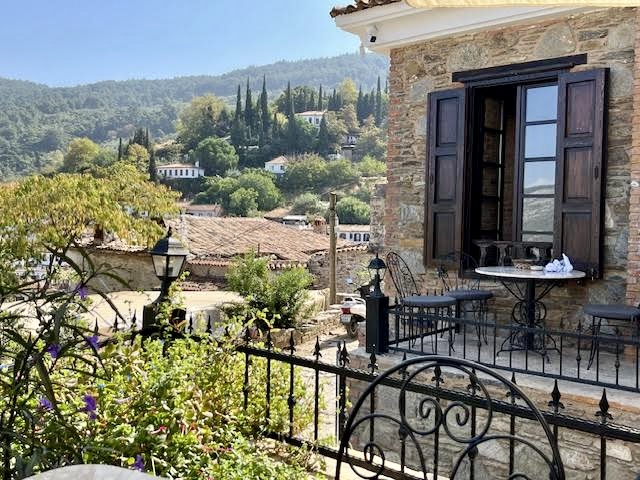
We finished our day in this enchanting village with lunch at a hilltop restaurant. This was our view>
An enlightening, thoroughly enjoyable stay in this spiritual corner of the country. On to Alacati – rumoured to look “just like a Greek village.”
 Leaving Ourselves Behind
Enjoying the account of your travels and the beautiful photos! Thanks for sharing your journey with us!
LikeLike
Thanks Christine – so glad to hear you are following along, and enjoying the trip with us.
LikeLike
looks like your still having fun .. so interesting all the buildings that are. Still standing in ruins … thanks for the photos guys !! Vikki
LikeLike
Vikki – we’re still having a great time, and I caught myself complaining about the heat today! I have to remember that by the time we get back we won’t be traipsing about in shorts. The ruins are really something – so many of us have walked this way before, it’s hard to keep that in perspective.
LikeLike
wonderful memories for sure !
stay safe vikki😍v.vettese
LikeLike
WOW Thank you for the pics & info !!! Amazing 👍👍❤️👏FloSent from Flo’s iPhone
LikeLike
Flo! Thanks for following and so glad you’re enjoying reading about our travels.
LikeLike
We didn’t love Ephesus either, but we did love the mosaics in the Terrace Houses. It wasn’t too busy for us, but Sirince was packed with bus loads of tourists. I’m enjoying traveling along with you guys. Maggie
LikeLike
Maggie, I always feel a bit guilty complaining about crowds, when we are out here also contributing to over-tourism. Still, I want to get to Portugal before too long. Your blog postings are wonderful, and really whet my appetite for visiting that country.
LikeLiked by 1 person
Great post. I wonder if you preferred Angkor Wat, Machu Picchu and the Mexican ruins because they were all reclaimed by the jungle for years before being rediscovered, and were mostly the product of a single culture, while Ephesus’ fortunes came and went, but it was never forgotten, and was the product of many cultures. Maybe it was just the crowds…
LikeLike
That’s a good point, although Ephesus was also buried, and had to be excavated – still only 20% done. While people may take umbrage with me not feeling a “spiritual” connection to a cradle of Christianity, I really didn’t feel any of the almost physical reaction to the other ruins. There were so many other elements going on as well. In Palenque we watched a snake swallow a frog, while listening to howler monkeys in the jungle. In Teotihuacan, we watched a Japanese gentlemen very tenderly lift his wife from her wheelchair and he climbed one of the pyramids with her on his back, so she could also have that experience.
LikeLike
Hi Ginny and Stephen,
I was enthralled with your photos of Ephesus but I have to agree with you that its effect is tarnished somewhat by the hordes of people that have also chosen to be there. I’m like you, I like quiet places to steal away to in order to reflect on what I have just seen. Having said that, it would have been a shame to have missed it.
Heather
Sent from my iPad
>
LikeLike
Oh, it would have been such a shame to miss such an important site, and I’m really glad we had the chance to see it.
I think crowds are just a part of tourism now, but the layout of Ephesus sort of funnelled everyone into the same stream, unlike other sites we’ve visited that allowed escape.
LikeLike