I really, really hope we have learned that nuclear warfare would be a bad thing, but it’s obvious we have not learned how to get along with one another. Visiting Hiroshima will always be unsettling, but these are scary times. The rules of the game seem to have shifted.
I remember years ago visiting the excellent museum Memoria y Tolerancia in Mexico City, dedicated to the horrors of 20th century genocides, and thinking, “thank goodness that’s all over.”
The potential for evil is simply a concept when it doesn’t touch you personally and it is hard to imagine what human beings are capable of. A visit to Hiroshima is a gut-punch but a necessary one.
The Hiroshima Peace Memorial Park and Museum was created in 1955, 10 years after the Enola Gay detonated 600 metres above Hiroshima, killing 38,000 people instantly and up to 200,000 within the weeks, months and years that followed.
The Museum is strikingly stark and beautiful; I can’t imagine a more fitting homage to those who were killed and who suffered and to modern-day Hiroshima’s deepest wish for eternal world peace.

We entered the museum with crowds of tourists, but it was notably silent. The exhibits are gut-wrenching and one hall even has a notice to warn people of graphic images.
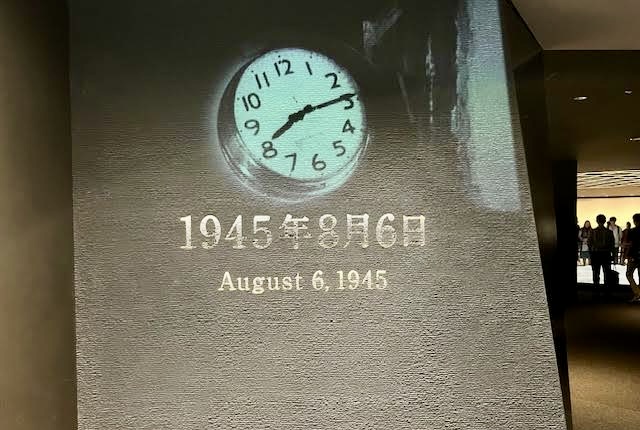
The moment of impact, frozen in time.
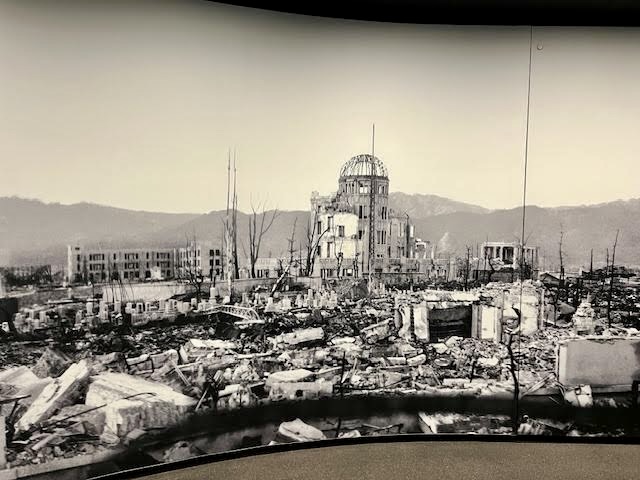
A long curved wall is filled with photographs of Hiroshima, right after the bomb struck.

There are many cases filled with scraps of clothing and small personal belongings that somehow survived intact. Then there are a number of items, still recognizable, but twisted and burnt.

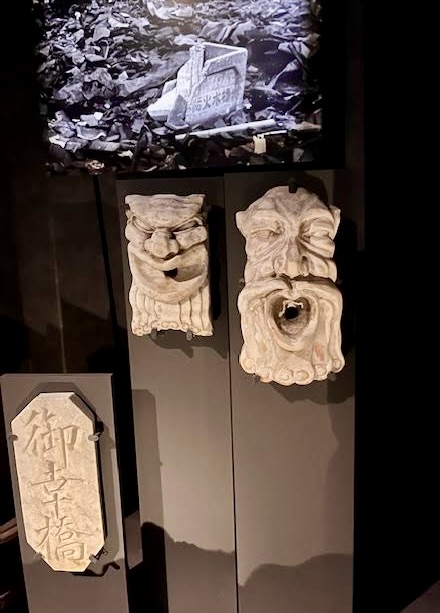
These concrete decorations from buildings survived the bomb.
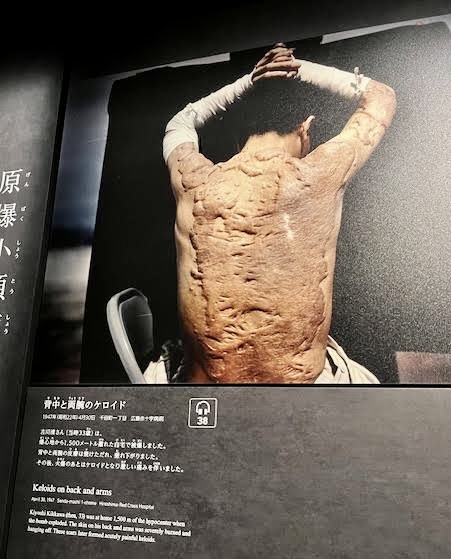
And then the exhibits that were the toughest – the human cost of ending the war. There were many photos like this one, depicting savage burns that, in most cases, caused the victims days of unbearable agony before they passed away from their injuries.

This young soldier suffered for almost a month after the bomb, and on Sept. 1, his gums started bleeding and blood spots appeared all over his body. He died three days later.

This photo was taken in 1947, two years after the bomb. This man had suffered severe burns that caused his skin to peel and fall off his body. The keloids that formed in place were extremely painful.
I can’t imagine.
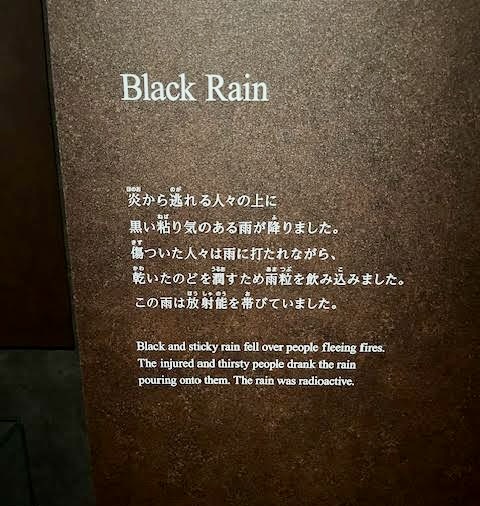
After the bomb struck and people started to recover, there was such unimaginable emotional suffering.
Children orphaned.
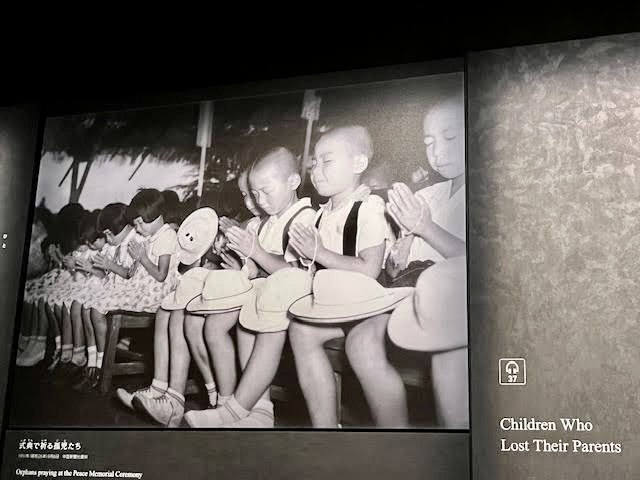
The elderly, vulnerable and alone, with no-one to care for them, had little reason to want to live.

This poignant postcard sent to this young girl’s brothers – a scene played out countless times as people tried to find missing loved ones.
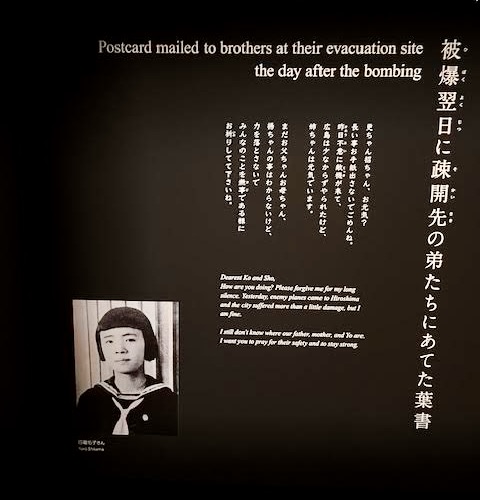
We filed out of the museum feeling quite heartsick and a bit numb. It’s a lot to process.
On the way into the Peace Park, there is this monument to a high school that was wiped out and hundreds of young students killed.
The rack of colourful papers on the left are paper cranes, which were offered to people who were seriously ill. The folding of 1000 paper cranes was attempted by Sadako Sasaki, a young girl who survived 10 years after the bomb, but died of leukemia. They can be found around Hiroshima as symbols of peace.

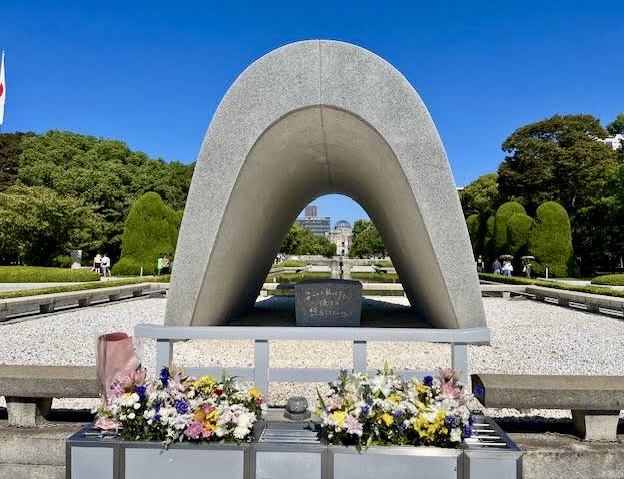
There is a broad walkway from the museum toward the A-Bomb Dome; with the distinctive shape of the Memorial Cenotaph, which holds the names of all people killed by the bomb.
The A-Bomb Dome was formerly the Hiroshima Prefectural Industrial Promotion Hall. While the city rebuilt , this structure was deliberately left standing exactly as it appeared after the bomb, right down to the rubble on the ground, as a stark reminder of the destruction.
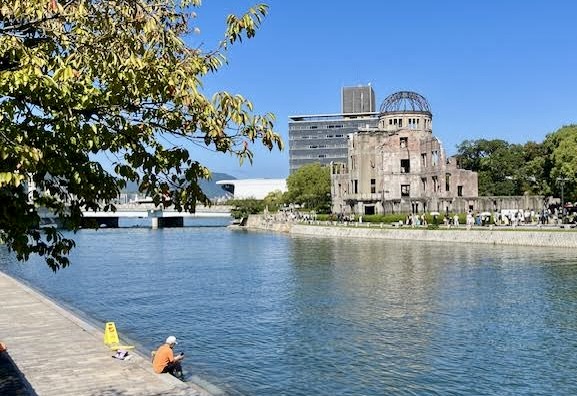
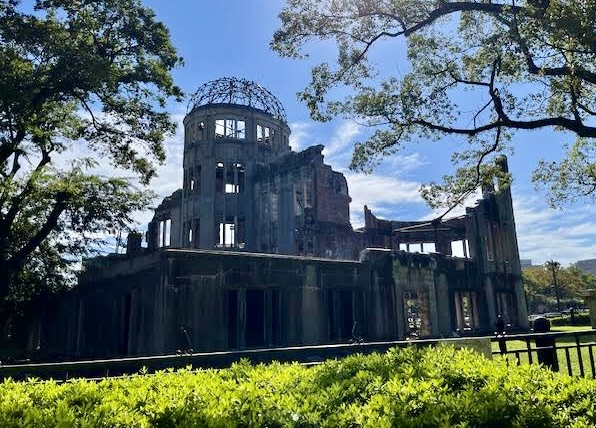
The Children’s Peace Monument.

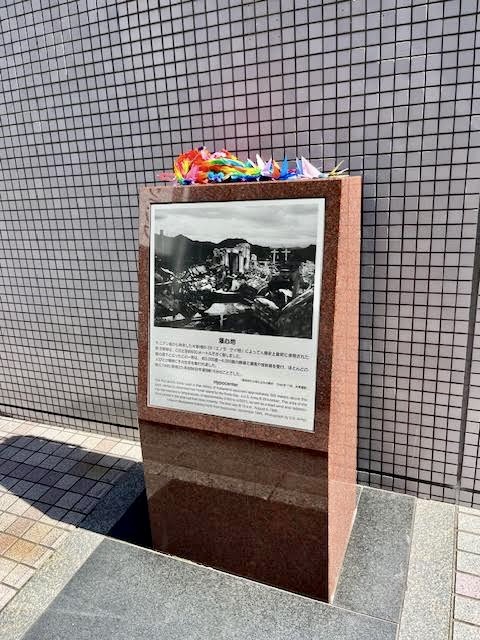
And finally, the epicenter of the blast that took out a hospital. A clinic was rebuilt and this monument marks the spot.
Whew! That was tough, and while most tourists come here to see exactly what I have just showed you, there is a lot to Hiroshima that is well worth visiting. This city is modern, thriving, has several bridges criss-crossing rivers, and is easy to stroll about.
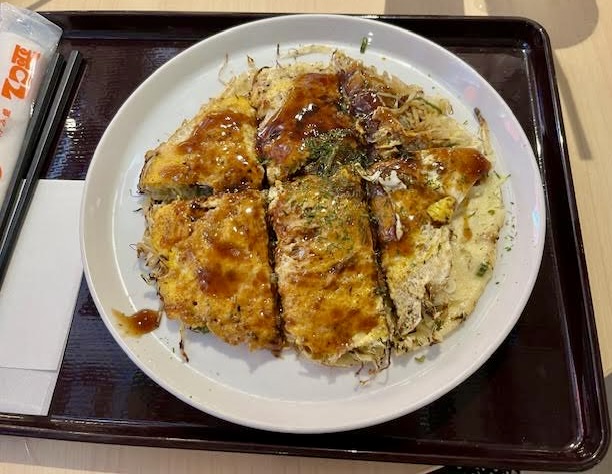
On a much lighter note, Hiroshima is famous for a number of dishes, including okonomiyaki – a layered pancake made of batter, shredded cabbage, thin slices of pork, green onion and noodles, all cooked on a grill until crispy and so delicious.
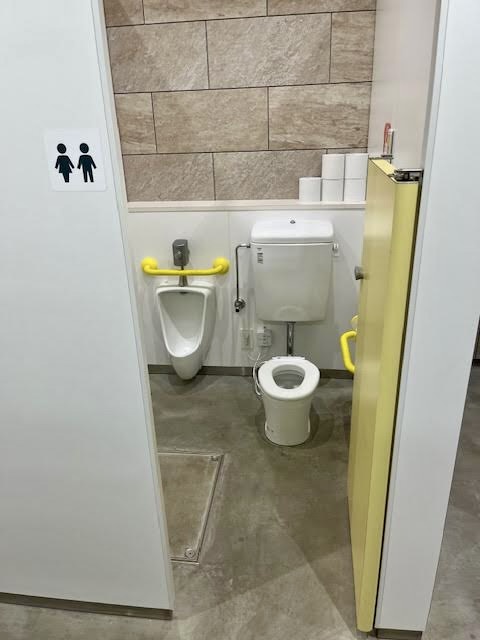
I had to show you this – the kid’s bathroom. I’ve never seen this in any public bathroom, here in Japan or anywhere – a pint-sized urinal and toilet.
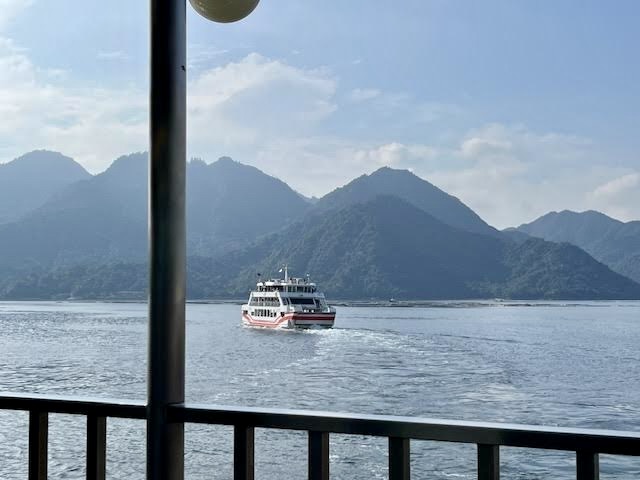
We’re in Hiroshima for just 2 1/2 days, and part of the must-see package here is a trip to Miyajima Island. We took the streetcar for an hour, hopped on a ferry for 10 minutes and we were transported to another world.
It was Sunday and the middle of a long holiday weekend, so we knew it would be crazy busy. We arrived at 8:30 a.m. and for the first hour or so, it was quite pleasant. We noticed a number of people had their small dogs with them and all of them were either in strollers, or in the case of this young man, being carried in a snugli. (He’ll make a great dad).

Miyajima Island is small and walkable, and known for its forests, its many shrines and its wild deer population. These deer, small and spotted, are adorable and quite tame, but there are signs everywhere not to feed them. Naturally, this rule does not apply to everyone.

There is a lovely walkway along the water, leading to the main event – the bright orange Torii Gate that appears to be floating in the water at high tide. Enroute, we came upon a number of these long, low boats. As it turns out, they are intended to ferry tourists out for a tour around the island. The boat trip held no appeal to us in 29 degree heat and an unforgiving sun but we wished we could have gone for a swim instead.

The famous Torii Gate.

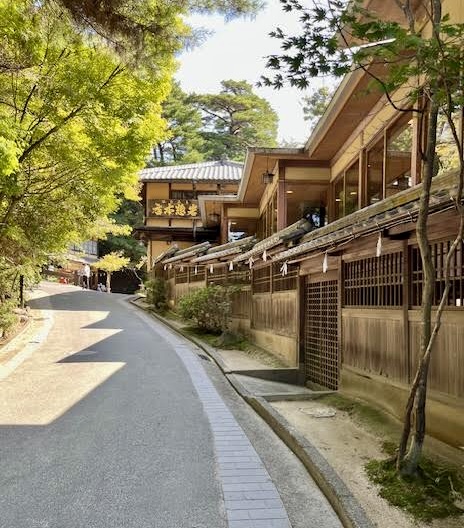
Miyajima has a number of streets away from the main drag and this one was quiet and peaceful, leading to guesthouses.
Not far from there, we walked over this bridge to Momijidani Park, a peaceful forest walk.

The Itsukushima Shrine is the most important shrine on the island, but it had insane lineups, so we decided to try later. A couple of hours later, the lineups were worse, so we took a pass.
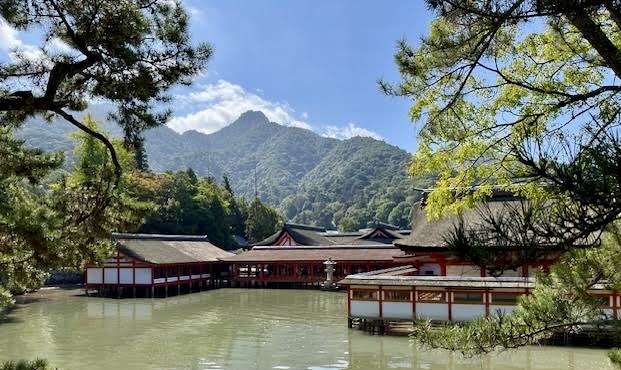
We did make it to this one (name escapes me), which felt so zen we stayed there for about half an hour. A woman nearby was doing yoga!
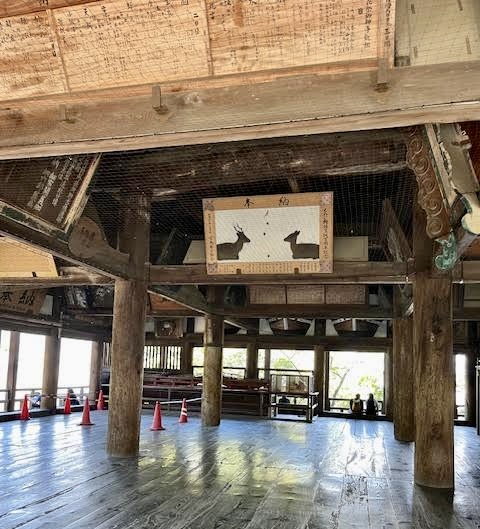
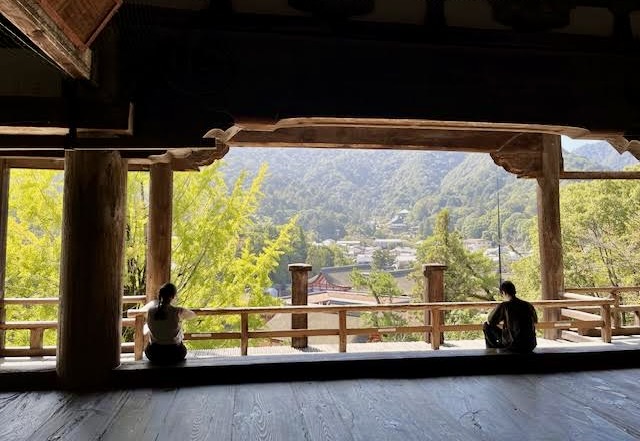
And there you have Hiroshima – the brutal past, the hopeful future and the beautiful surroundings – it was a lot.
Oh, and as we were leaving this temple, a gentleman asked us if we would like to do a brief tourist survey. He had gone to Memorial University in Newfoundland for his PhD in chemistry and had pursued a career in pharmaceuticals. We had quite the chat with him and as it turned out, he was born near Hiroshima in 1945. No ill effects from the fallout and he went on to enjoy a long and prosperous life. A nice way to end our time here.
 Leaving Ourselves Behind
Hello dear people-I have enjoyed your travel journal for several years, thank you! We are heading to japan next week. I
LikeLike
So happy you’re following along with us! I hope you have a wonderful time in Japan – where are you going and how long will you be here? If you haven’t been here before, don’t worry about transportation – there are so many people to help out and Google maps is very reliable as well. We just ask train staff before we go anywhere to confirm we’re on the right track, and it is easy.
LikeLike
Oh my, having visited there in April I couldn’t look at your pictures and read it all in detail as it gave me a trip back to the feelings and sadness we experienced there. We valued the visit through the memorial and it certainly gave context to the rest of our Japan trip. A lot of places are very new, even the traditional rebuilding of old castles, as WW2 demolished so much! The public spaces and wide new roads are beautiful and well designed for peaceful reflection.
LikeLike
That’s what we really noticed – how new everything is and there is a sameness to the architecture. Still, the parks and public spaces soften it all.
We’re so enjoying our time here -each part of Japan so far has brought a different element. Love the people – they have grace.
LikeLike
Thanks for sharing your well written descriptions and beautiful photographs of your time in Japan. I have never been to Japan but I sure remember Hiroshima, I was 3 years old when it happened but heard a lot more about it as I got older. Not the same as being there. I did visit Dachau in Germany in the 60s which probably had a similar effe,,ct, feeling the horror. Safe travels! I look forward to more of your posts!
Rohana Laing
LikeLike
Thanks Rohana – it seems we have no shortage of world sites of horror and destruction, and every one of them is a reminder of who we can be.
We’re really enjoying this trip – it is a fascinating country – lots of contradictions.
LikeLike
Hi Ginny and Stephen,
In answer to your question at the start of your blog … no, I don’t think we have learned anything. Human beings have terribly short memories, it seems. It was sobering to read your blog; but, I loved how you ended it with a feel good reminder of the power of hope.
Heather and Mitch
Sent from my iPad
>
LikeLike
I guess all we can do is take care of our own corner of the world and not contribute to the hatred that is out there. Speak up when we should and stay quiet when that makes sense.
I don’t know – how do we turn things around that are happening right now?
LikeLike
Very very sad indeed!
and the world leaders have not learned anything yet!!!!
Happy travels !
Danielle
LikeLike
Thank you for this. It certainly is so so unbelievable. The deaths & then the horrific injuries, deformities, so macabre. Can understand why it was sullen in the museum! Remember feeling like that at Holocaust Museums & visiting the actual camps.😥And no I don’t think we have learned with all the killing still going on.
How peaceful for you to escape to Miyajima! Wonderful pics again, thank you.
LikeLike