Okayama is a city that has somehow escaped the tourist hordes, which was a blessed relief. In a way, it makes sense, as the cities of Osaka and Kyoto are close by and have more obvious appeal. If you’re on a limited time frame, you might not consider a stop here.
What drew us to this city were a number of attractions; proximity to arty Naoshima Island, a nearby historical area and lots of canals.
A canal runs for kilometres through the centre of the city; flanked with a shady oasis of greenery, pathways, benches and sculptures.

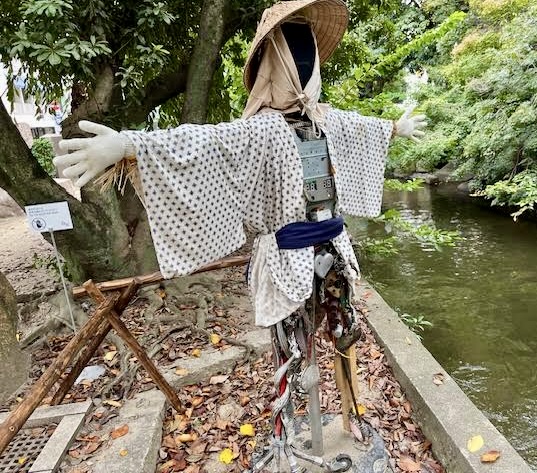
This “scarecrow” was equipped with a message (in Japanese only) that played every few minutes.
A Jizo statue, to mark the passing of a child. Quite remarkably, a dish is filled with coins and you know that no-one will touch them.

Yesterday we sat outside a grocery store, trying to orient ourselves and figure out where to eat dinner. In the few minutes we sat there, we watched a number of people ride up and park their bikes – not one person locked their bicycle. And why? Because there is no need – the bike will be there when they come back out.
This is another aspect of Japanese culture we are so interested in – the adherence to the rules and to doing the right thing. An example – the red light. Japanese will not cross the street if a light is red even if there are no cars for miles. Every fibre of my being has been fighting the urge to dash across the empty street, but a) that action would be met with disapproval and b) I’ve been told it is illegal. Apparently both of those elements are enough to keep the locals patiently waiting for the light to change.
On the subject of adopting desirable personal traits, this poster was hanging near our hotel – a gentle reminder of how to play well with others.

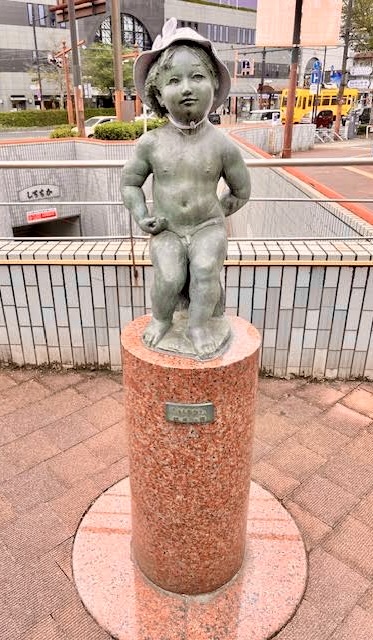
The folktale of Momotaro began in Okayama and there are statues of him to be found all over the city. As the story goes, Momotaro was a boy born from a giant peach who teams up with a dog, monkey and pheasant to defeat demons on Demon Island. He is a model for young children as he faces challenges and overcomes hardship. I just love his adorable little toddler body and the whimsy of making him the town mascot.
The architecture in Okayama is similar to buildings we have seen so far in other cities. Most buildings have few distinguishing features; It would be hard to describe Okayama as beautiful. But yet, it is a city with great appeal – wide boulevards, excellent transit, pockets of green and every few blocks, a building of outstanding design.
Okayama Symphony Hall, right across the street from our hotel.

Just around the corner from our hotel is the famed 300-year-old Korakuen Garden – one of Japan’s top three Edo-period gardens.
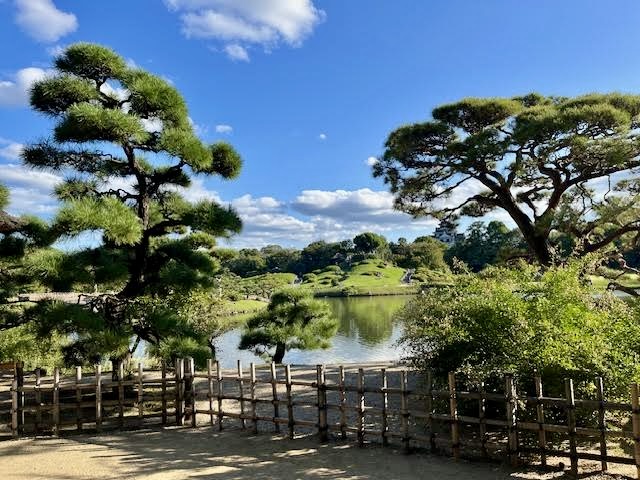
The gardens cover 14 hectares of immaculate grounds, small temples, a rest house and rice fields.

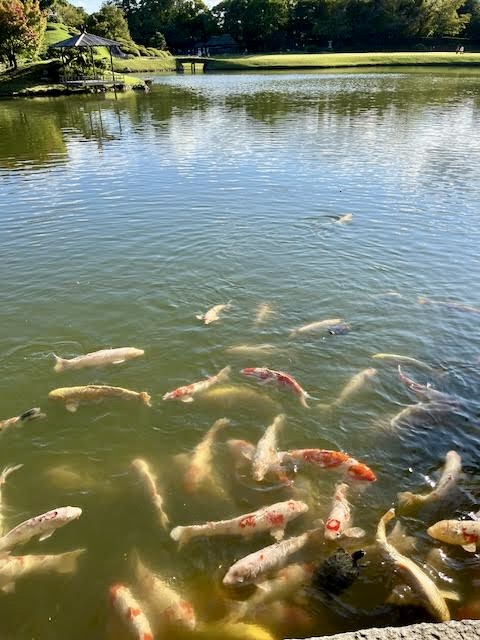
Dozens of koi and turtles swarmed this area; obviously a popular feeding place.
The suburb of Kurashika is a 20-minute train ride from Okayama Station. This area developed during the Edo period ( 1603-1868), as a hub for rice to be stored and then shipped via the canals that run through the area.

The city was named after the many storehouses (kura) that line the streets and a portion of that canal system and its buildings have been preserved and is known as the Bikan Historical District.

A typical house in this area.
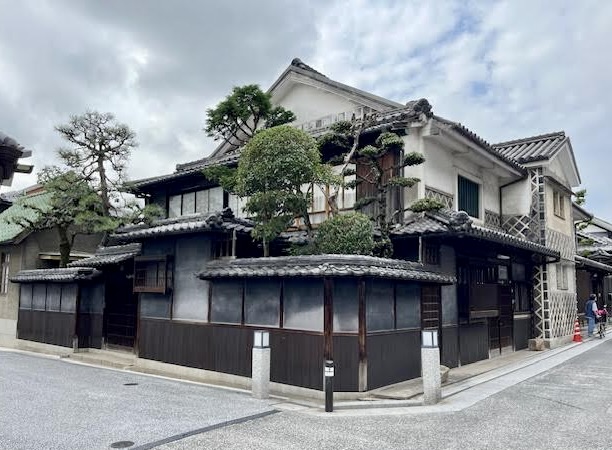
Kurashiki was better suited to growing cotton than rice and this developed into a booming denim industry. This area is the world’s largest producer of domestic denim, and the quality is simply beautiful. A number of brand names dominate, including Momotaro.
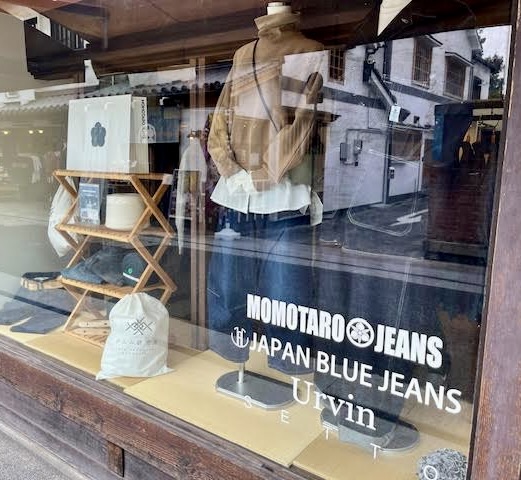
One street, Denim Street, is devoted to the various brands and each shop is curated and beautifully designed. The jeans run about $250-$300 a pair, but they would likely last for years. This is the ultimate Japanese souvenir.
Another shop promotes the hitoe Tabi shoe – the slightly off-putting cloven hoof style that is touted to strengthen muscles and tendons and promote stability. Not for me, but another example of Japanese innovation.

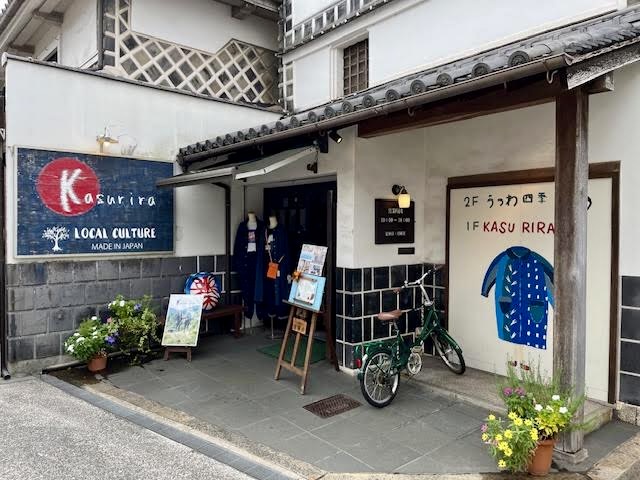
Every shop in this district was devoted to Japanese design and more specifically, to products made in this part of the country.
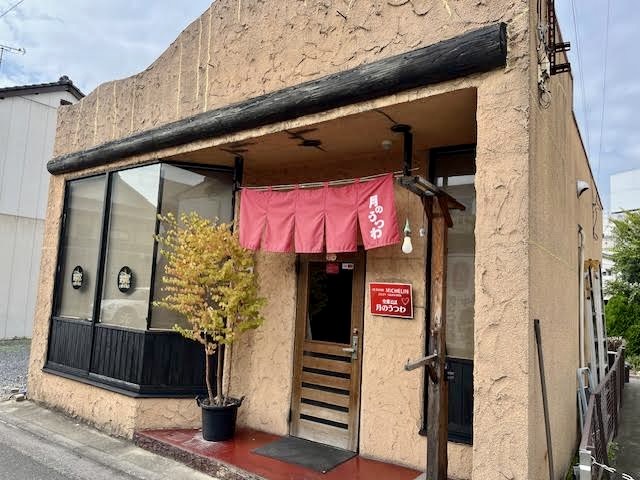
We walked by this modest restaurant, startled to see the Michelin star.
When we were putting together our itinerary for Japan, one of the attractions to Okayama was the proximity to Naoshima Island, one of three nearby “art” islands. Naoshima is about 1 1/2 hours away by train and ferry; a small and almost walkable island filled with art galleries, outdoor sculptures and scenic views of the water.
What we didn’t realize was that the 2025 Setouchi Triennale was on – an event that happens once every three years for 100 days and is a big deal. “Big deal” as in tons of tourists and high demand for some galleries, with the result that many were sold out for the day.
The whole island is art – from the train station to this installation to any number of sculptures along the waterfront.
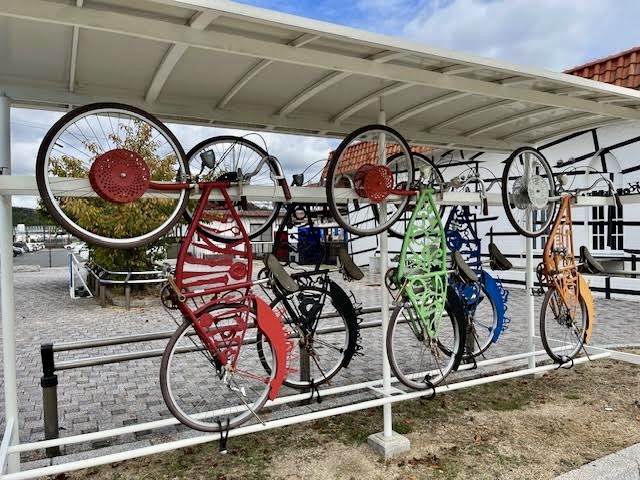
We were both really excited about this outing and should have been far better prepared. We din’t reserve anything, we left a bit late and arrived on the island about 11:45, feeling cranky and a bit peckish.
Have you ever set out for the day and nothing goes to plan – you have somehow sabotaged yourself? This is what happened to us. We spent quite a bit of time finding a restaurant and then by 1:00 pm, we hadn’t yet seen a single gallery.
We grabbed a bus and headed to the Naoshima New Museum of Art, opened in 2025. It is the creation of renowned architect Ando Tadao. Lots of concrete and geometry.

The building and contents were impressive. Installations are on a grand scale, in keeping with the structure.
An arch of 99 wolves leaping and crashing into a glass wall was the brainchild of artist Cai Guo-Qiang. It reflects the human condition – our tendency to remain loyal to dangerous ideologies, in the face of evidence they will destroy us.
Well, does not sum up the past, present and future?

Artist Heri Dono installed ten large panels that feature political satire and the human need for nature.

Do Ho Suh’s work “Hub” is a re-creation of one room from every place he has lived in Korea, London, Japan, New York, the UK and Berlin.

Since we were running out of time and many places had sold out, our next and final stop was Benesse House Museum. This series of buildings, also designed by Ando Tadao, is a museum/hotel/resort set right on the sea, with art inside and out.
A glimpse into the hotel, should you have the foresight to book far enough in advance:
https://benesse-artsite.jp/en/stay/
We liked the museum, didn’t love it, found the installations kind of “meh.” What it does well is incorporate the indoors and outdoors. It was peaceful and serene, so we strolled through and just enjoyed what unfolded in front of us.

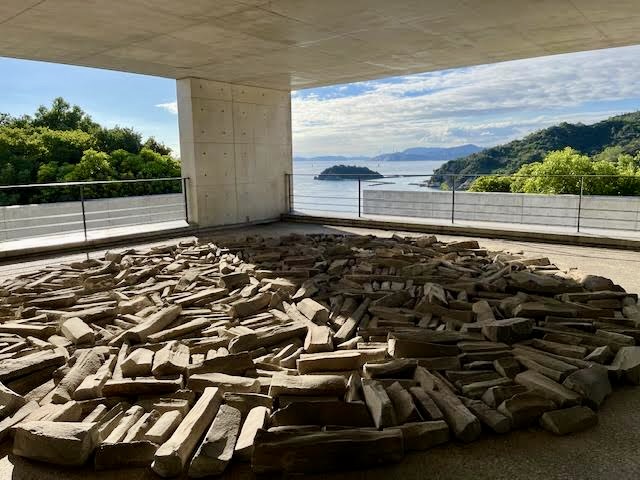

Otside the museum, the shoreline offers up a number of sculptures, including Yoyoi Kusama’s famous “Pumpkin.”

We’re so happy to have spent a bit of time in this part of the country and to have enjoyed a brief respite from the tourist crush. It was another insight into a different part of Japan, and now we head to Kyoto for eight days.
 Leaving Ourselves Behind
Your adventures are fabulous as always. Thank you for taking us along xo
LikeLike
thanks my friend! I appreciate you joining us – we don’t feel so far away.
LikeLike
Your adventures are fabulous as always. Thank you for taking us along xo
LikeLike
Your adventures are fabulous as always. Thank you for taking us along xo
LikeLike
Hello Ginny and Stephen,
Nice to see that you’re exploring Japan. What a place! We resided in Hiroshima from Dec. 1982 until March 1983. It left a profound impression on us with so many memories of all the places you have visited, and others. The museum at the A-bomb site is new to us, but the former one, though smaller, was also extremely powerful. We would pass near the site on our way into town from where we lived and see the “broken building”, as we named it for our 2 year-old daughter. Having Leah with us and the fact that Tom was studying, as well as having a strict budget, limited our travelling. Miyajima and other places out of town, and friends in Kyoto and Kobe made up most of our explorations. Obviously, a lot has changed in 40 years (!). Okayama looks very interesting and a relief from the crowds. Also, love the idea of dedicating a whole island to art. Japan is such a mixed bag of conformity/convention and quirkiness/originality. Something to experience first hand to understand. Wishing you more great experiences in the land of the rising sun!
LikeLike
Shelley – so nice to hear from you. I had no idea you guys lived in Japan and especially in Hiroshima. The city has done a wonderful job of both honouring the past and reclaiming the future, don’t you think?
And you’re so right about the many contradictions of Japan – I find it fascinating and unknowable. Never have I felt more like an outsider – not that Japanese aren’t welcoming, but that the differences are so many.
LikeLike
Thanks for this Ginny. I’m ure being in a non-touristy area as a trat. Looks a beautiful country and loved the canals.
Love Lyn
LikeLike
It was such a good break form the hordes. We are now in Kyoto, and Holy Nelly – I don’t know how the locals can stand it. Much more on this in a bit.
LikeLike
In spite of the fact that your day on Naoshima Island didn’t start out well, I’m glad you were able to visit a couple of its museums. The wolves sculpture is a wonderful example of art imitating life. Impressive!
Heather
Sent from my iPad
>
LikeLike
It would be nice to go back another time when the Triennale is not on, and devote a couple of days to the islands. Just walking around was lovely – we even saw a couple of tourists strip down to their skivvies and go for a swim, so a little advance preparation…
LikeLike
Thanks so much for sending these. I am really enjoying them and learning a lot, too! Particularly liked your point of view on current travel issues. I went back and read some of your other travel blogs and found them just as interesting.
Lynne
>
LikeLike
Hi Lynne – thanks for following – I’m glad you’re enjoying the postings. btw, your ridiculous handle is assigned by WordPress if you don’t sign up on your own (if I sign you up, in other words)!
LikeLike
It sounds like an interesting place. The wolves were impressive. But, I must admit, that I had not heard of the town before your blog and Bob’s folks had spent a year in Osaka so we heard many stories of the area. That’s why I love your blogs. I’m always seeing new places.
LikeLike
Thanks Jeanne – Okayama and surrounding areas were real gems. We definitely wanted to see the highlights visiting Japan for the first time, but if we came another time I think we’d concentrate on secondary markets entirely.
LikeLike