Over the years, Stephen and I have both had our share of unique barbershop/salon experiences while travelling. I usually come away with a no-style older-lady do that does nothing for me but trim up the rough edges. But nothing could have prepared us for the beating Stephen took two days ago at a barbershop picked solely on the basis of us peering in the window and the barber frantically waving back at us. What could go wrong – a few snips of thinning hair and a sturdier hand on trimming an unruly beard and mustache.
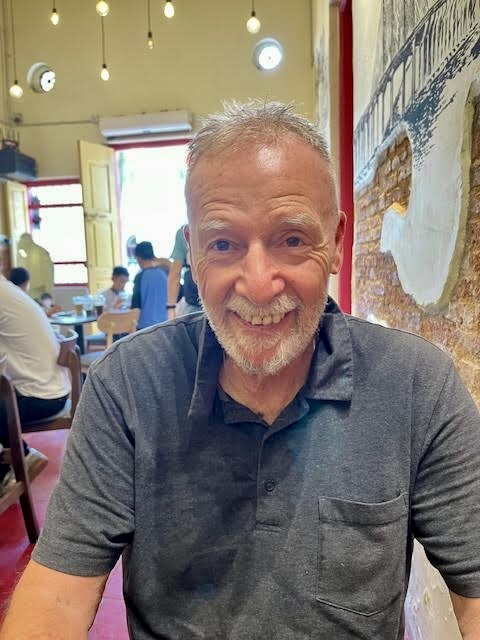
Well… as Stephen began to tell the barber what he wanted done, he got an emphatic “No!”, and so it began. The barber snipped and shaped and shaved Stephen’s head, with the end result of being nearly bald all around with a crown of hair on top. On to the beard – snip, snip, and a new shape began to emerge – a soul patch, with a deep V underneath – the first time in years that face has seen style.
And then… the barber smacked his hands together and began to chop and pound on Stephen’s neck, shoulders and upper arms – and not gently.
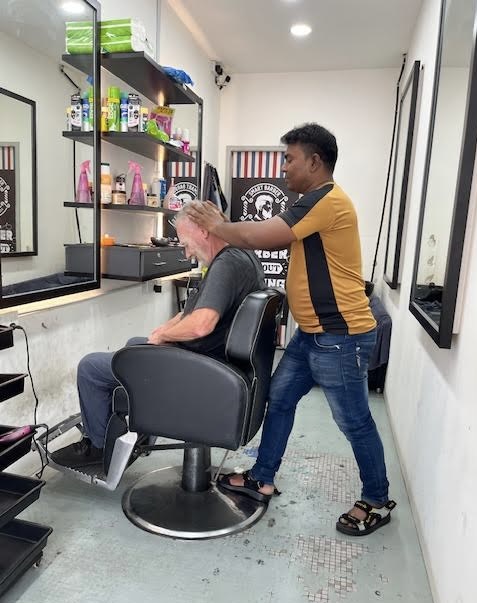
As uncomfortable as Stephen was, it was quite hilarious for me to watch, particularly as the barber was flipping him this way and that, slapping cream all over his face and head, then submitting him to a soaking at the sink. It was an incredible show. Indian barber – look it up.
The price sign on the wall indicated 21 Ringgits (roughly $7.50 CAD) for cut and beard trim. Our bold barber then showed Stephen 40 Ringgits (roughly double) on his phone, and Stephen gave him 50 Ringgits ($17, still $10 cheaper than he pays at home), so everyone was happy.
The end result.
Our time in Penang is coming to an end and it’s been a memorable visit. Stephen’s barbershop ordeal has not been the only smackdown – we’ve been nearly undone by the heat and humidity. Survival here really does depend on trying to organize sightseeing and outdoor activities in the morning and early evening.We have found that frequent hops into air-conditioned shops and cafes helps to revive flagging energy levels.
Visiting historic sites and museums has also been a great way to cope with the heat and provide fascinating insights into Penang’s complicated history.
The Leong San Tong Khoo Kongsi clanhouse began as a meeting point for Khoo clansmen who left China for Malaysia – a lineage that can be traced back to 1354, with the 9th generation living in Penang. Originally built in 1851, it was destroyed by fire in 1901 and rebuilt, with its most recent renovation happening 20 years ago.
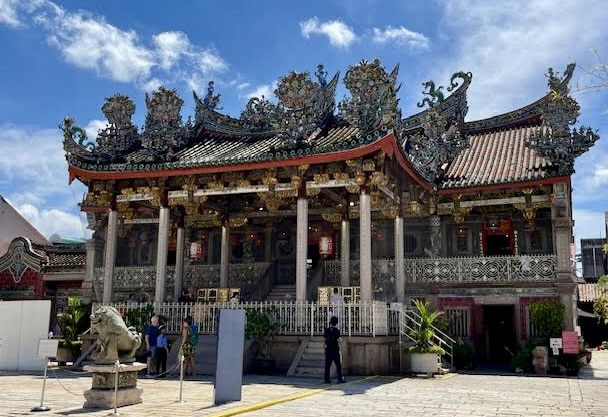
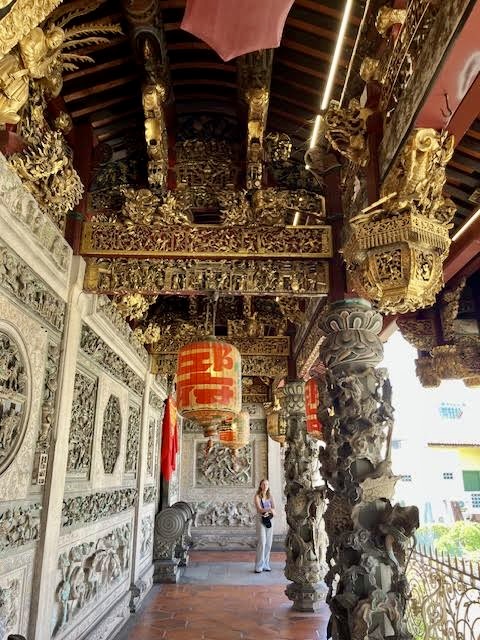
Some of the intricate carvings in stone and gold.
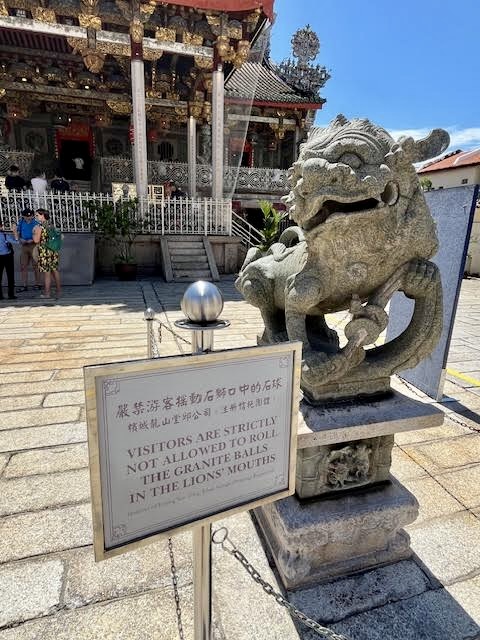
You know when you read a sign that isn’t necessarily logical, but clearly necessary? Enough people have found it irresistible to reach into the lion’s mouth and play with the stone balls inside that signs have had to be posted.
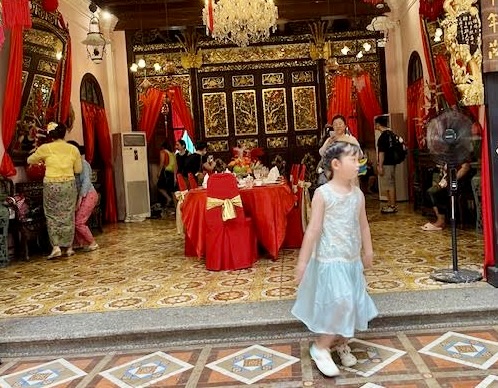
The Pintang Peranakan Mansion is another huge draw. Built at the end of the 19th century, it was the residence of a famous Chinese Kapitan. It features ironwork, tiled floors, Chinese wood-carved panels, and over 1000 antiques and artifacts. It is quite spectacular, and we were lucky to time our visit with an English-speaking tour, so in spite of having to dodge dozens upon dozens of other tourists, and a mittful of oblivious influencers, we learned a lot.
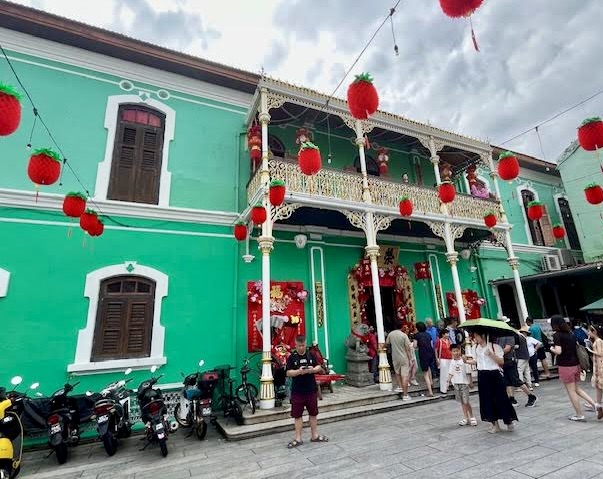
It is Chinese New Year right now, and many tourists are in town to celebrate. I love the fact they all dress up so well, and their kids are so adorable and well-behaved.
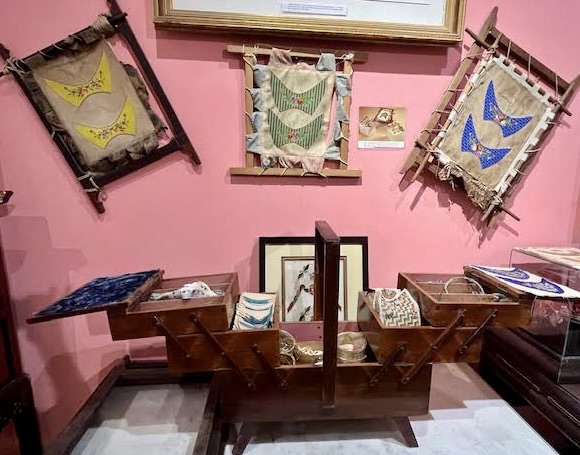
Part of the tour I found interesting was the double-edged sword of being a wealthy woman up until less than a century ago. You didn’t live in poverty and break your back in hard labour, but there were other sacrifices. Wealthy women were considered fragile, subjected to staying indoors and spending hours doing beadwork and needlepoint.
Examples of their work were on display; some of the beads so tiny they were almost impossible to pick up with an equally tiny needle.
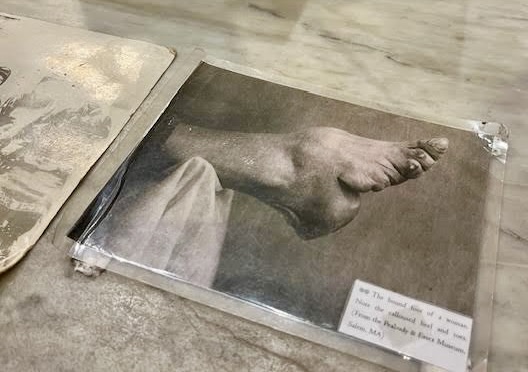
In addition to not being taxed physically, their beauty was to be preserved at all costs and foot-binding was in practice until less than a century ago. An impossibly small foot was the ideal and while they may have been attractive encased in child-sized shoes, this was the result: deformity and a lifetime of pain and immobility.
The Penang History Gallery does an incredible job of bringing alive Penang’s history, from 1786 to independence in 1957. Through a series of dioramas, we learned about maritime trade, the lavish lifestyles of the British, and the 1867 Penang Riot – a bloody feud between rival secret societies.
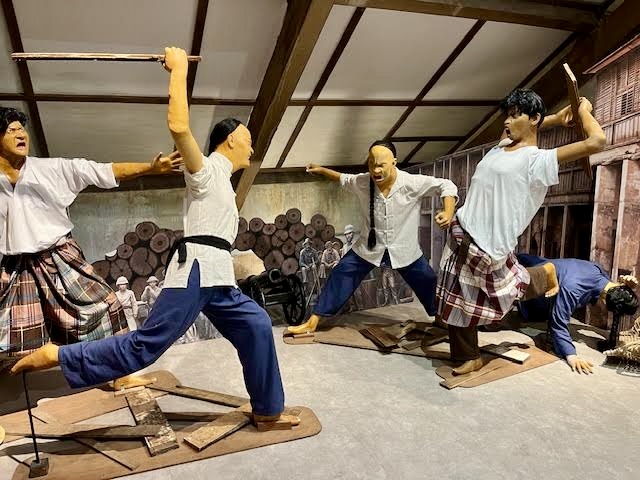
We also learned about the utter harshness of coolie labour, and the inevitable “dark side” of Penang life designed to try and ease the misery. Gambling dens, opium dens and prostitution were all part of life at that time.
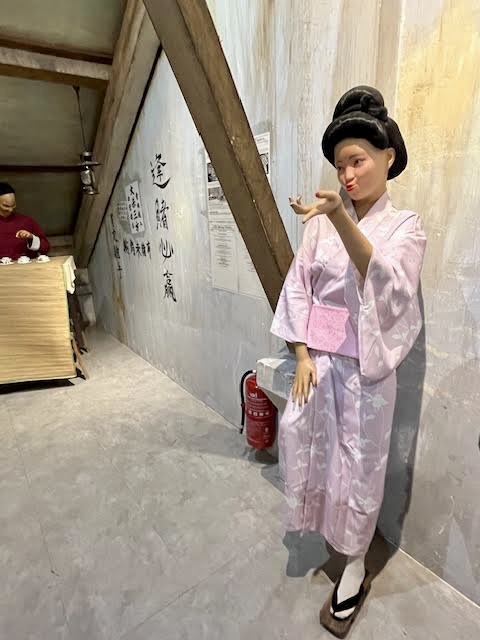
None of the vices have disappeared, of course and we’ve seen a few “working girls” during our stay here. This hotel was apparently a haunt (according to a favourable Tripadvisor review from over 10 years ago). It was described as being just how it looks – dirty, bugs and traffic in the hallways. But a number of former guests liked the atmosphere – the tropical decay and slightly dangerous seediness that we wouldn’t find back home. A few decades ago we might have found a place like this titillating, but at this stage in our lives we can do without bedbugs and stained mattresses.
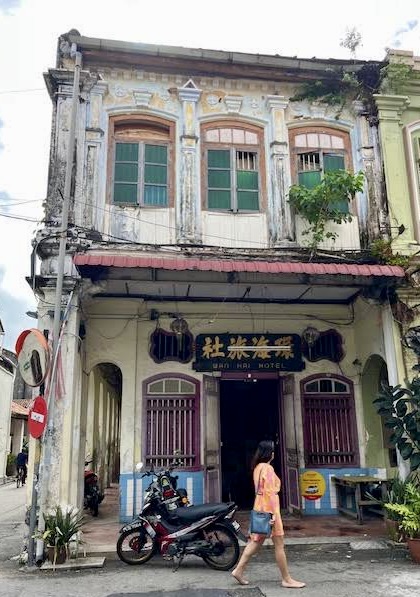
Penang has elements that can make one feel a bit queasy but it is more to do with heat, humidity and crumbling sidewalks. If the walls could tell stories…
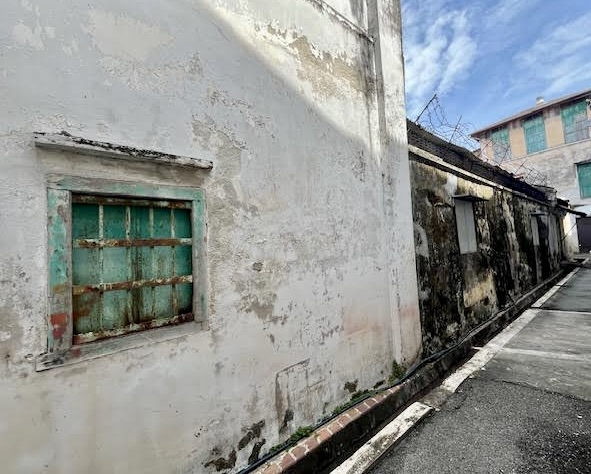
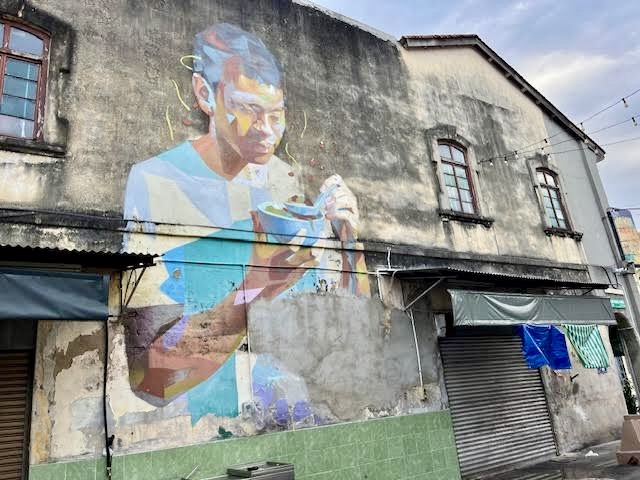
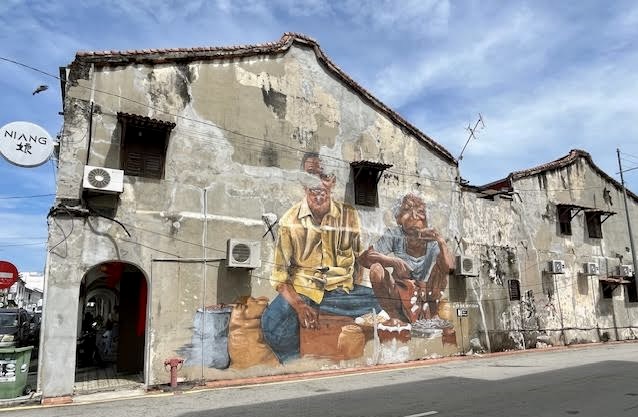
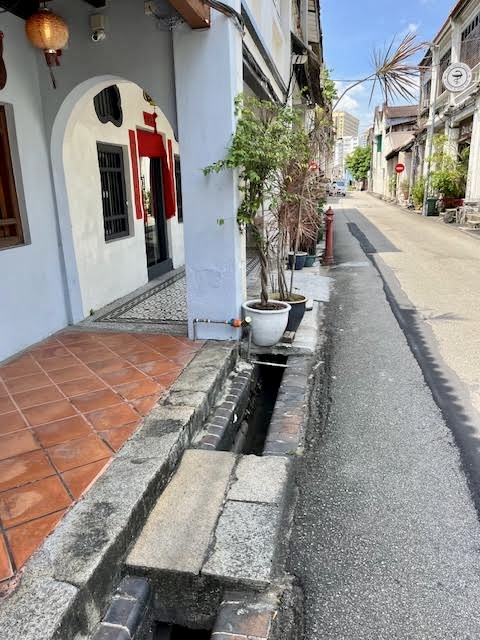
Most streets are lined with gutters that run about two feet below the surface of the road, to catch water run-off.
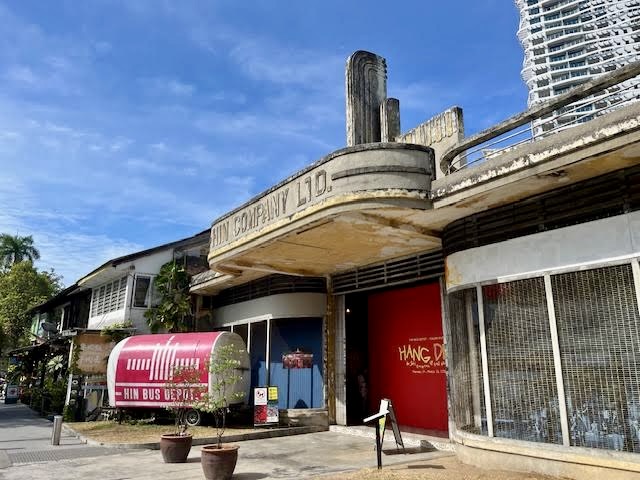
The old Hin Bus Depot was turned into an art gallery and events venue. It is an atmospheric space that hosts weekend markets, so we wandered down there to have a look. No need for little bags, or beaded bracelets, but it was really fun to see how an abandoned building has been repurposed.
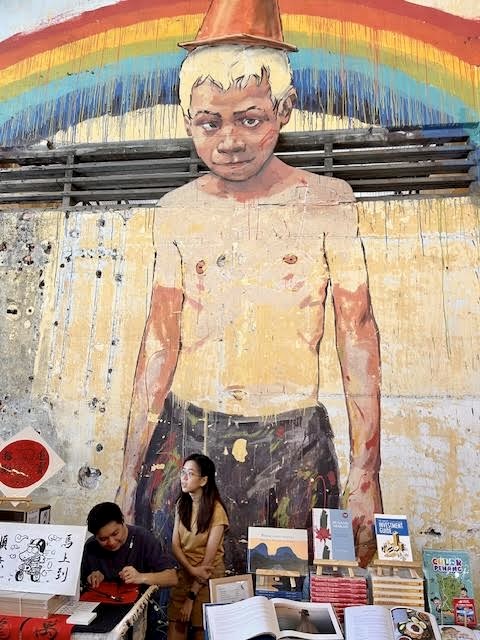
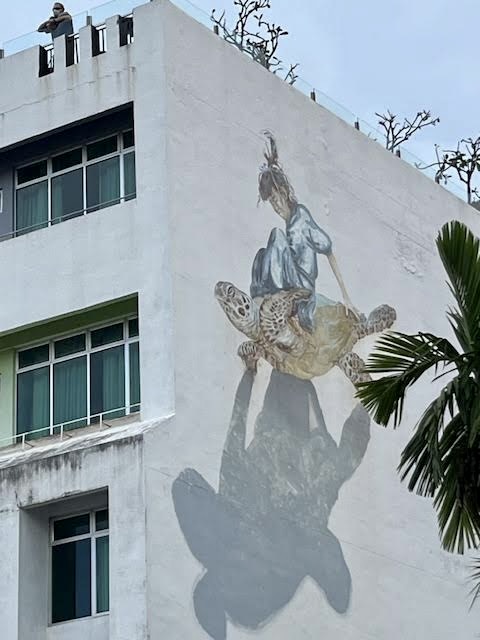
Just outside the Hin and down the road.
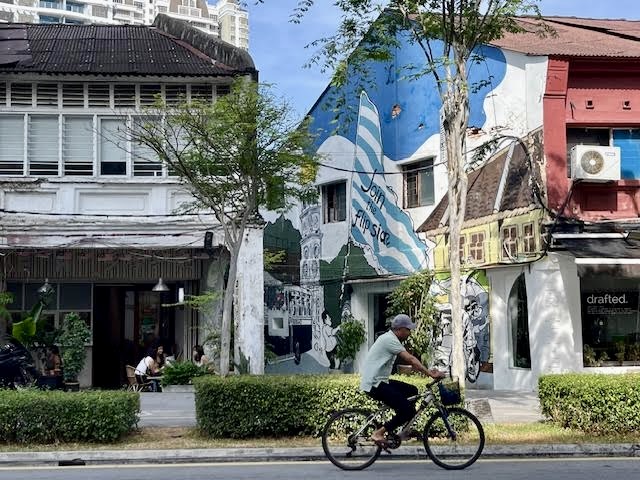
Not far from the Hin bus Depot is Jalan Kek Chuan – a short street filled with beautifully-restored shophouses, and described as being “one of the most beautiful streets in Penang.” I think it could compete for that title, but we found much of Penang to have its own particular beauty.
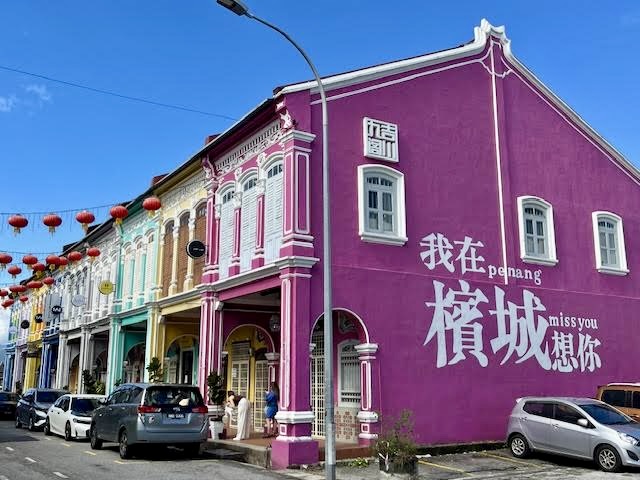
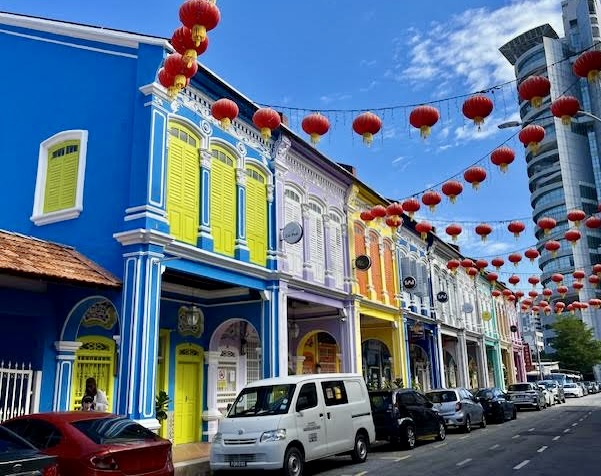
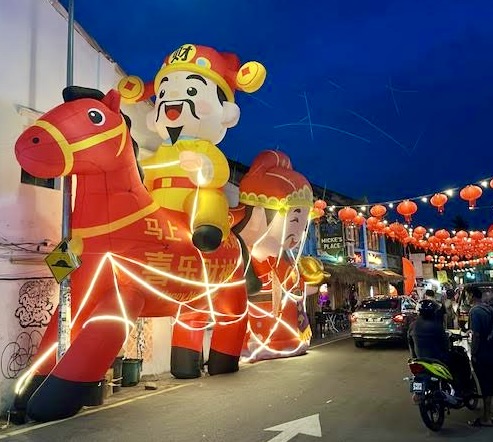
And finally – Chinese New Year. It officially runs from February 17 – March 3rd, but in reality lasts about one month. The whole country has been trimmed for CNY since we arrived mid-January, and it ain’t over yet. There are numerous celebrations, and umpteen firecrackers going off at all hours of the day and night, but there are so many ceremonies and family reunions – that is really what it is all about.
We are two of the tiny handful of non-Asian guests in our hotel – the rest have gathered in large groups, with many red outfits and thousands of photos ops. It is quite joyous to watch.
If you haven’t gathered by now – The Year of the Horse.
A gathering of people to witness the annual burning of all things negative – anything that has brought bad luck in the past year is to be gotten rid of, in a spectacularly vivid display.
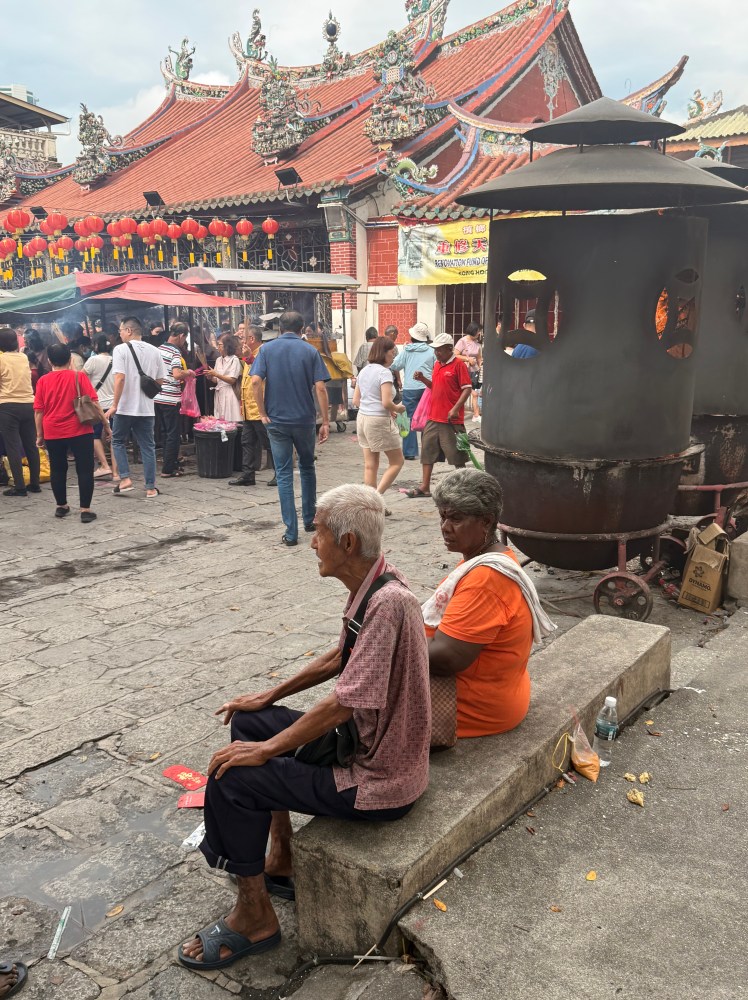
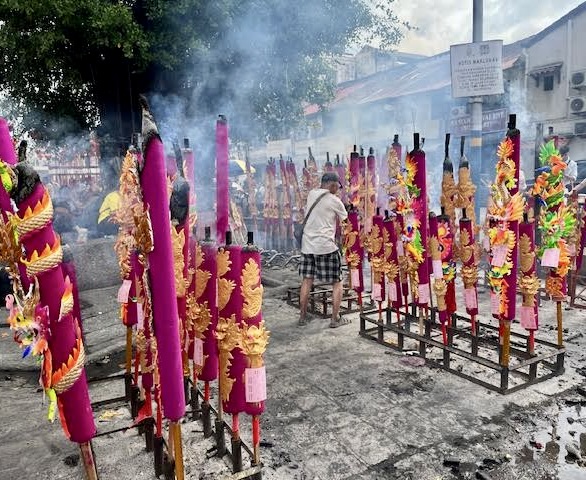
Today, the Lion Dance was being performed in our hotel, but it was held at 1:00 pm, and we weren’t able to make it back in time. Much as the burning ritual is important, so is the Lion Dance – a plea for a prosperous year.
This has been a really engrossing experience in Penang – in all its sweaty glory. It’s felt very Malaysian, whatever that means.
Now we’re off to Ipoh – a 4-hour bus ride away, with temples and karsts and heritage trails to explore.
 Leaving Ourselves Behind
Hi Ginny and Stephen,
How fortunate you are (or was it planned?) to be there during Chinese New Year! The timing cannot help but add to the experience you’re having in Penang!
Love Stephen’s haircut and beard by the way! Heather
Sent from my iPad
>
LikeLike
So lucky to be here for Chinese New Year! It seems that Penang really pulls out all the stops, so our timing there was great.
Now we’re in Ipoh and it’s still in full throttle, only with a bandstand down the street with concert-quality speakers!
LikeLike
Stephen’s adventure with the Indian barber really shows how you’re both willing to give the local culture a try – and I think it turned out quite well in this case. I took your suggestion and Googled Indian barber – it looks like it can be a much more immersive experience!
LikeLike
We had no idea. After Steve’s haircut, we popped in next door to “Sam’s Batik”, who is a well-known Indian shopkeeper in Penang.
We told him the story and we all had a good laugh. He said, ” He’s Bangladeshi. I went to him once, now I go to a Chinese guy.”
LikeLike