Meteora is also Greek for “suspended in the air“, which pretty accurately describes the monasteries to be found in this unearthly landscape in central Greece.
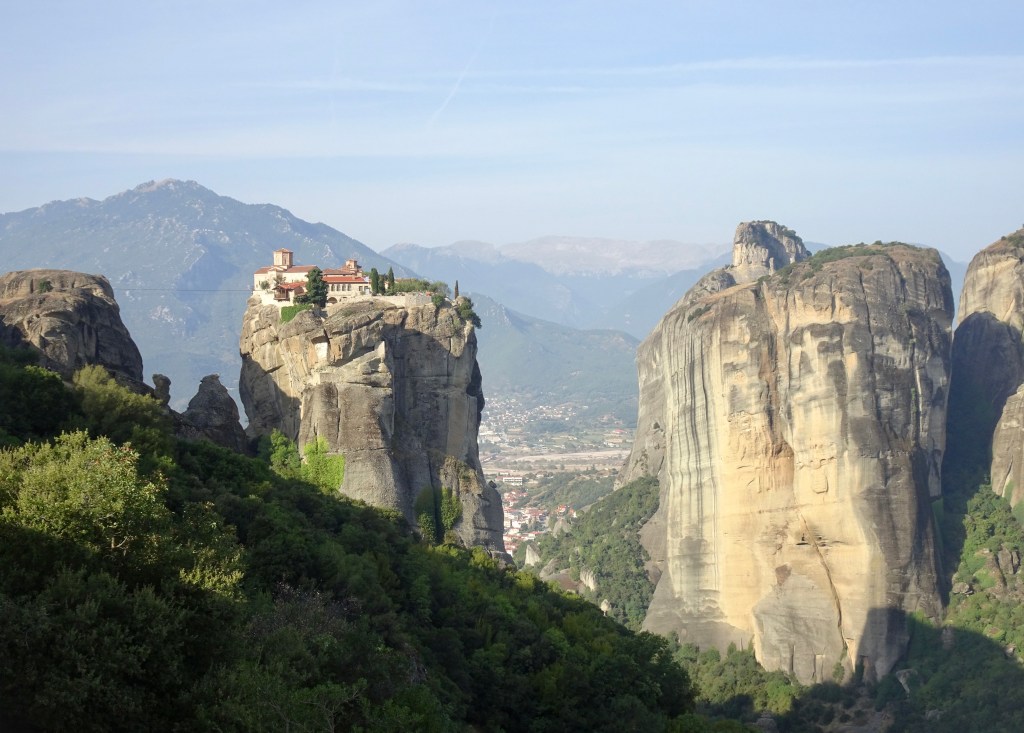
This story began between the 9th and 10th century, when hermit monks chose to live in isolation in the caves of these fantastical rock formations. They survived on donations of food, water and clothing and were considered to be holy men.
This lasted until the 12th century, when monks began to leave their isolation and form communities just below the Monastery of Agios Nikolas.
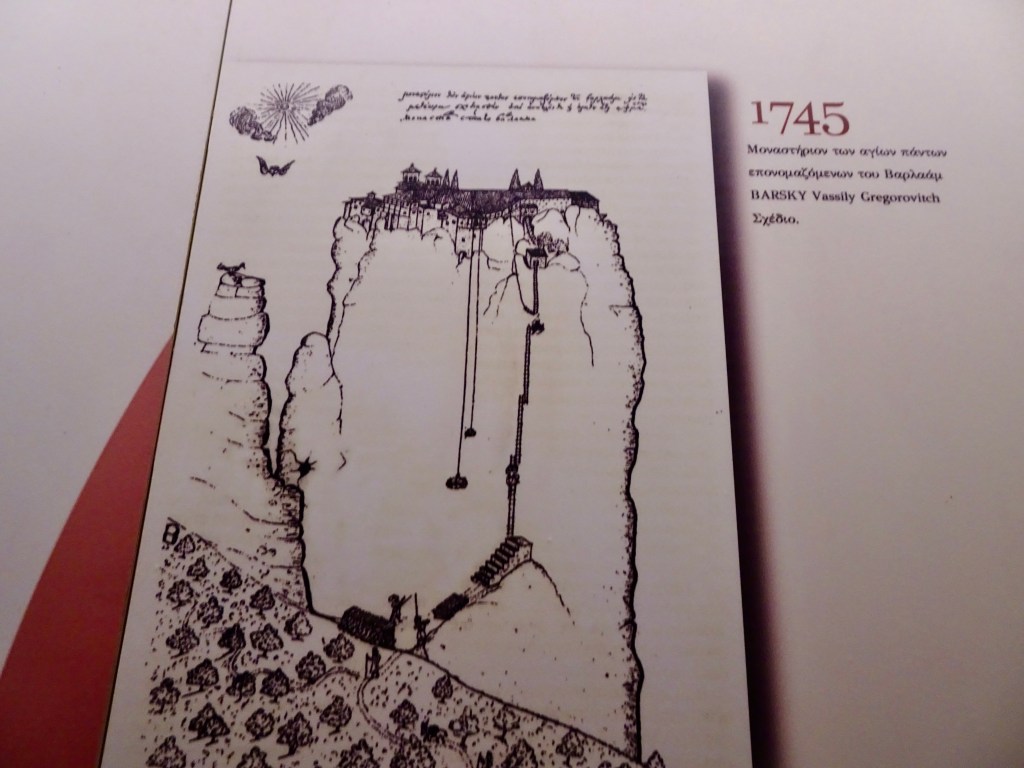
The ascetics attempted to ascend to higher rock pillars, using stakes and rope ladders. The illustration below shows the ropes and ladders, as well as the net baskets used to bring up supplies and people.
Two centuries later, in the 14th century, a monk named Athanasios climbed the second-highest rock in the area, to establish the first monastery, the Great Meteoron.
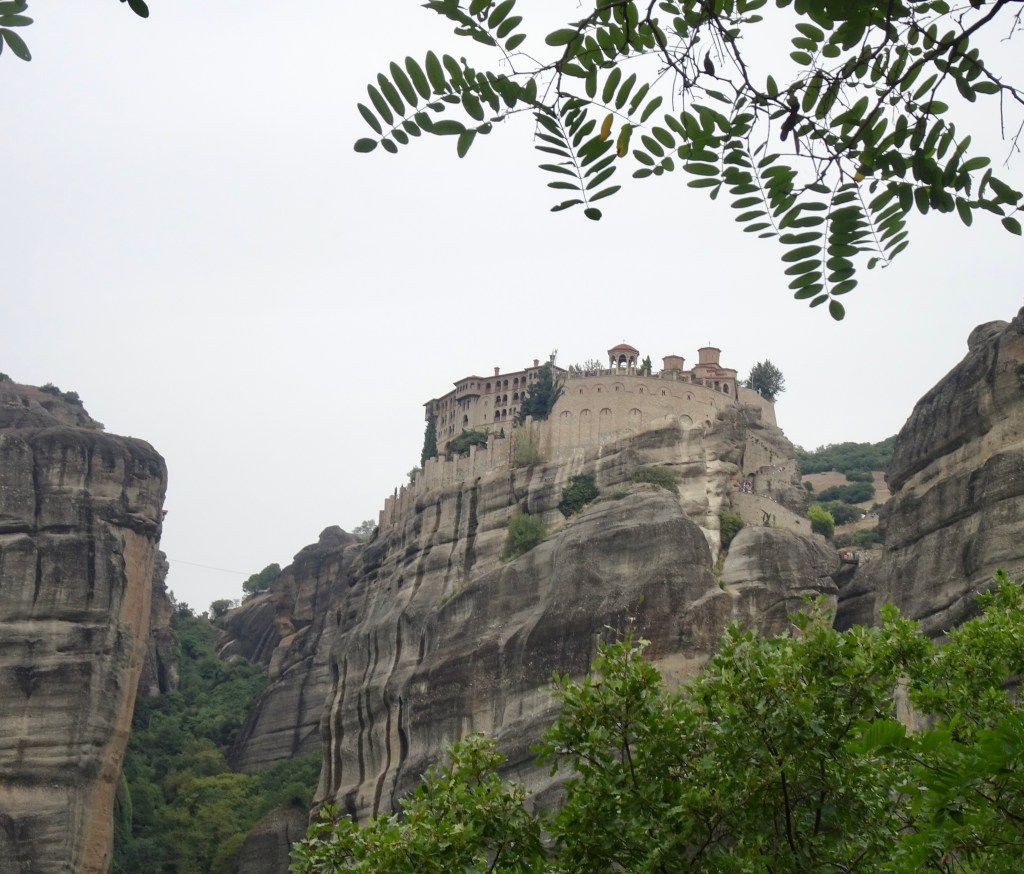
It was first erected in 1544 and took 70 years to complete. The 16th century became the most significant period of the building of monasteries; over 24 were built during this time.
A century later, the population declined steadily and today, just six monasteries are active and remain open to the public.
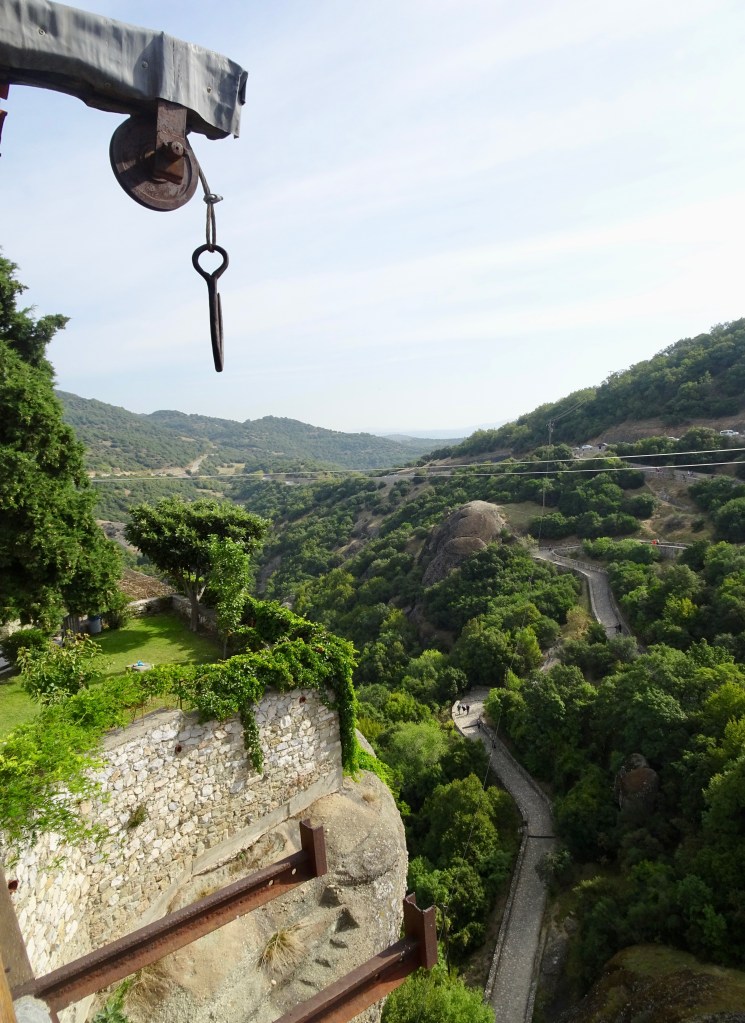
Take a close look at the Great Meteoron, the largest of the monasteries. Stone steps did not go in until the early 20th century, which meant that every hammer, bag of flour, piece of furniture or religious artifact was hauled up by a pulley system.
This hook, no longer in use, was one method of hauling goods up to heights of 600 metres from the ground.
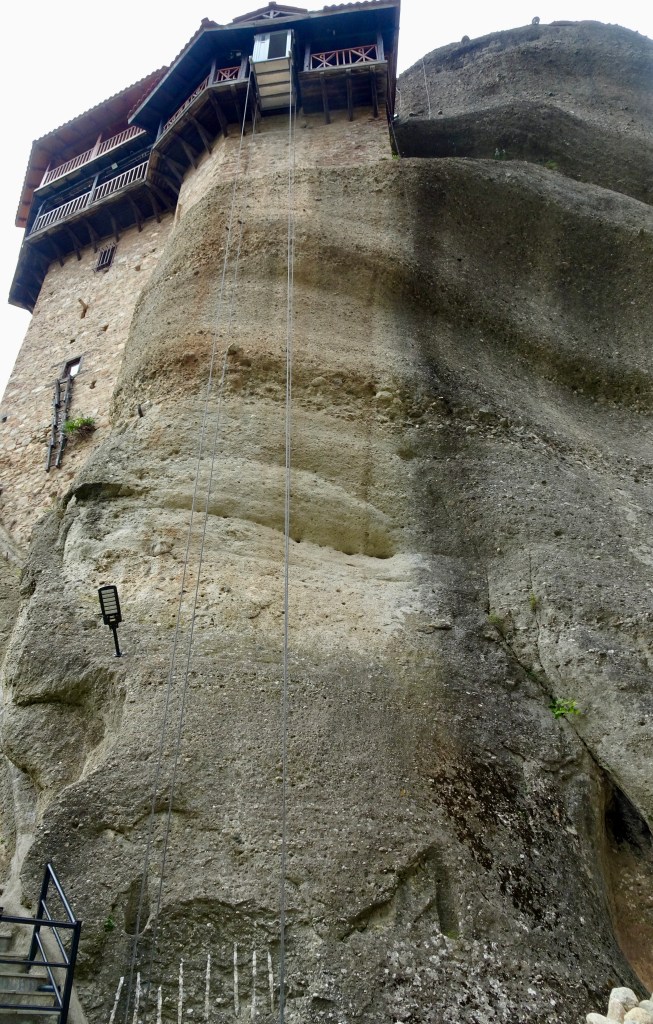
Today, goods are hauled up via a metal cage that travels vertically up the rock face…
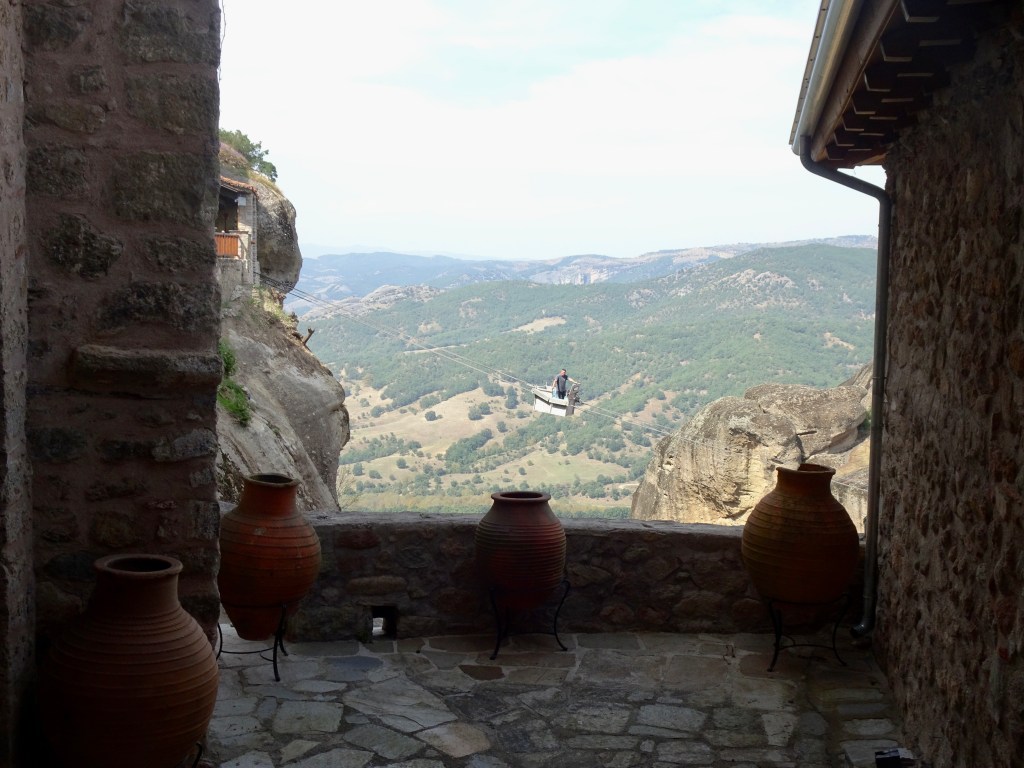
…or horizontally, along a cable, driven by someone with nerves of steel.
Let’s begin with these rocks. They began 25 million years ago, as a cone-shaped delta of rock, sand and sediment was carried along a river and deposited in the ancient lake of Thessaly. This delta entered the sea near present-day Kalabaka, and was then eroded by earthquakes, wind and rainfall, to split and form the unique and supernatural hills and rock pillars that created the “rock forest” of Meteora.
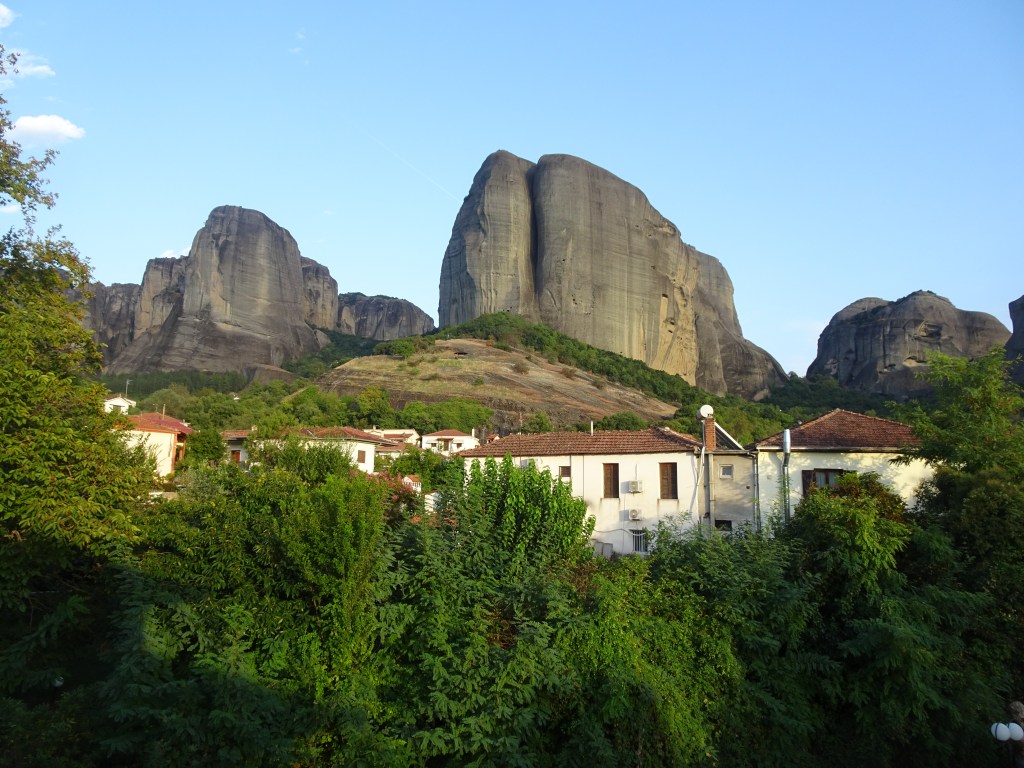
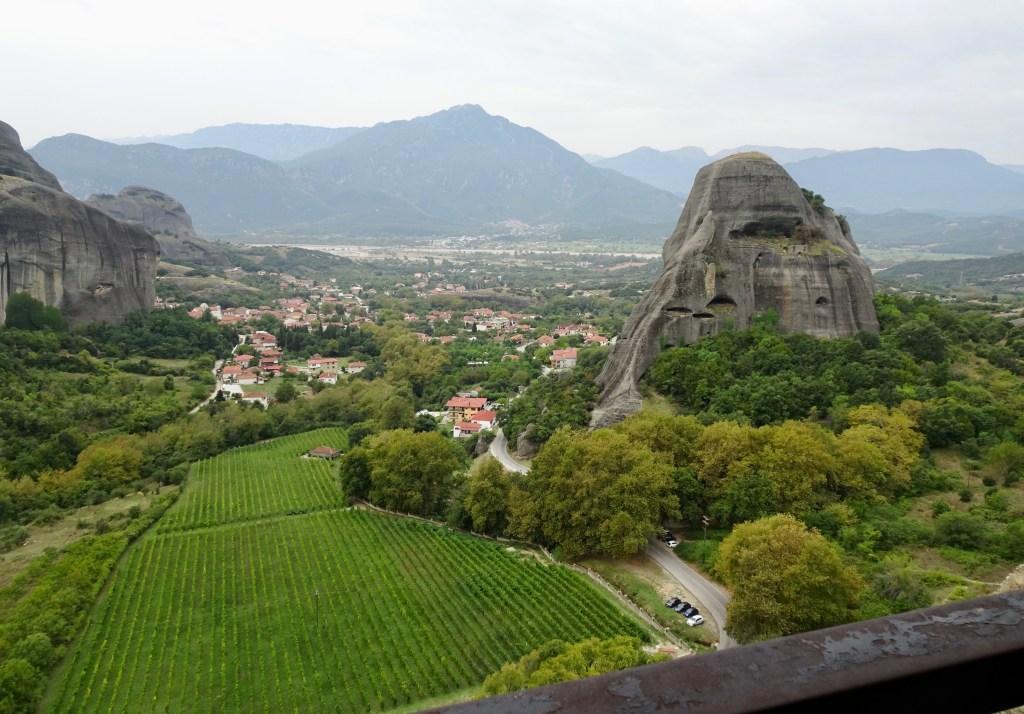
The area of Meteora encompasses the area around the town of Kalabaka and the village of Kastraki, where we stayed. This is the view from our hotel room.
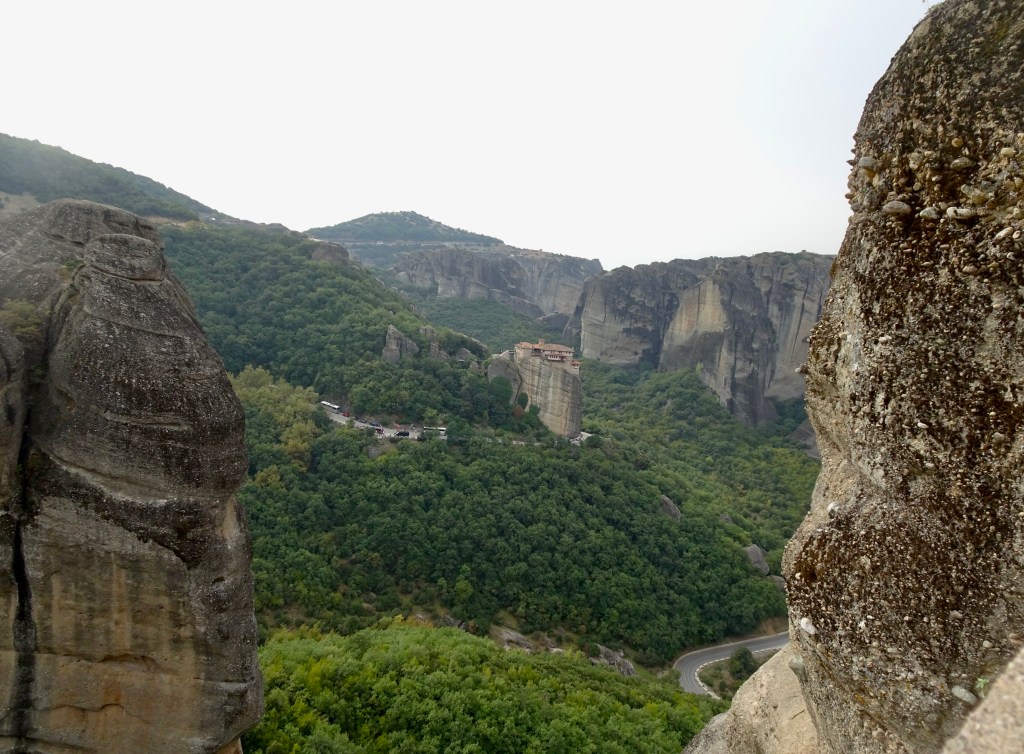
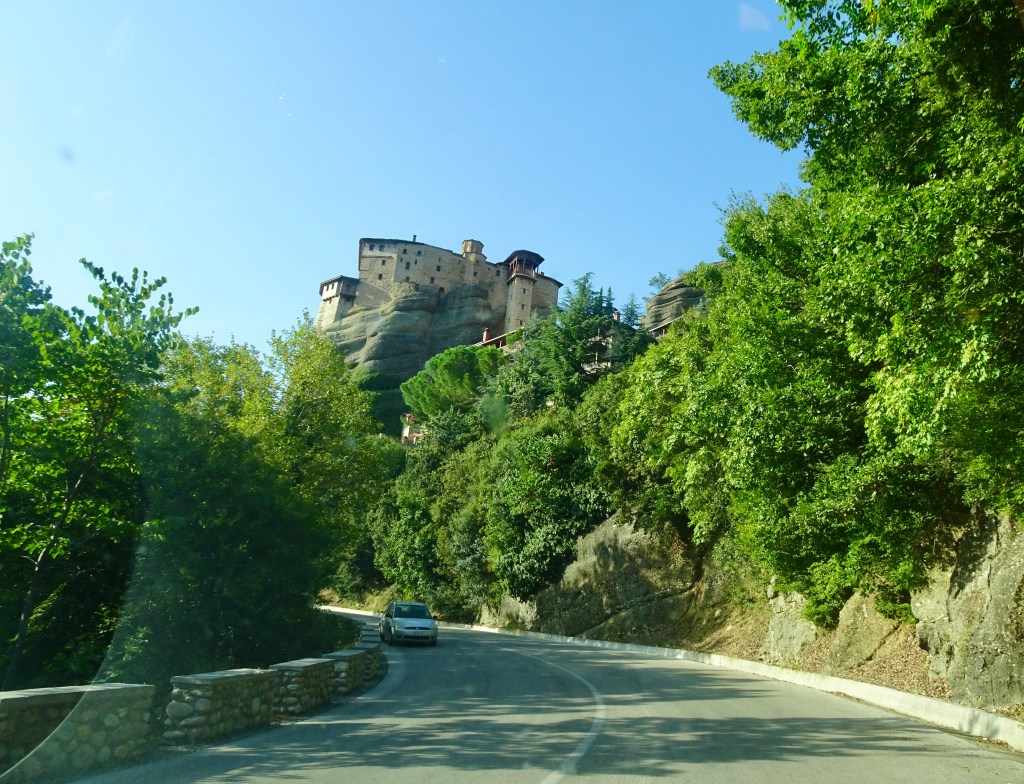
The roads between the monasteries are twisty and switchback at times but very good, with every corner offering a photo op.
The village of Kastraki, with a vineyard in the foreground.
The monasteries had fallen into disrepair over the years, and many of their religious artifacts were looted during World War 11.
In 1988, Meteora became part of the UNESCO World Heritage list. Over the decades, the monasteries have undergone dramatic restorations, with extensive and ongoing reconstruction and the preservation of frescoes.
It can be difficult to determine what part of the monastery is original and what part has been renovated in the past century or decade.
The chapels in each monastery are exquisite, with the original frescoes and paintings, but photos are not allowed.
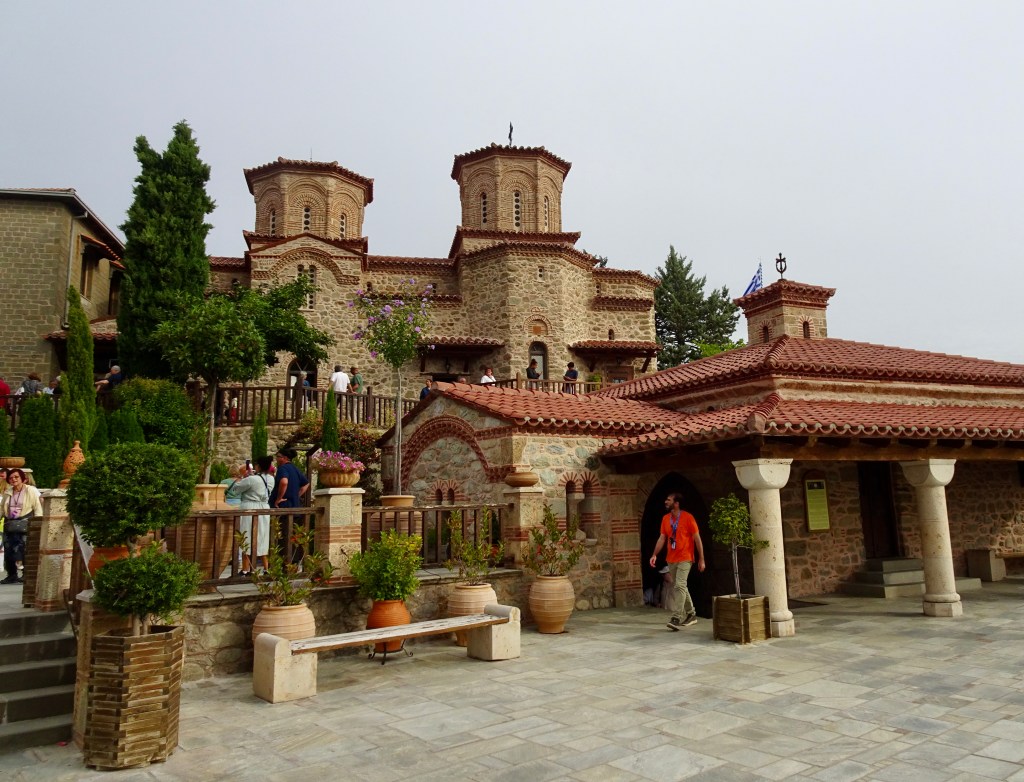
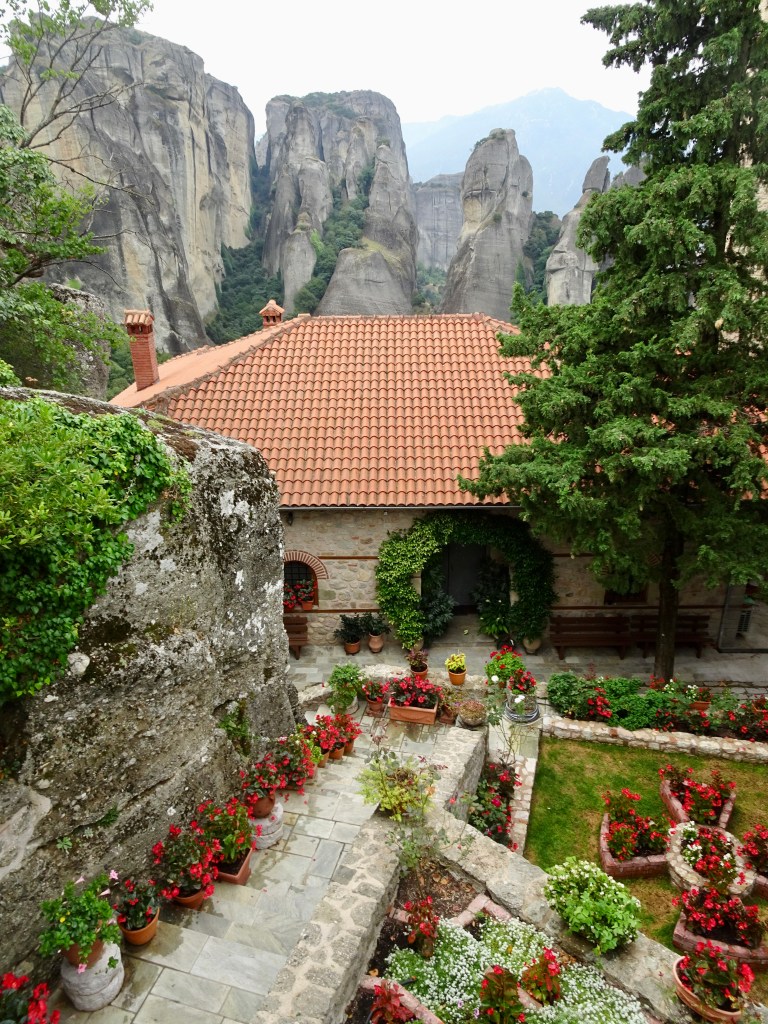
We visited all six monasteries (actually two of them – Agios Stefanos and Roussanou – are convents run by nuns). They are all different, some more impressive than others, but for the sake of this blog, I’ll just post photos that exemplify the more interesting characteristics.
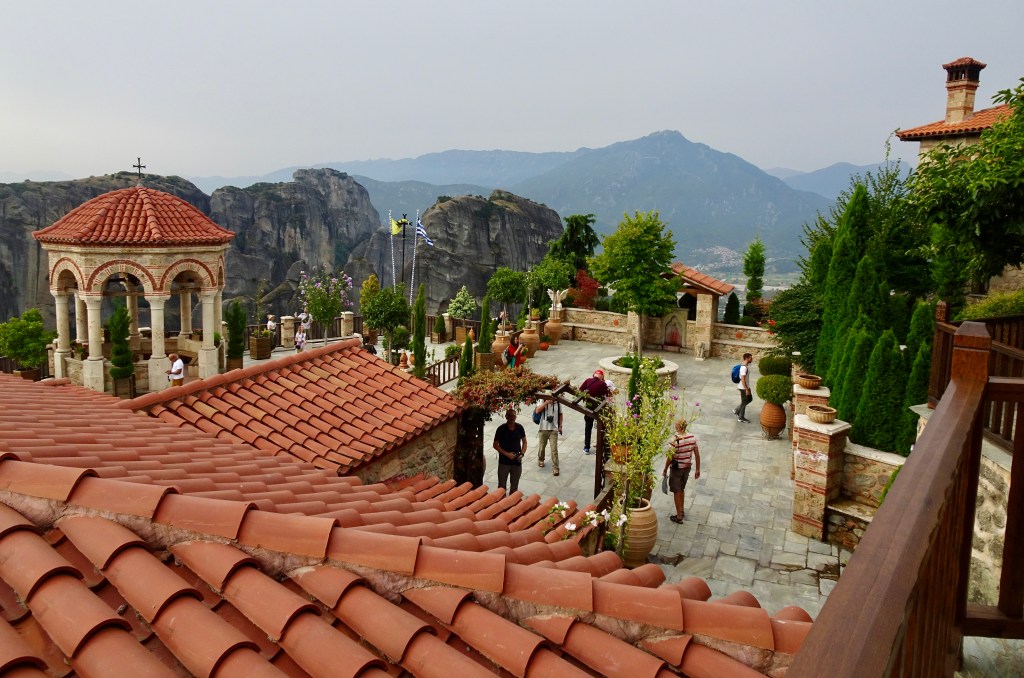
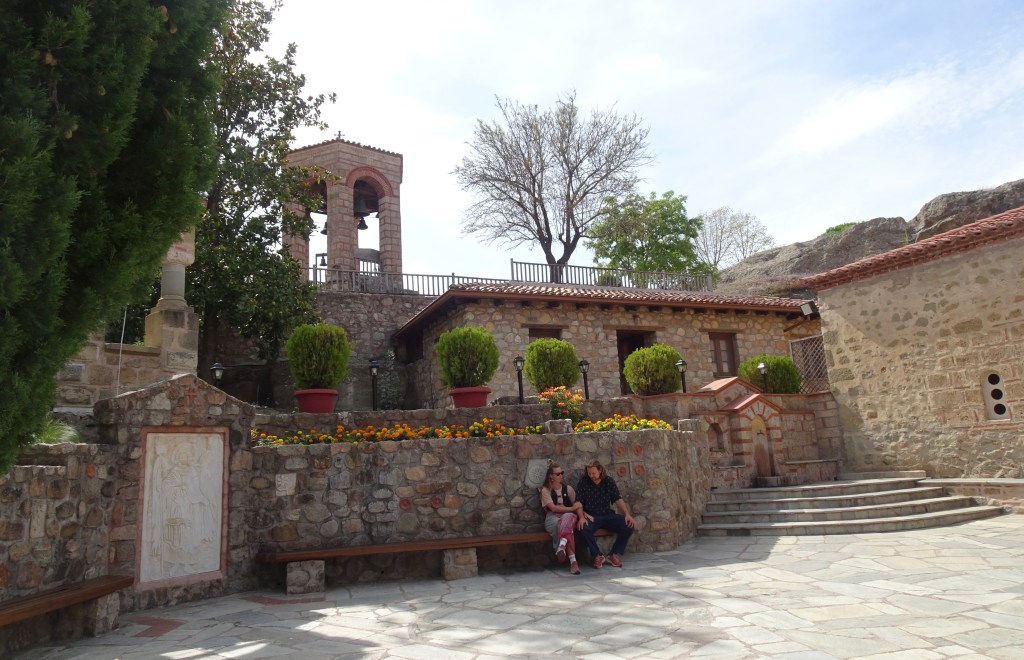
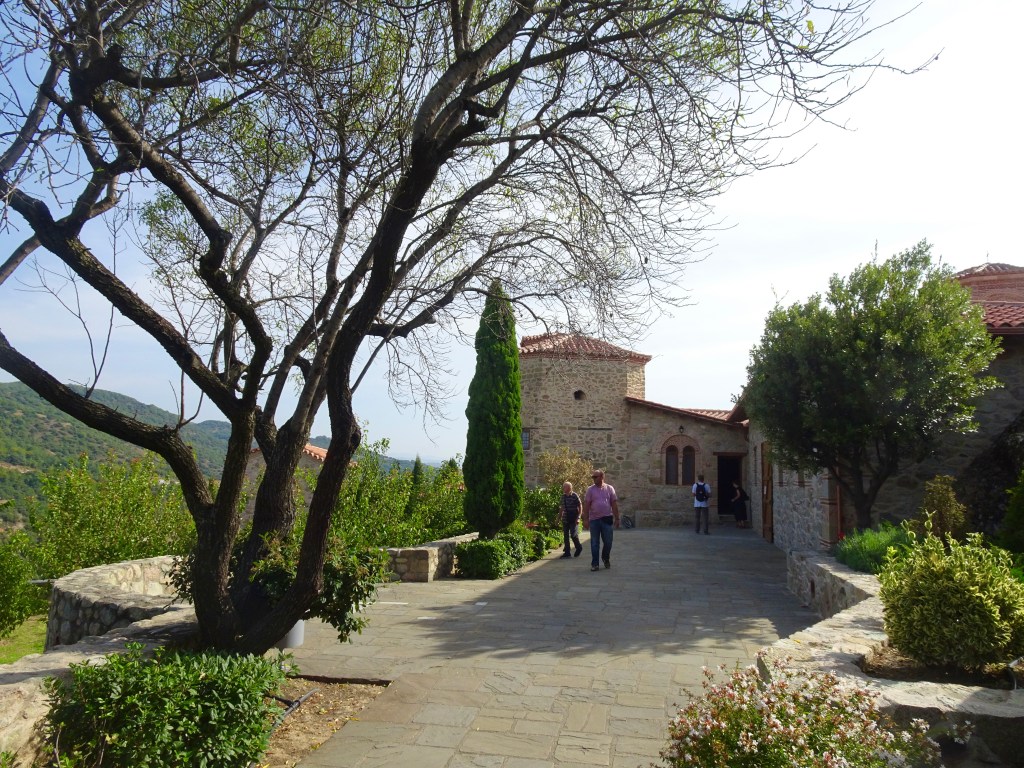
Today, there are approximately 50 nuns and 17 monks still living and working in the monasteries. No surprise that this is a rigorously religious devotion, but have a look at the requirements of a monastic life.
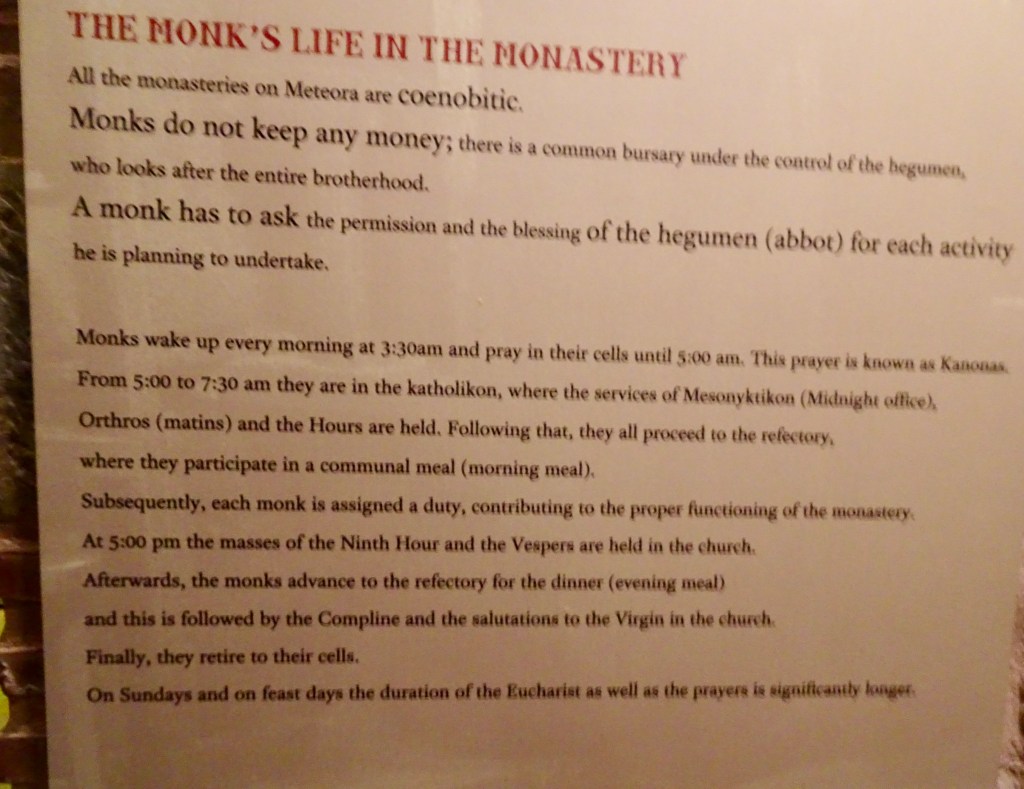
In present day, a monk’s life consists of total obedience to God, to working, studying and prayer. They also strive to offer a living witness of Christ to people who have lost their religious way.
Which brings us to the tourism factor. We are charged a modest three euros to enter each monastery, and required to abide by a dress code which means long pants for men, long skirts for women and no sleeveless tops for either. We are provided coverups if we require them and generally speaking this works well, although we did see a few flagrant rule-breakers and even a gentleman who thought it made sense to bring his dog to a holy place. I overheard a woman ask her friend if she thought there was a coffee shop at the top.
Visiting the monasteries, at least at this time of year, is not a solitary and contemplative stroll. Busloads (dozens and dozens of buses) arrive right at opening hour (9:00 am), and disgorge hundreds of tourists. What this meant, for a couple of the larger monasteries, was being surrounded by tour guides and their charges, clogging the stairs, blocking the view and disrupting the mood.
Our hotel host is not happy about the buses. Most of them come in from Athens or Thessaloniki for a day trip. They leave no money in the towns and do not stay long enough to really learn much about Meteora, other than to scratch it off a list and leave again. As a Greek, he is offended.
I wonder what the monks think of us all, and how the original monks would be stupefied to find out their isolated lives were now being marketed to the masses. We include ourselves among those masses, no superior tourist attitude here, but there is an irony to it all and yet again an example of the negative impacts of tourism, of which we are a part.
All of this to say – Meteora is still a wondrous sight to behold, and we did find many peaceful moments to savour and imagine and be filled with awe.
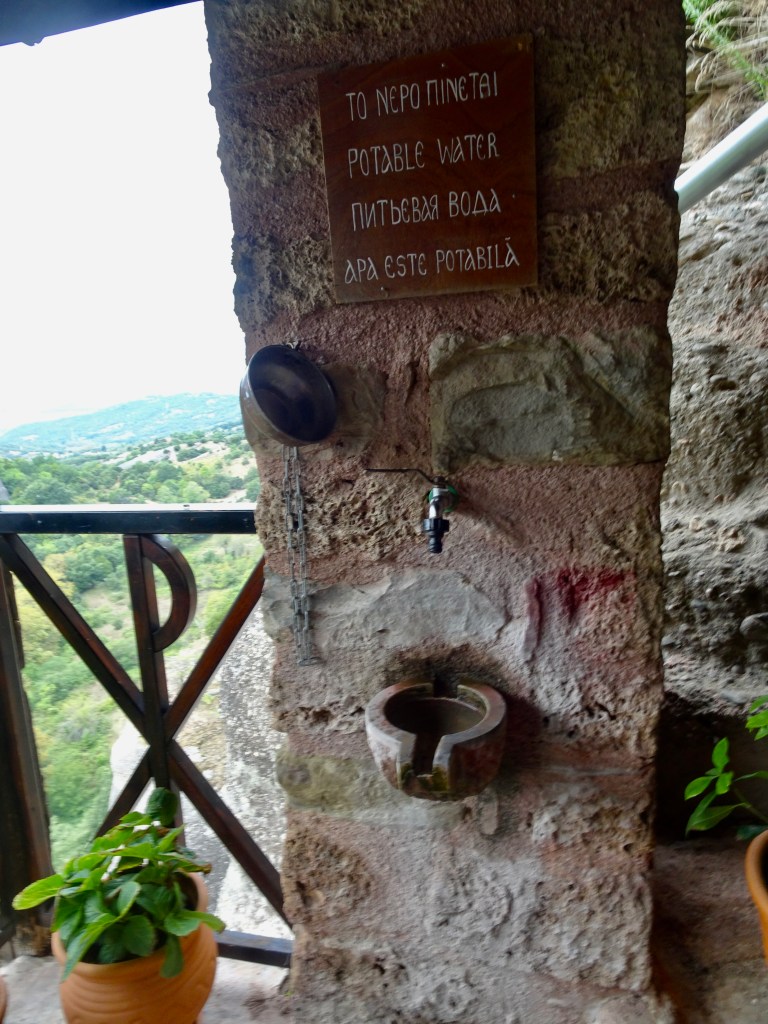
I took a sip of water from the fountain at one of the monasteries – is it holy water? We drank holy water at Amritsar in India after a week-long bout of food poisoning, and honestly felt cleansed afterwards. Maybe this water would possess similar healing qualities? I also threw coins into a well, with good wishes for my family members – might as well hedge my bets.
Another thing to keep in mind when visiting the monasteries is the climbing. Each monastery has between 100 and 300 steps up (and down), so this is not a passive activity. We were happy to have two days to spread out the visits to give our knees a break.
Some more photos to round out the images of this mystical, magical place.
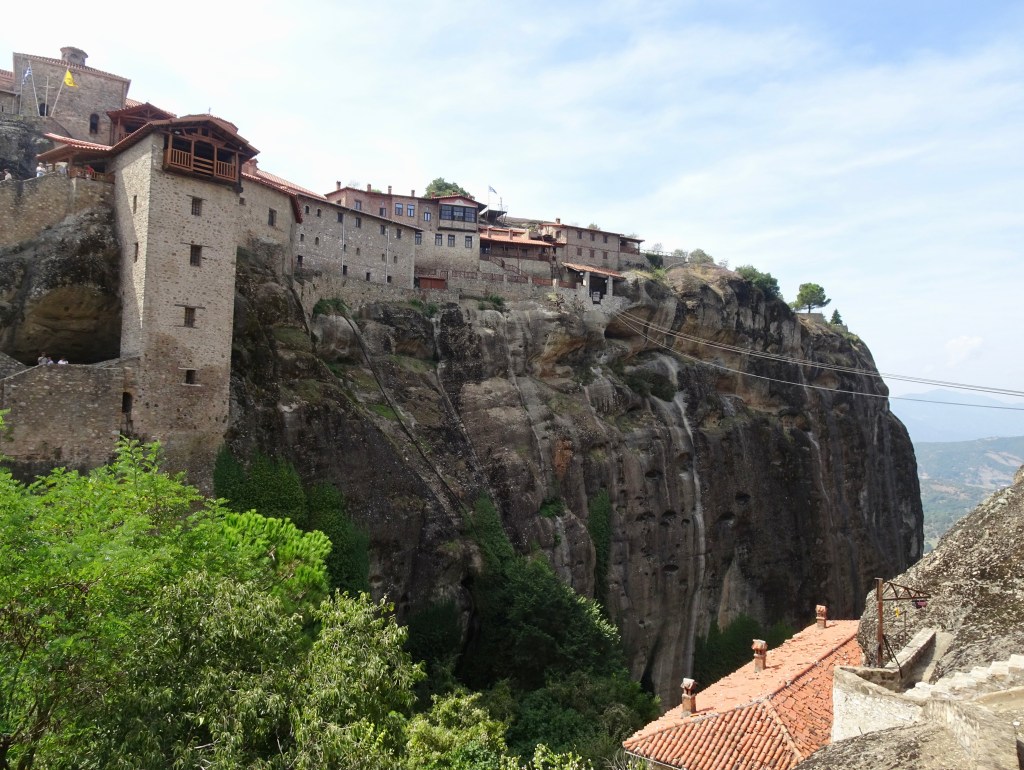
This was a popular photo spot for the too-close-to-the-edge shot that makes my knees weak.
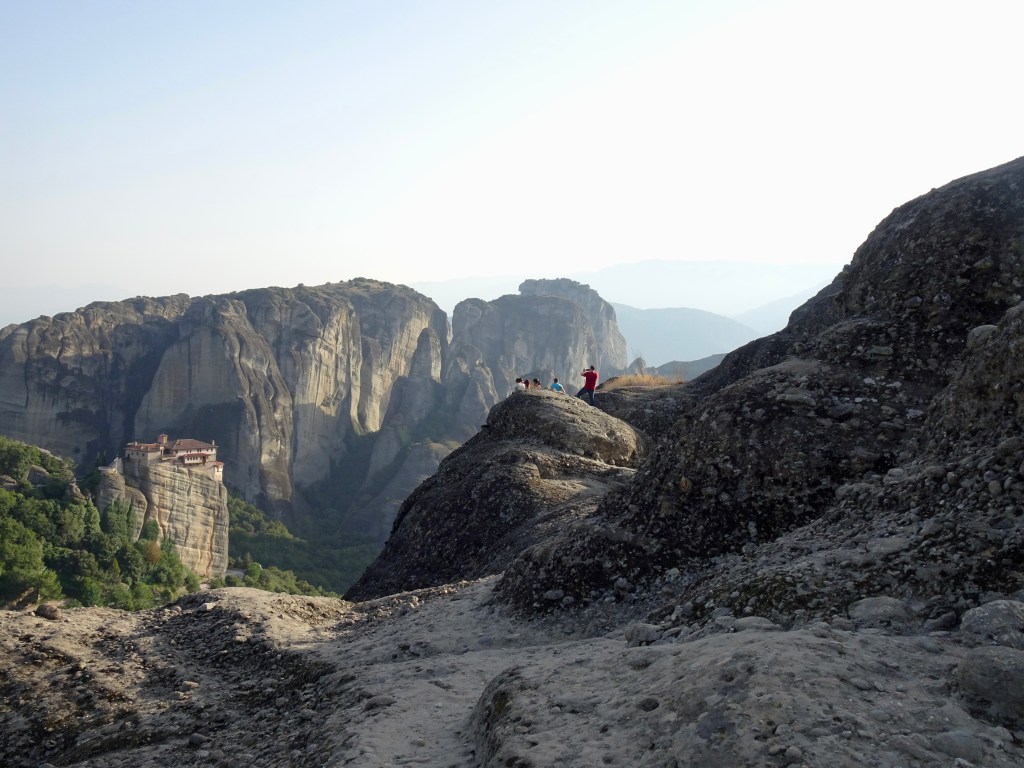
Even with the tourist hordes, Meteora greatly surpassed our expectations. There is no way to adequately describe the place, the light, the spirituality and the almost incomprehensible fact that these monasteries even exist.
Off to Corfu for a week – see you again in a bit.
 Leaving Ourselves Behind
We were there in 2022 – loved it – definitely one for the bucket list!
LikeLike
It’s one of the most unbelievable places we’ve ever seen – we feel so lucky to have been there.
LikeLiked by 2 people
Thanks for sharing. I especially liked the historical recount. I always love reading your posts. Karen
LikeLiked by 1 person
The life of a monk has new meaning for me. However, what a beautiful place to comune with God.
LikeLike
If you could deal with the extreme isolation, and obvious challenges with getting about, to say nothing of vertigo, then I think these monasteries would provide tremendous religious gratification.
The monk’s life is a curiosity, and getting up every day at 3:00 a.m. is just the beginning.
LikeLike
Oh my goodness! What a wonderful experience to see this through your eyes, pics & words. What a site to behold! Have only seen pics of it but to have our friends there in person is something! It is sad about the buses and buses of tourists but it’s like that at all major places isn’t it? Keep enjoying your travels, we sure are.
LikeLike
Very informative blog Mom,
Breathtaking pictures.
LikeLike
Thanks Dan! So glad you’re following along – I think you would have loved this part of Greece.
LikeLike
Another marvellous place to visit!
Happy travels friends!
Danielle
LikeLike
Thanks Danielle – good to hear from you! Do you have any travel planned in the next while?
LikeLike
Yes, I have to go with the flow a bit more, and not immediately go into protective mode when I see crowds of tourists. It is always possible to find a quiet corner to drink it all in.
LikeLike
That place is totally amazing, so glad we can live your experiences in your blog and photos. Keep them coming.
LikeLike
It was pretty incredible, Sharon. At one point, I was standing on the terrace of one monastery, looking out across the valley to another monastery and thought to myself, “I’m in Meteora.”
This had all been just photographs and then I was there!
LikeLike
Considering the life of a mark hundreds of years ago, and the locati
LikeLike
HI Jon, I don’t know what happened here, but your message got chewed up!
LikeLike
love your photos and story, what a beautiiful place. I would love to go there to paint! I can see the concern though about all the tourists….
LikeLike
It would be an incredible place to paint – the light is wonderful. I wish we had been there when there were low clouds – there were photos of the monks standing on the hilltops, with clouds around them and the hilltops peeking through – very atmospheric.
LikeLike
What an incredible place! The monastic life seems kind of crazy at first sight, but when I consider the hours I’ve spent this month crawling along in traffic, or flipping through click bait on my phone, I think they might have a point.
Did you take the cable car up in that one shot? WAY better than being hauled up several hundred feet in a wicker basket, at the end of a long braided rope, in the days before mandatory annual inspections!
LikeLike
Mike, that little cable car is reserved for the folks who transport the goods, as well as presumably the monks. The rest of us climb the stairs!
They did have an illustration of a monk, curled up in fetal position in a net suspended on a pulley, before the cable cars came in. But then when you consider that they built the monastery from nothing and found ways to get up and down before the pulley system was installed, I guess it would feel like a luxury to be swinging up in a net.
LikeLike
What an amazing place.!!! Without you two I would never have known this place or lif style ever existed. Thank you once again for sharing your travels and research…Miss you both
LikeLike
It was a thrill to be able to get there, Nanc, and it went way beyond my wildest dreams.
Miss you too.
LikeLike
I learn so much from reading your blogs, Ginny. I have never heard of Meteora; but, it sounds like a fascinating place to visit if one’s knees can handle it!
LikeLike
Thanks Heather – I appreciate that! The knees take a beating – hundreds of steps up and down and a lot of uneven footing.
LikeLike
I loved this part of the trip to Greece, a long train ride from Athens but so worth it because this part of the adventure was so different from the well known ruins and beaches that get all the attention. Love seeing all your travel posts…Lucinda
LikeLike
Hi Cindy – good to hear from you. We have friends taking their Escape trailer down the Baja this winter, and naturally I thought of you and Bob. Did you ever make a return trip?
LikeLike
Bob has returned every year, even during the times when travel was supposed to be restricted he managed to get there. I was not so adventurous and stayed north with family as travel was restricted . Anyway, when Bob got back in the spring he announced that he was no longer wanting to be in a relationship. So after 20 years, he decided to please himself, abandon commitment and run off to try to be forever young and wild and free in the Baja. Not sure how he can feel good about this in his heart, but it certainly has been a huge challenge for me at 73. so……..I am redesigning what will happen next. it goes to show, you just never know what is around the next corner….but hey at least we all still have “corners to look around” and be curious about so that is good. It is funny that you visited the place that I chose to go to first in Greece as it was so different and It was not a typical beachy place that Bob loves with all the fishing etc…basically he said no, he had never heard of it and we didn’t need to go there.. I really had to insist as he usually made all the travel choices, and booked things before I even got a voice. But….this time was different as we were meeting up with friends in Greece on the island of Tilos and it would not have looked good on his end if they asked about our travels and I mentioned he would not go somewhere I wanted to go so he “let me have my way on this one” anyway he was pleasantly surprised so that was good. Maybe those ancient monks’ spirits got to him! This is your second trip to Greece right? Yikes this went off on a tangent so getting back to your friends and Baja, Bob is always there on a beach or two with his toyota and pop-up camper and fishing gear and ??? Have happy and safe travels.
LikeLike
Very interesting post and as always, very well written. I’m going to pass this on to friend who was a Franciscan monk.
LikeLiked by 1 person
I find all your posts interesting reading. It’s great to follow you on your journey.
LikeLike
Thanks Bill – I think of you and how many hundreds of photos you would take here!
LikeLike
I always dream of going to the places you blog about – Is there any way of getting a wheelchair up to Meteora – maybe special dispensation in the little cable car? Pippa
LikeLiked by 1 person
Oh Pippa – Meteora is probably the most inaccessible place in Greece! Even that little cable car is probably a challenge – I cannot imagine the comfort level required to travel in that little contraption hundreds of feet up in the air!
LikeLike
I didn’t think I could be wowed anymore than I already was, but this place place is beyond believable. I’ve run out of words to describe the beauty you have experienced. How fortunate you both are ti have had the opportunity. Stay safe. When do you head home!
I’ve been delayed reading your blogs so maybe you have headed home. J
LikeLike
I think Meteora has to top the list of “indescribable, there-are-no-words” kind of places. Our trip is almost over – we leave tomorrow for two nights in Frankfurt before we fly home on the 23rd.
It’s been a great trip, but ‘m ready to get back home – missing the grandkids terribly and I have to stop eating ice cream every day.
LikeLike
hi thx so much for your blog
We are visiting early June before heading to Corfu
would you recommend Kastraki over Kalambaka ? We are considering 2 nights. Haven’t considered car hire yet though sounds like you need it ?
LikeLike