The Llogara Pass has also made the list on Dangerousroads.org but I think calling it “dangerous” is possibly overstating the case. This 31-km. high mountain pass that follows the coast from south of Vlora to Dhermi is a road that demands attention, but most people lucky enough to take this trip give the road the respect it deserves.

It began back in 48 BC, as the reputed route that Julius Caesar took during the Roman Civil War. In all the years since, the Llogara Pass was in pretty rough shape and impassable in parts, which meant that some coastal sections of Albania were quite isolated.
As recently as 2009, this road could truly be classified as “dangerous” – very narrow, single-lane in parts, missing guardrails and with the road surface either dirt or crumbling asphalt. Today, it is fully paved, well engineered and offers up several wide lookout points to take a breather and snap a few photos. At several points there are small restaurants and stands set up selling honey, herbs and local wine.
It was not heavily travelled when we drove it, but we shared the road with slower-moving buses and trucks. It is almost non-stop switchbacks, with very few opportunities to pass, so if you are stuck behind a truck, it’s best just to relax and enjoy the view.
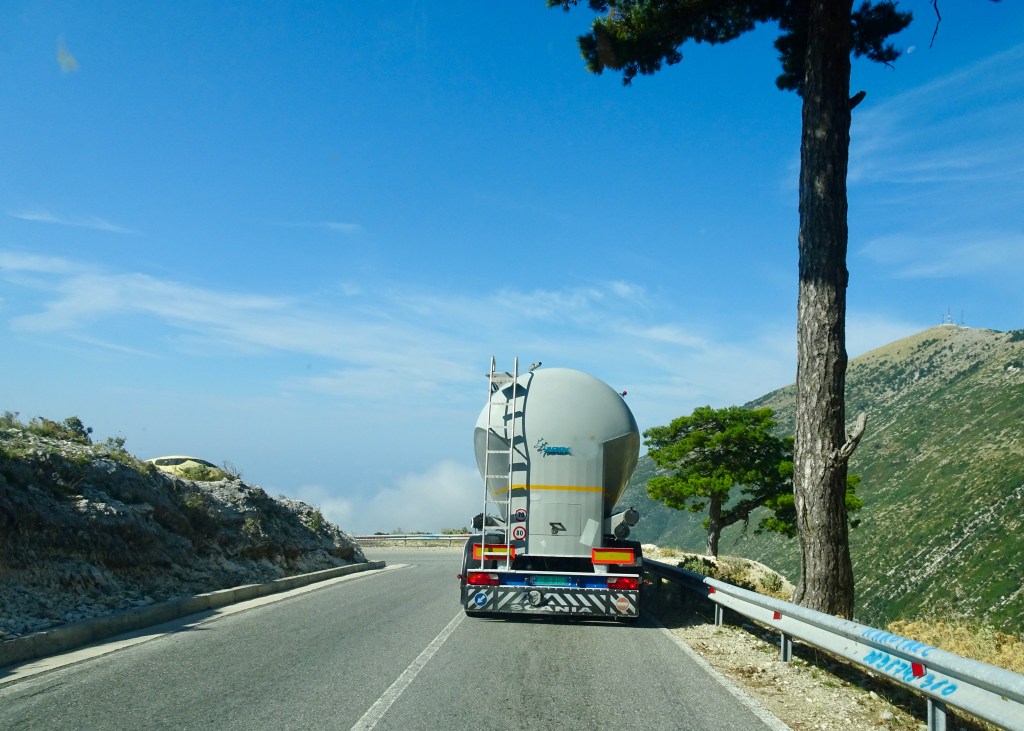
Although visibility on the road was good, low cloud cover partially obscured the views to the coast below. At the summit lookout, we pulled off with the hopes of having a better vista, but it was not to be.
An unexpected bonus was seeing this couple setting up to paraglide. It was quite fascinating to watch. They had strips of fabric tied to a shrub to gauge the wind direction and twice tried to get the lift to take off. Finally – success! Stephen caught this on video and we talked with the husband later. He was quite delighted for his wife, as on a clear day the thermals would have lifted her up. As it worked out, she set off on a leisurely sail across the clouds, with a slow descent – ” the perfect trip.”
Just as the paraglider was having the perfect trip, so were we. An example of the road and elevation below ( summit – 1043 m.)
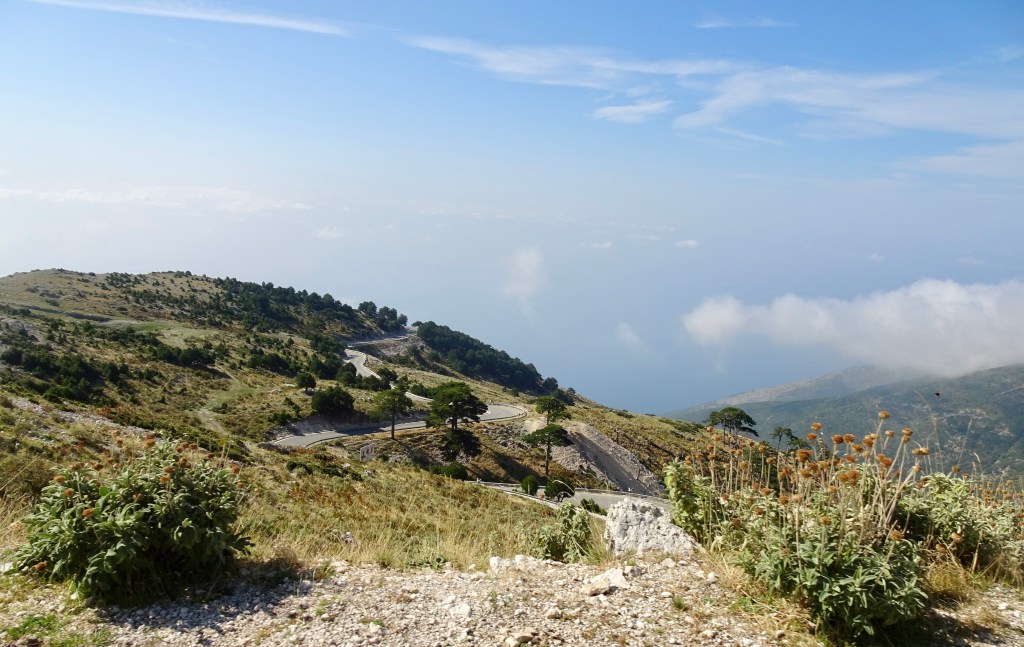
The road went from switchback to a slightly softer grade, as we slowly made our descent.

Civilization began to emerge, with houses here and there and then small mountain villages. When we approached this village, we cautiously drove down this narrow stretch of road, saying to ourselves, “I wonder why there is a red light here?”
Luckily no harm was done as we met up with the driver who was rightfully making his way through and was quite understanding at the sight of befuddled tourists. We backed up, let him pass us with a wave and an apologetic smile and waited for the light to turn green. Apparently red lights are the universal signal to stop, even when they appear in unexpected places.

On the other side of this curve, the road widened to two lanes again. We pulled over to have a cool drink at a small cafe and chat with some good-natured French tourists. I tried out my rusty present-tense, conjugating-verbs-in-my-head French on them and they seemed to understand me. They found out we were from Canada and we found out they were from Brittany, which prompted me to tell them the name of my friend from Brittany, in the highly unlikely event they might have met her decades ago.
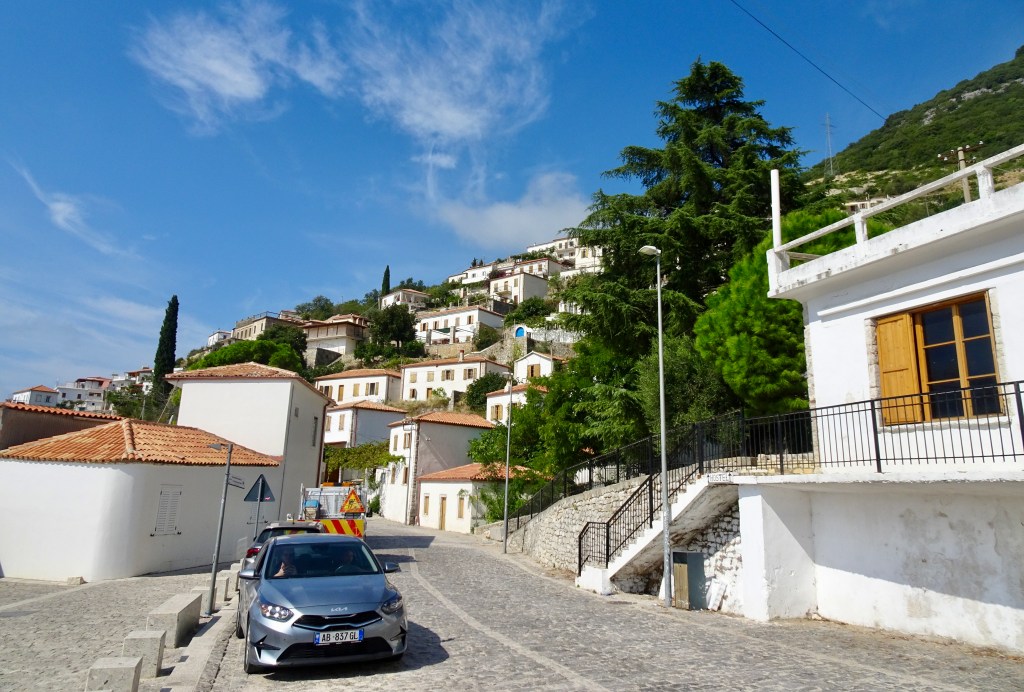
So…our mountain adventures over, we drove into the small beach town of Ksamil (pronounced Sam-ill). We chose to come here for a couple of reasons. Ksamil was supposed to have one of Albania’s best beaches (rivalling those of the Maldives), and is called ” the pearl of the Ionian Sea.”
This was our view as we approached Ksamil.

The town of Ksamil ( roughly 10,000 pp), hugs the beaches and bays and climbs up the hills. It is neither pretty nor homely – rather it is a tangle of streets filled with hotels, more hotels, and hotels being built.
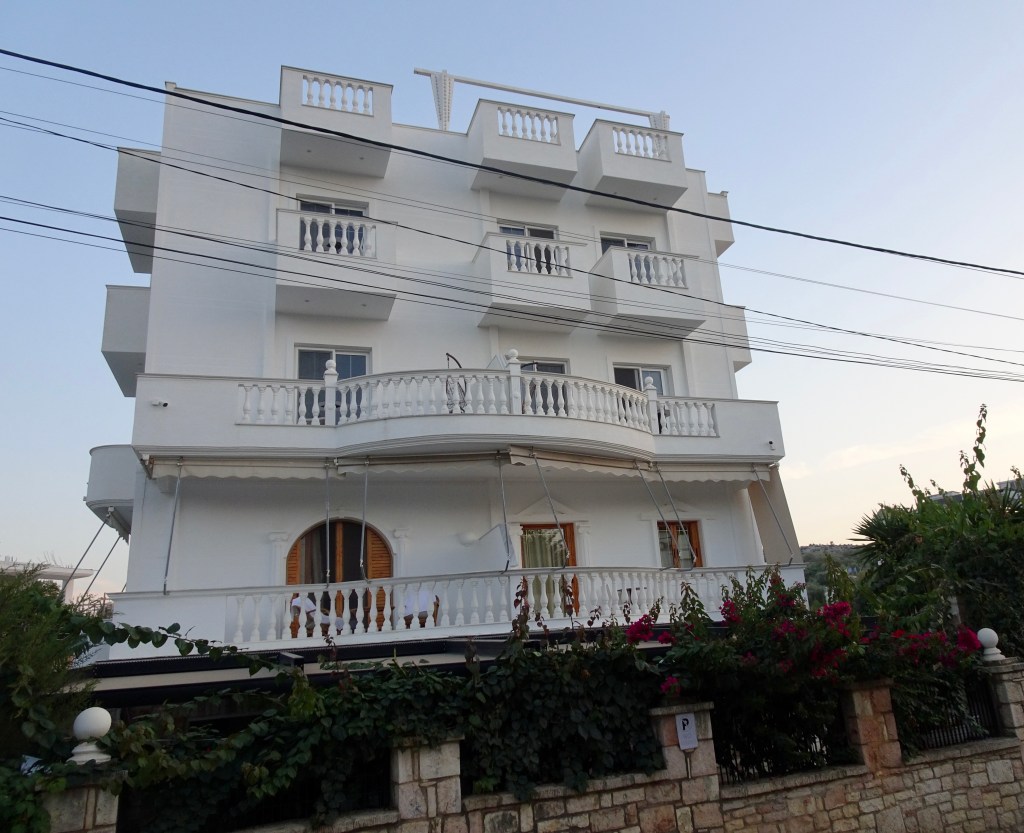
This was our hotel – the Vila Vasaliu, a block from the beach, where we were treated to the warm hospitality of our host Yani and his parents. Our hotel was recently renovated, spotlessly clean and offered up a huge buffet breakfast each morning – all for $70 a night.
Ksamil in high season is where Albanians come to play, and while the season is almost over, the beach clubs are still pounding music and charging high fees for sun beds. We were expecting the same calm, mellow turquoise perfection we found in the beaches in Greece, but unfortunately, the main beaches were spoiled for us by the noise and the somewhat tacky carnival atmosphere.
It’s a shame, because the setting around the beaches and bays is so gorgeous.

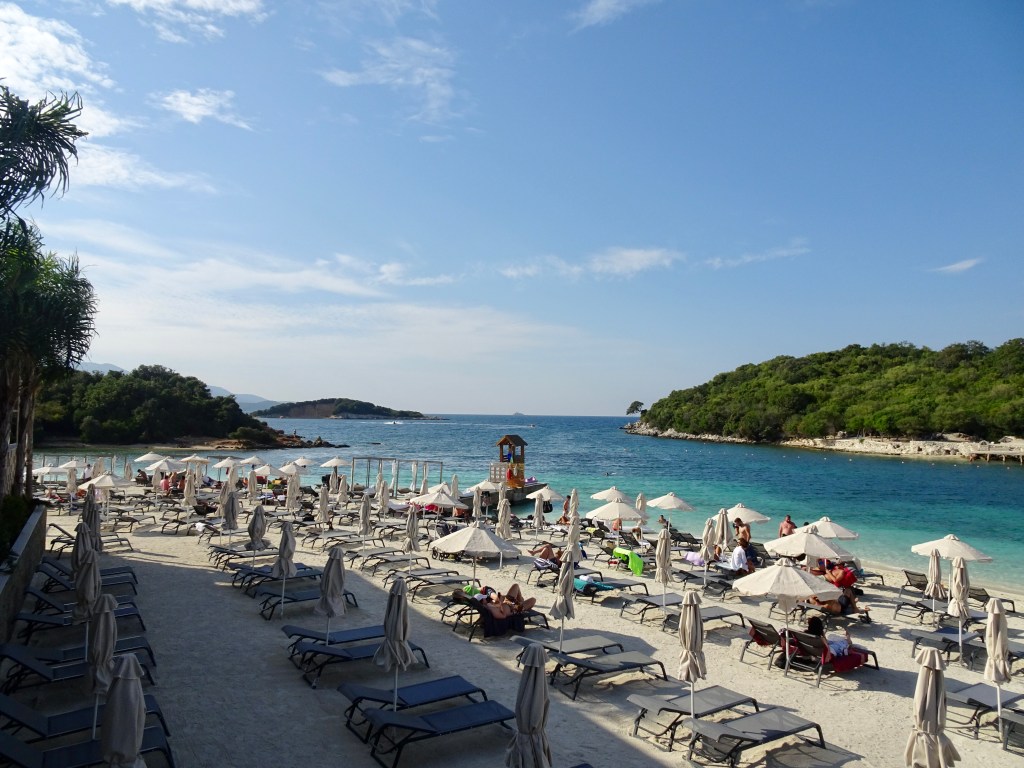
We did find a beach called “Last Bay”; accessed by a dirt road and although there were no amenities, it was quiet and peaceful, with about 20 or 30 other tourists. The water was clean and clear and exactly what we were looking for.

Unfortunately, Albania has a significant problem with trash on the streets and on the beaches. We’re not sure why there are not more garbage cans around, but at this point, there is not a mentality to pick up after oneself. We see signs asking people not to litter, but they seem to go unheeded.
These cans were on the way to the beach, and this is not an uncommon sight.

Although we found Ksamil a bit scruffy, we can also see signs everywhere of changing and sprucing up. Ksamil is a victim of its own success; it will always be a hugely popular beach holiday destination for the many people who want the excitement and the buzz. Perhaps the beaches further north might have been a better bet for us.
However, the other reason we wanted to stay here was to visit a couple of nearby sites – primarily the Butrint Archaeological Site, which was designated as Albania’s first UNESCO World Heritage site in 1992.
As much as I try, many archaeological sites don’t impact me the way I know they should. I stare at crumbling piles of rock, and try and fail to imagine what went on thousands of years ago. I don’t see small villages and industry and homes and lives – I see rock.
Butrint, which dates back to the 8th century B.C., was instantly impressive, as a lot of the site has been preserved and restored. It is also spread out over a very large area; it is easy to spend a few hours here. Also – big bonus – the setting by the estuaries, surrounded by massive trees and plenty of shade, really enhanced our experience. No trudging under a blazing sun in shades of beige. Butrint has also been awarded the RAMSAR, in recognition for its wetlands which are of international importance. With those wetlands come over 800 plants and 246 species of birds.

Butrint is surrounded by water, so frequently the paths would lead to scenes like this one.

A chapel.
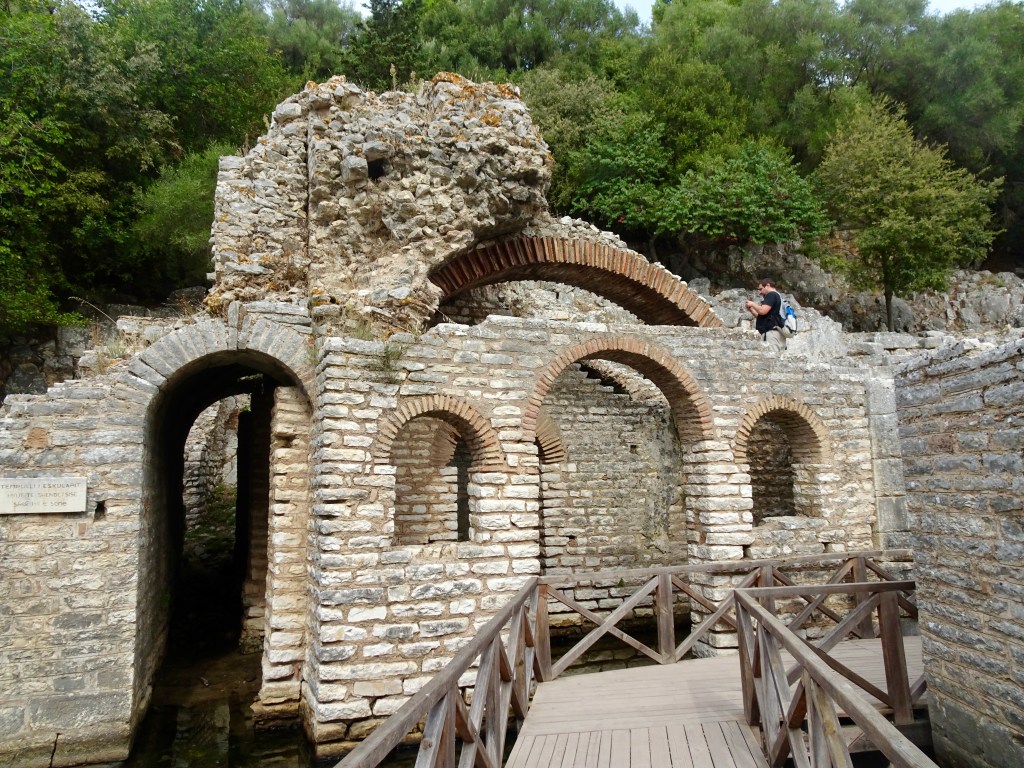
The baptistery from the 6th century.

The Great Basilica

The Venetian castle of the 14th and 16th century, reconstructed in the 1930s. This castle also houses the small museum, which outlines the chronological history from the Bronze Age through Roman, Byzantine, Venetian and Ottoman cultures.

After a very interesting and satisfying stroll through ancient times, we emerged to see this sight. A cable ferry crosses the inlet, carrying what appears to be just two vehicles at a time to another Venetian Castle.

The other site we were interested in seeing was the “Blue Eye.” This natural phenomenon occurs in a cold water spring that bubbles up at least 50 metres from a karst hole, creating a vivid blue colour in the shape of an eye. The water in the river around Blue Eye is crystal clear, bright green and blue and ice-cold. People wade in (despite signs asking them to stay out), but when we visited, there were no swimmers.

As these things go, it was somewhat underwhelming, but the entire experience was completely enjoyable. A beautiful 40-minute drive from Ksamil, a 20-minute walk from the parking lot, a delightful chat with an Albanian family visiting from Tirana, and the walk in the woods to see the Blue Eye.
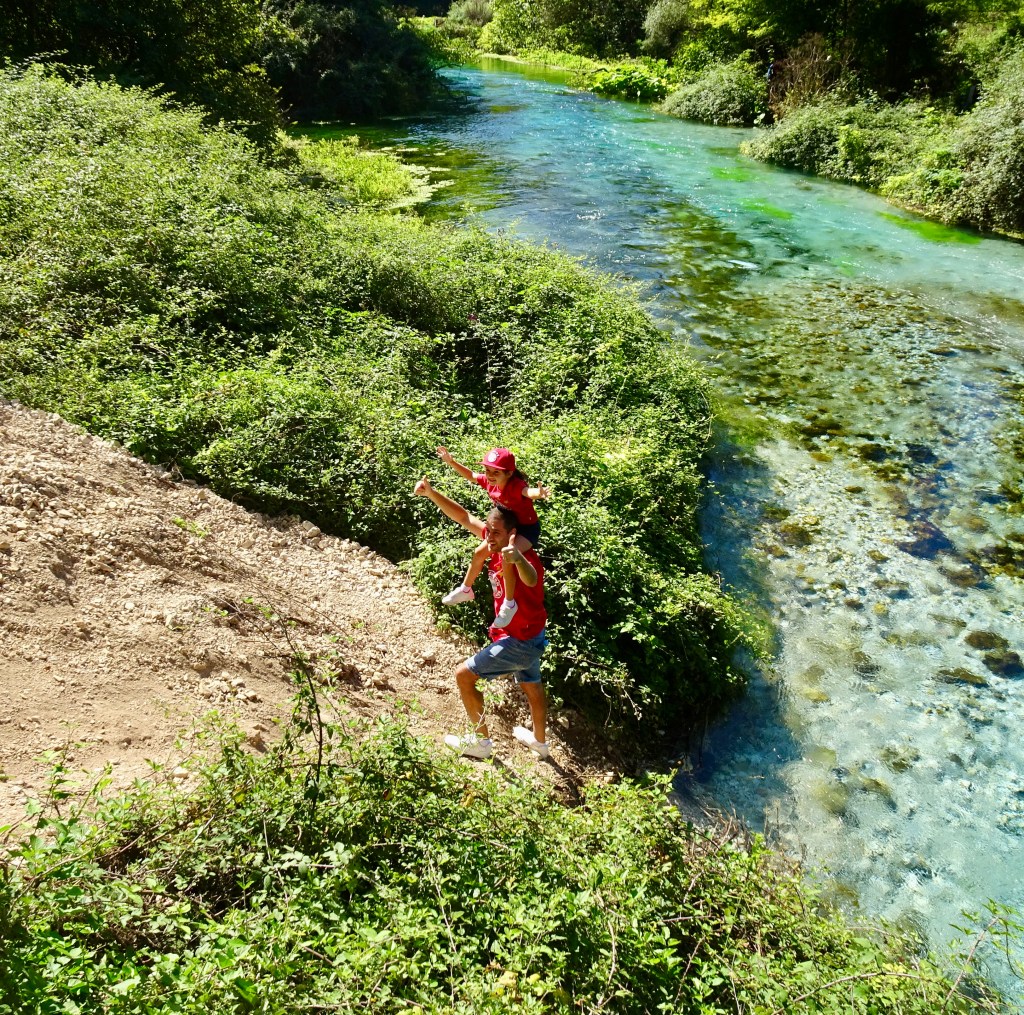
We watched a father walk his daughter down the steep grade to the river, hoist her on his shoulders for an photo op. (Thinking to myself, ” this is something a father would do.“)
We had two Italian orange sodas, sitting in the shade, overlooking the icy river. We watched a huge bird on a stump that no-one was able to identify.
We walked back to our car, and on the drive home, we stopped for these guys. One cow was holding up traffic by standing in the middle of the road, peeing for what seemed like a full minute.

And sometimes those are the best days, filled with moments you can’t plan. Our time in Ksamil was not what we had anticipated, but it gave us little pieces of Albania we will remember.
And now, we begin our drive north into the mountains, beginning with Gjirokaster, the city of stone.
 Leaving Ourselves Behind
Travelling in long-settled areas always makes me wonder how different people were all those years ago. Not that much, I bet – sure, no wifi, but maybe dads hoisting kids to their shoulders in perilous spots for a lengthy sketch to bring back from the holiday, bathers hogging the best spots at the beach, litter. One of the imponderables, as you’d say.
Thanks again for an interesting blog – I’m looking forward to the next one!
LikeLike
Thanks Mike! Yes, no way of knowing what leisure time looked like back then. I’m guessing they weren’t wondering whether their equivalents of Travis and Taylor will make a go of it.
LikeLike
Very interesting. Julie and I are really enjoying your blog.
LikeLike
Thanks Bill – I’m glad to hear it. Your name has come up numerous times on this trip – how much you would find here to photograph.
LikeLike
I’m always impressed by the fact that the two of you don’t allow trepidation to get in the way of your adventures. The Llorgara Pass is one such example. Some might forgo the drive but just think what they would be missing!
LikeLike
Having a paved road with regular lookouts with nice Albanians selling fruit and cold drinks helped to normalize the drive! If we had been here when the roads were still gravel and without guardrails, nothing could have persuaded me to take that risk.
LikeLike