We were beginning to wonder if all the rave reviews we had read about Albania were exaggerated. We had an image in our minds of Albania (medieval villages, narrow cobblestoned streets, olive groves and vineyards) that we just weren’t seeing until we left the frenetic beach scene of Ksamil, drove up into the mountains and arrived in Gjirokaster.

Gjirokaster, called the City of Stone for obvious reasons, has its origins as far back as 1336. Like the rest of Albania, this area has been under ongoing siege, but its main influences happened during the Ottoman period, which is reflected in the architecture . By 1670, there were 2000 homes, eight mosques, three churches, and hundreds of small shops – all built in and around the imposing castle that overlooks the city. It has not grown that much over the centuries – today there are only 20,000 residents.
Before I go any further, let me tell you about our arrival. Our GPS brought us to a street with a no-entry sign. Was it a road or was it a pedestrian-only path? We called our host, who assured us that we were fine to go ahead and drive straight up that narrow, single-lane road. Although Stephen said he was comfortable, I was mildly terrified. Driving here is not for the faint of heart. With a couple of exceptions, all streets are narrow, nearly vertical and constructed of limestone that makes your tires squeak as they endeavour to gain traction.
We are staying at Lula Guesthouse, a delightful apartment with a sweeping valley view and uncertain parking. The day we arrived, we were in luck – one of the potential four spots was open and our host directed us in and placed a large rock behind, so we wouldn’t do a Thelma and Louise in reverse over the open ledge to a drop hundreds of feet below. If that spot hadn’t been open, it’s not clear where we would have parked.
Our apartment door. Our parking spot is further down the street, out of view in this photo.
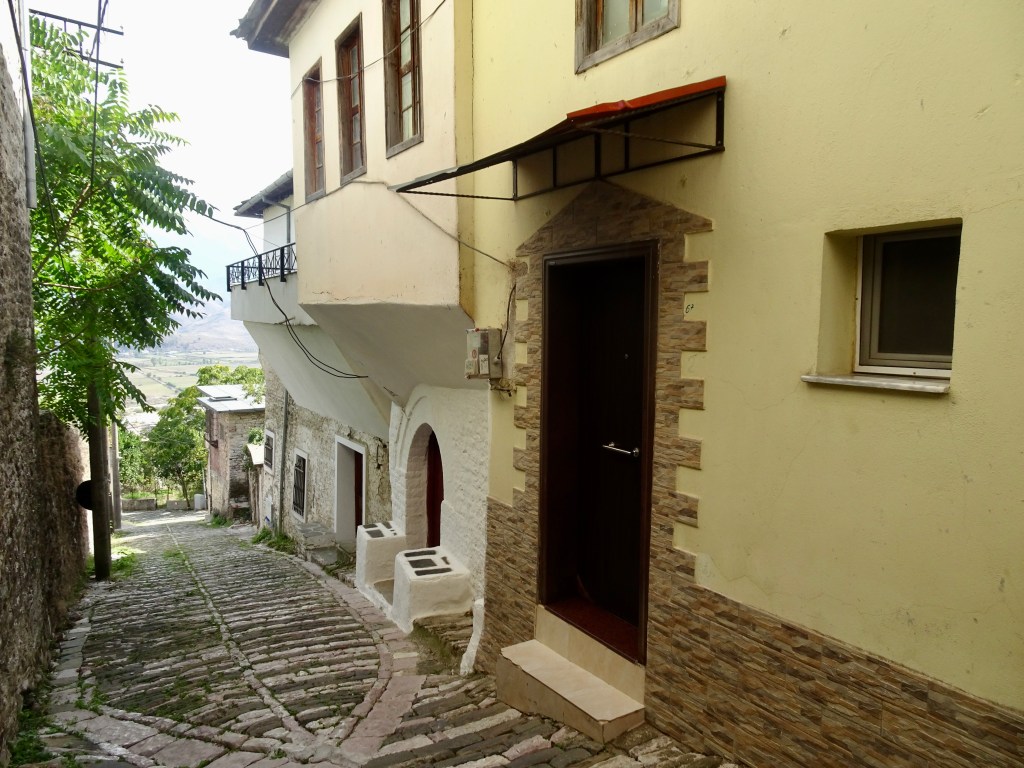
The view uphill from our place. To reach every attraction in town, we walked uphill for about 10 minutes, and then uphill and downhill for the rest of the day. Good legs, good lungs – the reward for all the climbing.
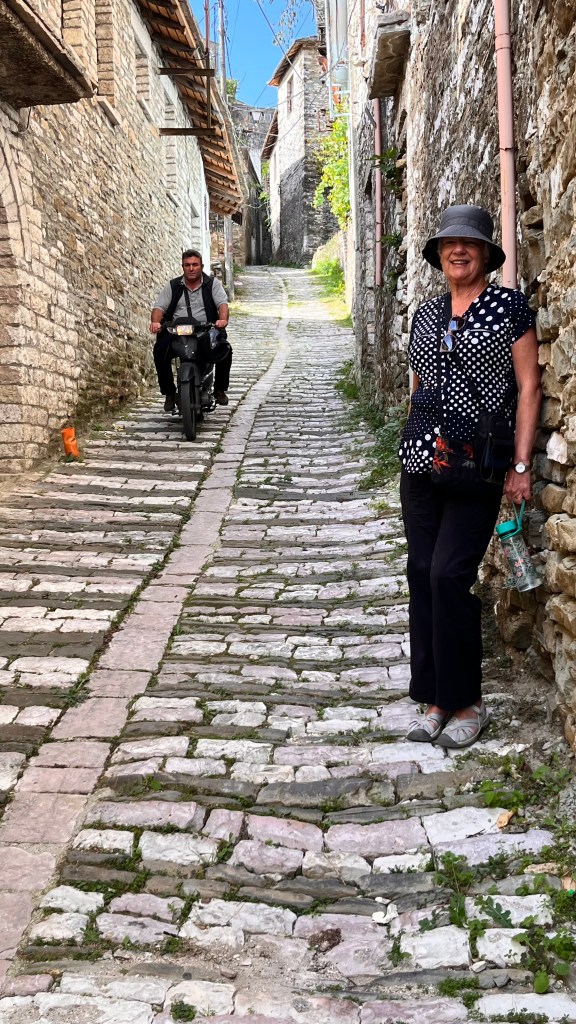
Another street view, of Stephen making his way home.

And, not to belabour the point, but this is the width the local bus has to deal with as it makes its way up along the upper streets in town.
Also, if you notice the cobblestones alternate between black and a pinkish-white. The design is deliberate – if it is raining, the best advice is to walk on the black stones as they have better traction. The lighter stones are attractive, but slippery. Luckily for us, we did not have to drive nor walk in the rain.

Gjirokaster consists of Old Town and New Town. New Town is made up of nondescript apartment buildings, autobody shops, large grocery stores and most commercial outlets. Old Town is the City of Stone, the original city built around the Castle, and the area where all the attractions are located. Homes were built centuries ago from locally quarried limestone, and many roofs are made of slate. Each slab is laid individually, then layered, being held in place solely by their weight. You can see the roofs in the photo below; built to last.

The streets and pathways are similarly impressive. Some have existed for centuries.
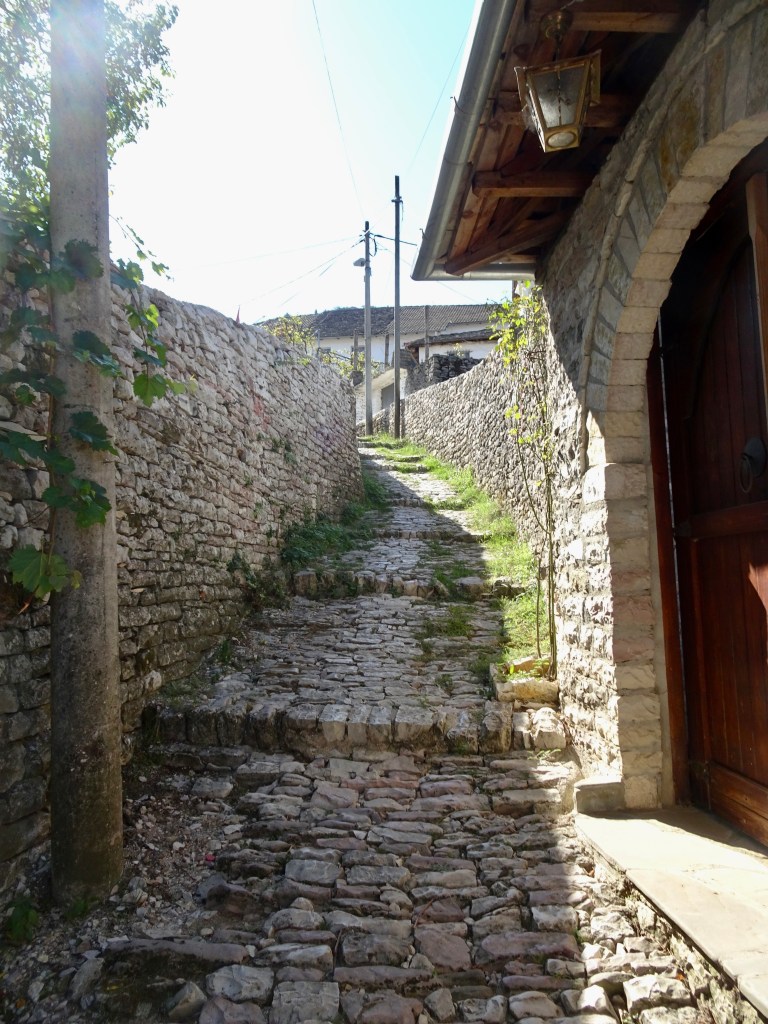
Most of the streets in Gjirokaster may appear old, but have only been in place during the communist era. Between 1960 and 1980, a team led by a stonemason named Simi Lukani laid over 60,000 square metres of street, much of it with involuntary labour.
Gjirokaster’s history is firmly imprinted with a history that was at times, quite sinister. This is the birthplace of Enver Hoxha (pronounced Hod-ja), the paranoid despotic leader who held Albania in his grip for over 40 years. During his reign, he created an 800-m. bunker, with 59 rooms, (and just three bathrooms), to shelter the Communist party elite from what Hoxha considered to be imminent atomic attack.
We took a tour with an incredibly well-versed and passionate guide, who warned us that touring the tunnel might be claustrophobic. This was the entrance.

The tour lasted about 25 minutes, and I’m not going to lie – it was not my most comfortable time here in Gjirokaster, especially since the gate was locked behind us once we entered.
Although there was ventilation, there was not one window and no natural light. The idea of the shelter would be to store enough food and water for three months, and as our guide explained – every three months, the stored food was removed and thrown out and a new store of food was brought in. Every three months – for 18 years, while much of the local population was starving.
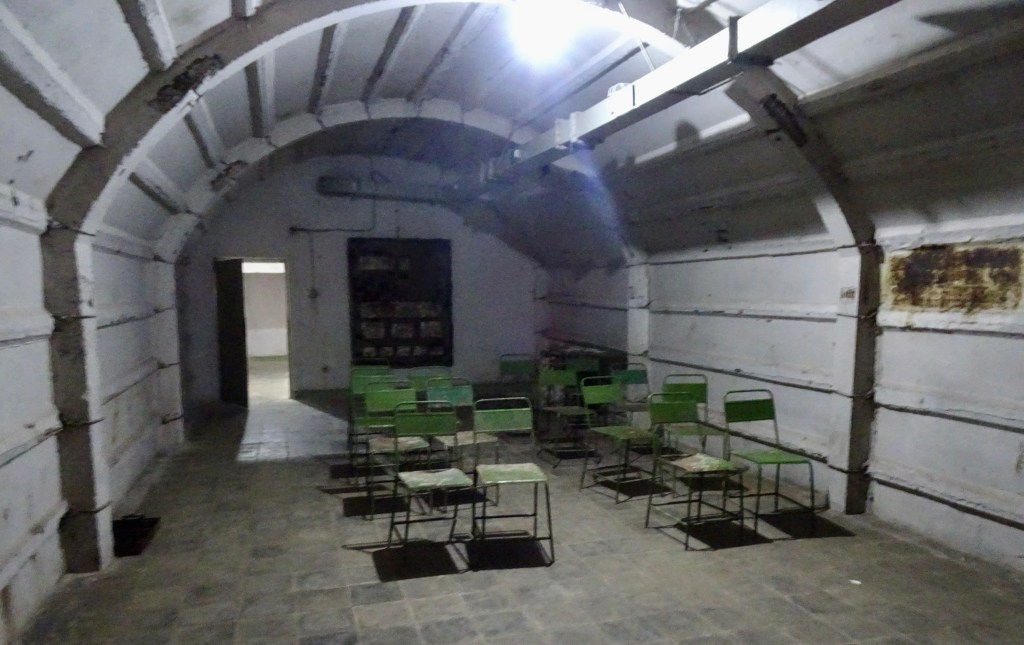
A view of what life would be like, in a bunker with Enver and his pals.

Once the regime fell, this bunker was looted, and very little remains today, other than a few tables and chairs. This was a gathering place, with blackboards on both sides of the room; presumably to plan life in the post-apocalyptic world they would enter once supplies ran out.
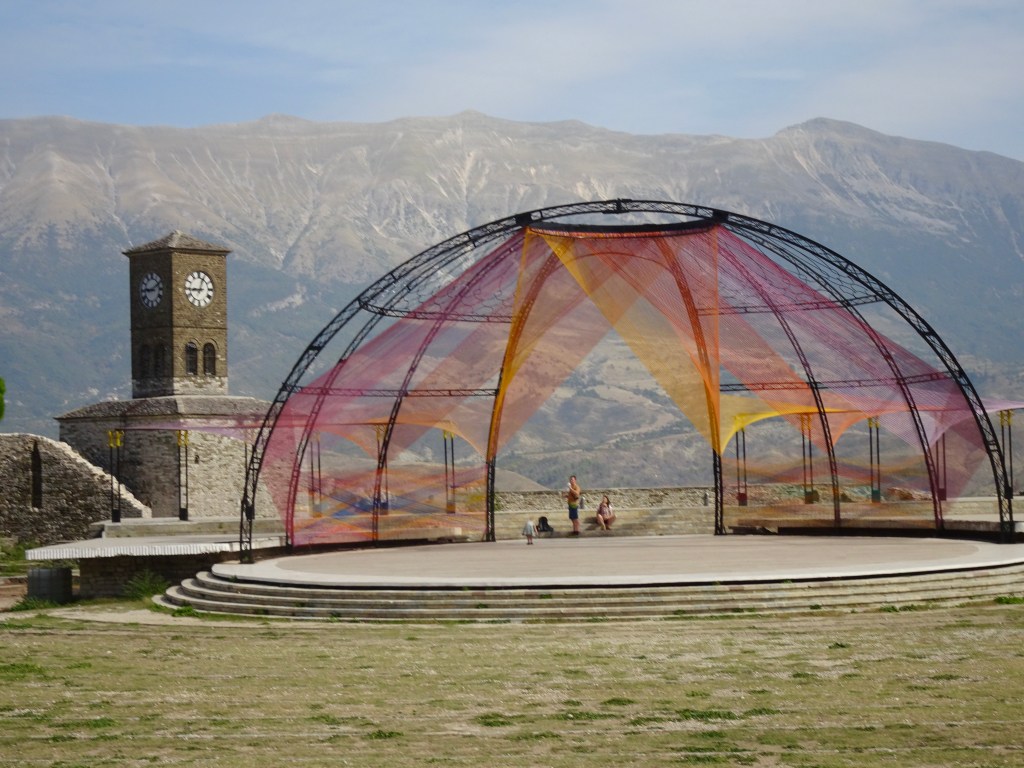
Moving from the not-too-distant past to the 6th century, we climbed the hill to visit the Castle, which dominates the town, rising 360 metres and measuring 500 metres in length, and contains both a museum and Albania’s most notorious prison.
First the grounds. The grounds within the castle walls used to contain houses, but now the field is used for festivals and presentations.
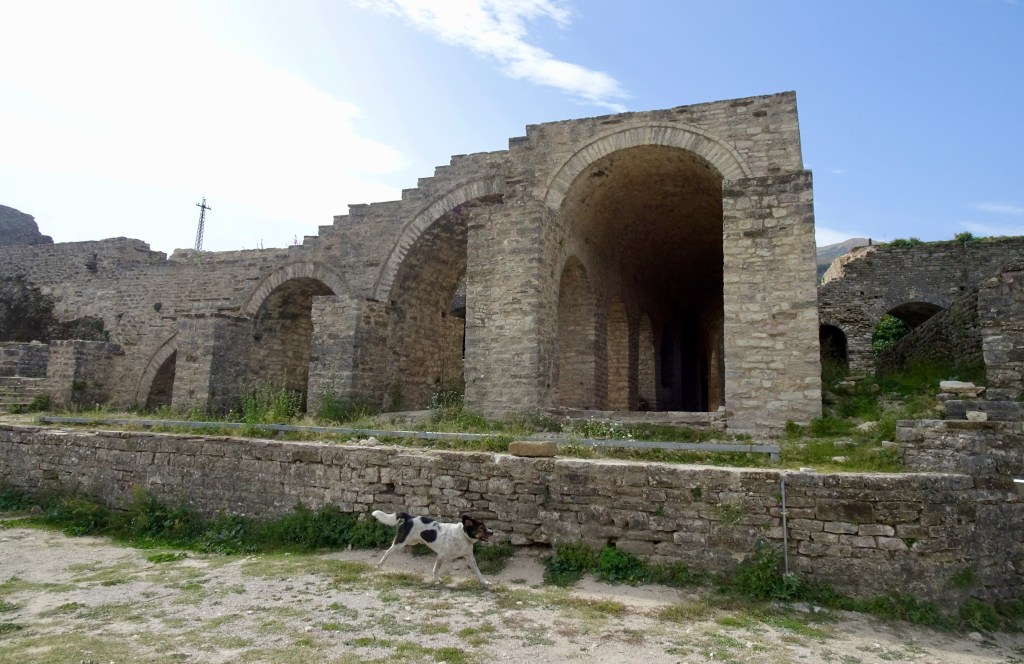
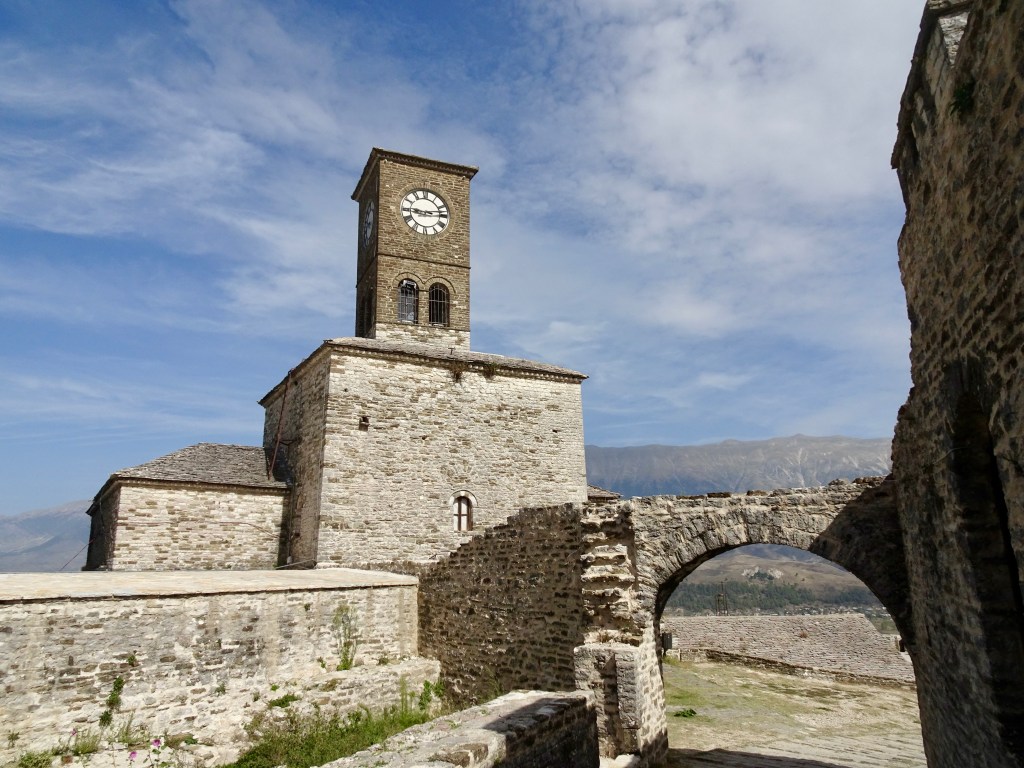
We toured a very interesting museum that provided a wealth of information about Gjirokaster’s history, both in Albanian and English. As well, we toured Albania’s most notorious political prison, in use up until the 70s. There was no English translation, but this plaque helps to explain the anguish suffered within these walls.

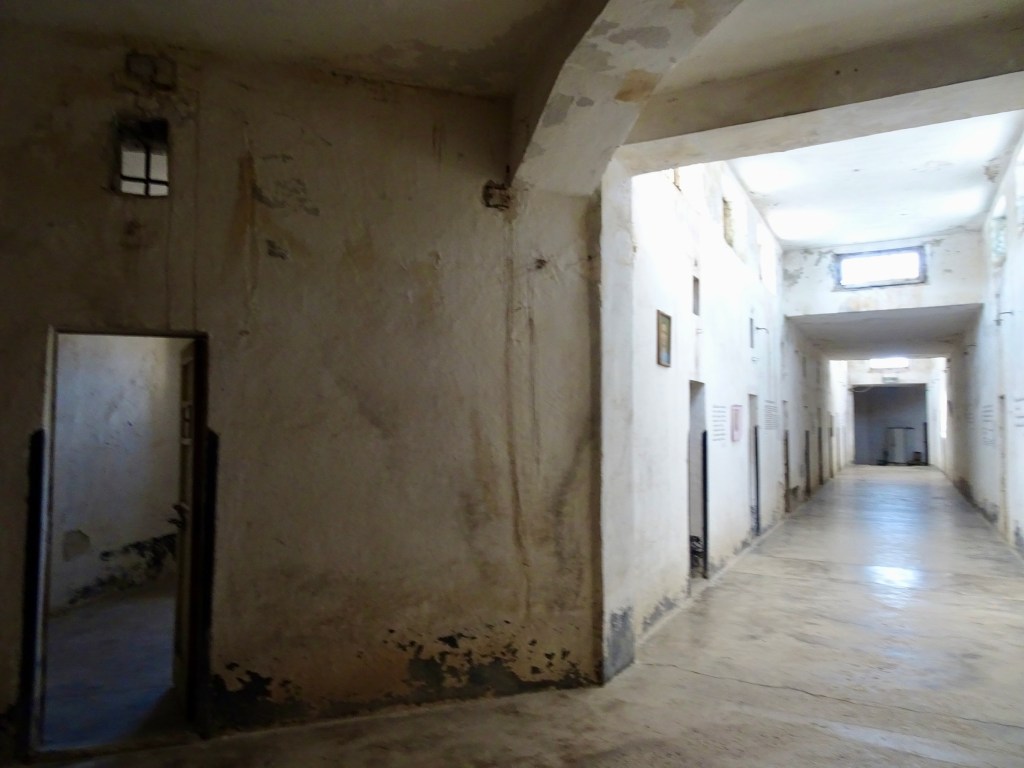
One of the cells, with prisoner’s writing scrawled on the walls.

Enver Hoxha was born in Gjirokaster in 1908 and his family home burned to the ground in 1916. In 1966, Hoxha had a far grander dwelling built on the site of his former home, and pronounced that to be his birthplace. The current building now houses the Ethnographic Museum, with clothing, furniture and artifacts to show how well-born Albanians lived in the 19th century. One room does describe how clergy were murdered during the Hoxha regime, but there is a propaganda reel running in one room, showing Hoxha moving among adoring crowds.
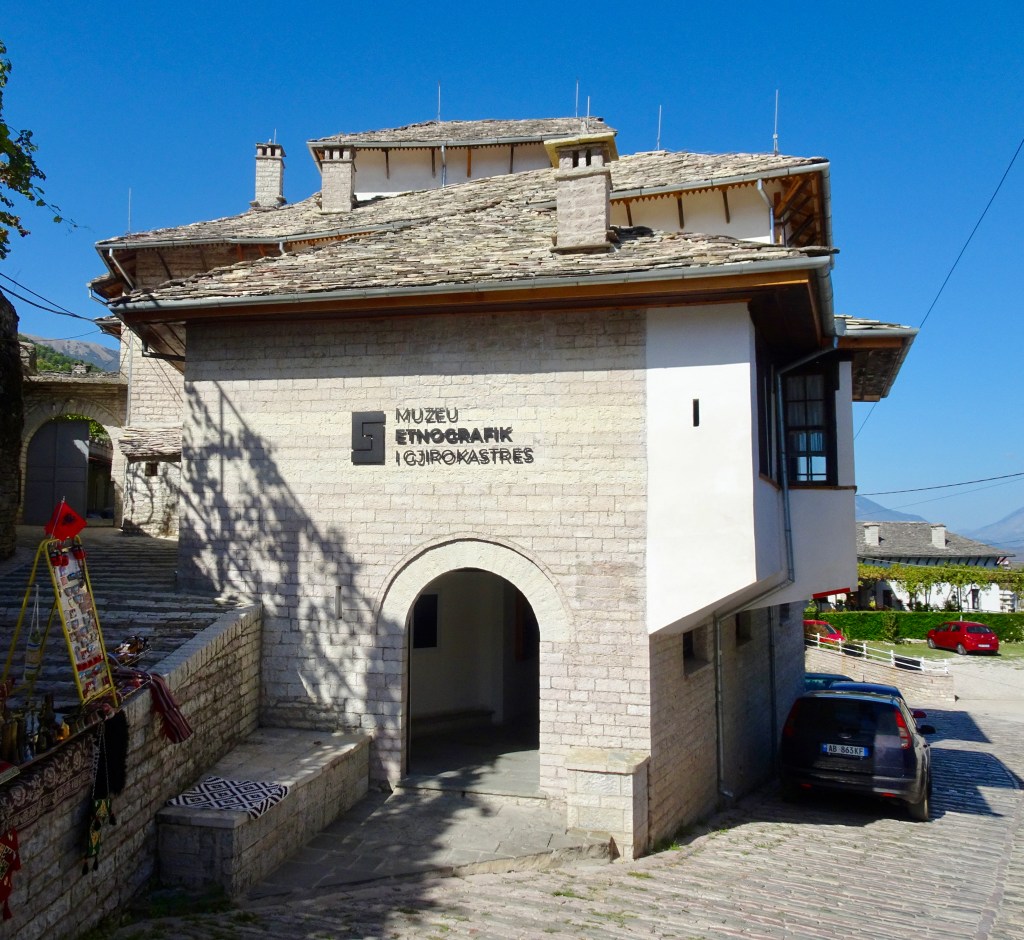
There are several significant homes in Gjirokaster that typify the architecture of the town, and in all cases, belonged to wealthy families. These homes were seized during the communist regime, repurposed during those decades and then returned again to their rightful owners after the fall of communism.
The Skenduli House was fascinating to tour, thanks to its 11th-generation owner, Naskip Skenduli, who conducted the tour in French (which I mostly understood). He pointed out the many windows (64), led us through the common rooms, kitchen and bedrooms and talked about the hidden staircases, cisterns, ingenious toilet design, etc. He was forced to leave his home for four decades, and although he returned after the fall, he does not currently live in the house – it operates solely as a museum.

Similarly, the Zecate House – a well-preserved example of a tower house.

The Fico House – a little unusual because of the colour, and it was built much later – in 1902.
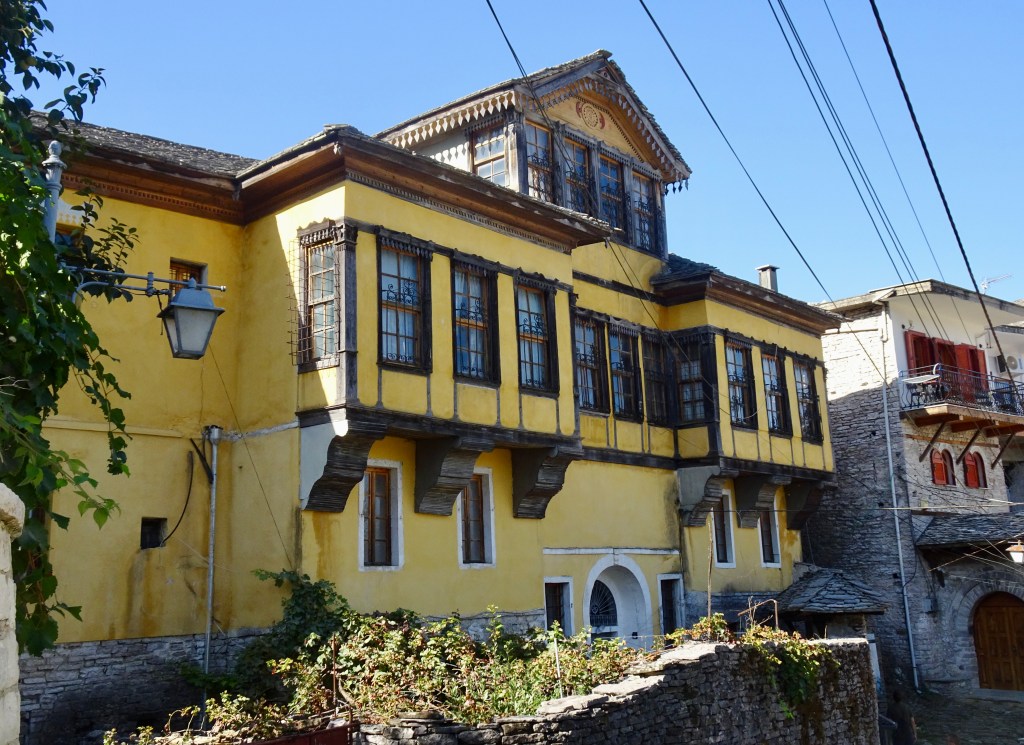
We toured the site of the home of world-renowned writer Ismail Kadare. Like Hoxha, his home had been destroyed by fire – the original was built in 1799, but a new building reconstructed in 1997, to mirror the home that had been lost. It opened to the public on Jan. 28, 2018, on Kadare’s 80th birthday.

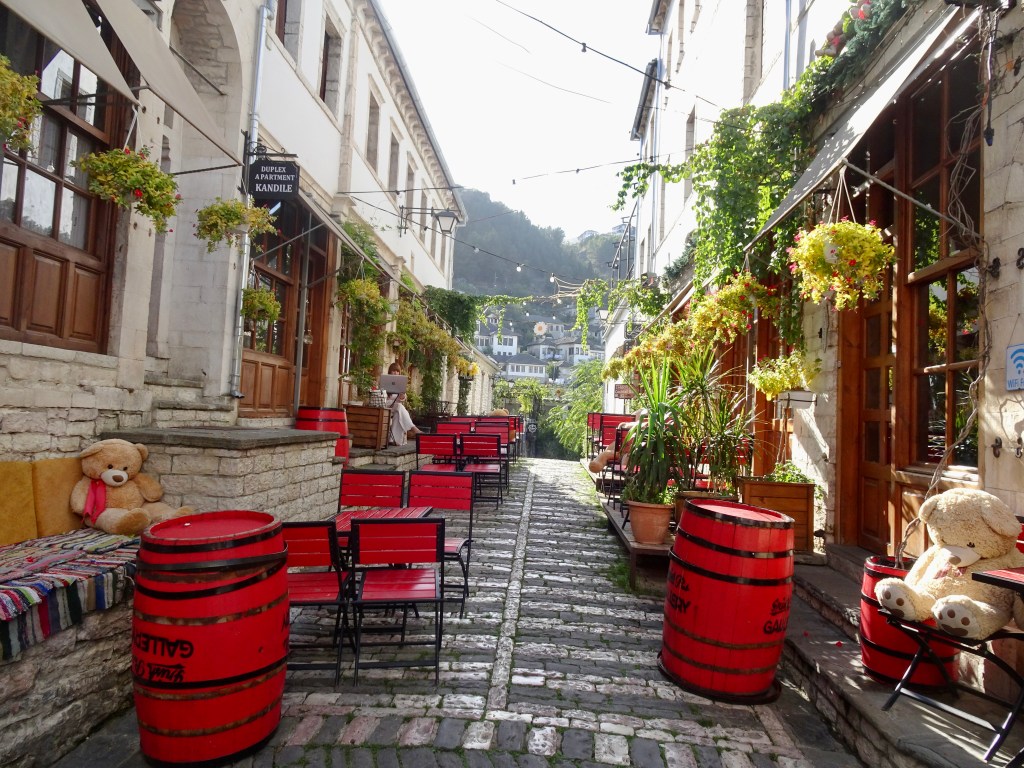
The Ottoman-style Bazaar dated back to the 17th century, but was rebuilt in the 19th century after a fire.
It is a compact area that consists of Ottoman-style buildings containing shops, restaurants and cafes and buzzes with activity all day and night.

We’ve seen these giant teddy bears at restaurants before and still have no idea why they are there.
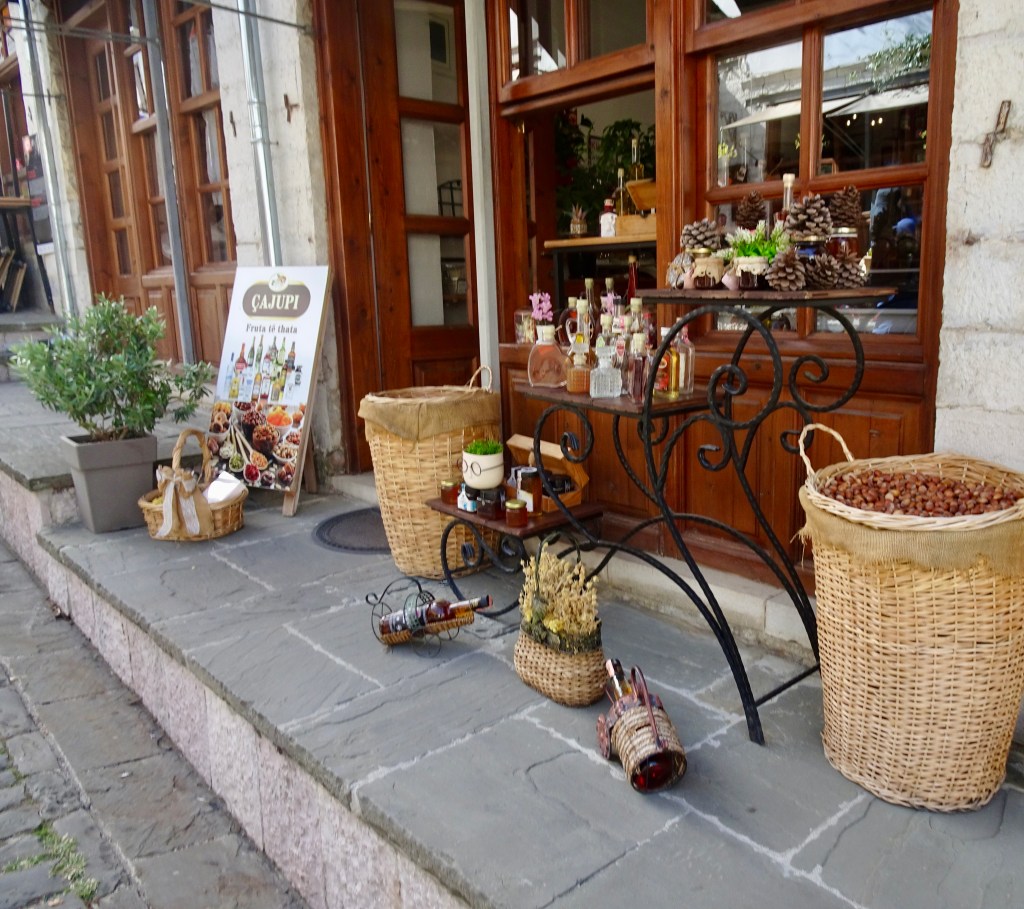
Specialty shop featuring local herbs, honeys, teas and liquors.
Carpets, pillow covers, textiles, and wooden toys. We’ve been looking at carved whistles for our grandson, but for the sake of the parents’ sanity, have thought better of it. Maybe a slingshot?

So, Albania… we have found you! your rich history, your colour, your warm and welcoming people.
Tomorrow we had to Berat, another mountain town with beautiful architecture, rich history and quite possibly, scary driving.
 Leaving Ourselves Behind
wow, this is one of your most interesting (to me) posts! thankyou for the wonderful photos and stories. We drove by Albania in the 60s but could not go in, the country was so isolated and cut off. What amazing architecture and stone work. Good thing you both are in good shape to walk all thos hills and slippery cobblestones! Stay safe and keep sending those of us who travel vicariously these days your fascinating posts!
LikeLike
Hi Rohana
I’m trying to imagine your route – through Greece and up into the former Yugoslavia? You have so many interesting travel stories to tell – lots to talk about when we see each other again.
LikeLike
A most fascinating post Ginny, and well done on your French grasp!!
There is got to be a meaningful answer to the bear question, keep on digging my friend. Also, I am impressed with your underground forays. I know they are not your favourite! Practice makes perfect, keep it up and keep on reporting, we love it!
LikeLike
Laurence – I just looked it up – teddy bears are used to ward off evil spirits! We just arrived in Berat and there was one hanging in an open window – too high up to get a good photo, but quite creepy.
The tourists on our tour were French, and a family from Norway, although the dad spoke French and translated for them. Their kids all spoke English – it is embarrassing to always be the unilingual Canadians among the polyglot Europeans.
LikeLike
Never too late to pickup a second language. I know a good teacher !!
LikeLiked by 1 person
Great post we all agree but I kept on waiting for the usual funny bit that makes me laugh out loud…. Too bad, must be only me….
LikeLiked by 1 person
Hi Ginny & Stephen, Now this is the Albania I thought it was like. What an experience for you and those roads are really something to behold. Thankfully my mind clicked into gear and I could open this email. It was one of your best blogs for sure. Love Lyn
LikeLike
Hi Lyn
Glad to see the blog opened up for you after all. I was worried it was a bit glitchy. A number of Albanians we have talked to are keen to hear that we like their country. Their tourism is not exactly in its infancy, but everyone wants to keep moving forward and improving things.
LikeLike
I’ve missed so many of the posts, Ginny, but I saved them so will go back and read. This one was wonderful. You should publish as you write so well. Looks like a place we would love to go but at least we have seen your pictures. Stay safe. Sounds like driving is not for the faint of heart. J
LikeLike
Glad to hear you enjoyed this one, Joan. The only faint-heart was me – Stephen was just fine and he was doing the driving. I could not imagine having to navigate those teeny, steep, twisty lanes, but apparently the “danger” was all in my head!
LikeLike
I’ve missed so many of the posts, Ginny, but I saved them so will go back and read. This one was wonderful. You should publish as you write so well. Looks like a place we would love to go but at least we have seen your pictures. Stay safe. Sounds like driving is not for the faint of heart.
Having trouble posting this reply so will have to see if it goes this time. It tells me it’s. Duplicate cope. No clue.
J
LikeLike
Thanks for this really interesting post, Ginny and Steve. I had read Kadare’s The Fall of the City of Stone a couple of years ago, a grim and sometimes darkly funny story about goings on in Gjirokaster during the lunacy of the totalitarian regime. It would be fascinating to visit the real place. We’re looking forward to your next stop.
LikeLike
Shelley, we had never even heard of Ismail Kadare and apparently there is a bookstore in Tirana where we may be able to pick up his books.
Albania is a very interesting place – not like anywhere else we have been.
LikeLike
Wow. How interesting. I must admit, I really knew nothing about Albania. You are an excellent source of knowledge, Ginny. This blog was fascinating.
LikeLike
Hi Jeanne
So glad you’re enjoying it – we’re learning so much as we go along. Like you, I knew very little before it started to pop up in recent travel blogs and articles.
LikeLike
So happy to hear you finally found the Albania you were looking for and without suffering sprained ankles to boot!
LikeLike
Yes, I have already had one quite nasty fall on this trip – a gash over my eye and a purple eye for a couple of weeks, so you can bet I am watching my footing quite carefully.
LikeLike
Well, that looks pretty sweet. Always amazed at the prospect of living in such a community on a cobbly, hillside. You will be fit! Must be fit!
LikeLike
You definitely need the right footwear. Although I saw a number of old souls slowly making their way uphill in their slippers.
Fit? Oh boy – I look forward to the day when I can climb up more than a couple of flights of stairs without puffing. (might be that nasty smoking habit I had as a kid.)
LikeLike
Oh, saw a docu on TV about the centenarians and where they live. Often include a lifestyle on a hillside… lots of walking up and down.
LikeLike
Also, possibly cleaner air than living in a city. Speaking of clean air – how’s life in your neck of the woods?
LikeLike
Don’t see how to post a picture for you here but full autumn eastern colours, cool but not cold. Loving it.
Love your informative blogs and I can travel too. ❤️
So, when is your next eastern Canada trip. Oops. One at a time. Be there. It looks lovely!
LikeLiked by 1 person
Hi Ginny and Steve – It’s taken us a bit to figure out how to reply to your amazing blogs from my I-pad. But, I am thoroughly enjoying them and learning so much from your informative commentary and spectacular pictures. From this and previous destinations, it appears you must be incredibly fit to be climbing all these hills. Enjoying seeing the pictures of you two looking so happy and fit! Take care🤗
LikeLike
Thanks Julie – I’m happy to hear you’re enjoying the blogs. I don’t know how fit I am, but when you’ve got little old Albanian ladies setting an example, you keep going!
LikeLike