Actually the beauty of Drake Bay, on the wild Osa Peninsula, is far from elusive. It is wild, dangerous, dramatic, difficult to access and still largely undeveloped. Jungle creeps right down to largely uninhabited black beaches and rocky outcroppings, thundering waves crash to shore – this area in the southern part of Costa Rica, is home to just 12,000 people, but houses over 3% of the planet’s biodiversity, spread over 41,800 acres.
These were the mind-blowing facts that attracted us to the place. We figured we would be tripping over toucans without the annoyance of sharing the trails with busloads of fellow tourists. And that’s not wrong. But… the elusive part of Drake Bay is that even though the jungles are teeming with wildlife, they can be hard to spot.
To begin at the beginning, one has three ways of arriving in Drake Bay – by plane, by car or by boat. Until very recently, the road from Sierpe to Drake Bay was a pot-holed horror that required three hours of infinite patience and a 4×4 to navigate three rivers. The potholes, patience and time are still there, but the rivers now have bridges. Our option was to take a one-hour boat ride from Sierpe, up the river and through the mangroves.

As we left the river to enter the Pacific, we were met with the high waves of an incoming tide and it took considerable skill on the part of our captain to maneuver the heights and troughs, until he moved us past the wave break and out towards town.
There is no dock in Drake Bay (nor is there a dock anywhere else), so every boat entry and exit involves stepping down into a foot or so of water. Depending upon the tide, this can be easy, or it can be hard. All part of the adventure. Pura vida.
Drake Bay is a small village, with a couple of grocery stores, a few restaurants, a number of hotels and an even greater number of tour operators.
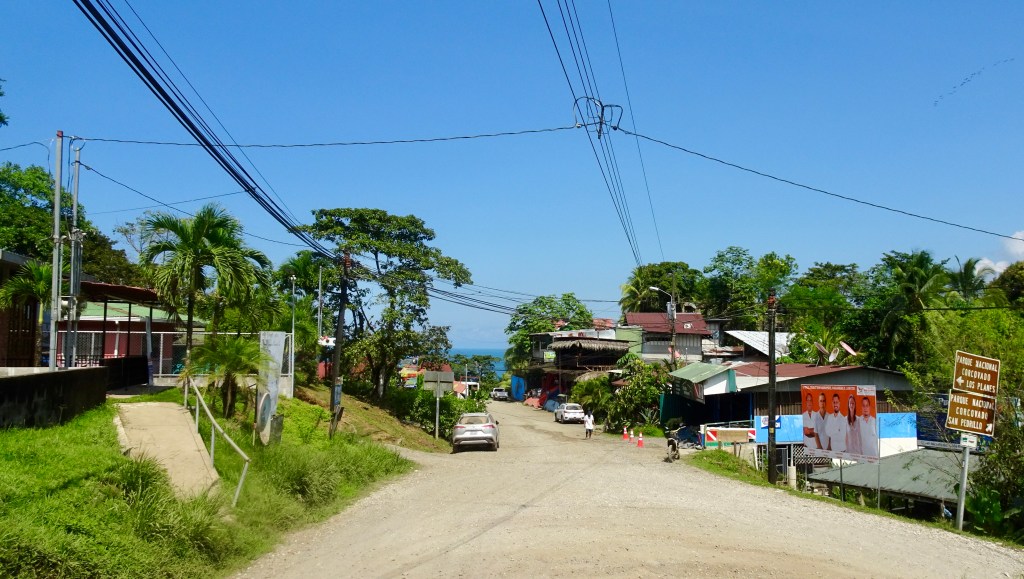
We were met by our host, Jonathan, who drove us to our hotel, Casa Gitana, about 3 km. up the coast from town. It is a sweet property of 10 rooms, with an on-site restaurant, and right across the street from a beautiful beach.

The view down the road.

The beach. We did not go horseback riding, but the swimming was wonderful – just enough of a wave to play in and not get pulled out to sea.
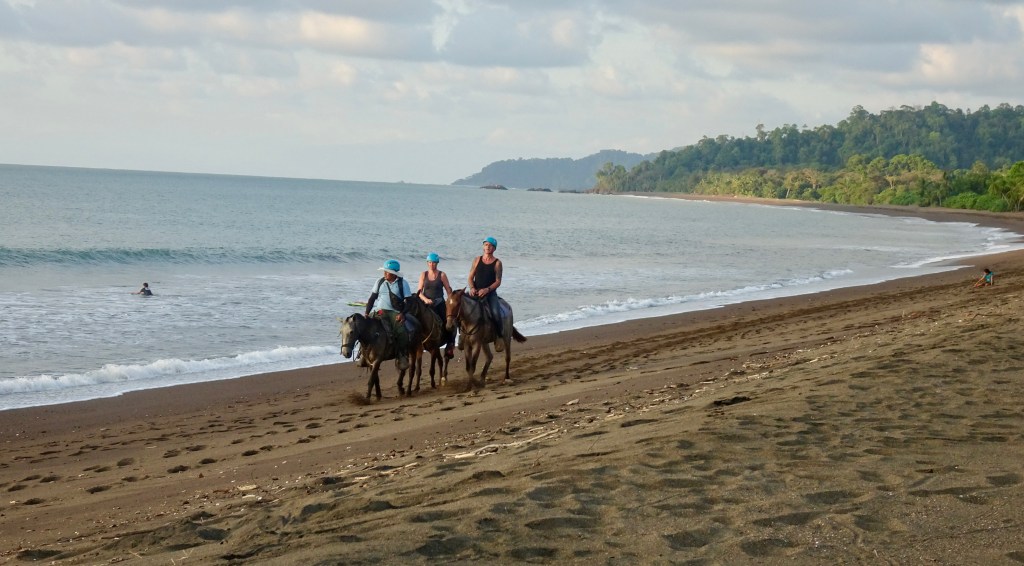
We watched the sunset every night, sitting propped up against a log, with a couple of cold Imperial Originals, one of Costa Rica’s most popular beers.

We booked two tours here. The first one was a snorkelling tour to Canu Island – over an hour by boat out to a large island, reputed to have some of the best diving and snorkelling in Costa Rica. Our tour included all equipment, lunch and our delightful guide Katrine.

The plan was to have two snorkelling sessions, around different parts of the island, punctuated by food breaks. Our challenge that day was that the sea was very rough, which made for slightly unnerving swimming in bouncy water (two strokes forward, one stroke back). By the end of the day, we were all exhausted. My favourite snorkelling experiences so far have always been from shore, rather than from a boat in open water. I prefer to enjoy the surreal experience of sharing the underwater world in a more relaxed way.
This felt less like snorkelling and more like resistance training and sadly, the marine rewards were not that impressive. We did see three or four turtles and I saw a 5-foot white-tip shark, which shimmied in its shark-like way just below me. We saw the usual tropical fish, and we saw some dying coral.
Still, the tour was fun, our fellow travellers were a great mix , lunch was delicious and bountiful and we even got to play on the water slide.

Yesterday was the Big Kahuna – the reason everyone comes here – the tour of Corcovado National Park. If one were to do this area justice, probably the best plan would be to stay at an eco-lodge right in the park and devote a number of days there. In that time frame, you would see the greatest numbers of animals and birds, and come away with a far different experience of this pristine and highly protected region.
You cannot enter the park without a guide; for the protection of the park as well as the tourists. Bull sharks and hammerhead sharks come right to shore, and crocodiles travel in the rivers and out to sea. Herds of peccaries are unpredictable and the park is home to pumas and jaguars. Naturally we wanted to see all of them.
When you first arrive, your bags are checked. One of our fellow tourists was harshly admonished because she had forgotten to remove a disposable plastic bottle from her bag. Park rangers patrol the shores to keep an eye out for drug boats and poachers. This is conservation at its most intense and it’s heartening to see such strict measures in place.
The park station where we landed and began our hike.

We were a small group – just six of us. Bart and Eatch from the Netherlands, Mark and Carla from Switzerland, us and our extremely knowledgable guide Elia.

Our tour involved a 1-hour boat ride from Drake Bay followed by a brief interpretive session and four hours of hiking through the jungle. Elia has a degree in natural history and has lived in Drake Bay her whole life. She told us stories about life in the wild as a child – one of their pigs surviving a bite from a venomous snake ( his fatty layers saved him); her mother warning the kids to stay out of the river because of crocodiles (naturally they all went in), and learning about medicinal plants from her grandfather.
Elia was extremely informative and told us dozens of facts we would never have otherwise known about; we were lucky to have had her as a guide.
This spiky tree serves as a handy rubbing post for peccaries to rub against to get rid of fleas.

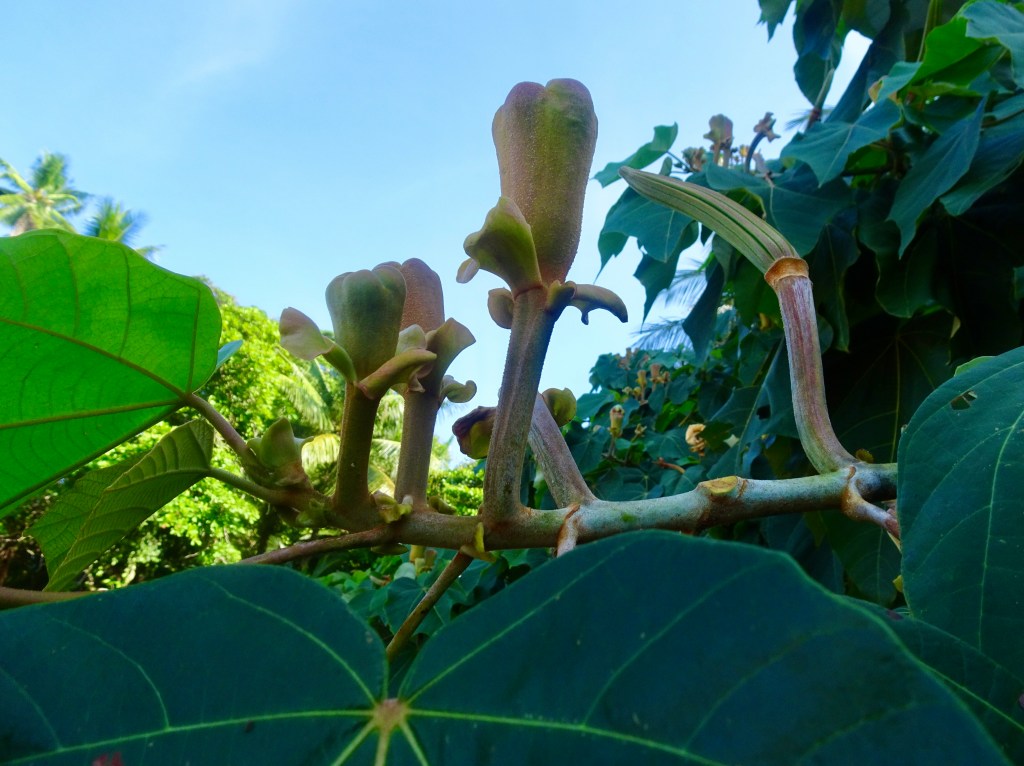
You might never guess that these flamboyant flowers and their equally show-offy (but inedible) fruit are part of a balsa tree – the same wood that we think of when we think of model airplanes.
If we were on our own, we would never have known this tree is home to a colony of bats – tucked just inside the open trunk.

If when you think of a jungle, you think of vines, I have a few here for you.

As we walked through the jungle, the terrain remained mostly flat. At times we would be deep in foliage, hot and humid and at other times, the trail would open up and we’d even feel a bit of a breeze. Mainly though, we trudged along in 32 degree heat and brutal humidity.

Sometimes, the trail would open up to the ocean and we were treated to sights like this.

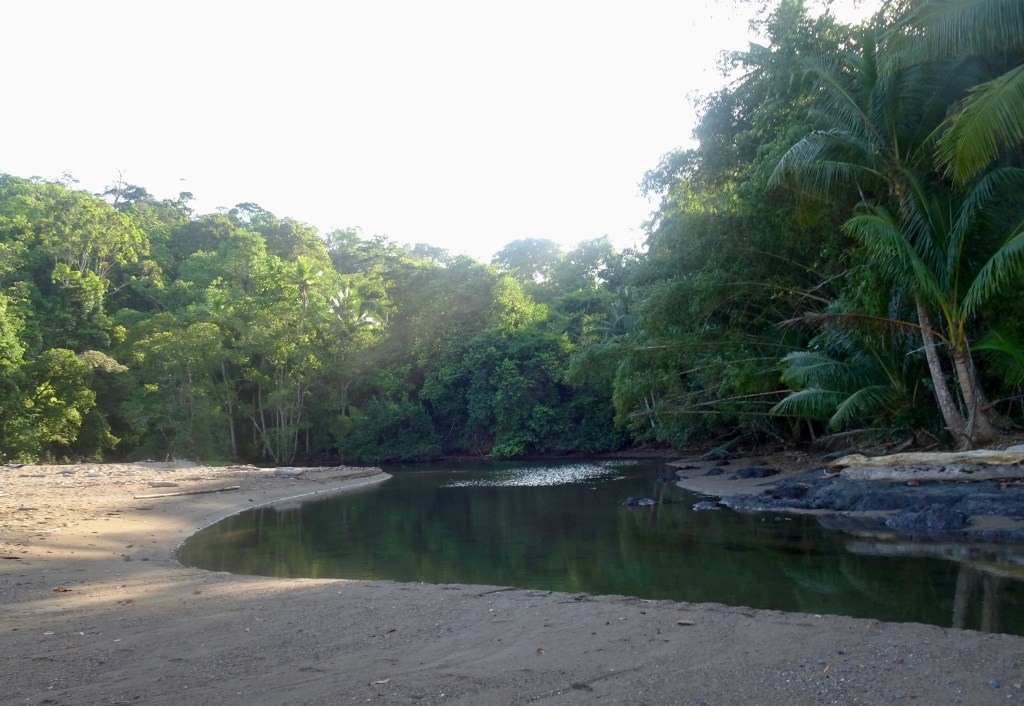
We did have a cooling-off break at this river. Took off our shoes, sat with our feet in the water and took our chances with the crocodiles.
One thing we do know about any kind of wildlife tour is that you will see a) nothing, b) very little or c) have a bonanza of sightings with several close-ups. Your guide may do their very best to try and predict where the animals are, but in the end, it is pure luck. And in terms of the big catches (tapirs, peccaries, pumas, jaguars), we saw tapir poop, puma tracks and the tail end of a peccary escaping up a hill.
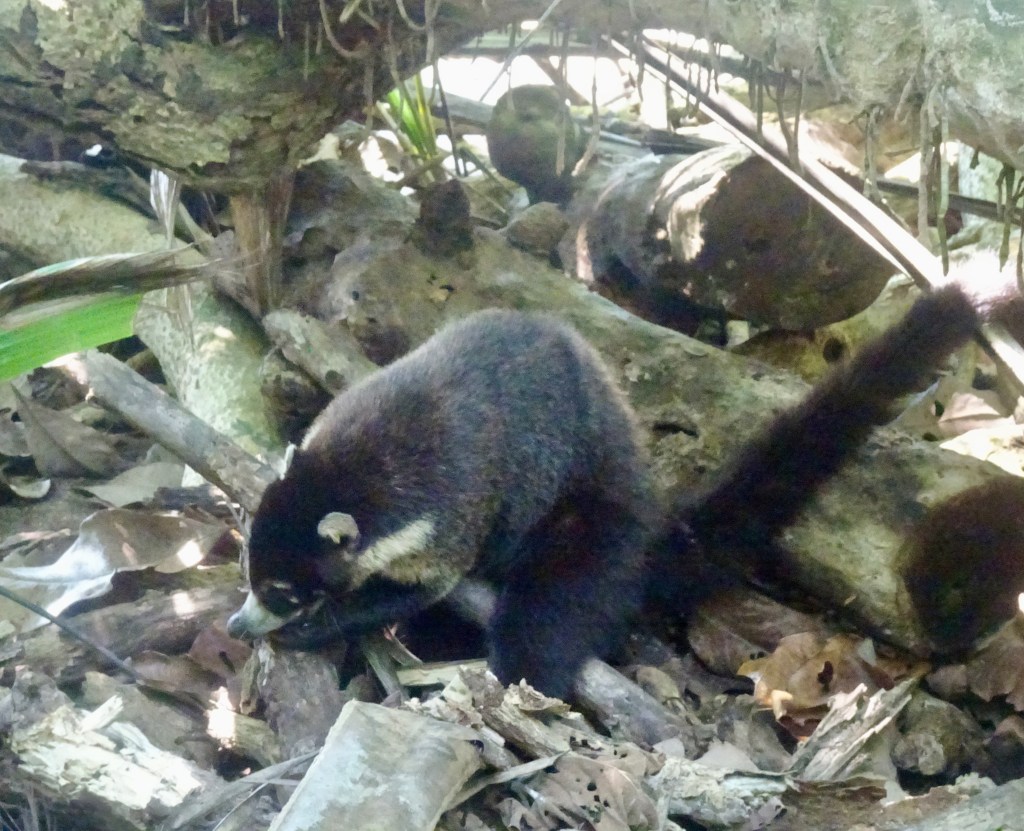
But we did come across a little herd of coatimundis – these adorable little creatures that are pretty much a guarantee on any tour. After we watched them for a while, we slowly walked right past them without issue – they are very used to humans.
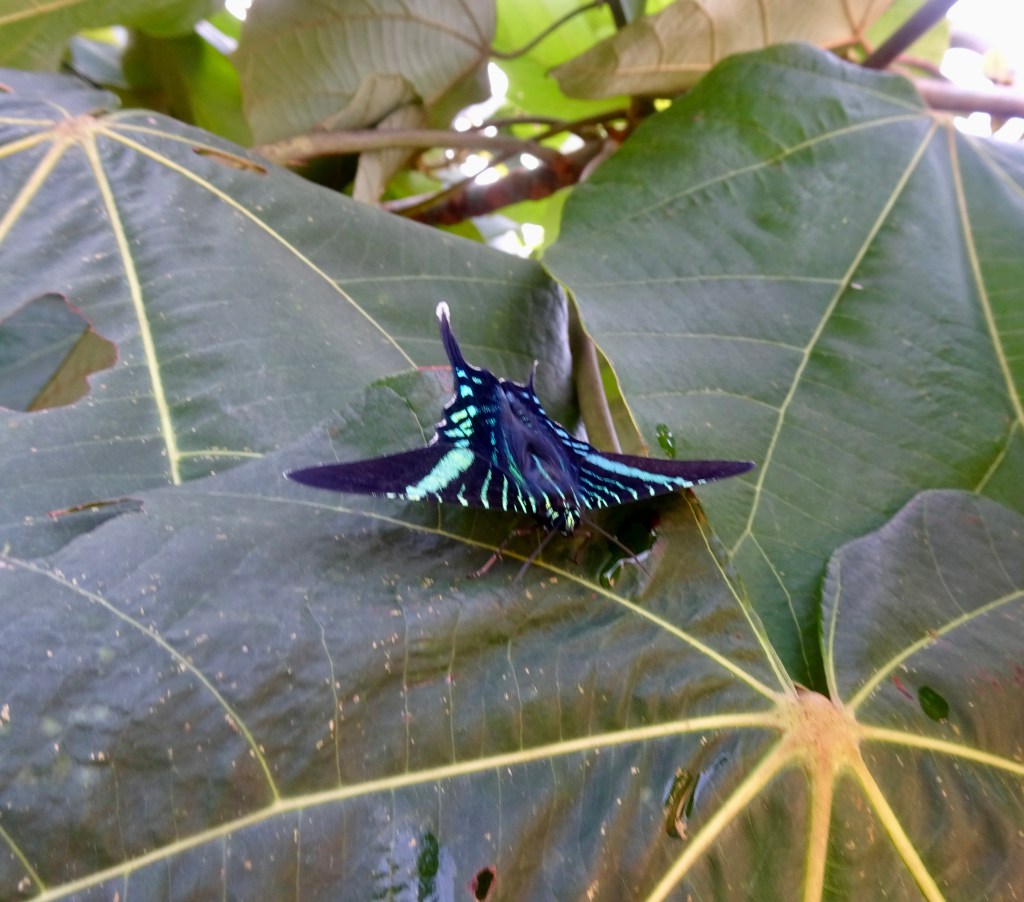
We saw dozens of different species of butterflies. This one landed on a leaf and posed for us.
As for birds? We saw the glorious macaws flying past, and three toucans way up in a tree; too far to be photographed, or even viewed with a telescope.
The rest of the birds we saw were only visible through Elia’s telescope.
The red-breasted trogon

Another type of trogon ( name escapes me).

This gorgeous bird – also didn’t catch the name.

Elia had an unerring ear for bird and animal calls, and although the howler monkey was silent when we walked by, she somehow knew she was there. If you look at the bottom of the monkey, you will see her baby’s tiny tail hanging down.

We feel fortunate to have visited this incredible corner of the country. We wonder at the delicate balance that needs to be struck between encouraging tourism and maintaining the untouched quality of this place.
Will the dusty little town become a little less dusty? It is too remote to become another Tulum, but how much improvement to infrastructure is too much? At present, there are no docks for the boats, which depending upon the tides, can pose real risks to tourists. Last year, according to our guide, a high wave caught a boat as tourists were attempting to board, and there were multiple injuries. One man broke his back and two women suffered broken legs.
The scene yesterday at Corcovado.
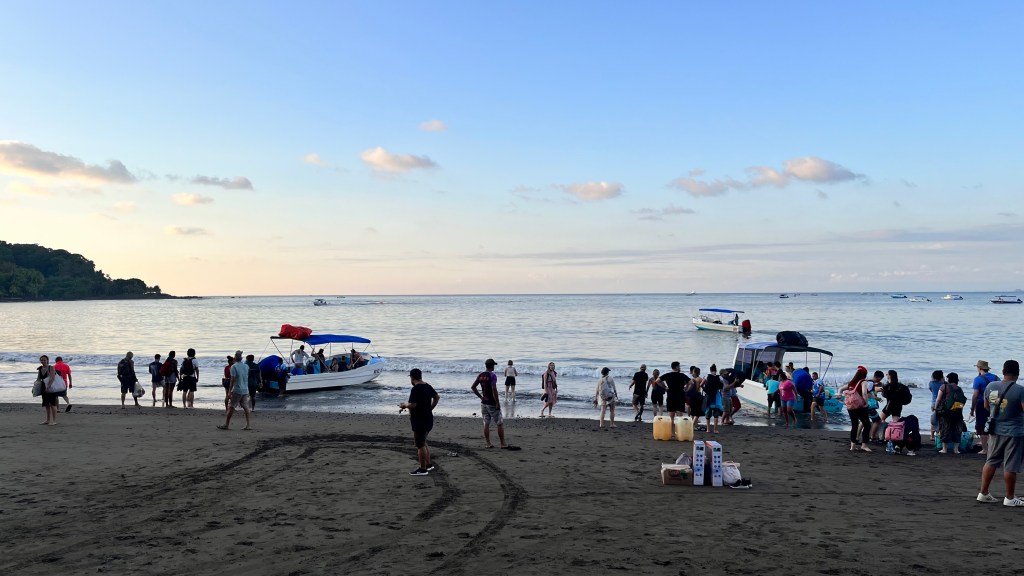
We found it a bit unnerving to be hustled aboard our boat yesterday. If someone had mobility issues it’s not clear how it would work. Timing is everything and during high tide, the captain has about four minutes to get everyone aboard and seated. Our planned landing from the park to our beach had to be scrapped because the waves were too high. We were dropped at a calmer beach and a car sent to pick us up.
All of this is normal for the people who live here, and I do wonder how much the locals should be expected to change to accommodate tourists. My feeling is that it is on us to come here with a solid acceptance of the “tourist” limitations, and let it be what it is.
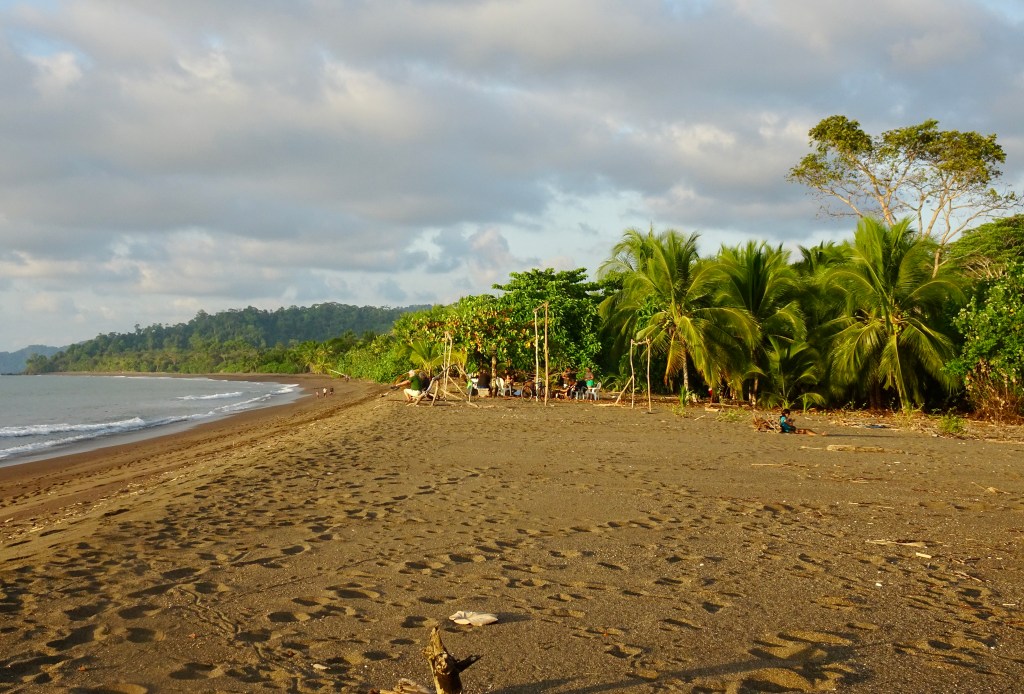
We’re about to go and watch our final sunset here. This will be our view – that luminous glow as the sun begins to make everything and everyone look a little softer.
Tomorrow we take one boat, and two buses to our next spot – the town of Quepos, on the edge of Manuel Antonio National Park. It is the most-visited park in Costa Rica, “a zoo“, as someone described it distastefully. From the sublime to the ridiculous, maybe?
 Leaving Ourselves Behind
Love the bird pics!
LikeLike
thanks Pete – we are hoping to see a whole lot more of them without the aid of a telescope.
LikeLike
Your posts and pictures are amazing. I agree about the snorkeling- I don’t enjoy the open water and feel much safer when I can see the shore:)
LikeLike
We had lifejackets on, so felt fairly sure we weren’t going to drown, but it was a slog. When we tried to get back to the boat, I got caught in a current and just couldn’t make any progress, so they backed the boat up to rescue the last stragglers. I flopped onto the boat and swore I would never do a “boat” snorkelling trip again.
LikeLike
You two are so adventurous. Amazing and nice to know that there is a serious attempt to protect the biodiversity. Just the mention of crocodiles would have me heading for the hills. 🙂
LikeLike
We took our lead from the guide – figured she had a stake in keeping us all safe, and by that point I was so hot, I didn’t care any more.
LikeLike
Very enjoyable blog. An area we did not visit – interesting. Hope you get to see a Quetsel (spelling ?). It is the most beautiful bird (red, green,blue). I think it was while in the cloud forest we saw one high up on a branch. Our guide pointed it out to us. We saw several Toucons and the Maccaws were just making a comeback. They were almost extinct in Costa Rica about 15 years ago. You have yet to encounter the Sloth . We saw them with babies. It really brought back memories for me. Watch out for those crocs !!!
Love Lyn
LikeLike
Our guide heard the quetzel bird call, but she couldn’t see it. They are a prized sighting, so sure hope we get lucky in the cloud forest. And the sloths too – the place we are staying in Monteverde is apparently right next door to a “sloth tree” – if that is even a thing. So of course we have fingers crossed to see a sloth and babies as well!
LikeLike
It was end of Feb. when we were in C.R. so you could see Sloth babies. We saw 2 & 3 toed ones. We also saw a Tiger Heron eating a baby Boa Constrictor. Watch out for those deadly Fer- De-Lane snakes. They also have Rattle snakes which I didn’t realize. The Monteverde Hummingbird & butterfly garden is amazing. Check out the Tarcoles Jungle crocodile Tour. We saw amazing birds with even Herons doing a courting dance. It’s great. Saw more Sloths in Manuel Antonio Nat. Park. In Sarchi you will see biggest ox cart. Know you will see things we didn’t and us you. One night we did see a glow at the top of Mt. Arenal.
Lucky you to be enjoying the warmth of C.R. while we have minus 13 with the wind chill factor. Beautiful sunny and blue sky days but oh so cold. Snow expected Tues. and Wed.
Enjoy and look forward to more news.
Love Lyn
LikeLike
Great pics 😊
Beautiful. I was there so long ago & we loved it then too !! Enjoy.
Flo
LikeLike
I’d love to hear about your experiences in Costa Rica, Flo. I think everyone has great memories of their times here.
LikeLike
Dona and I spent a week at “Poor Mans Paradise ” 20 years ago ( the last privately owned spot before Corcovado)–looks like not much has changed–thank heaven. At that time the nearest road was 14 miles away?? One day we encountered the strangest sight about 5 miles up the trail–the people who lived near PMP were carrying in a washing machine strapped to his back–she was obviously very pleased. At Poor mans Paradise when they shut the generator off at 10 pm the jungle took three steps forward. One of my favourite places !!! When you are back in BC we should get together with Wendy!
LikeLike
I just checked out Poor Mans Paradise – it looks fantastic and especially with all meals included. I met a couple on our snorkelling tour who were staying there – two Venezuelans who now live in San Jose. They raved about it.
I’m quite impressed at how resourceful the locals are, since everything from food to washing machines has to be trekked in on those roads.
We would love to see you guys again, and definitely with Wendy as well – what a crazy connection we have!
LikeLike
You never cease to amaze me, absolutely love your blogs, they get more interesting as you go. Keep up the nice work and keep having a wonderful life. Hugs for us
LikeLike
Thanks Sharon- I appreciate that! I guess you and Tony are well into your Baja life again. We have friends who are discovering Baja this year and loving it. We met a young Dutch couple on our Corcovado tour who were very interested in whales, so I told them all about the many opportunities they would have to see whales in Baja.
You live in a beautiful part of the world. (Well, two beautiful parts of the world!)
LikeLike
Amazing place and your exquisite pictures and descriptive prose make it come to life for me. Impressed by your ability to endure a four hour trek in that sweltering heat and humidity. Well done.🤗
LikeLike
Thanks Julie, but honestly, sometimes you simply get through things because there is no other choice. I asked our guide how she coped with the heat and she said, “I am like an adaptive bird.” For the rest of our time in Costa Rica, I will try to be an adaptive bird.
LikeLike
In spite of missing some of the creatures you were hoping to see with your guide, it appears from your pictures you were able to see some birds you are not likely to see anywhere else. Some of the plumage is stunning! Relieved to read you were able to leave the area safely considering some people have not been so lucky while boarding the boats.
LikeLike
We’re hoping there will be many more bird sightings before we go. Today would have been perfect, as we had a torrential thunderstorm last night, and the birds were very active this morning when we left for our boat. Our host told us that “rain makes the animals happy”.
Boat ride was a dream – it was very low tide and the water was calm.
LikeLike
What a great adventure, you two! Love reading your vivid posts! Thank you for bringing us the world (esp. when the windchill here is minus 34!) xo
LikeLike
Thanks Shelagh! Sounds like you’ve moved.:>) Haul out those woolies.
Sometimes I wonder if I have the courage to go up north in winter to see the northern lights – that has been such a dream of mine.
LikeLike
With everything you’ve done since you “left yourselves behind”, I am 100 % sure you do, Ginny! xoxo
LikeLike
What a beautiful country! Looking at the peccary’s scratching tree, it’s just as well you didn’t meet one close up and surprised: if they’re using the bark for gentle relief from fleas, they won’t be discouraged by sticks and stones.
LikeLike
Mike – that’s what I thought. Those spikes hurt – I guess peccaries have that porcine hide that is impervious to sharp objects. I read somewhere that if you encounter peccaries and they behave in an aggressive fashion, to climb a tree. It seemed like the advice of last resort – most of the trees are distinctly unclimbable, with that spike tree being a hard no.
LikeLike