I’m not really a monkey fan – they kind of freak me out. When we were travelling in Southeast Asia and in India, the monkeys there were used to being fed by humans and were quite bold and aggressive. I have vivid memories of fearfully facing down small troops of monkeys, loping toward me in determined anticipation. I know what to do in a bear encounter, but monkeys? Backing away slowly won’t work and climbing a tree isn’t the answer. I would be seriously outmaneuvered.
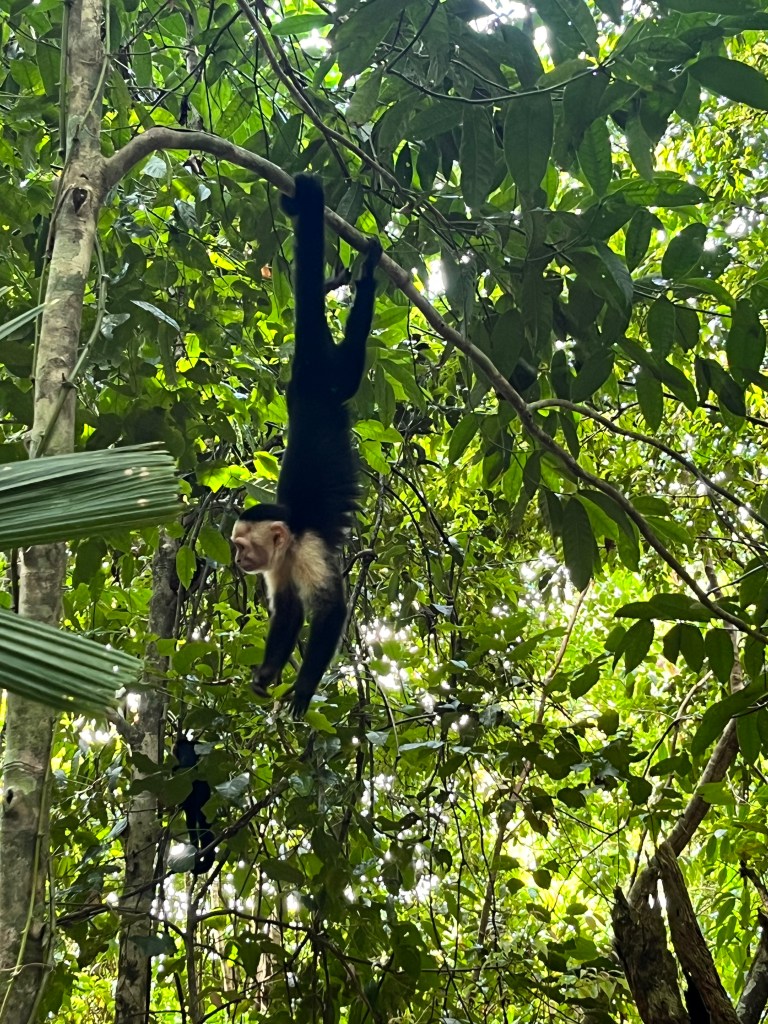
Thankfully, the monkeys of Costa Rica appear to be more of the curious but reserved variety. There are three species of monkeys in Manuel Antonio National Park – the howler monkey, the squirrel monkey and the white-face monkey.
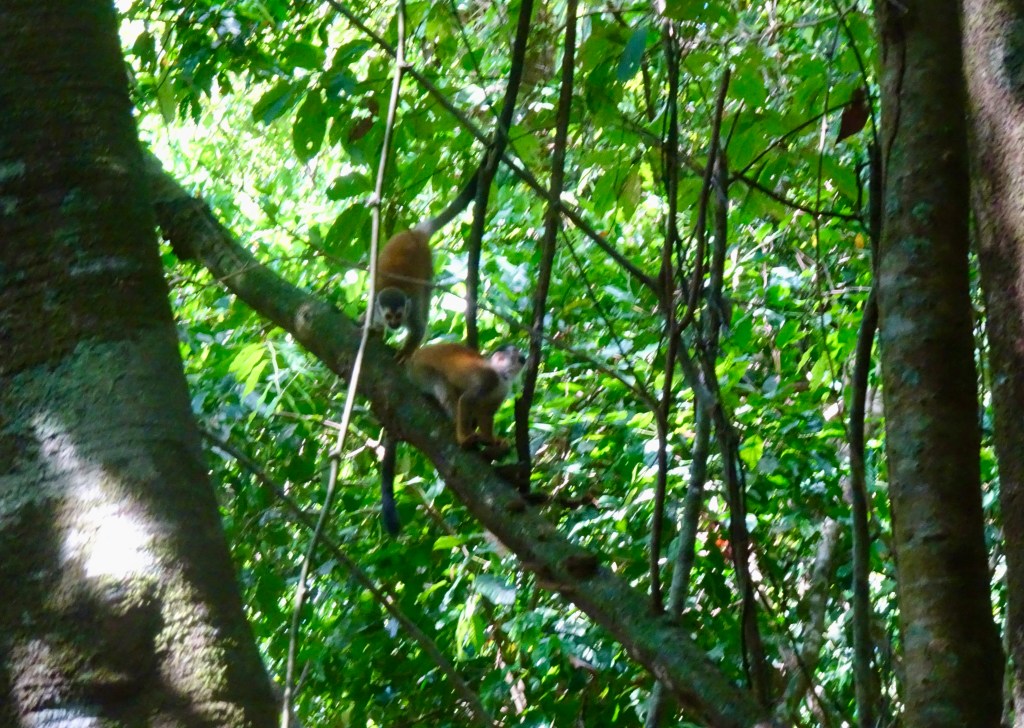
The howler monkey was too far up in the trees to see well, but the cute little squirrel monkeys gave us quite the show. They leaped, they cavorted, they hung upside down, they chased each other and in short, they moved around so much that this blurry photo was the best I could capture.
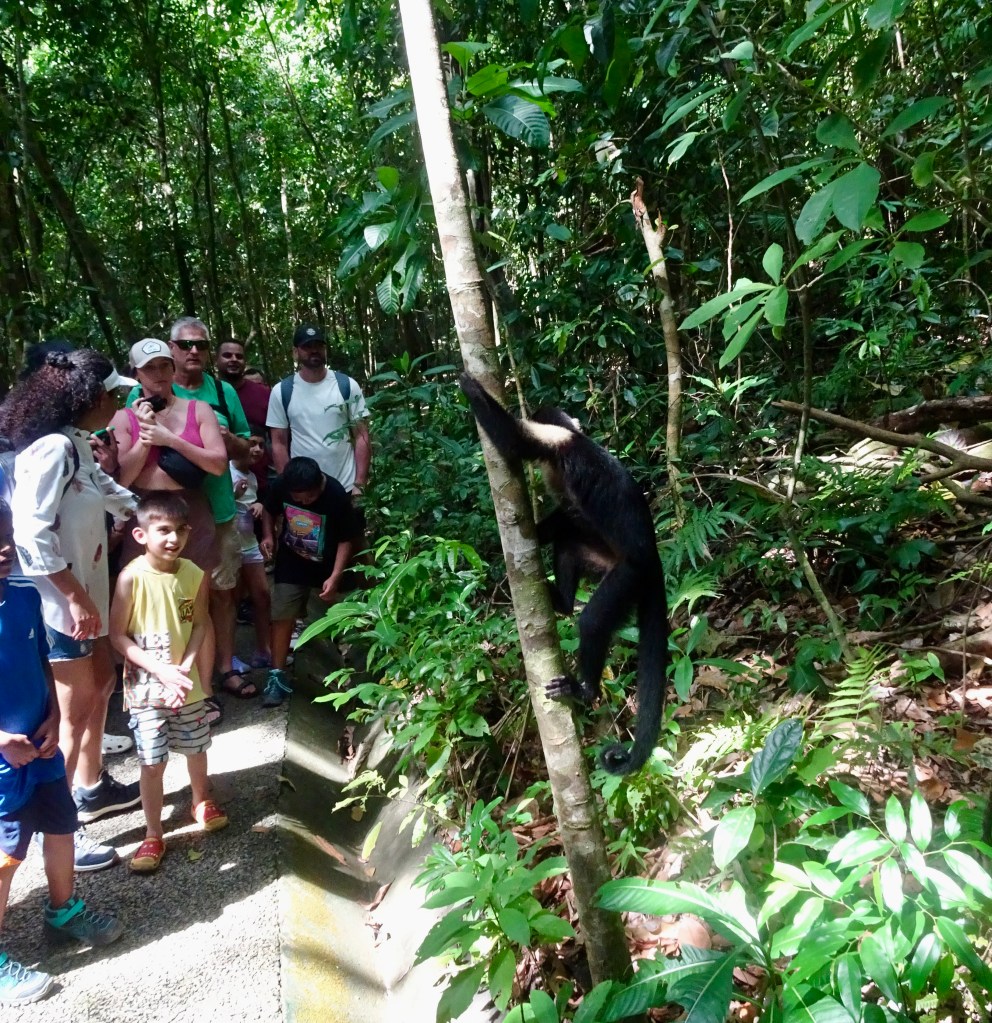
The white-faced monkeys were the indisputable stars of the show. Their showy appearance, monkey scowl and all, was one appealing quality, but these monkeys were very comfortable coming a little closer to their audience. Almost a bit too close, judging by this little boy’s slightly wary expression.
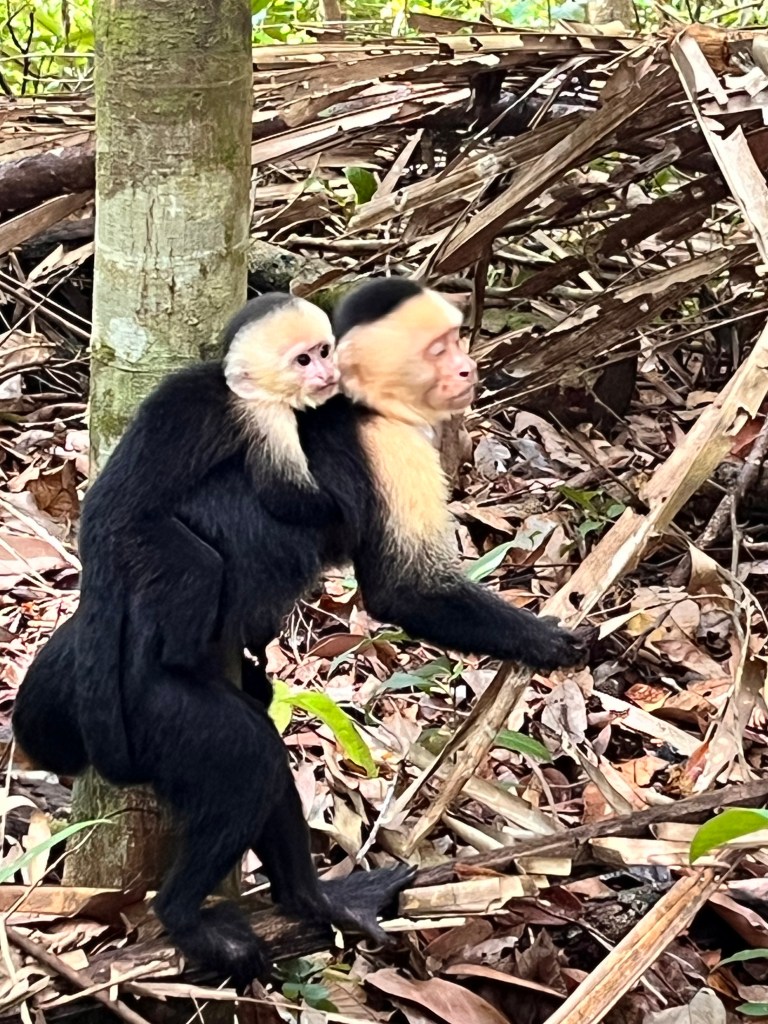
Mum and baby stopped to pose for a photo; unperturbed by the excited chatter from their audience.
And this was the audience. I’m the one with the red backpack, looking for a way to barge through the crowd. Naturally no-one was moving.

If you’ve ever been on a whale-watching tour, you’ll know that at the first sighting of a fin or a tail, the tom-toms go out and before you know it, you are surrounded by boatloads of camera-wielding tourists.
Such is the case at Manuel Antonio. The difference is that on an ocean, there is room for everyone to see the whale breach. Here, we are funnelled through narrow paths and naturally, if you are in front of some animal action, you’re not giving an inch.
Thankfully, this crowd scene only happened a couple of times. Manuel Antonio National Park, at 680 hectares, is the smallest of Costa Rica’s 30 parks, but it is the most-visited. It is easy to see why – abundant wildlife, stunning beaches and mainly flat wheelchair accessible trails with plenty of interpretive signs and maps.
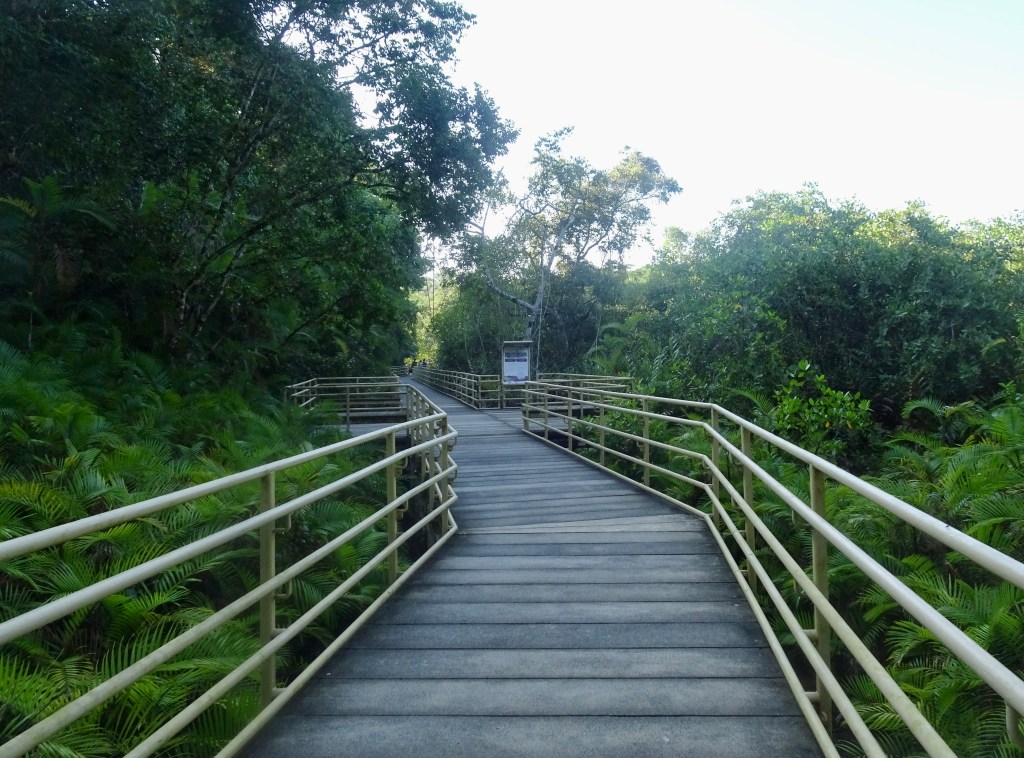
Once again, we were heartened to see the controls that are in place to protect the flora and fauna. It begins at the entrance gate – you are not permitted to enter the park without having first paid online and registered for a specific day and time slot. There is a daily quota of visitors of 2000 allowed, down from last year’s quota of 3000. Your backpacks are checked for disposable plastic bottles and food (strictly forbidden, except for baby food) and then you join a dishearteningly long lineup. Your QR code is scanned, your ID presented and you’re on your way. Amazingly, once you break free of the herd, you find yourself quite alone for much of the time.
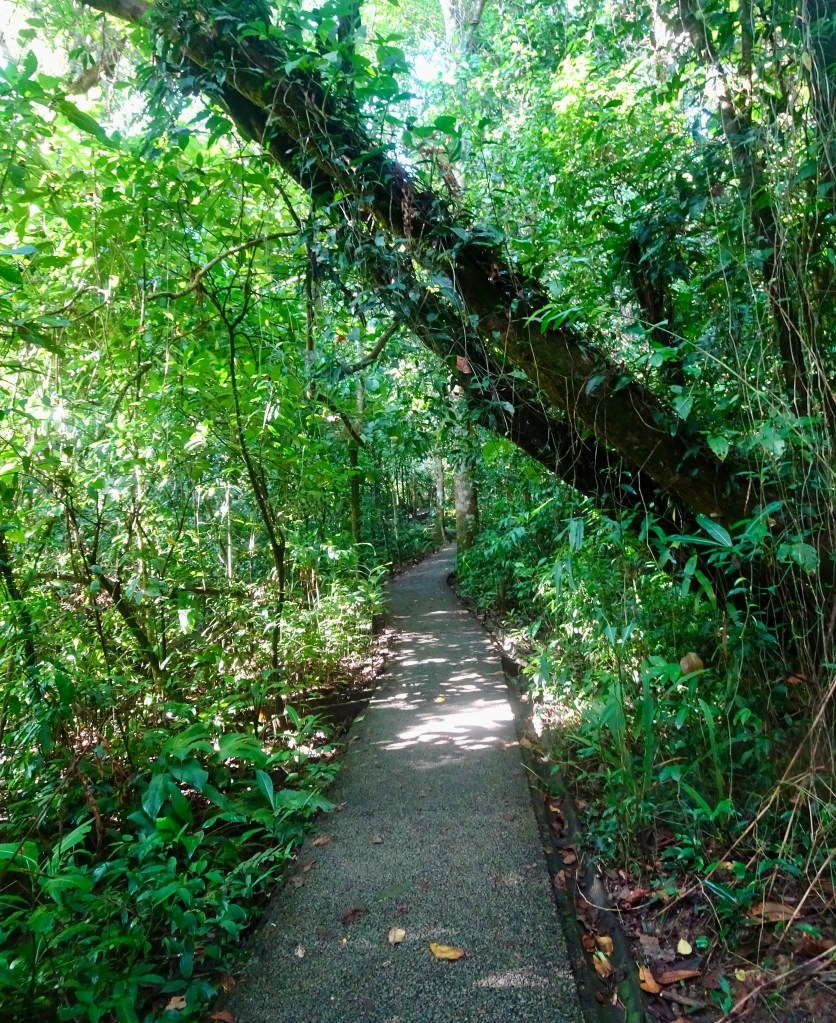
It is possible to enter Manuel Antonio without a guide or being part of a tour. While there is no question that having a guide would have enhanced the experience, we opted to explore the park on our own. A single admission is $US20, and being part of a group tour is $US60, so we figured we would save our “guide money” for other parks where it might be more beneficial.
Manuel Antonio can easily be described as being “a walk in the park“, very beautiful, relatively short trails and much of it in the shade – perfect for all ages. Having interpretive signs at regular intervals was helpful – we would not otherwise have known about this intimidating plant.
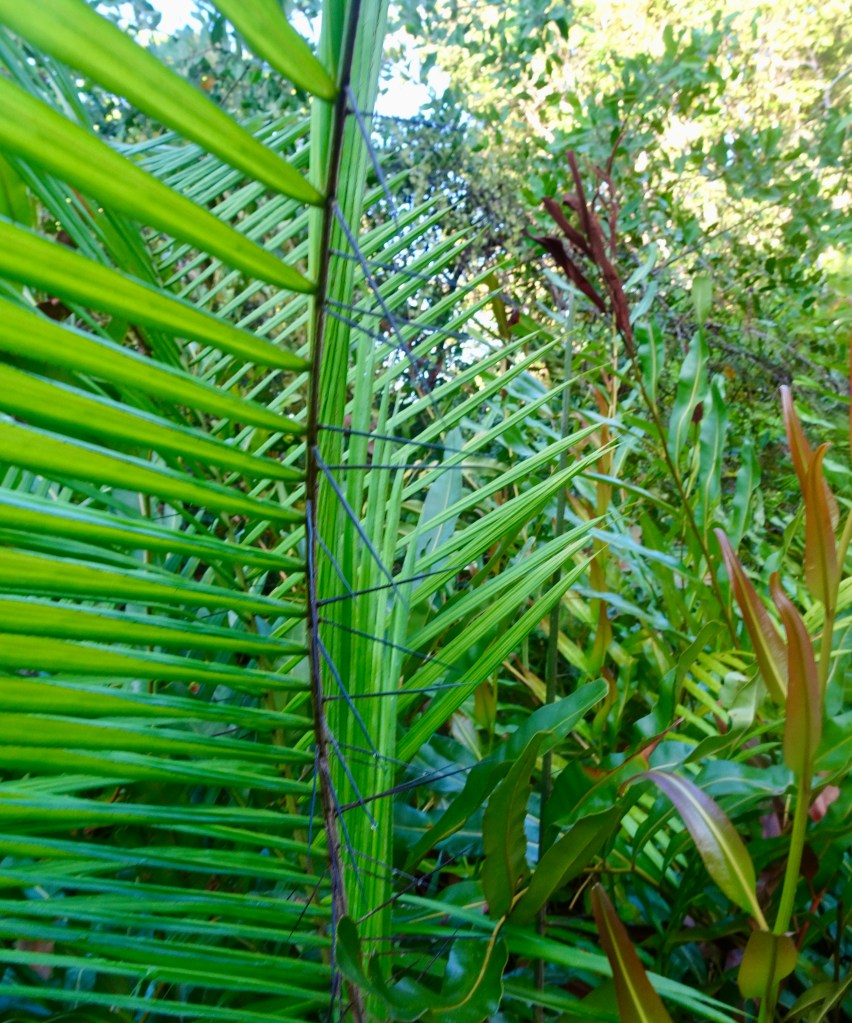
See those sharp little needles? The viscoyal palms grow in clumps and form an impenetrable barrier to all but the most determined of creatures. The prize? This plant carries both the carrot and the stick – the carrot being a sweet fruit that attracts monkeys who manage to squeeze in without harm.
Aside from seeing monkeys up close, we also saw a sloth high up in the treetops. We overheard a guide saying he was active (whatever “active” means in sloth terms), but within 30 seconds he had moved to a different position and then settled in and didn’t move again. We saw three little deer, which surprised me – I didn’t think of deer living in the tropics.
Another huge attraction in Manuel Antonio are the beaches. Some are a little on the rugged side and not safe for swimming. There are signs warning of rip currents on several of the beaches.
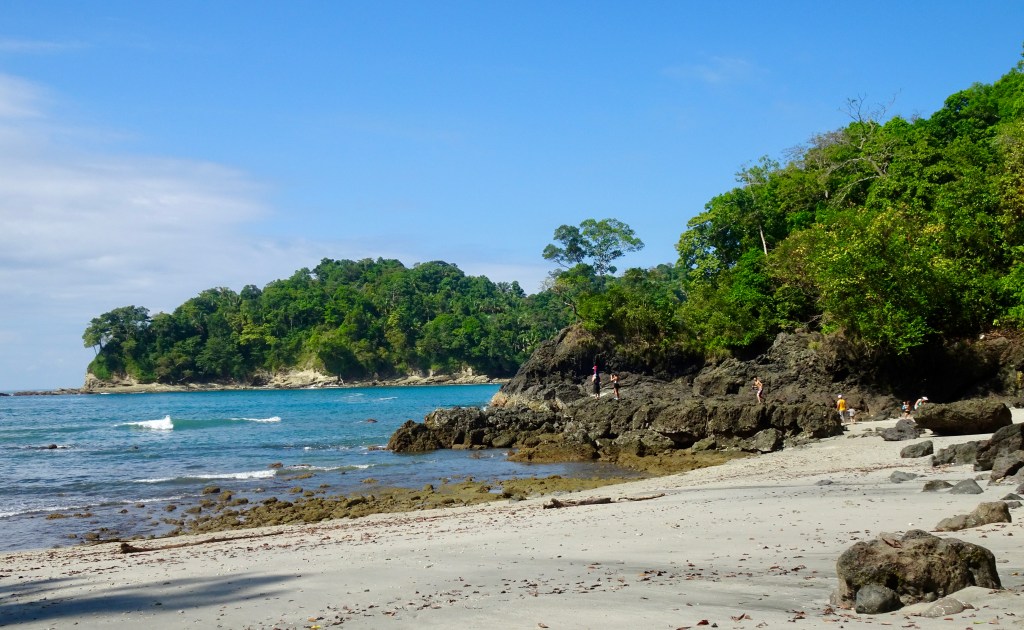
And others are delicious – soft waves, white sand and a ring of shade trees at the entrance. There is a main beach that most people stop at because it is calm and safe for families, but it can get quite crowded. We stopped at this beach for about an hour to have a couple of swims and we almost had the place to ourselves.
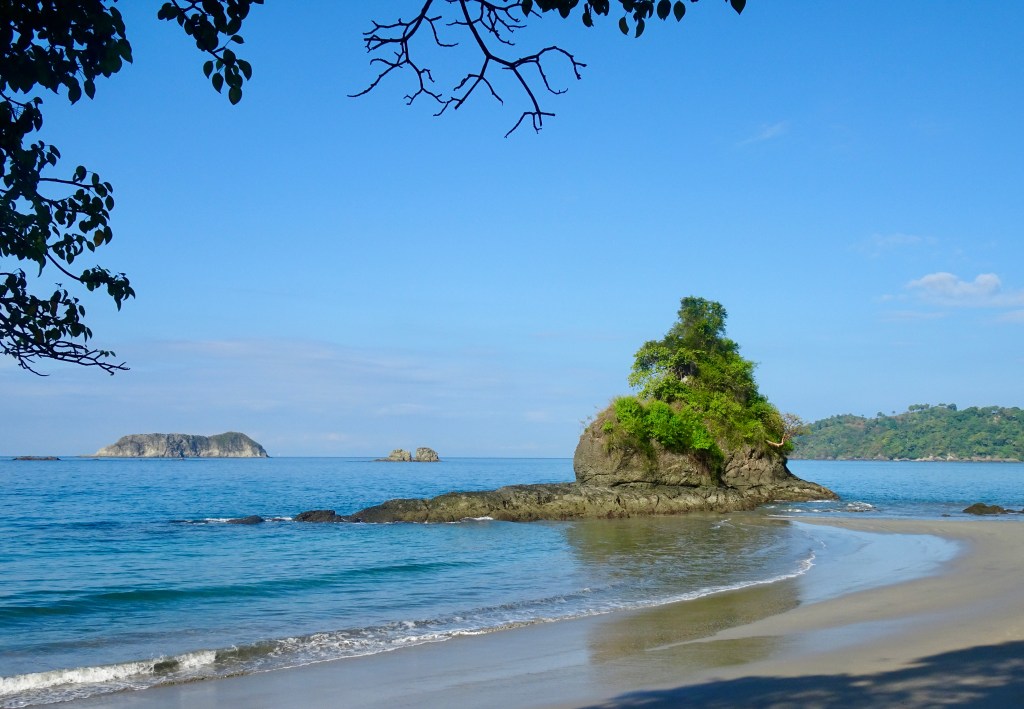
You have two options for hotels in this area – either the strip right around the park, appropriately called Manuel Antonio. This area is built entirely for the tourists and has hotels, restaurants and shops that stretch for a few kilometres along the shore. It is much closer to the park and is also more expensive.
You can also stay in nearby Quepos, which is where the locals live. We chose to stay here in part because of price point, but also because of easy access to the bus station. Getting to and from the park was easy – a shuttle runs every 15-minutes, costs $1, and takes about 20 minutes.
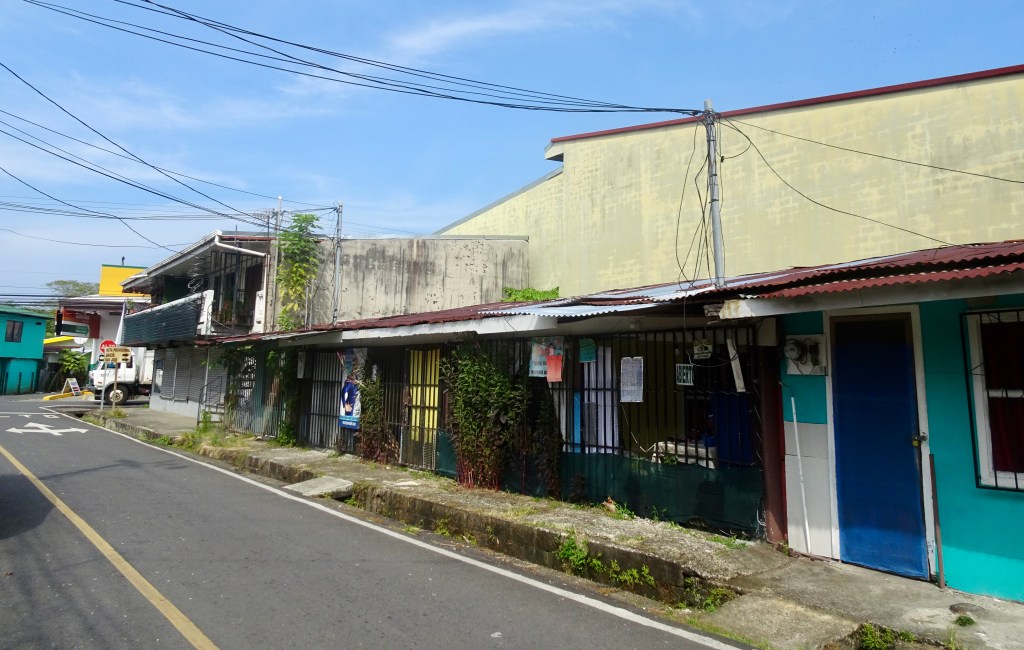
Quepos is a busy little port town, and since it serves mainly as a tourism transfer point, the infrastructure has not been polished. Streets and homes are modest. See those ditches? They are there to accommodate the torrential rainfall; I wonder how many times a driver miscalculates and finds one tire stuck in the ditch.
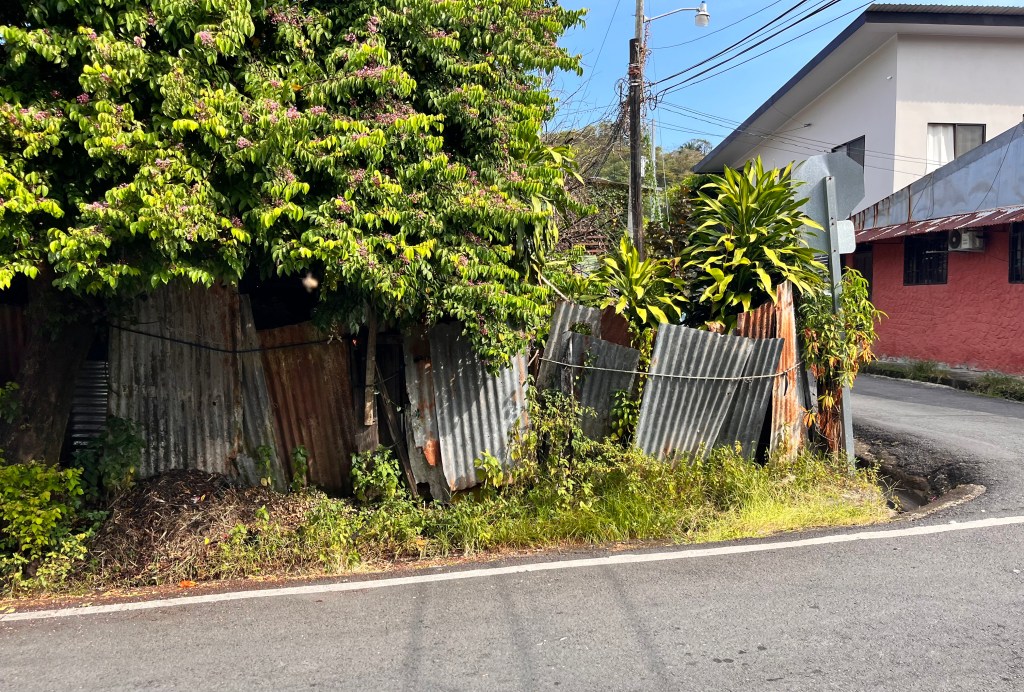
There is a lot of jerry-rigging in Quepos – materials are salvaged and put to use.
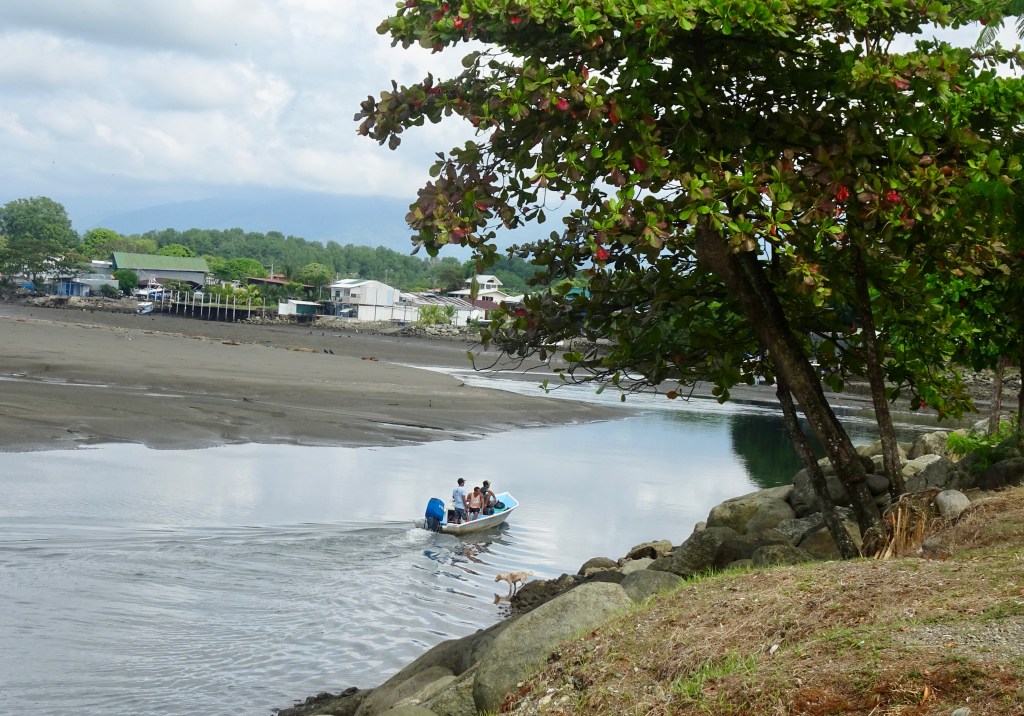
We headed down to the boardwalk on our first day here, and while it was far from being a polished malecon, we found beauty and tranquility as we sat in the shade and watched the world go by.
We almost missed this tough old fella sunning himself just beneath our feet.
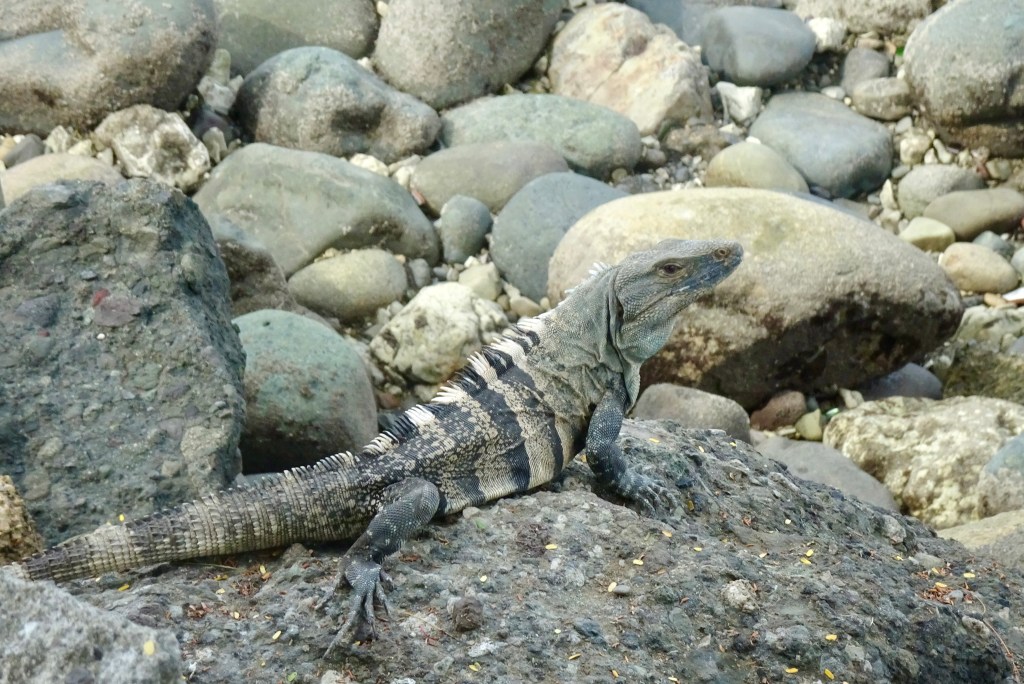
But…first impressions never tell the whole story. As we walked further along the malecon, we came upon a swank development with upmarket stores and restaurants and an even swanker marina to go with it.
By this time we were nearly crazed with the heat, so we approached a waterside restaurant and asked if we could just come in for a drink.
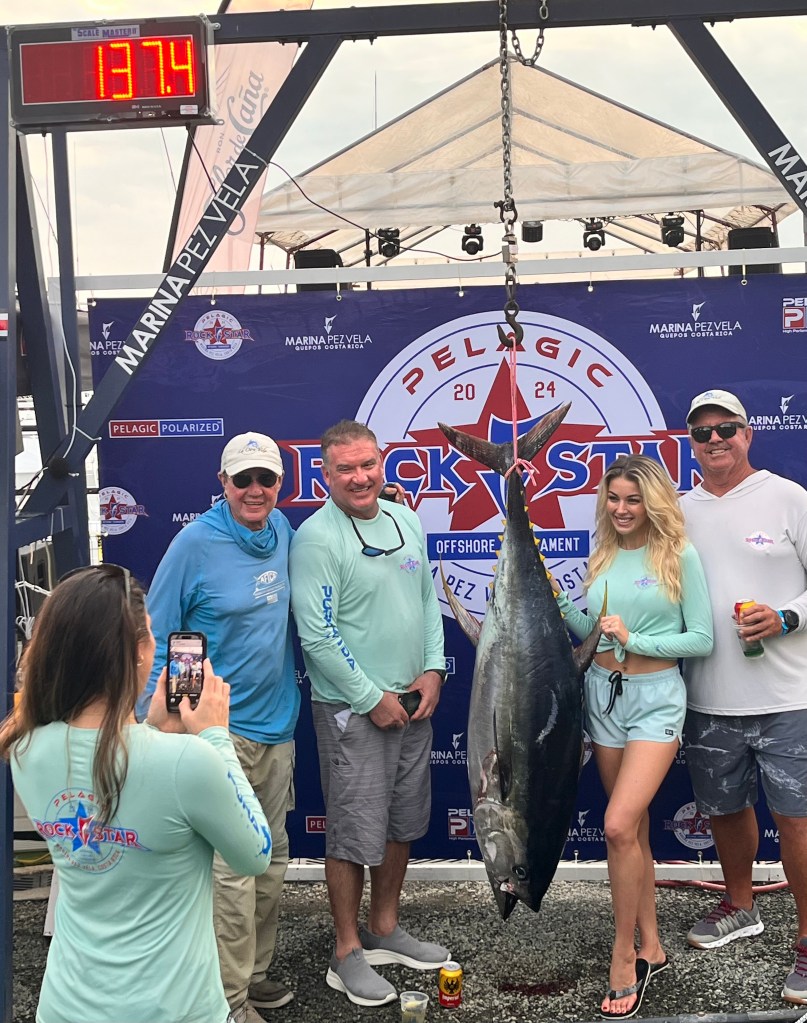
As it turned out, we had arrived the weekend of the annual Pelagic Rockstar Offshore Fishing tournament, which is a very big deal – the largest and richest tournament in costa Rica. Once I got over my confusion (I thought our server was saying a Pilates Tournament), we began to take in our surroundings.
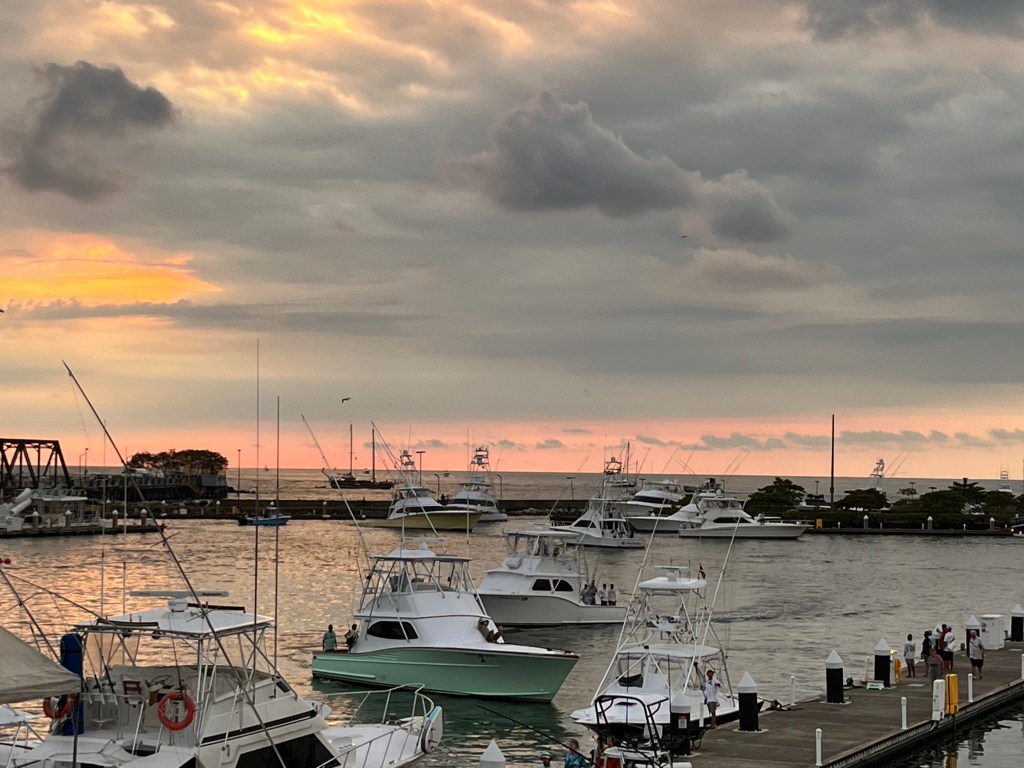
We decided to come back that afternoon to watch the sunset and have dinner. We knew it would be busy, so we ran down there at 5:00 and snagged the last table. This was our view.

Every time I am around boaters, I always feel like I am missing out on a whole world of fun. Boaters are tanned, relaxed, happy people. This crew of international sports fisher-(people?) have even more to smile about. They sail around the world catching 400-lb. marlin and 130-lb. tuna and then they compete in tournaments and win big money. The Pelagic, which attracts competitors from all over the world including Canada (as the announcer yelled out incredulously) has a $US 1.3 million dollar purse, divided up into a number of categories.
We weren’t around long enough to see the winners, but we did see some old-fashioned testosterone-fuelled showmanship – the announcer, the fisherman, the fish and the eye candy.
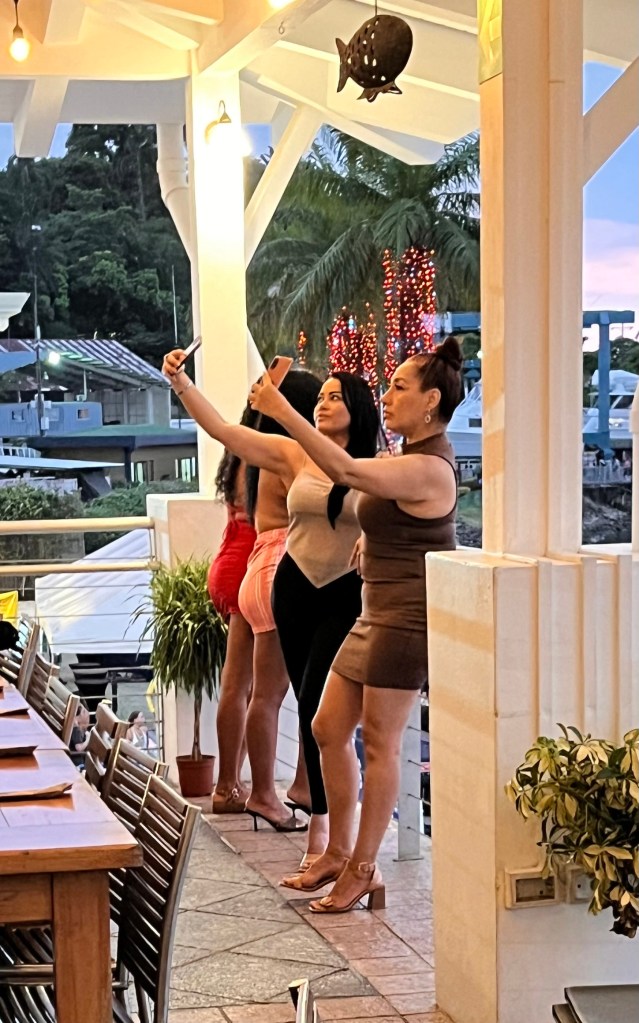
Speaking of eye candy… These ladies were standing just down from our table and causing poor Stephen a little consternation. Latina women already have a lot going for them and then they add on – nails, hair, make-up, heels, perfume, stretchy micro-dresses and attitude.
As we watched the endless preening and pouting and posing, it struck me. Latina women are not plagued by body image – they dress to the nines and they love their curves.
And…the reason we were there in the first place – the sunset and the boats.
Costa Rica is not just about the animals and birds. We saw another side in Manuel Antonio; the juxtaposition between working class and international money. Tomorrow we are heading to Monteverde for a few days in the blessedly cool cloud forest.


Wow. The Park sounds like it has changed tremendously in the 20 years since we visited. Bob was not surprised. We were the only ones in the Park the day we visited that beautiful place. We loved it! Your comments on Latin ladies is right on. We see it here in Mexico as well.
LikeLike
You think about how much travel has changed in 20 years. I feel fortunate to have done the travelling I’ve done already, but every place we go now is busy, busy, busy. Still trying to find the path less travelled, but it’s getting harder. Crowds, $$$, lineups. Still…it’s worth the quest.
LikeLike
You’ve mentioned the heat a few times since you arrived in CR, but it hasn’t come in older trip blogs, and you’ve been to some pretty warm places. Is it the humidity? Time of year? Proximity to the Equator? Recent arrival from Canada? Hopefully moving on to higher ground will help. A pleasure to read, as always.
LikeLike
Not sure what it is, Mike – that’s a good point. We found Galapagos very hot, Thailand hot and humid, most of India very hot, but somehow the heat in Costa Rica has been tough to bear. Right now we’re up in the mountains in Monteverde with a steady breeze, much lower temps, and the slightest little graze of moisture in the air – barely discernable, but cooling.
LikeLike
I’m not a huge fan of monkeys either. I’m just as content looking at pictures of them, although I must admit they are interesting to watch (in my case from a instance!)
LikeLike
It’s funny to watch people when there are monkeys around – everyone is so excited and charmed by them, but as soon as one of them climbs down and appears to be approaching the crowd, they all back away quickly!
LikeLike
Would love to be there with you. My niece Heather had a place near Manuel Antonia National Park. The monkeys befriended her
LikeLike
I do think these monkeys would not do any harm, other than perhaps steal your sunglasses if you left them on your beach towel. I’m sure if you lived here you would develop a real fondness for them.
LikeLike
Guess we should learn to embrace our curves too eh Ginny. Hope you still get to find a Quetsel bird. Their colours arLooddddddddddddddddddddddddddddde beautiful. Watch those white faced monkeys don’t steal your sunglasses etc. They are quite the thieves. We too loved the beaches there. Don snorkeled but I chickened out. A sea lion fluttered by him but I would have freaked right out.
Enjoy he heat. We’re freezing here in Langley with a couple of feet of snow and freezing rain now.
Now I hope you find some Sloths and babies.
Love Lyn
LikeLike