I was desperate to see a sloth; a sentiment not shared by Stephen at all. He just didn’t get the attraction, and was unfazed by the fact that as of yesterday, this was as close to a sloth sighting as we had come.

Okay, so perhaps that black shape more closely resembles a Sasquatch baby than a sloth, but this was as good as we were going to get without a guide. Sloths are notoriously difficult to spot and in most cases are so far up in the trees they are not even visible without a telescope.
My advice to anyone coming to Costa Rica with their heart set on seeing a sloth: GET A GUIDE. This was what we saw with a guide, over a two-hour tromp through the jungle:


The male sloth, made distinctive by the orange stripe on the belly. The females have grey stripes. Typically, one male and three to four females can be found in a small territory of 100 metres.

Mother and baby. Mother sloths will actively care for their young for the first three to four months of their lives. After that, the babies are ready to care for themselves, although the mothers keep a close eye out for another couple of months.

The sloth was smiling at me. The fact that sloths are so ridiculously cute and we all think they are actually smiling at us is a huge part of their appeal.
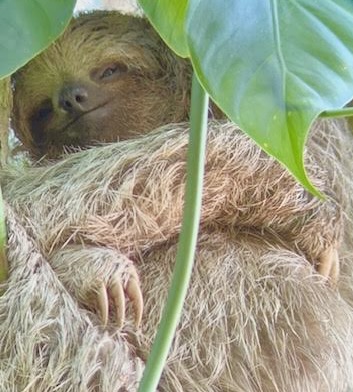
There are two-toed and three-toed sloths in Costa Rica. Known as el perezoso (lazy) in Spanish, the word sloth has entered our vocabulary as a synonym for sluggishness, lethargy and indolence. Sloths possess a tremendously slow metabolism, in part because their diet consists primarily of leaves and very little protein. They can take up to a week to digest a single meal, and they only defecate once a week; a laborious process of climbing down from the treetops that can cost them 30% of their energy.
Sloth fur is somewhat unappealing. It has its own ecosystem of algae, fungi, moths and mites; a symbiotic relationship that can give the fur a green tint. While all of that should be a turn-off, sloths still capture the imagination of most of us lucky enough to see them.
While our guide specializes in sloth-spotting, he also pointed out this strawberry poison dart frog, also known as a blue jean frog – a one-inch critter that while it is not known to be lethal to humans, is still unpredictable in its effects on skin contact and best left undisturbed.
This one was hiding in leaf litter on the ground.

We also saw two beautiful birds. The Rufous-tailed Jacamar.

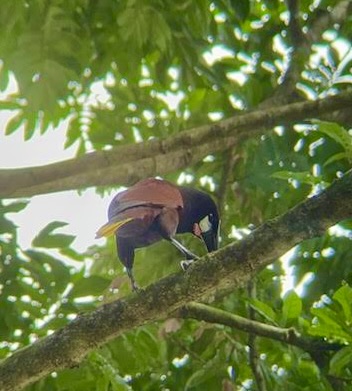
The Yellow-tailed Montezuma Oropendola
Arenal La Fortuna has been our home for the past four days. We arrived here by the popular route from Monteverde known euphemistically as “Jeep Boat Jeep“ but is in fact, “Van Boat Van“. We were picked up by air-conditioned van at our Airbnb, driven for two hours, dropped at Arenal Lake, ferried across by boat and picked up on the other side by van and dropped to our Airbnb here. Very civilized and a nice break from our usual humping of backpacks along sweaty streets to a sketchy bus station.
La Fortuna is touristy but not overly so and the locals still far outnumber the gringos. There is a beautiful park in the centre of town that serves as a hub; most of the restaurants, shops, tour operators and hotels span out from here.
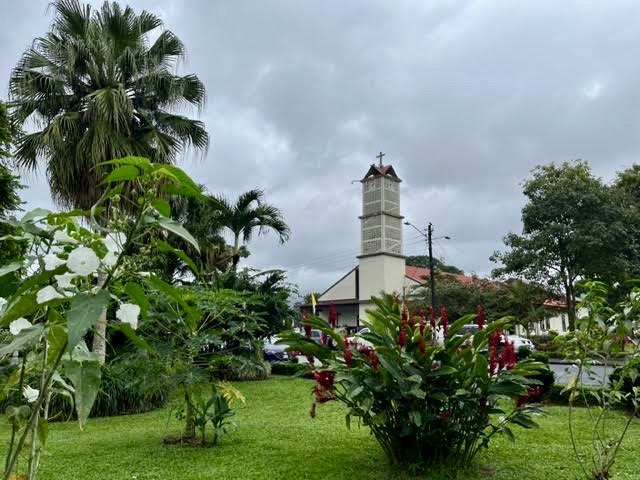
The main attraction here is the Arenal Volcano; at 5,358 feet it is visible from most parts of town on a clear day. During our stay we had low cloud cover and periods of rain, so we never did have a good view.
Arenal Volcano is quiet but still active; its last major eruption in 1968 caused severe destruction to three villages and killed many people. A nearby smaller volcano is inactive and is a popular site for hiking.
We had the choice of visiting Arenal Volcano National Park or Arenal 1968, a privately-owned park. We chose the former, based on our great experiences so far with Costa Rica’s national parks. We did not have clear visibility that day, certainly not the fault of the park, but we were quite disappointed with the trails and the facilities. Everything seemed a little shabby and uncared for. Quite possibly, like many of the world’s national park systems, they are underfunded.
We walked through a lot of bamboo forests.
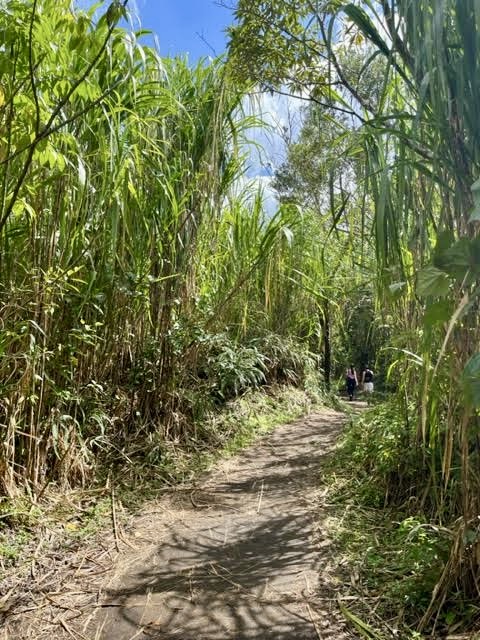
We picked our way carefully over the lava flow trail, remnants of previous eruptions.

We reached the top of one of the lookouts to Arenal Volcano and sat for about 20 minutes, willing the clouds to move enough to grab a clear view, but it never happened.

The national park did not have a restaurant, so we walked 500 metres back up the hill to the privately-owned park Arenal 1968, to have lunch. The cafe was situated at the top of a hill, surrounded by gardens. This was the view from our table, an almost-unobstructed view of the volcano:

And these were the surrounding gardens:
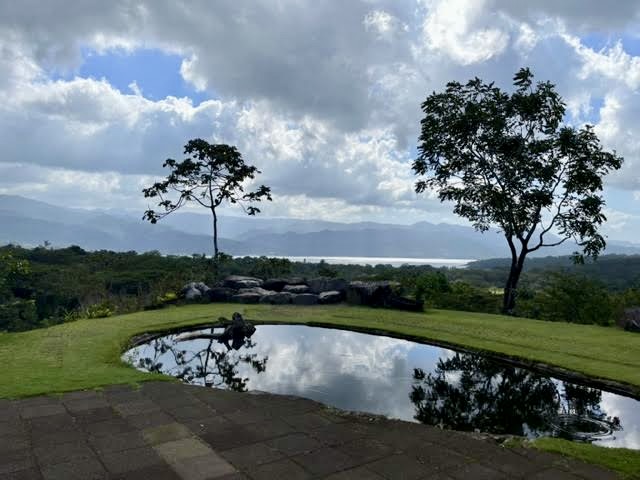
And these were the brazen white-throated magpie jays who were keeping a close eye on our lunch.

This was a memorable experience, and although we didn’t go through this park to compare it to the national park, we felt disappointed that this had not been our choice.
Still, everything in Costa Rica is a fresh experience. As I write this, I am sitting by the window overlooking a grove of palm trees. A boy just rode by on a bicycle, past a dog sleeping in the shade.
This is our Airbnb rental – we sit on the bench upstairs with our morning coffee and watch the hummingbirds.

The Bogarin Trail is another private park, within walking distance of our place. They have a number of trails that loop around the park, preceded by this teaser at the entrance. Two posts with fruit attached have been set up to entice birds; the area flanked by comfortable rocking chairs for those who just wanted to sit and observe. I think this is a yellow-tailed Montezuma oropendola.

The big thrill were the toucans – tons of toucans. They seemed to be coming out of a perch in a tree, then swooping out and landing on branches. They’re very active – we watched for several minutes.


Hanging Bridges are a big thing in both Monteverde and La Fortuna. They are suspension bridges set high up among the treetops to capture different views of the jungle and its inhabitants. Marketing photos show monkeys hanging off the railings, but even without that bonus shot, this was an incredible experience.
Views are jaw-dropping and even though our chance to have a clear view of Arenal Volcano from this bridge was not successful, it was still a glorious sight.

One of the six hanging bridges. It is a mildly unnerving experience to walk across these bridges. They have a natural side-to-side sway that make photo-taking a bit of a challenge and does require you to hang onto the railing for balance.
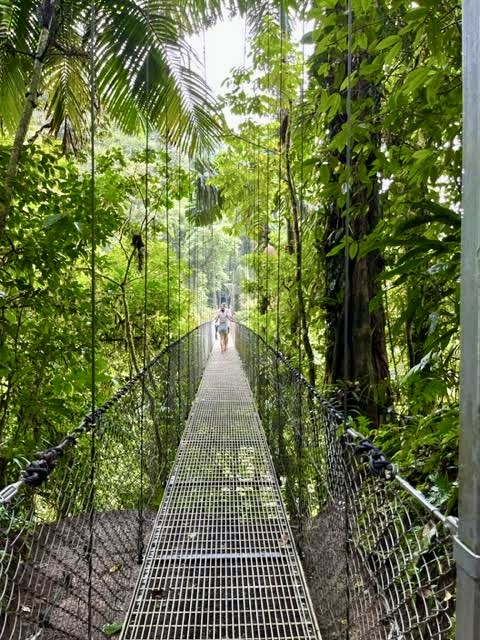
These stable fixed bridges were just part of the trail system.
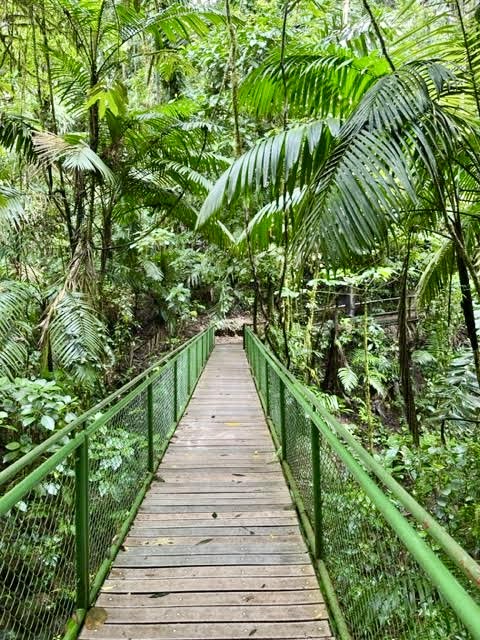
Photogenic trails.

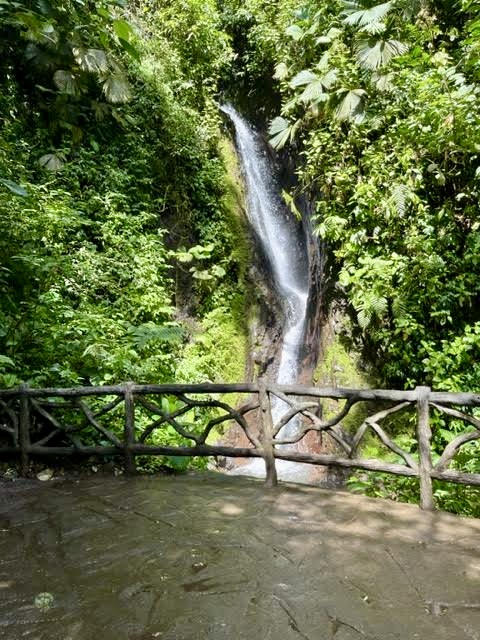
One of the side trails, leading to a waterfall.
As much as we have been well warned to stay on the trails, wear closed-toed shoes and avoid touching trees or plants to avoid contact with venomous snakes or frogs, so too are we cautioned against harming the trees.


Every place we have visited in Costa Rica so far has been quite distinct in landscape, birds and animals and climate.
Tomorrow we go “Bus Bus Bus” to Cahuita, on the Caribbean side. This will be our last stop in the country – six days left before we head to Panama.
 Leaving Ourselves Behind
We had the same experience with the volcano, completely clouded over. Ended up buying postcards.
Happy travels.
LikeLike
Apparently La Fortuna is one of the rainiest places in Costa Rica! Still beautiful, though and the mist kept us cool.
LikeLike
I also was fascinated by the sloths, especially loved watching them move! it seemed to take forever just to move an inch but they did move! very, very slowly…..such interesting animals. Loved your photos and stories as usual, enjoy the rest of your time in Costa Rica!
LikeLike
Thanks Rohana – we saw another sloth today at Cahuita National Park. It was even more exciting because we saw it easily in a tree, without binoculars.
LikeLike
Beautiful pics, Ginny! Loved the Sloths. Headed to Toronto early tomorrow to see the Grandboys. Enjoy Panama.
LikeLike
Ah – so your family is still in Toronto? Have fun with those grandkids!
LikeLike
<
div>Yes, they are still here or
LikeLike
🥰
LikeLiked by 1 person
Another great read having my morning coffee in the sunshine. Amazing photos and such a wonderful blog each and every time. Enjoy the rest of your stay there and will look forward to more interesting stories.
LikeLike
Thanks Sharon! I’m imagining you and Tony in your beautiful home in los Barriles.
LikeLike
When I read that sloths have territories of only 100 square metres it didn’t seem like much, but moving as slowly as they do, it must take quite a long time to go from one side to another. More sloth facts: moving slowly makes them less likely to be spotted by predators, as does the algae that grows on their fur, which provides a natural camouflage. Also, sloths make poor pets – I guess we kinda knew that.
LikeLike
Lousy pets. Stinky, shedding mites on the carpet, and no help at all around the house.
LikeLike
I learned some interesting facts about sloths from your post. I’ve seen sloths before but always in captivity. It must have been thrilling for you to see them in their natural setting – well worth opting for a guide!
LikeLike
I don’t know what the attraction is, Heather. I guess they are kind of a national symbol – like seeing a kangaroo or a panda bear -you’re naturally curious about them.
LikeLike
Another interesting blog of your fascinating adventure. I have enjoyed seeing and learning about all the new animals and birds. Never had heard of the “sloth” but they are darn cute. Also, I see that you found another cute Airbnb. Hanging bridges look challenging. Good for you to a. Let the challenge.
enjoy your last days in Costa Rica and we look forward to seeing your blogs about Panama.
LikeLike
Thanks Julie! I guess you’re all adjusted to life back in Nanaimo – it’s always good to go away and good to come home again.
Hope all is well with you two.
LikeLike