Panama City was an accidental destination. We had planned to go to Peru directly from Costa Rica, but Stephen discovered a flight option with Copa Airlines that was too good to pass on – up to a five-day layover in Panama City at no extra charge.
Exploring the country of Panama would have to wait for another time, but the opportunity to see the Panama Canal, walk through the historic streets of Old Town and get a teaser of Panamanian culture was irresistible.
At first we were looking at the newly gentrified neighbourhood of Casco Viejo (right on the waterfront, beautifully restored buildings, site of many tourist attractions), but couldn’t close the gap on hotel room prices, so we moved up the street to an Airbnb in the yet-to-be-gentrified barrio of Santa Ana.
This is our street, the pedestrian-only Avenida Central, as viewed from our balcony.

This is our apartment, bottom on the right.
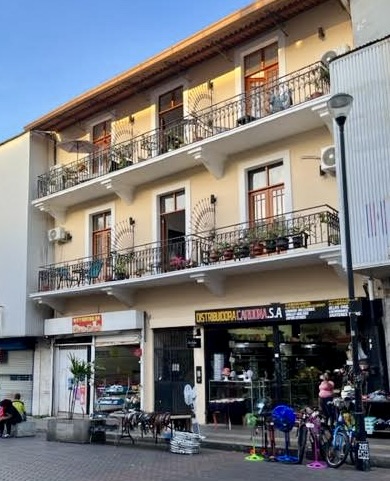
The local restaurant, right across the street, favourite of locals, tourists, cops, and teenage boys. A fresh fruit drink and a piping hot empanada can be had for $2.75, with lovely people who work 14-hour days, seven days a week.

Our host, Jonathan, is passionately devoted to this area; an area that until recently was considered a no-go zone. Thanks to a major police presence that threat has greatly diminished, but the overhaul of old buildings and the installation of cool restaurants has yet to happen. Jonathan is a pioneer in having the courage to renovate eight suites in our building and trust others to follow.
We enjoyed watching the local colour from our balcony, we felt entirely safe walking in the area at night and we were within a five-minute walk to Casco Viejo.
This was the scene up all the side streets in Santa Ana; run-down and populated by people living in poverty. As Jonathan told us, “No reason to go up those streets, they are not touristic.” I think it was his discreet way of asking us not to be voyeuristic.

And so it goes – the frustration and anger among a population who see evidence of vast wealth in their city, with almost nothing passed to them. A taxi driver told us the average annual salary is US$25,000, with the minimum wage in Panama at just US$700 a month.
Lotto sales are a big thing here; three times a week tables are set up and locals try their luck.

When I thought of Panama in the past, a few images came to mind: the canal, Noriega and the U.S. invasion.
Panamanians appear to be imprinted by two distinctive dates that have really shaped their destiny.
September 7, 1977 – the date Jimmy Carter signed the treaty to transfer the Canal back to Panamanians (although that was not actually implemented until Dec. 31, 1999).
December 20, 1989 – the day the U.S. invaded Panama to capture Noriega. While it could be argued that the intention of democratizing the country was an honourable one, many felt the execution of that attack was massively heavy-handed and had devastating consequences. The U.S. army steamrolled through Noriega’s neighbourhood, El Churrillo, an impoverished working-class barrio, bombing and destroying much of the area and killing thousands of people. In the absence of Noriega’s monopoly, a newly hatched drug trade began to flourish, turning El Churrillo into a violent hellhole of turf warfare and brutal murders. It has taken years for police to bring back the neighbourhood, but it remains a danger zone; one that even taxi drivers avoid.
What can only be described as a “lapse” on our part, we decided to walk five kilometres to the Biomuseo on the Amador Causeway, with an unavoidable path straight through El Churrillo. We left the polished comfort of Casco Viejo, and soon were in a streetscape of garbage, dogs, broken pavement, and falling-down buildings.
When we encountered two police officers who seemed alarmed at seeing older grey-haired gringos, they kindly steered us to a safer, albeit longer path to our destination. We arrived sweaty, slightly exhausted and slightly sun-stroked. Another example in a long list of “what were we thinking?”
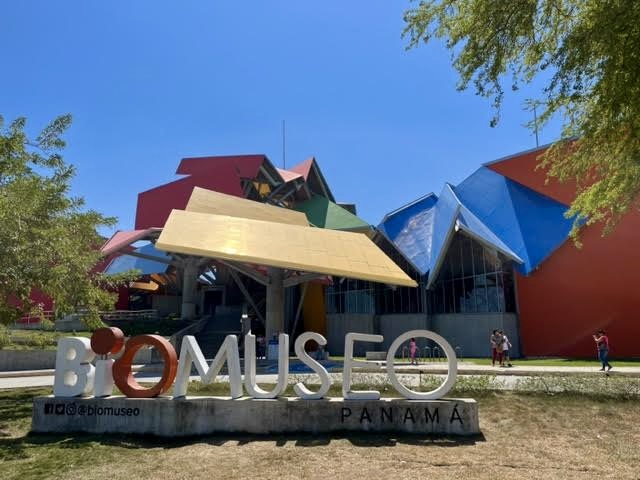
The Biomuseo was a fascinating museum of the natural history of Panama, focusing on the importance of how the isthmus changed the world’s development, in particular with the ongoing migration of animals and birds between the two continents. Interactive, well-laid-out and as a bonus, designed by architect Frank Gehry; his first installation in Latin America.
The Biomuseo is set on the banks of the Amador Causeway.

The Amador Causeway, which was built from the rock extracted during the building of the canal, was originally constructed to protect the southern entrance to the canal. It extends six kilometres out and houses parks, restaurants, hiking and biking trails and the Biomuseo.
And… on to the Panama Canal. I had an idea that we could hop in a boat going through the canal, ride through to the other side, then turn around and sail back. It is possible, but since each passage takes about 10 hours one way, this would happen over two days and the novelty would soon wear off. I can only imagine what an experience it must be to go through (one way) on a cruise ship.
Instead, we had the opportunity (with roughly 1000 other visitors) to observe the passage of ships at the Miraflores Locks. The Miraflores Visitor Centre is comprised of a museum (currently under renovation), an excellent IMAX presentation about the history of the canal (narrated by Morgan Freeman), and the outdoor two-storey viewing area where we all crammed in to watch the ships and listen to the Spanish/English explanation of how the locks function.

The lock system is comprised of chambers that move the ships up to 85 feet high and then down again; three times up and three times down.
Ships are inched through (literally with inches to spare on either side), with the help of mules ( tank-like units that keep the ship on course as they travel down.
Being able to watch the progress of the ships passing through the locks is still not enough to grasp the magnitude of this engineering triumph.
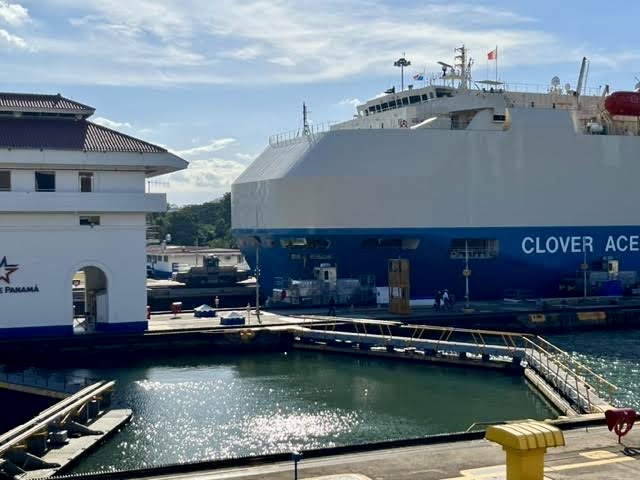
This is the rail path the mules travel up and down as the ship passes through.
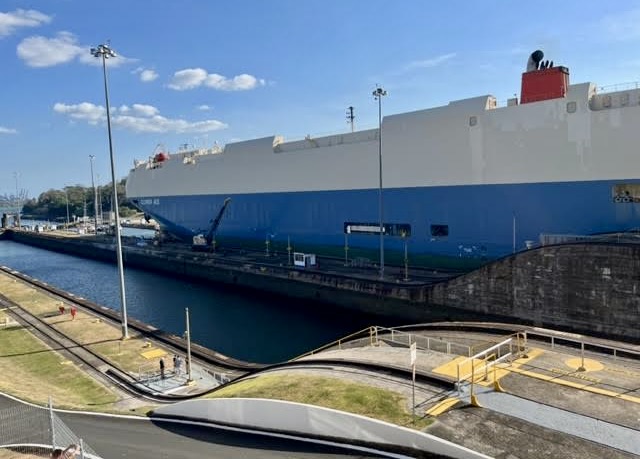
Roughly 40 ships a day pass through the Canal. Larger ships, like the one in the photo, pay a walloping US$350,000 to make the journey.
The building of the canal had been in the works long before the United States finally succeeded. The French made a valiant effort, but as they were devoted to a straight sea level canal, they were defeated by the mountainous terrain and a high death toll due to tropical diseases, accidents and the harsh environment. In total, over 25,000 people lost their lives to the building of the canal.
However, they laid the groundwork for the U.S.’s ultimate success; a key turning point was the damming of the Chagres River, which created a lake in the middle of the isthmus and eliminated the need for the almost impenetrable digging through mountains.
Long story short – the United States created a Canal Zone, a 5 mile buffer, which allowed construction from 1903 and continued until 1979, two years after the treaty signed by Jimmy Carter, handing the canal back to the Panamanians.
The Canal Zone is fraught with a history of discriminatory compensation practices. The labour force was divided into “gold” and “silver”. Gold was reserved for U.S. workers, with higher pay, better housing, education, health care and recreation, whereas Silver was for workers of colour, with much lower pay, substandard housing, and poor quality food.
This was not openly acknowledged; as illustrated by this Coca-Cola poster that suggests equality and friendship among Americans and Panamanians.

Coca-Cola is a BIG deal in Panama. In 1906, Panama became the first country outside North America to operate bottling plants.
The Cafe Coca-Cola, the oldest cafe in the city, opened in 1875 and has been named a UNESCO World Heritage site. A modest diner, nonetheless its visitors include Che Guevara, Fidel Castro, Eva Peron, and Pablo Neruda. It has become a hub in the neighbourhood.
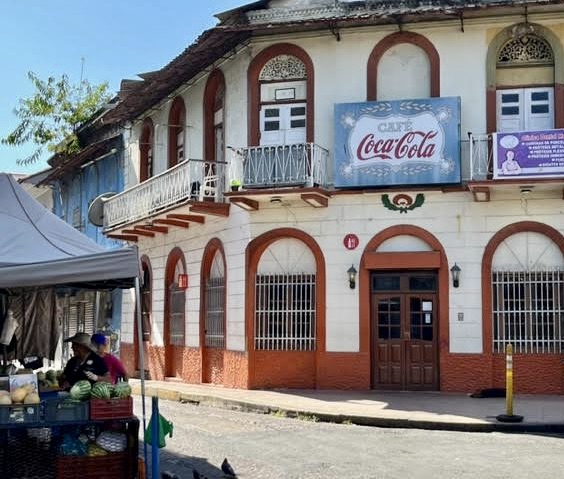
We ate there twice, as it was a three-minute walk from our place. In spite of its notoriety, little has been done to change the original. Prices were low, food was basic diner scoff (hamburgers, grilled cheese, spaghetti), and diners a mix of locals and tourists.

Just down the street from the Cafe Coca-Cola lies the neighbourhood of Casco Viejo. Just 15 or 20 years ago, this area was run-down and dangerous. Amazingly, street after street now shows off beautifully restored buildings, upscale shops and discreetly expensive restaurants.


While there is a feeling of prosperity in this neighbourhood, it seems everything is for sale or rent.

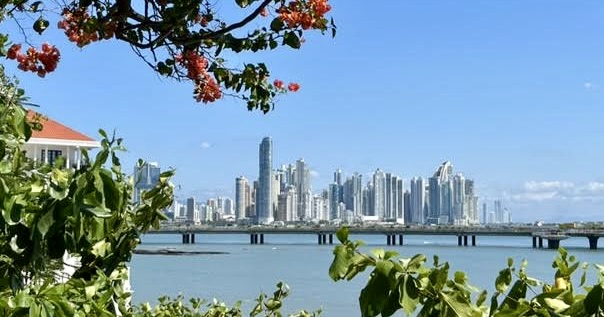
We were first struck by that impression of “not all being as it seems“, as we drove into the city from the airport. Downtown Panama City glitters. Luxury high-rise apartments and office towers. Architecturally innovative buildings tucked in beside five-star hotels. Lush gardens run alongside the ocean. And hardly a person in sight. Many of the buildings appear unoccupied; a cynical person could be forgiven for believing the rumours of money laundering and corruption.
We never did venture over for a closer look, we just viewed the Land of Oz from a distance.
We had so many memorable moments during our time in Panama.
We met Conrad, a sly 87-year-old who commandeered us on the first day when our defences were down. The next thing we knew we were being led around on a “tour“; with Conrad becoming less interesting by the minute. It cost us a few bucks more than it was worth, but no harm done.

Alex and Alanna (our son and daughter-in-law) went to Colombia and the San Blas islands on their honeymoon and gifted us with a mola, a beautiful piece of reverse applique embroidery done by the Guna Indians. We loved it and were keen to see more of them.
Molas were prominent here in Panama City, including at The Mola Museum, where over 300 examples are on display and the story of the mola explained.

While most Guna Indians live in the San Blas islands, many live in other parts of Panama. We stopped to watch a dance in one of the plazas, and I was touched by this group of Guna kids; as bored as any teenage kid anywhere.

Not so these little gazelles; chasing each other in the park while their parents drummed and danced.
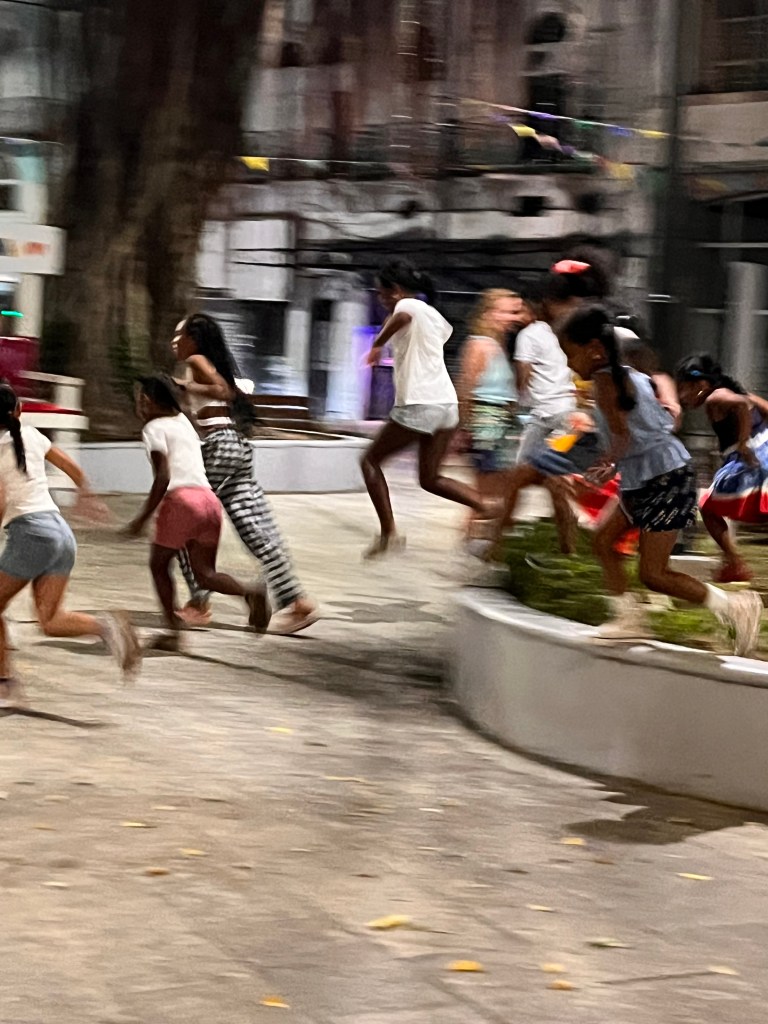
They leaped up to the gazebo and performed their own dance routine, and damned if the little ones weren’t twerking with the rest of the them! I even had a dance-off one night with a few excitable locals who waved me up off the bench. That’s the spirit I’ll remember – the warmth and joy of the Panamanians.
We wish we had more time here to explore the rest of the country. Next time…
Now, we’re off to Lima to begin our Peruvian adventures.
 Leaving Ourselves Behind
enjoy Peru !
LikeLike
Thanks Danielle! Any travel plans this winter?
LikeLike
Loved your story and photos of Panama, thanks! I was only in the airport once and always curious. I am really looking forward to hearing and seeing about your time in Peru as that was one of my favourite countries in S. America. If I was younger I would love to go back. Stay safe and have more wonderful, educational and sharable experiences!
LikeLike
Everyone loves Peru, it seems. We can’t wait to really start exploring.
LikeLike
We really enjoyed Panama, it’s quite different from the capital. Hope you get to explore the rest one day 🙂 Maggie
LikeLike
I think we will be sure to do that, and maybe tuck in Cartagena at the same time.
LikeLiked by 1 person
Oh Cartagena has a great Old Town!
LikeLike
Sometimes “accidents” turn out to be a blessing in disguise, as was the case for you, enabling the two of you to see and experience a place you didn’t intend to visit!
LikeLike
It’s so true, isn’t it? Not possible or even wise to try and plan everything.
LikeLike
Brief excursions into sketchy neighborhoods aside, I’ve always admired your willingness to immerse yourselves in the places that you visit, as much as it’s possible to do so. The people that you meet always seem to respond well to you, and it must make memories that you wouldn’t have behind the windows of an air-conditioned bus. May the travel gods continue to watch over you!
LikeLike
I think we’ve been luckier than we deserve sometimes!
LikeLike