We’ve just spent our first week in Peru; in the clifftop waterfront neighbourhood of Miraflores, Lima to be exact. Miraflores is where most tourists tend to gravitate to, even the backpackers. Although the descriptors “upscale”, “luxury shopping” and “highrise hotels” are not normally our drivers, we decided to play it safe and go with the masses. Surprisingly, Miraflores has been a whole lot more interesting than we expected and it is a calm and walkable pocket in this chaotic city of 11 million people.
We’re staying at an Airbnb just a few blocks from the waterfront. This is the side view from our balcony (described rather ambitiously as an “ocean” view).

An intriguing aspect to Miraflores and much of Lima, is that it rises dramatically about 300 feet above sea level, with cliffs creating one barrier to the sea and the Pan-American Highway creating another.

There is a malecon which runs for several kilometres along the clifftop. This is one of Lima’s greatest attractions; a lush, well-designed park system that is dotted with walking paths, biking paths, benches, manicured gardens and sculptures.

A major meeting place is the Larcomar Shopping Centre, right at the foot of our street. It is an open plaza, circled by the malecon, which offers dozens of stores, restaurants, and services, even a movie theatre.

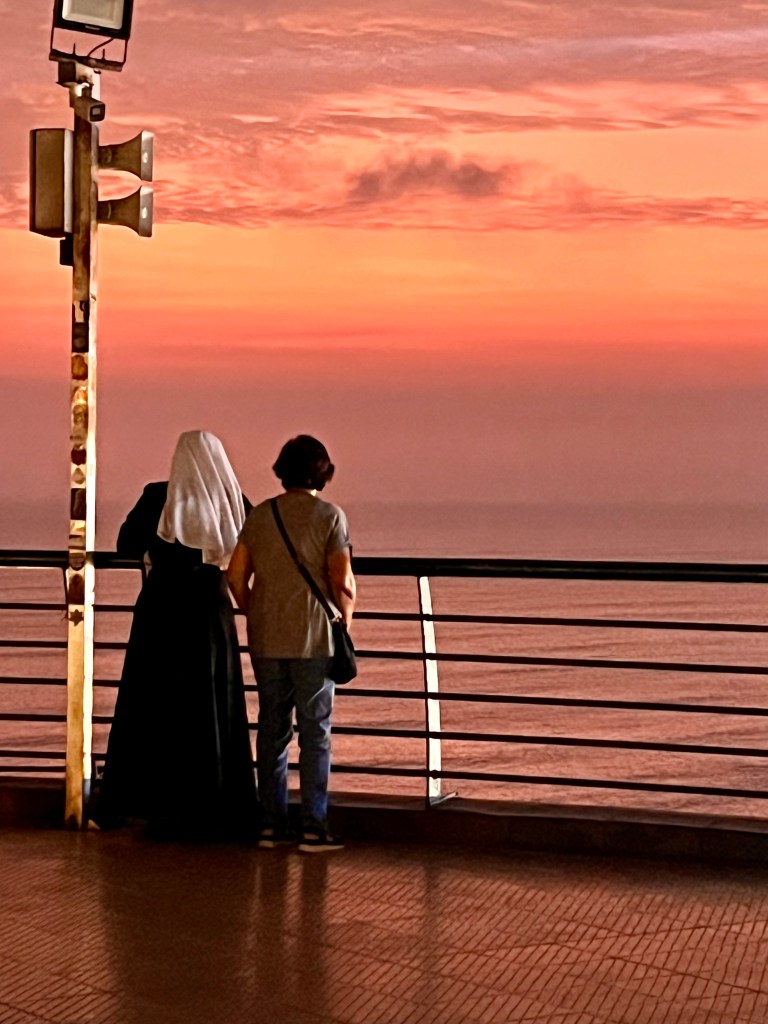
As plazas go, it was extremely pleasant to browse around in the open air, but I never saw a lot of actual shopping happening. The crowds were all there to hang out and watch the nightly show. Stephen grabbed this shot.
On our first night there, we wandered along the malecon after sunset, then turned up a side street and came upon this extraordinary sight.

It is a memorial set up to honour the more than 260 doctors who lost their lives while treating Covid patients. It took a while to register what we were reading, until the dates (2020s) started to sink in. A gentleman walking by confirmed they had died of Covid. Further research told the tragic story of a country with a health care system in shambles before the pandemic and the chaos that followed with no PPE and facilities collapsing under the strain. I couldn’t find information about how many other health care professionals also died during the pandemic, but those numbers must be two to three times higher.
It was sobering to see this visual evidence of how different countries were affected during Covid and how poorly many of them fared, in the absence of PPEs and later on, a vaccination program. It’s also freshly aggravating to think about Canada’s self-appointed “freedom fighters”, who have no idea how well-protected we were during Covid and what freedom that has provided us now.
Subject change: Can’t get enough of these gorgeous trees, a common sight on the clifftop malecon.

A much-visited site along the malecon is the Parque del Amor, with the giant “El Beso” (The Kiss) by renowned Peruvian sculptor Victor Delfin as the centrepiece. Unveiled on Valentine’s Day, February 14, 1993, this provocative piece portrays the artist and his wife in a passionate embrace. It is apparently a frequent backdrop in wedding photos and every Valentine’s Day, couples enact their own “beso” in front of the sculpture.
If you look closely at the background on the bottom left, you can see a chain link fence filled with thousands of “love locks“, and the tiled walls are filled with amorous sayings.

I guess this falls into the “love” category (or the “it’s-never-too-late-to-learn category). A sweet scene of a young man helping his nervous girlfriend learn how to ride a bike, made so much easier in Lima’s truly insane traffic, by the presence of bike lanes.
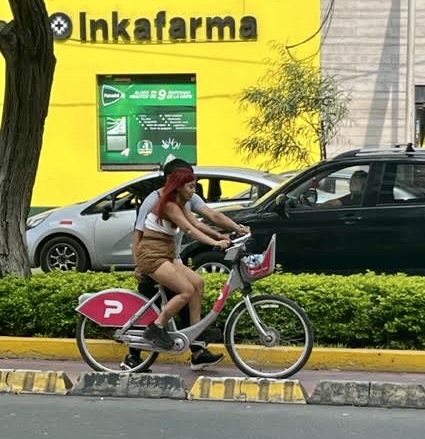
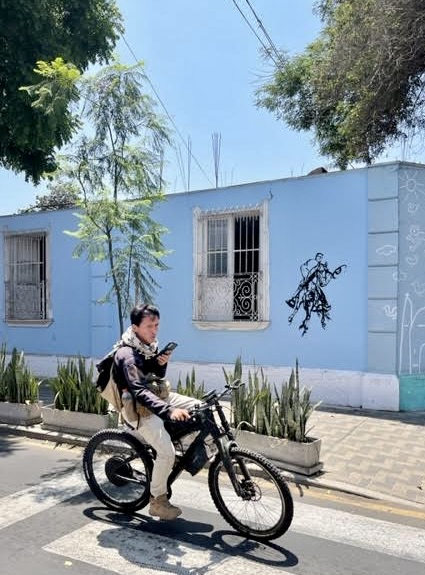
Cyclists are well taken care of in Lima, or at least in Miraflores – designated lanes run on most major roads. Even on non-designated lanes, cyclists seem extremely relaxed.
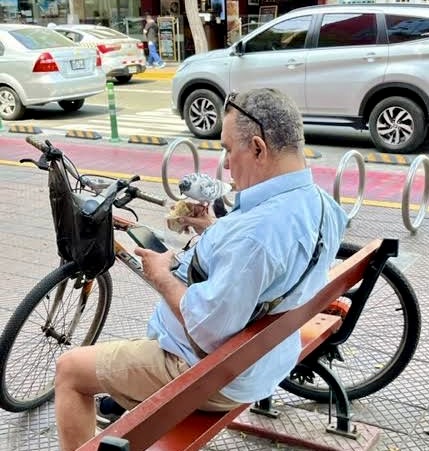
We saw a sight yesterday that gave me pause, but then again, when we’re travelling, I live for this stuff. I’m assuming a lot, but a) I’m assuming this is not this man’s pet pigeon, b) this is simply a random landing that has not been discouraged and c) this man may eat the rest of his sandwich after he has allowed the pigeon to peck away at it for a while. Gross, but then again, we allow our dogs to lick our faces.
Food in Peru. We are in for a treat for the next two months – Peru has an international reputation for wonderful food and so far, we have not been disappointed. While I may not be able to bring myself to eat cuy (guinea pig), I am hoping to try as many different dishes as possible.
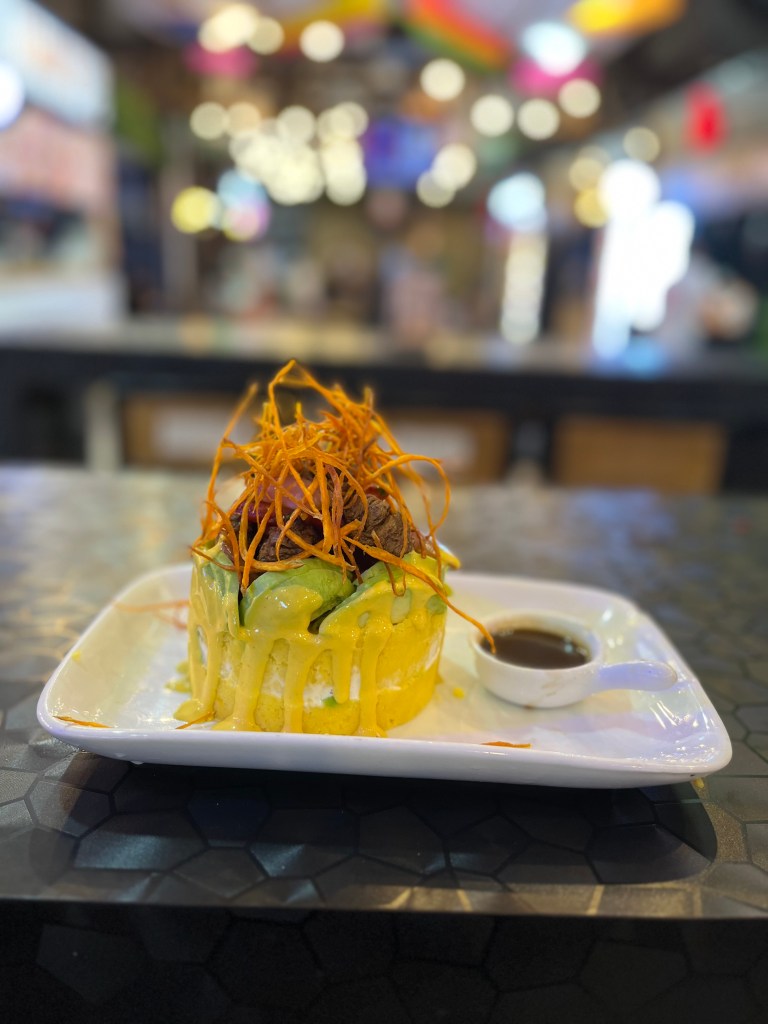
This is a variation of causa - a dish made of yellow mashed potatoes, wrapped in avocado, stuffed with any number of fillings (in this case tender beef), drizzled with a savoury sauce and topped with razor-thin sweet potatoes. I had one today topped with incredible fish ceviche and calamari.
And then there is Peru’s answer to Coca-Cola – Inca Kola. It is every bit as sweet and bad for you as “the real thing“, except this one tastes exactly like Double Bubble and looks like shade mechanic gasoline. it was fun to try, but I can’t see making it a habit.

The neighbourhood right next door to Miraflores is called Barranco – justifiably proud of its slightly grittier, more bohemian and definitely more artistic roots.
We walked along the malecon and just kept going until the scenery started to change a bit.

Around the corner from this park, we came upon the art gallery of famed artist Jade Rivera. He started out as a graffiti artist and over the years his art matured as he became more of a muralist. His paintings can be found in his gallery, on the streets of Lima and in a number of cities worldwide.
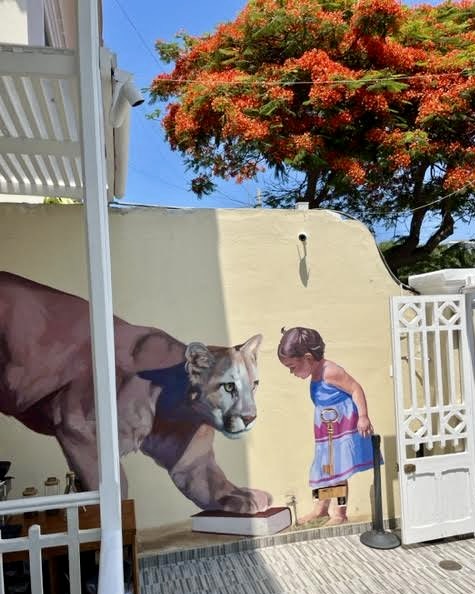


The streets of Barranco have a little more life than Miraflores, and seem that much more accessible.
The Bridge of Sighs ( so-named as it was frequented by lovers), is an inescapable part of the Barranco landscape and of course we walked over (twice), making wishes for good luck both times.
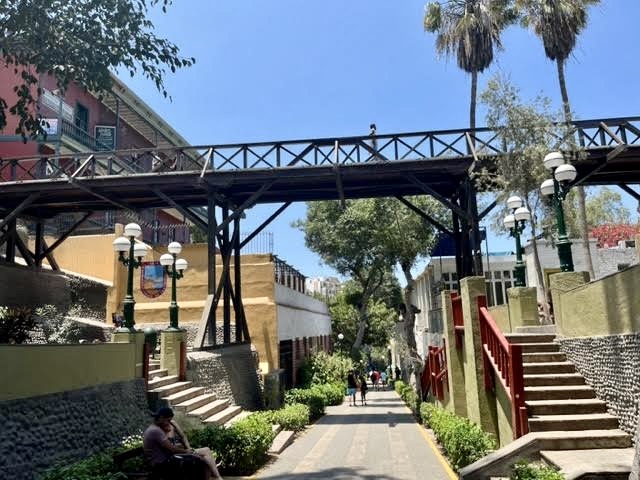
View from the Bridge.

A tribute to Chabuca Granda – a singer and composer who was born in the area in 1920, found world-wide fame and eventually lived in Miami, where she died in 1983.

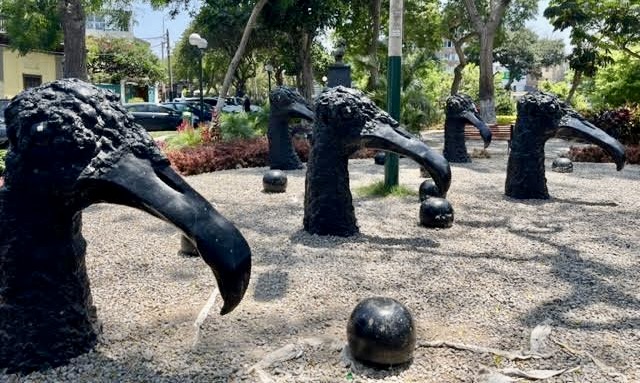
Park sculptures.
We took a walking tour to Lima’s Centro Historico, as we felt the information offered by a tour guide would be more local and rich than anything we could research on our own. That has usually been the case in the past, and our walking tours have added a lot to our understanding of a place.
Unfortunately, this walking tour was a bit of a disappointment. It was advertised as being Spanish and English, which I misunderstood, as I thought that meant, “either/or”, not “both”. We had a very large group – 25 of us, with Rubi leading us down the street and over several blocks to get to the metro. With all of that accomplished, we arrived 20 minutes later for what was supposed to be a 2 1/2 hour tour.
What happened instead was that at each point of interest, Rubi would first explain everything in English, and then tell us to walk around, take photos and come back in seven minutes (after she explained everything again to the Spanish-speaking tourists).
After two or three times like this, you could see the group was starting to crumble. We became quite bored and while we spent a lot of time learning about the national crest, I don’t remember a whole lot more.
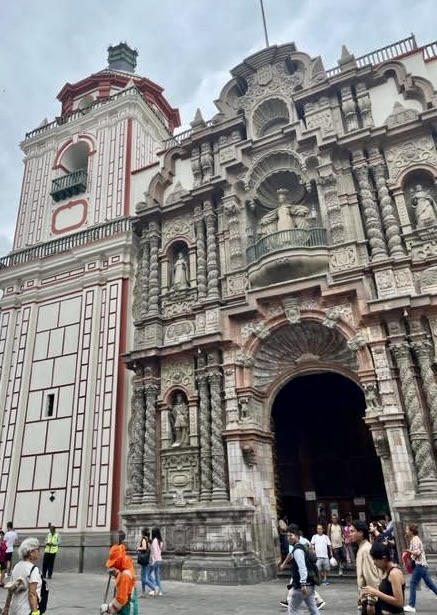
Lima’s centrepiece, the Plaza Armas was mainly closed off, due to recent protests. We were allowed in at one end and the following photos are of the various buildings we were not allowed to visit.
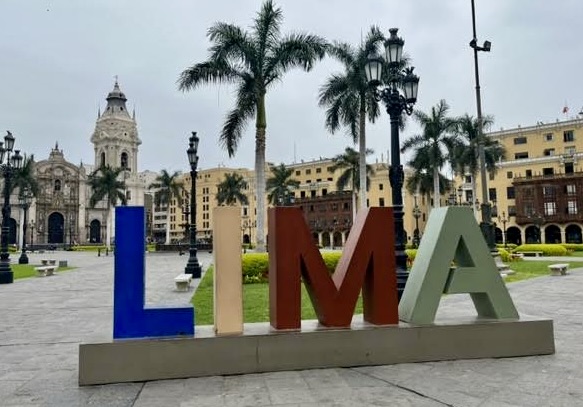
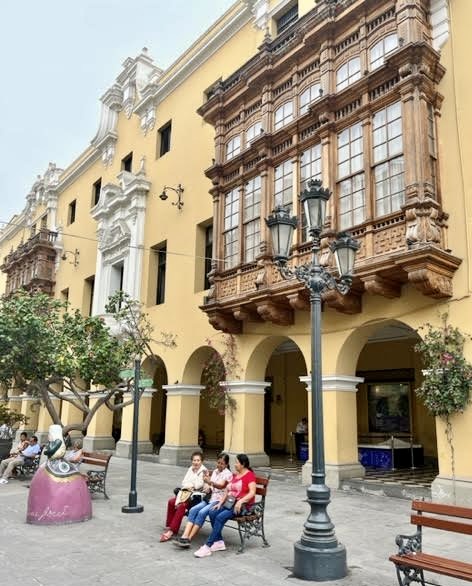
16th -century cathedral.
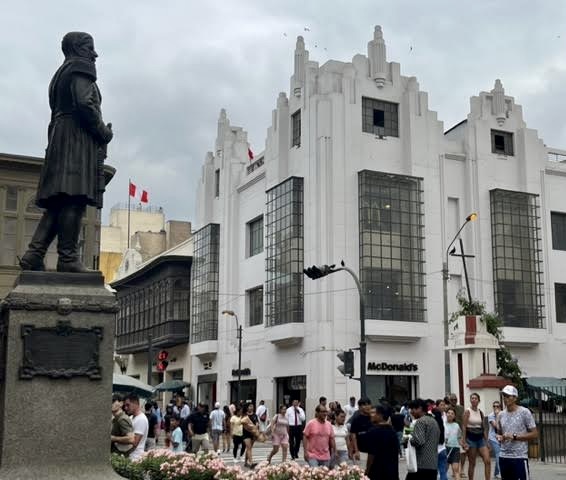
One of the more discreet McDonalds I have ever seen; housed in a beautiful Art Nouveau building.
This final stop on the tour was actually very interesting, possibly because this was about Rubi’s neighbourhood. The colourful houses going up the hillside are part of a revitalization project called Project Rainbow, instigated in part by artist Carla Magan, as part of an artist collective.
They took nine months and painted over 1000 houses, inspired by ancient patterns known as “Chakanas.” These can also be referred to as Incan crosses, thought to cross worlds and in this case, cross over from one neighbour to another and connect them.

We never really got a handle on Lima and I don’t think that was Lima’s fault. We didn’t love it, we didn’t hate it. It wasn’t the big city experience we were hoping for. It wasn’t Mexico City, which fills my heart. It was still fun – we saw lots of new things and we also just lived a normal life. I got a pedicure, which was a thrill and I’m very happy with the progress I’m making with Spanish.
We chatted with wonderful people who shared how they are exhausted with their long hours of work, fed up with the corruption in their country and with the ongoing protests that never seem to change a thing.
Tomorrow we head north to Trujillo, which is situated very close to the world’s largest and oldest adobe city. See you again in a few days.
 Leaving Ourselves Behind
love your stories and photos so far from Peru. looking forward to Machu Pichu! Stay safe and well,
love
Rohana
LikeLike
Thanks Rohana – we are also looking forward to Machu Picchu – leaving it almost to the last though. We’re trying to figure out how to keep ourselves acclimatized to altitude, make it to the Amazon and then back again without feeling the effects.
LikeLike
Hey there! Let us know if you’re planning to head to the north coast — we have friends in Mancora that we’d love you to say hello to.
LikeLike
how is the pisco compared to the Chilean one?
both countries want to be the inventor!
we had to cancel our trip to Chile due to high temp and fires in Valparaiso and vina del mar so sad
enjoy Peru!!
LikeLike
We haven’t had a pisco yet – I know – big oversight. I think the Peruvians are pretty much convinced it is their drink!
Danielle – what an absolute disappointment to have to cancel your trip. We couldn’t believe the photos of Valparaiso and Vina del Mar – like Hawaii – such destruction.
We met tourists from Vina del Mar on our walking tour in Lima, and they were lucky – their house escaped the fire. Still – we are all living with such unpredictable weather, and it seems no-one is safe anymore.
LikeLike
Michelle! Nice to hear from you and I see you and Maggie are back on Gabe again – good for you! Maybe we can catch up this spring or summer.
We won’t be in Mancora though. It’s a big surfing destination, yes? We are currently in Trujillo and then head to Cajamarca, and then after that, we go south again to Arequipa.
As is always the case, you miss as much as you see.
LikeLike
Michelle – your reply is below Danielle – I don’t know what happened!
LikeLike
Another fascinating post, you two. The photo of the doctors who lost their lives during the height of the pandemic is so moving. And Ginny, I’m sure I will use your phrase “freshly aggravating” (with attribution) often! Thank you for the love and care you put into your blog. Safe travels!
LikeLike
Thanks Shelagh – so much appreciated! I hope all is going well with you.
LikeLike
I see Stephen has found someone to keep him company on park benches! By the way, his sunset picture is stunning! I was particularly taken with the memorial to the doctors who succumbed to COVID while caring for the sick. How tragic.
LikeLike
Wasn’t that a gorgeous photo? You don’t get those sunsets every night and then you’ve got to know how to frame them. ( we don’t get nuns in our neck of the woods, either:>)
So tragic to try and imagine the loss of life on that scale among the health care profession – I’m sure that resonates so much with you.
LikeLike
The Bridge of Sighs – are Peruvians unlucky in love? If so, shouldn’t there be safety netting under the bridge? If not, is there a bridge for those who’ve been more fortunate? I’d vote for calling it The Bridge of Ginny and Stephen, if asked.
LikeLike
If walking around and watching the couples in Peru is any indication, I would say that most of them are batting 1000.
No, I think the “sighs” refer to those involuntary exhalations emitted when staring into the eyes of a beloved. No netting required.
LikeLike