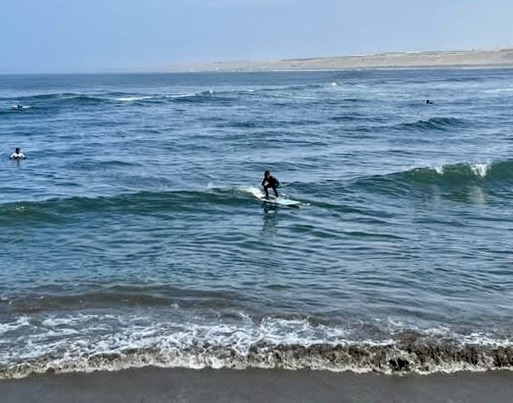
There is something so light-hearted and happy about watching surfers; you just know there is nowhere else they would rather be. Huanchaco, a small town just north of Trujillo on Peru’s northern desert coast, is pretty darn close to surfing heaven. Unlike many other destinations, this area has consistent waves all year, thereby attracting surfers of all ages and abilities.

We watched this dad teaching his little boy to surf. Dad was chest-deep in water and he talked and pointed, as his son straddled the board and waited for the right moment to launch. The “right moment” has always been an elusive element to me. I watch and watch and wonder why the dozens of bobbing surfers seem to miss wave after wave. Maybe I will have to try it myself one day to understand.
At any rate, this kid was catching way more waves than anyone else.
Surfers weren’t the only ones riding the waves. Fishermen in Huanchaco were riding their “caballitos de tortoras” ( little horses). These sleek skiffs, made of reeds bound with cord, have been in use for over 3500 years. Their design allows the men to easily cut through the waves; a larger boat would not have the same maneuverability. As well, they use bamboo poles instead of paddles.
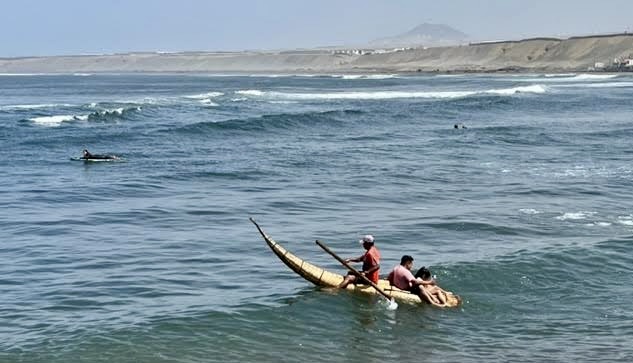
The boats typically last a month or two – most fishermen have two or three boats and are constantly creating one ones. When they are not being used to fish, they make excellent surfboards!

Huanchaco’s beaches are not really suitable for swimming as the water is rough and cold. But there are worse ways to spend a day than watching all the activity and wandering along the seawall.

A photo shoot in progress.

As interesting as all of this is, Huanchaco was really a diversion from our main destination. We flew north to Trujillo to see some ancient archaeological ruins – the oldest adobe city in the world.
Before I proceed, I want to share this sign with you – posted in the Lima airport. A similar sign was posted on the men’s washroom. Peru’s government is corrupt, their sidewalks are crumbling and many Peruvians live in dire poverty. But, they are kind and generous and inclusive people and this is not a sign you will readily find in more “enlightened” countries.

So…Trujillo. A northern coastal city of over one million residents, it is within spitting distance of some fascinating archaeological sites, but the city itself has little to recommend it.
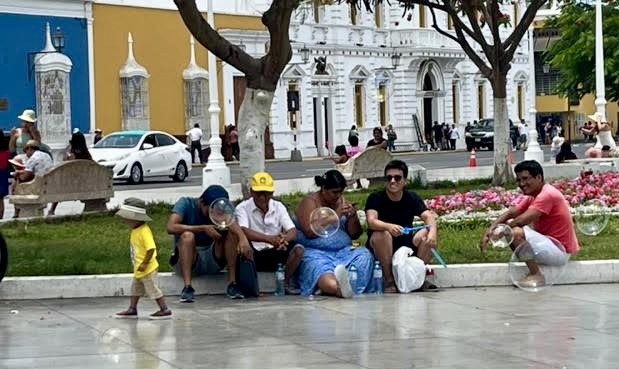
The main square, Plaza de Armas is quite beautiful. The centrepiece is the Monument to Freedom sculpture by German sculptor Edmund Moeller to commemorate Trujillo’s independence in 1820.

It is ringed by neoclassical and baroque buildings, including the yellow cathedral in the background. Tourists and locals try to grab a bit of shade and people-watch. Dad was having a lot of fun blowing bubbles long after his little boy lost interest.
A pedestrian-only street spokes off the square for several blocks.
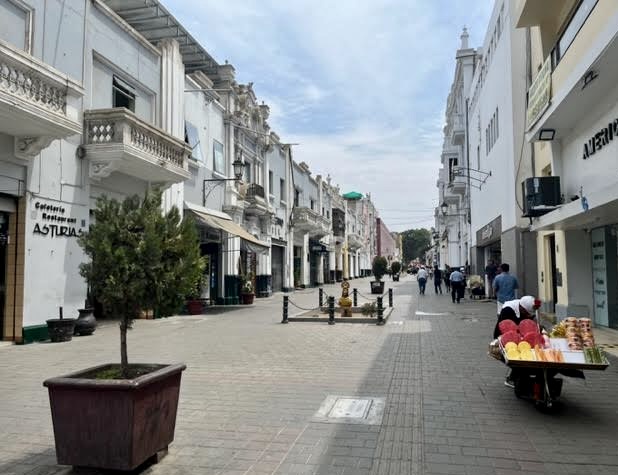
The architecture just off the main square is still beautiful, but it has not been maintained or restored.

And in neighbourhoods like ours, about a 20-minute walk away from Centro Historico, homes are modest and the streets are made for kids with soccer balls.

There are two main attractions near Trujillo – Chan Chan and Moche Huacas de la Luna and de la Sol. They are both important and both distinct.
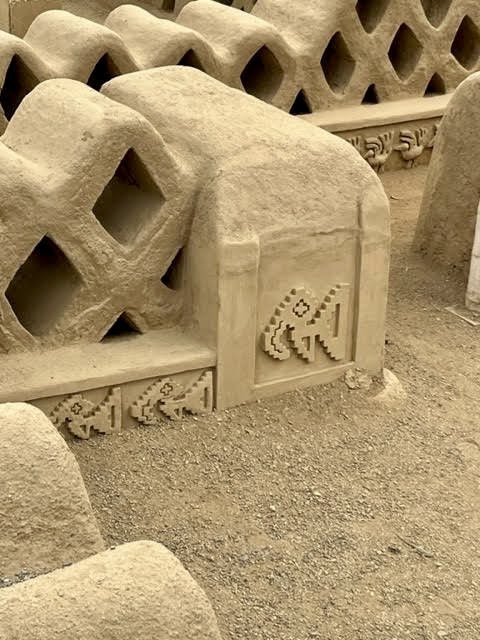
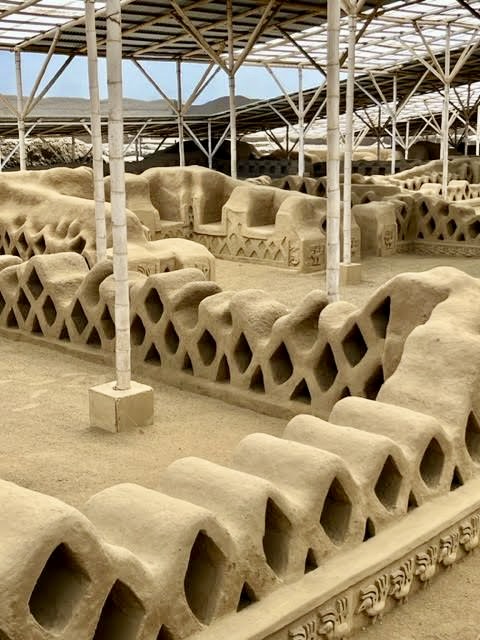
We visited Chan Chan ( City of the Sun) first; located about 20 minutes out of the city. It is a pre-Colombian city from the 9th century that covers 20 square kilometres. It was the seat of the ancient Chimu and at its height it had between 60,000 and 100,000 inhabitants. It was destroyed when the Incas took over in 1470, followed by years of looting, so much of what you see today is a restoration.

Chan Chan made the UNESCO list in 1988 – the same year as it made the list of World Heritage Sites in Danger. Due to environmental damage caused by El Nino, much of the structures are under cover, which protects both the site and its visitors from the scorching sun.
Chan Chan was actually nine citadel cities – all of them crossed by perfectly lined streets and avenues.

The walls were adorned were bas-reliefs of images; warriors, pelicans, snakes.
lll
I have just skimmed over the history of Chan Chan – in part because we decided not to hire a guide, which was a mistake. While we thoroughly enjoyed wandering the site on our own, a guide would have really enhanced the experience. There are no interpretive signs at Chan Chan, so our information was only gathered online prior to and after the visit.
Our visit to Huaca de la Luna was by far a richer experience. This site is comprised of two buildings with the urban centre between them that made up the Moche capital between 200 and 850 AD. Residents were potters, weavers, metalworkers and carvers and unlike Chan Chan, almost all of this site is original.
Mandatory guided group tours leave every half-hour, in Spanish only. We both were quite gratified to realize we understood a fair bit of what our guide was saying.
Although none of us were masked, this image was a reminder of how Covid had been such a threat to indigenous groups during the height of the pandemic.

Our guide was excellent, so knowledgable and concise in her information.
Huaca is the Quechua word for “sacred place“, and the excavation of this site has only been going on since 1991. During that time, archaeologists have uncovered two distinct structures from a mound of earth. In between, an entire city lies, yet to be excavated.
The Huaca del Sol, one of the largest adobe structures in the Americas, was so seriously disturbed by treasure hunters in the 17th century that it is not open to the public.
The Huaca de la Luna was the area we explored.

Unlike Chan Chan, the reason the Huaca was so perfectly preserved was that the temples were built one on top of the other.
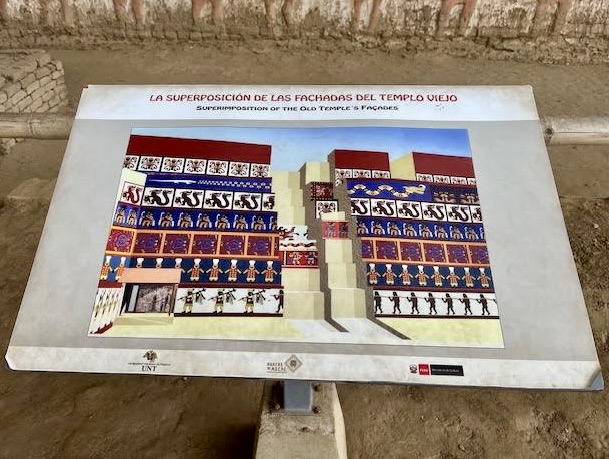
As a result, the carvings and wall art were uncovered in perfect condition.

We had several ideal vantage points from which to view the structure and the art. It was very interesting to walk around the site and watch ongoing work in progress.

The best for the last – the site of the human sacrifices. Human remains were found at this site (where the grey boulders are to the left of the guide). Moche warriors fought to the death – the losers were stripped naked, marched to this site, where their blood was offered to an altar.

And finally – chocolate. We ran the gauntlet of a line-up of kiosks on our way out, and this shop caught Stephen’s eye. The young girls immediately sensed a sale and we couldn’t resist their enthusiastic pitch.

There was so much history and culture to absorb here. We found both sites absorbing and quite unlike other ancient sites we have explored in Mexico.
We look forward to more of the same in Cajamarca – our next destination. We leave tomorrow for our first long-distance bus ride through the Andes – somewhere between seven and eight hours, but the scenery should keep us occupied.
 Leaving Ourselves Behind
Wonderful photos and stories, thanks! enjoy your exploration of Peru, the scenery, the people, the culture, all so interesting! I look forward to your next article and photos. I hope you are both keeping healthy and enjoying your adventures.
LikeLike
Rohana, now we’re in Cajamarca and it is beginning to feel like the Peru I imagined. Very different from the other South American countries we’ve been to so far.
LikeLike
We visited Trujillo a couple of years ago. The archeological sites are pretty impressive. Thanks for the revisit. Maggie
LikeLike
It is always a challenge for me to imagine life hundreds, if not thousands of years ago, but some sites portray images more vividly than others and both of these did that for me.
LikeLiked by 1 person
Great post, Ginny! We are in La Ropa now for the next month. We can hear the surf crashing from our balcony.
LikeLike
Ah, La Ropa! And surf crashing from your balcony – what a lovely image. I hope you have a wonderful time there and completely relax.
LikeLike
You’re going to love the bus ride through the Andes. Be prepared for just about anything. It’s the most exciting bus ride I have ever taken.
LikeLike
Oscar, when I think of bus rides thorough the Andes, I can’t help myself but bring to mind unfortunate images of shrines to those who missed the guardrails.
Our ride had its moments, including a solid hour of driving through thick fog on switchback roads. But, you’re absolutely right – it was exciting.
LikeLike
Fascinated by the wall art at the Huaca de la Luna sight! Thrilled that you got to see it while you were there!
LikeLike
It’s especially exciting to see because it was so well preserved. Often existing wall art is faded and peeling.
LikeLike
It’s always fascinating to see the remains of ancient civilizations, and to try to guess how ordinary people lived on a daily basis – worried about becoming a sacrifice, or just trying keep the bas-reliefs the same size and in a straight line? The great imponderables, as you’d probably say.
LikeLike
That’s hilarious, especially if you consider that failure to keep the bas-reliefs in a straight line might result in becoming a sacrifice.
LikeLike
Wow, a fascinating place. What a contrast to where we are in the South Pacific. It inspires us to continue our travels. Thanks
LikeLike
We can’t give up yet, Sheila. Too many corners to turn and no way of knowing what lies beyond them.
LikeLike
As with Panam City and in fact with all of your interesting destinations, your pictures, just enough historical and highlights of these place, allow us to get a feel for each place. How lucky we are that you like to do this and do it so well. with Trujillo, we are treated to two marvellous archaeological sites. The type of unique boats used by the fisherman Bill of course found fascinating. I of course was fascinated by the “Mejeres en Diversidad” bathroom and thank you for including it.
Stay healthy (you both look great) and safe travels.
LikeLike
Thanks Julie – so happy you are following our blog. I’m always fascinated by things that have lasted for centuries (like the reed boats). Obviously we’re travelling a lot faster with a motor or a sail, but still – these things do the job they were designed to do perfectly.
Looks like spring has arrived in our corner of the world!
LikeLike