When we were reading about Arequipa, we were intrigued and excited about visiting Peru’s second-largest city. Founded in 1540, this colonial-era city of about one million people sits at 7661 feet above sea level and is framed by three volcanoes, Chachani, Pichu Pichu and El Misti.
El Misti is the most prominent volcano, with its perfect snow-capped cone, creating a photogenic backdrop from most parts of the city. This is our view of El Misti, taken from our balcony.

See that blue sky? That was the only day we had blue sky and many days we didn’t see El Misti at all. Although Arequipa is famous for its temperate, arid climate (300 days of sun yearly), it also has a rainy season and we are right smack in the middle of it.
Our days went like this – mornings were generally warm ( 20-24 degrees) and dry. By 2:00 p.m., the clouds grew darker and by late afternoon it was raining. Layers are essential, as is a raincoat or umbrella.
Arequipa is a beautiful city and while we were disappointed at first not to have perfect weather for sightseeing and photos, we figured out a routine and did the outdoor stuff in the morning and saved museums or late lunches for the afternoon.
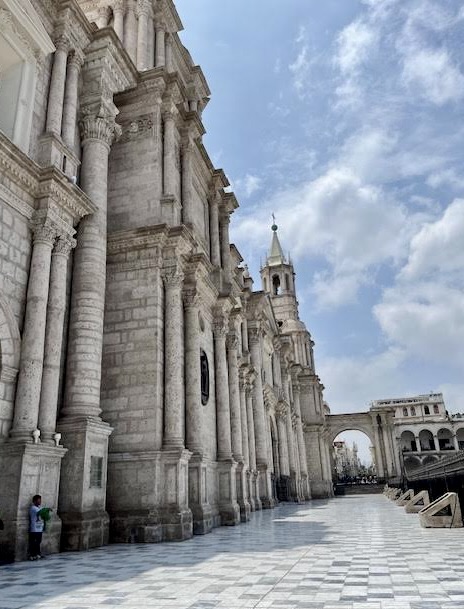
Arequipa is known as “The White City” because so many of its buildings are constructed from a unique local stone. Centuries of volcanic ash fell in the area and was petrified and created the material known as “sillar.” Most of the buildings in Arequipa’s historic centre are made of sillar and the effect is quite striking. Some of the more notable examples of buildings made of sillar follow.
The 17th century neo-classical Basilica Cathedral, which takes up one city block of the Plaza de Armas.

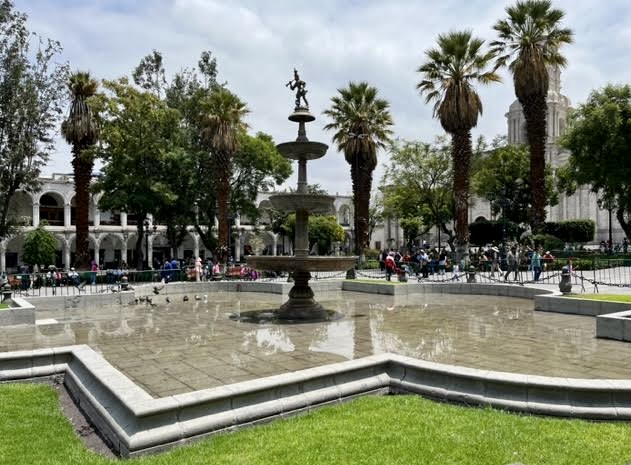
Plaza de Armas, one of the most beautiful plazas in Peru.
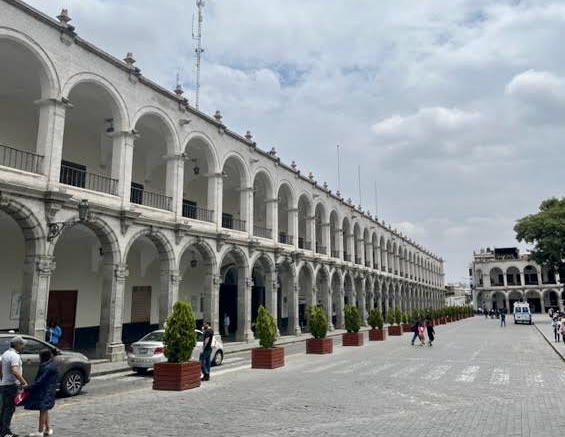
Portals line three sides of the plaza, filled with tour agencies, shops and restaurants, as well as providing shade from the sun and shelter from the rain.
The Compania de Jesus Church. The exterior carvings are extremely ornate and the altar inside is covered in gold leaf.

Banks in Arequipa are exceptionally fancy, with ornate carvings and grand entrances. Many times I turned into a doorway, expecting to see a museum or gallery and was met instead with an armed guard.

As is so often the case, what lies beyond a doorway is a delightful little gift – a break from the street. This hotel provided a glimpse into the discreet serenity that was just inside.

More typically, the downtown streets would be filled with these sorts of buildings, open for all to admire. Two to three stories, with wrought iron, carved doors and engraved stonework.

Arequipa is extremely walkable. One of the major tourist attractions is the Yanahuara Plaza and viewpoint, about a 45-minute walk from our place.
As we approached the barrio of Yanahuara, the architecture began to change a bit. The streets became more congested and pedestrianized and we began the climb to the viewpoint.
On a sunny day, this archway frames a spectacular view of the city, with all three volcanoes in full view. Not to be on the day we went, unfortunately.
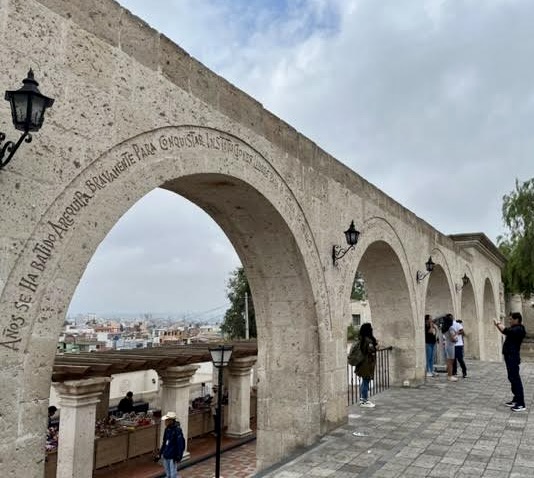
Still, it was a lovely walk and fun to watch the dozens upon dozens of photos and selfies being taken. We are so often a source of curiosity and amusement to the locals. Arequipa definitely has foreign tourists, but perhaps because we are older and grey-haired we stand out a bit. Three young guys walked by us, and one yelled out, “Hello, how are you?”, which cracked his friends up. Thirteen-year-old boys – built to the same specs the world over.
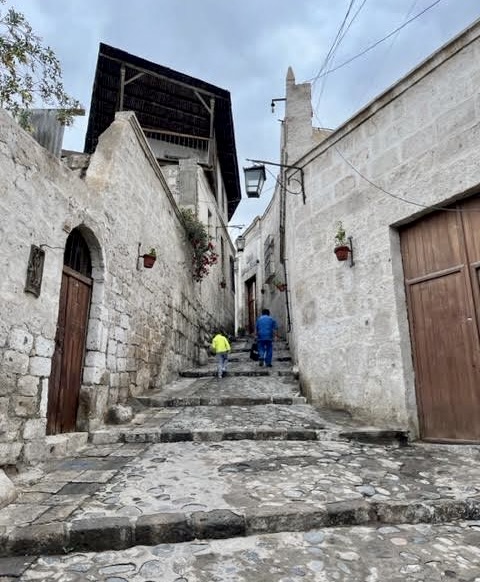
On our walk back down, we passed through the charming neighbourhood of San Lazaro – the oldest barrio in Arequipa. It was founded even before the rest of the city in 1540, and many of the streets are narrow, with barely room for a car to pass through.

There are many museums and art galleries in Arequipa. Some are quite specific – The Cannabis Museum, The Pisco Museum and the Chocolate Museum and others, like the University Cultural Centre, offer up works by some of Arequipa’s most interesting current artists, set in a stunning building. All free of charge.
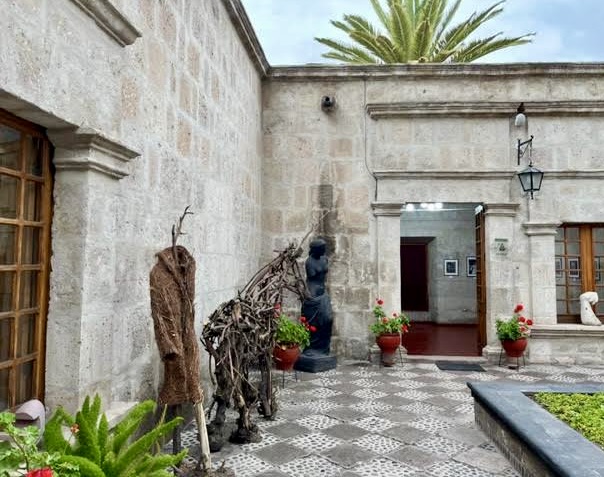
There were tags attached to each piece with the name of the artist, but I could not discover anything about any of them online.
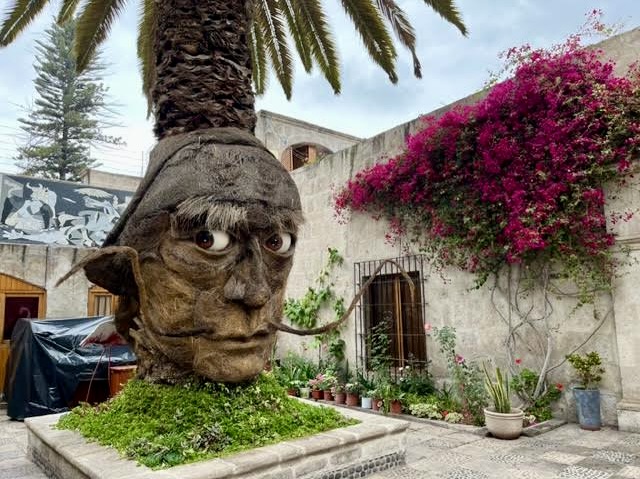
This rather sinister creature, with Dali-esque mustache, was attached to a large palm tree.
These haunting paintings each had a single title. This one: Sacrifices
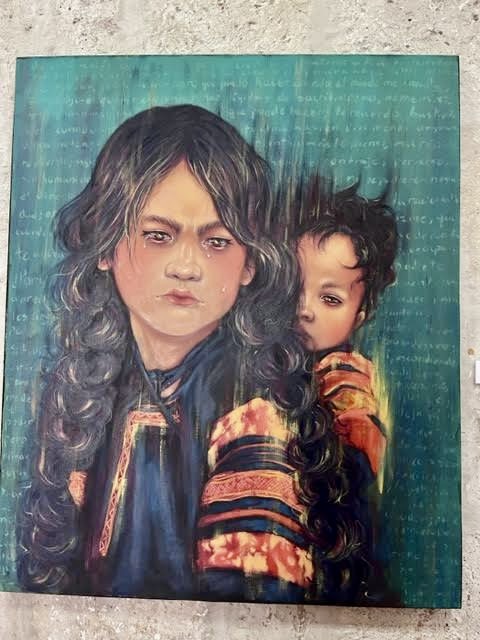
This one: Hope.

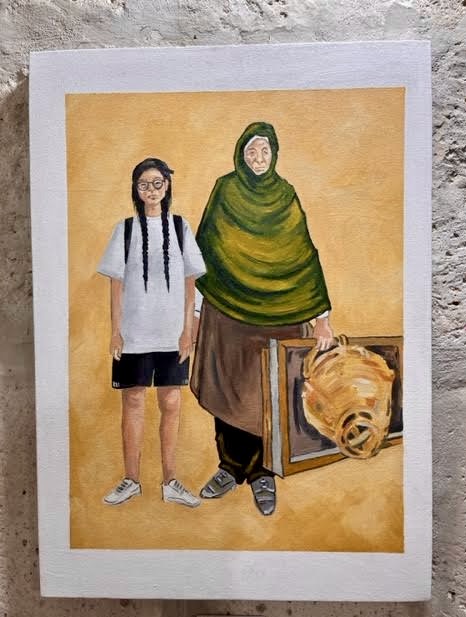
This one reflects the reality of the Quechua people. Their traditions, dress and culture are slowly disappearing, as the young ones opt instead for modern life.
The piece-de-resistance, the must-see in Arequipa is the Monastery of Santa Catalina. This monastery, founded in 1580, served as a city within a city for nuns. Novices from wealthy families lived here for up to four years, propped up by their family’s generous dowries, as they learned the strict rules of joining the order. Leaving the order after four years was not really an option, as it would bring shame to the families.
Santa Catalina Monastery covers 20,000 square metres, and is comprised of several cells, chapels, kitchens, common prayer rooms, open squares and narrow streets. It took about two hours to walk through and I could imagine the serenity of such a life – faith, order, guidelines and peace.
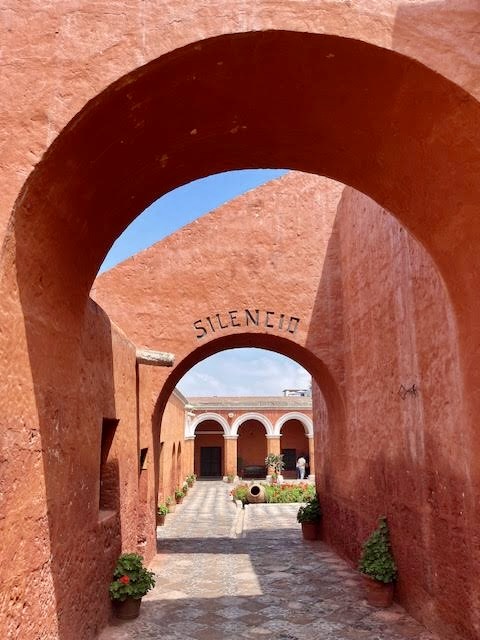


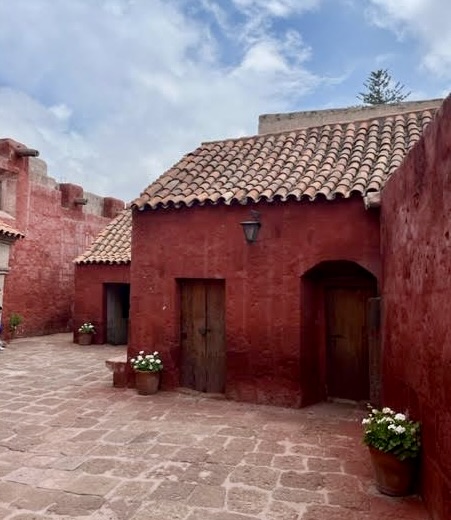
After all the monochromatic tones of the “outside“, the vivid colours and lush plantings in the monastery were so energizing.

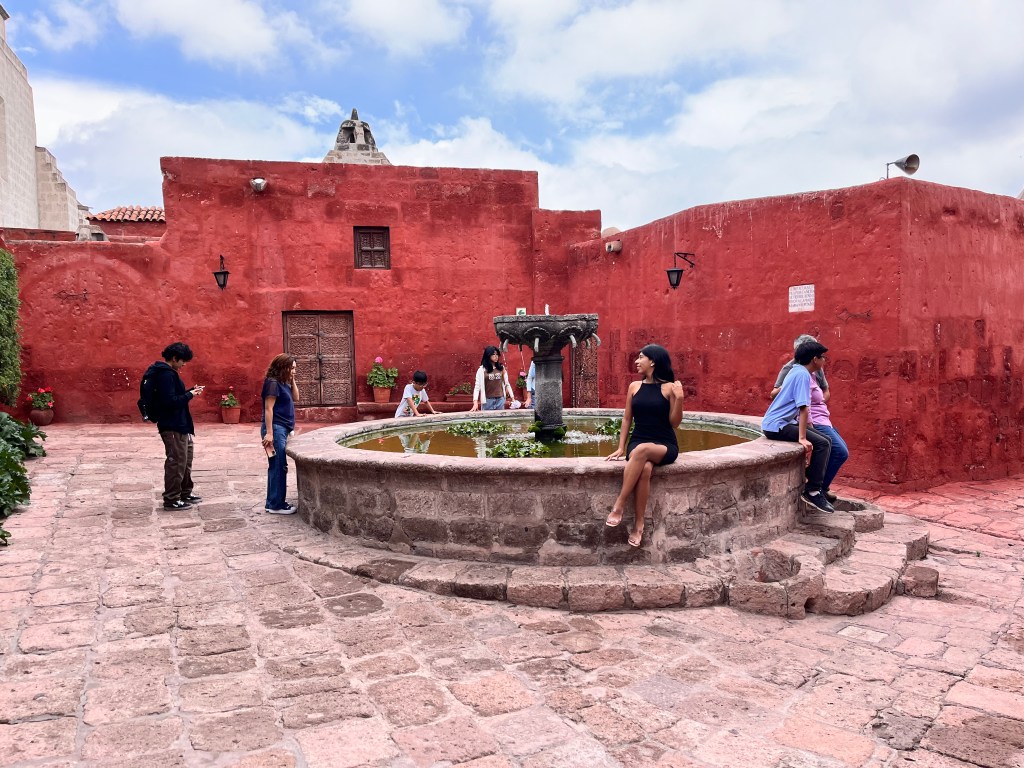
The central fountain and wishing well was a natural gathering place for visitors. This young woman, who struck dozens of poses, clearly has no aspirations to join a religious order.
Of course, Arequipa is not all old stone and churches. There is excellent food to be found here and this inviting entrance led to one of our favourite restaurants, La Despensa. Excellent food at great prices (roughly $6-$8 per dish), although my wobbly Spanish led to a poor choice. A sandwich which sounded like it was composed of two types of cheese, tapenade, arugula and tomato caught my eye, but one of the “cheeses” was actually a head cheese – gelatinous slices that were spiralled on top of the bread. My mistake – Stephen ate the head cheese and I ate the rest of the sandwich.

The local market was another food adventure. I used to love to stroll down the meat aisles of Latin markets, taking photos of yellow chicken carcasses with legs akimbo, or “art shots” of pigs heads and hooves. My poor stomach can’t do it anymore, so I stuck to a shot of Peru’s potatoes – some of the 4000 varieties grown in this country.

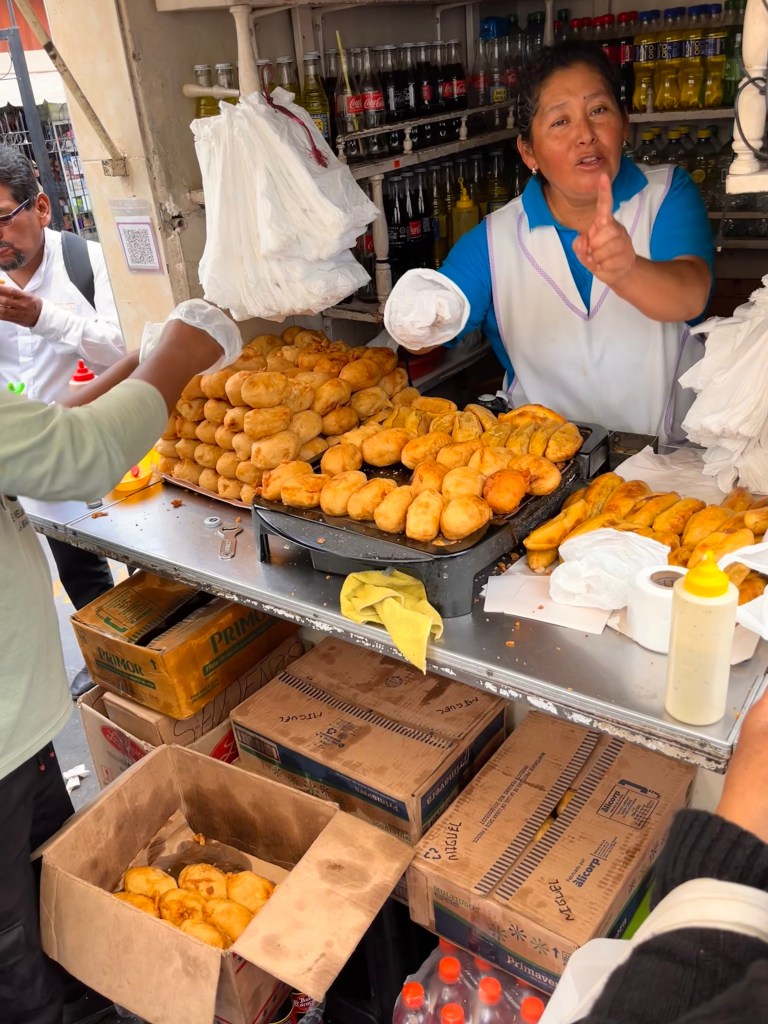
As we walked into the market, we passed a stall that was four deep – all clamouring for papas rellenos and other fried, starchy snacks. We couldn’t resist – picture mashed potatoes that have been mixed with olives and caramelized onions, then fried so the outside is crispy brown. $1.30 a piece, with one tiny napkin to wipe your greasy fingers.
Stephen took this shot of the proprietor and her wares, to the chant of “photo! photo!” from the bystanders. This was all the encouragement she needed to demand, ” Photo – one dollar!“
All in good fun, but as you can see, food safety has taken a pass here.
And finally, let me introduce you to Anabel Flores. She is a tour guide and travel agent, introduced to us by our Airbnb host, and she has been a lifesaver.
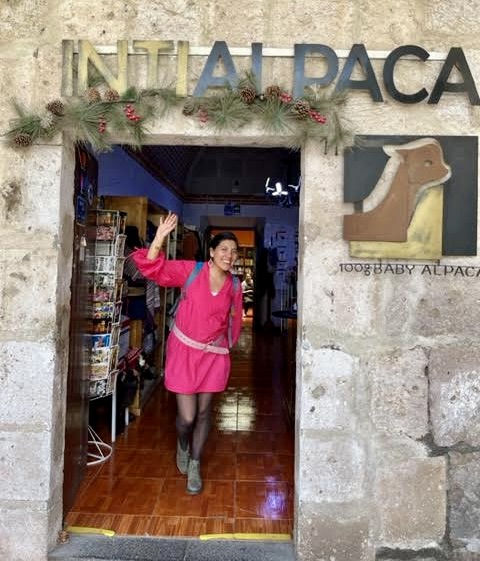
We are going to the Colca Canyon tomorrow for a two-day hike and tour of the area. The main reason for going is the chance to see the condors, who lift off from a ridge over the canyon in the early hours of the morning. Anabel organized everything for us – bus, guide, hotel, entrance fee and then bus on to Puno, and she invited us to contact her with any other travel questions.
As it turned out, our attempts to book tickets to Machu Picchu online were thwarted when the site would not accept our credit cards. We were given a reservation number and our other option was to pay in person at an office in Cusco – where we would not be until March 9. After a futile and frustrating (Google translate) conversation with the office, we finally determined that we only had five hours to pick up our tickets, or they were void. Other online agents were a possibility, but they added hefty commission fees.
Anabel to the rescue – she contacted a colleague in Cusco, who booked our tickets and then she met us downtown to transfer the money. This is an experience I will remember with great fondness – yet another kind and heartfelt encounter with a Peruvian.
And so, tomorrow a five-hour bus ride to one of the world’s deepest canyons – keep your fingers crossed for a condor sighting this Friday.
 Leaving Ourselves Behind
Loved the teen boy wisecrack!
LikeLike
They’re everywhere those teen boys! I imagine you’re running into a few of them in Mexico.
LikeLike
Anabel sounds like someone you need to find at all stops along the way. Will be looking forward to photos of Condor’s in flight on you next posting.
LikeLike
We all need Anabel in our travels. Calm, competent and sincerely wanting us to have the best time in her country.
LikeLike
Love these photos! thanks!
LikeLike
con mucho gusto!
LikeLike
All these years later, you are retracing our footsteps. We loved our trip. You’ll enjoy Puno, I believe, and Lago Titicaca. Machu Picchu will leave you speechless. Happy you had someone who could help with the scheduling. Hope you catch sight of a condor!
LikeLike
It will be really fun to catch up with you guys and compare notes about our trips.
LikeLike
The description of papas rellenos made my mouth water – judging by the well-stocked shelves at the back of her stall, Coca-Cola is the go-to accompaniment for them! With 4000 varieties of potatoes in the country, are you tempted to stay until you’ve tried them all?
LikeLiked by 1 person
Seeing the condors in the wild would be amazing. I think they have some in the Berlin zoo(: they are huge but captive there. The fried potato dish sounds wonderful. Love any fried potato dish. 🙂
LikeLike
We’re so hoping we see them tomorrow – weather will play a big part.
LikeLike
What exquisite buildings for the two of you to admire! Sounds like you were able to work around the rain and make the best of the weather. My fingers are crossed for the condors!
LikeLike
Thanks Heather – we’re counting on all the positive vibes we can get.
LikeLike