The Colca Canyon is pretty firmly on the tourist trail for a solid variety of reasons. Second-deepest canyon in the world – between 3250 to 4160 metres deep. Largest number of wetlands in the Andes.
The Colca River that bisects the canyon runs 129 km. long and empties into the Pacific Ocean. Some pretty rugged trekking opportunities in mind-blowing surroundings.
And of course…the Andean condor, the largest bird in the world. This bird averages four and a half feet in height, with a wingspan of 10 feet and weighs between eight and 11 kilograms.
Due to their huge size and weight, condors don’t actually “fly”, but use upward thermals to lift off. They climb 7000 metres easily and they can glide for hundreds of kilometres, with actually flapping their wings only about 1% of their air time.
They are considered vulnerable to endangered, with their numbers dropping due in part to environmental conditions and a slow reproductive rate. Numbers of condors in Peru are impossible to pin down – anywhere from hundreds to thousands and apparently there are under 40 condors in the Colca Canyon. And this, the rainy season, is not even the best season to view them.
So imagine our delight when we saw this:
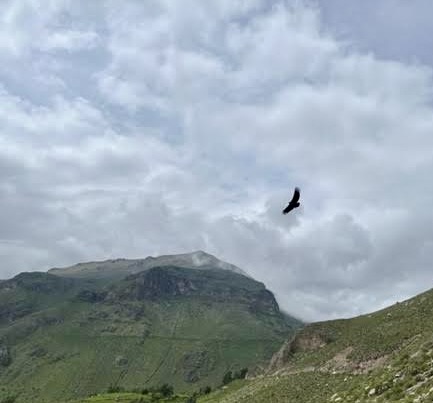
And this:
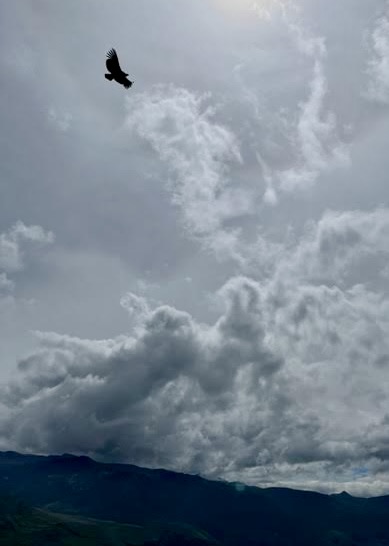
Our expectations had been well managed and when we arrived at the Cruz de Condor viewpoint to find it mostly fogged in, we accepted that a sighting would not likely be happening.
After an hour of waiting and hoping, we drove a little further down the road to another viewpoint and a chance to buy souvenirs.
This lady is dressed in the traditional attire of the region, notably including a fancy hat, rather than the more common high straw sombrero.
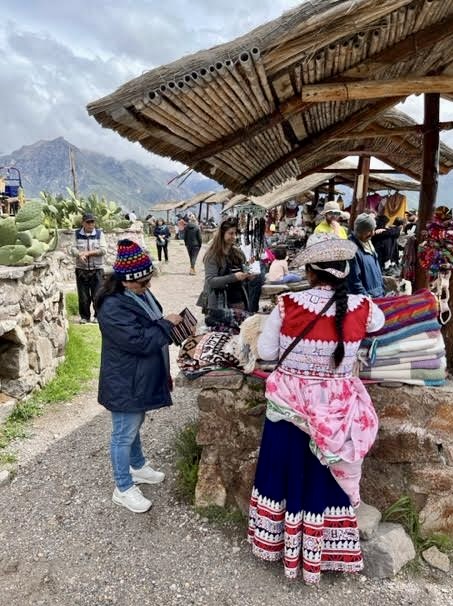
We were all milling about with other tourists, taking photos and admiring the view, when all of a sudden, a young condor swooped right over our heads like a plane about to land. As you can imagine, a roar went up in the crowd, phones came out and the above photos were the best anybody could capture. We watched in frustration as the condor flew further and further away, then teased us with a return glide and then left again.
I will remember that brief thrill at hearing “Condor” and looking up to see a prehistoric creature darken the sky for an instant. We did see a few more sightings of condors, but all from a distance. We were told we were lucky and indeed, I did feel so fortunate to be standing in the Andes and have the privilege of seeing this magnificent bird.
But honestly, seeing the condors felt more like a ticked box than a highlight. Our two-day, one-night tour was exceptional from start to finish. Anabel booked this entire tour for us and we wouldn’t have changed a thing. A tourist bus picked us up in Arequipa and we began our drive with a small group – our guide Luisa, our driver Chanel and just eight other tourists – four Spaniards, three Chileans and one Polish woman currently living in Berlin. Luckily for us, everyone spoke some English and our guide handled the commentary well, moving easily between the two languages.
Our drive into the Andes began like this; gently rolling hills, populated with alpaca, vicuna and llamas.

You know the excitement you feel when you first glimpse wildlife and then before you know it, you’re thinking to yourself, “oh, another vicuna.” This trip was like this – they were everywhere – both wild and somewhat domesticated.
Our bus drive from Arequipa to the small town of Chivay took about five hours. Along the way, we had several stops, with the small town of Yanque being one of the more dramatic. A church with a central plaza, and modest-yet-attractive homes, Yanque is typical of Andean towns – less for tourists and more for Peruvians.

The landscape started to get a little more rugged.

And then it would soften again – terraced agricultural land, with ancient stone fences.

Yet another landscape.
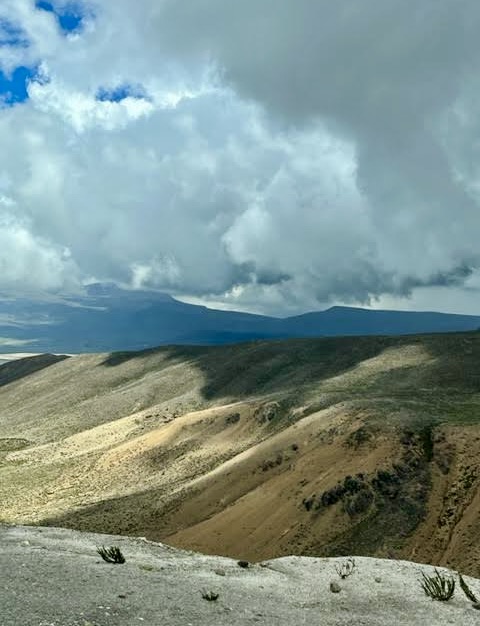
This area of the Andes has abundant wetlands, which attract migratory birds, including Andean geese and flamingos. We did see a number of flamingos, but they were quite a distance from the road; a pink haze on one corner of the lagoon.

Another roadside attraction: dozens of llamas and a few of their babies. Two women set up a stand with a few souvenirs, but naturally everyone wanted the chance to wander up close among these animals and in the case of one particularly patient llama, take selfies.

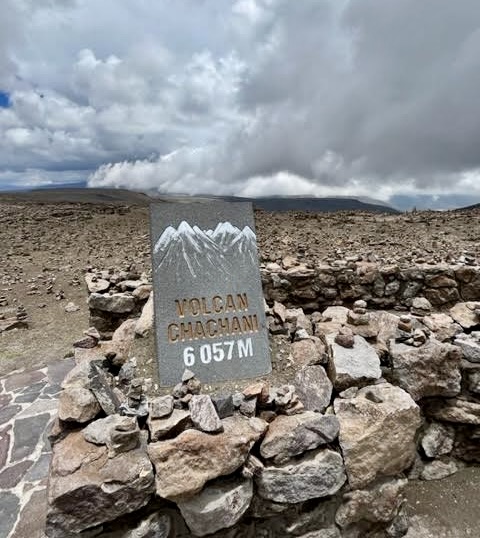
Next up – a viewpoint, that in clear weather, must be mind-blowing. There are several markers showing the volcanoes, and their height above sea level, hiding behind those clouds.
At this same location, there are hundreds of inukshuks left by tourists to commemorate their visits. I constructed a small inukshuk for our grandchildren, Leo and Violet. It is looking in the same direction as Volcan Chachani.
Also, for anyone who wonders about this sort of thing – the highest toilet in the Andes.
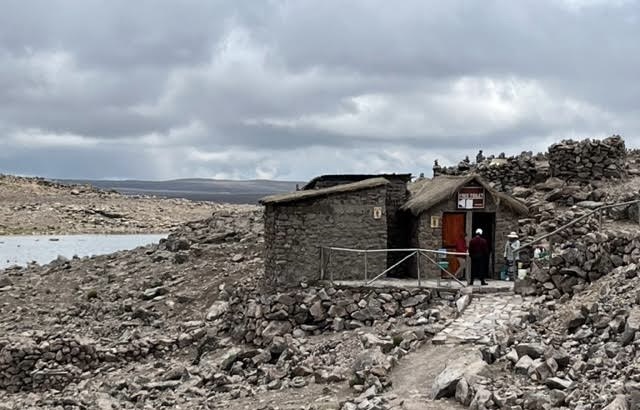
After a wonderful buffet lunch, filled with Peruvian specialities, including alpaca stew and a few minutes to shop and purchase coca leaves, we proceeded to the town of Chivay.
I bought a bag of coca leaves on the advice of our guide. Much like any other product, quality is key and she wanted to make sure we got “good stuff.”
You cannot get high on coca leaves – they are medicinal to help with cranky tummies and altitude sickness. The altitude here is no joke – so far, Stephen has experienced just a headache and fatigue and I have experienced bouts of breathlessness. An infusion of coca leaves in tea is very beneficial to ward off more serious symptoms, as is chewing a wad of leaves.
Luisa taught me the following: take out three good leaves and facing east, blow on them and make a wish. Put the leaves in your mouth to allow your saliva to soften them. Take another several leaves and in the middle of them, pinch off a piece of “ash”, roll into a ball and insert in your mouth. Chew gently until the ash releases the minerals (a pleasant, slightly sweet taste), and then stash in one side of your mouth, chewing from time to time. After half an hour, the effectiveness is gone, so spit out in a lady-like manner.
Coca Leaves, with ash.

We arrived in Chivay, were deposited in our various hotels and then met again in a couple of hours for a soak in the area thermal baths. It was heavenly – outdoor pools with a mountain setting. Unfortunately, because it had started to rain a bit, we didn’t bring cameras, so have no photos. Just take my word for it – soaking in volcanic mineral hot springs in the Andes is pretty sweet.
The town of Chivay was a curious mix of whimsy, story-telling, religion and tourist amenities. In the centre, we have Jesus on the cross carved into a tree, with a coloured fountain as a backdrop.

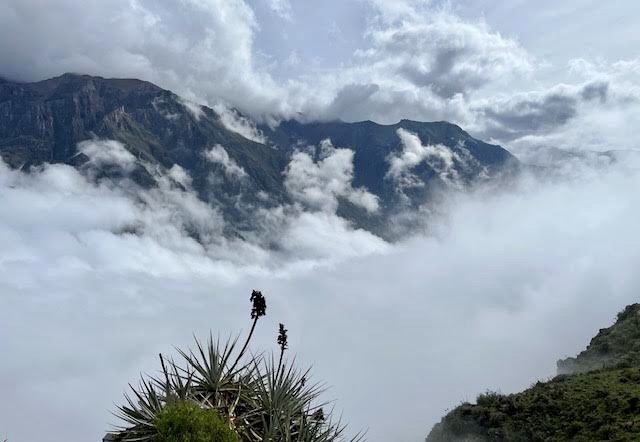
We were up bright and early the next morning in search of condors. But first, we embarked on a half-hour walk on the ridge of the canyon and for all of us, this walk was the most magical part of the tour. We had cloud cover that opened up to reveal peaks that were so indescribable in their ancient-ness and their massive-ness and their Andes-ness that we were all quite at a loss for words.

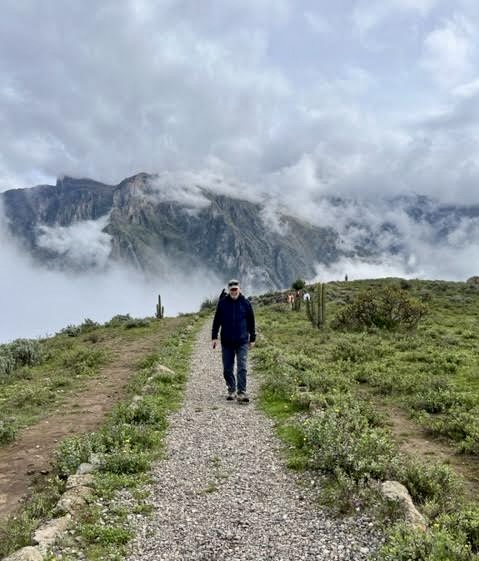
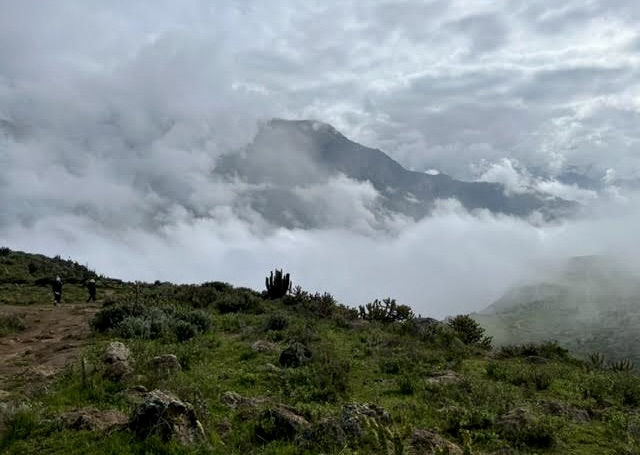
Our group.

After that experience, we poured back into the van and to make the day absolutely perfect, we saw our condors.
We also saw the Colca Canyon – from the top.

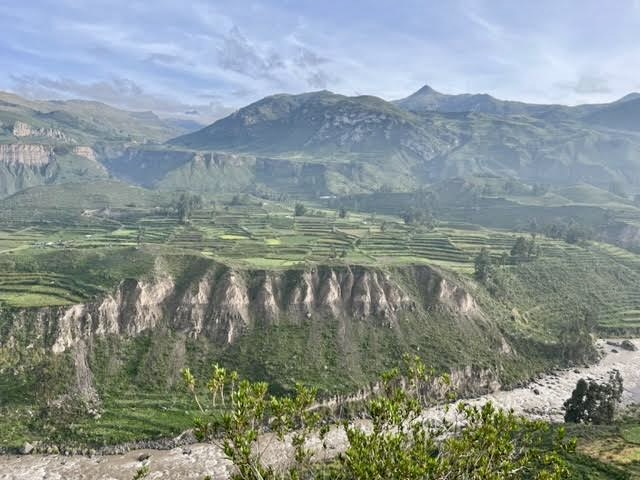

Just to clarify – we “walked” around the top of the Colca Canyon, we did not “trek.” Trekkers climb all the way down into the canyon, trek around for hours and then climb all the way up again. They do this over two or three or more days and naturally they are rewarded with incredible sights not visible from the top. This trek is variously described as being “really, really difficult“, and “grueling“, and “not for everyone.” Taking our cue from that, we opted for the tour instead and have no regrets.
We did have some amusing moments though. If there is a sol to be made, a Peruvian will have figured out the angle. Anticipating condor sighting disappointment, these resourceful souls are located at a number of lookout points as a consolation prize. (along with photo ops of local colour and baby llamas)

We had one more stop before beginning our trip to Puno. The name of this town escapes me, but it capitalizes on the tourist throngs near Colca Canyon.
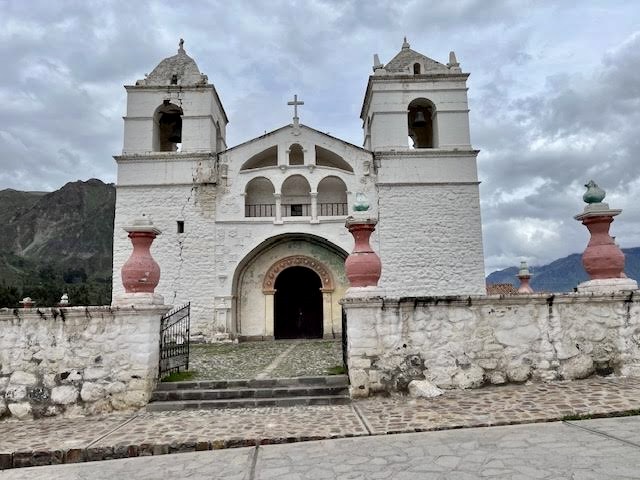
The town church.
One of several shops selling really beautiful alpaca products.
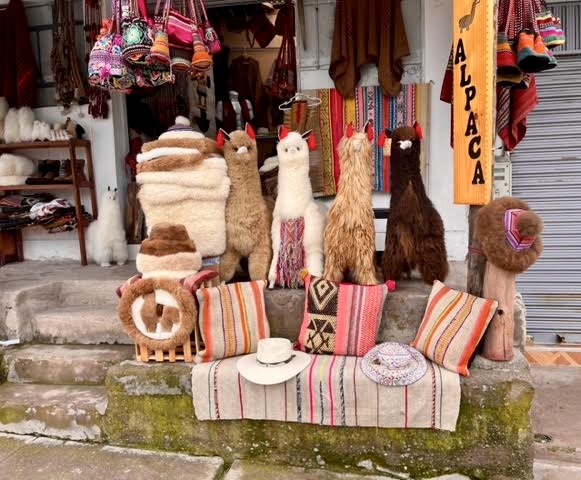
Alpacas and llamas were everywhere in this town. It seems they are almost like pets in a number of households.

Our original plan was this: After our lunch, our guide and driver would take us to an intersection where we would part ways. They would head back to Arequipa and we would all board another van bound for Puno.
Our guide had kindly waited until we enjoyed our day to break the news to us that our road to Puno was currently impassable due to heavy rain that caused catastrophic flooding. Although they had crews working to repair the damage, it was not clear when the road might be in operation again, so we had two options. Join the line of cars hoping to get through, or take an alternate road. Even better, both our driver and guide decided they would take us there themselves, by whatever means.
When we reached the point where the road had been washed out, it was clear nothing was moving and no idea when it might be moving, so we opted for the alternate road – a seldom-used single lane dirt road that would take an hour and a half to get through.
We began our adventure, and followed this van for most of the way.

For the first while, it was fine. Our driver was excellent and the scenery was our silver lining – a glimpse into the remote llama and alpaca farms that are miles away from anything and that circle around a massive lake.

The challenges began as frustrated drivers, fed up with hours-long waits at the flooded-out area, began to choose the alternate as their only hope to get home. A curvy one-lane dirt road is not conducive to traffic and although drivers were generally good about pulling over if that was possible, the sheer volume of vehicles began to pose serious hazards.

It was often our driver who took the lead; jumping out of our van to encourage frightened drivers to keep moving – that their wheels would indeed stay on the road and not plummet down the hill.
At one point, a van became stuck and it was all hands on deck to give a push. Our driver is the one with the pink shirt and Stephen is the one by the driver’s door.

Eventually, we made it back to the main highway. By then, it was dusk and we were meeting up with drivers just beginning that journey. We were mightily happy to be off that road, which was challenging enough in full daylight and would have been perilous in the dark.
We arrived in Puno, worn out but happy to be on terra firma again. We parted from our group with big hugs all around and ready for a good night’s sleep. Two days in Puno and Lake Titicaca – see you again in a couple of days.
 Leaving Ourselves Behind
What an amazing adventure. Seeing the condors is one of the highlights of our travels. We have loved following along with this trip as it brings back so many happy memories. Enjoy Puno and do go out on the lake. We are leaving Singapore and off to Taiwan today. We are a world away from you!
LikeLike
Just got back from the lake Sheila. SO much to digest – it was amazing. Peru just keeps on giving.
LikeLike
More great photos, thanks! They remind me why I loved my visit to Peru. I never did get to Lake Titicaca so I really look forward to your next post! By the way, I did see lots of condors, and lots of Peruvians selling things at every rest stop. However, like you I suspect I didnt have room to buy things so i took photos, but that was in the days before cellphones when we had to buy film and get it processed. imagine!
LikeLike
The good old days! When you dropped off film and waited anxiously for your holiday pics, only to realize you just paid for a few photos with thumbprints in the corner!
We’re loving Peru – sure glad the world is digital because I’ve taken hundreds of photos.
LikeLike
Gorgeous photos, Ginny! Love the way the adventure is ever-changing (in a positive way). It is always a gift when we see your posts in our email, allowing us to share a bit of the journey. Keep ’em coming!
LikeLike
You’re so right – every day is an adventure in Peru, even the detours. We look forward to catching up again to compare notes with your Peru trip, although we know how it ended. :>)
LikeLike
Great photos of the tour. Pushing a van, Flamingos, Llamas, Alpacas, Coca leaves, and even Condors probably created unique memories of Colca canyon. P.S.-If you would like to observe Condor’s again close up, I’d recommend exploring Las Peinetas in Chile.
LikeLike
Bob, we had three Chileans on that trip and they talked about the condors in their country. I think the next time we need to be more mindful of the time of year – it wil make a big difference.
LikeLike
i am amazed by the colours, especially the sky. It doesn’t look real!!! What an incredible experience.
LikeLike
Nance, your photographer’s fingers would be itching here. The photos take themselves.
LikeLike
Absolutely gorgeous photos, Ginny. I Second Nancy’s comment about the color of the sky. I’m looking forward to your Puno post.
LikeLike
Jeanne, I think those skies are part of the upside of the rainy season – such amazing clouds and contrasts to the bright blue – they do look like paintings.
LikeLike
What a trip you had – gorgeous scenery – and the condors were the icing on the cake!
LikeLike
It was memorable – on so many levels. Our tour guide had the privilege of watching a condor for 15 minutes – she showed us the photo, taken last year. The condor was perched on the edge of the ridge and it opened its wings and closed them for about 15 minutes before it finally took off. Not many people are that lucky to observe a condor in the wild for that long.
LikeLike