Although Puno has its attractions and it is known for its folklore, very few tourists would make the long trek from Arequipa (and back out again), if it was not for the fascinating history and surroundings of Lake Titicaca and its inhabitants.
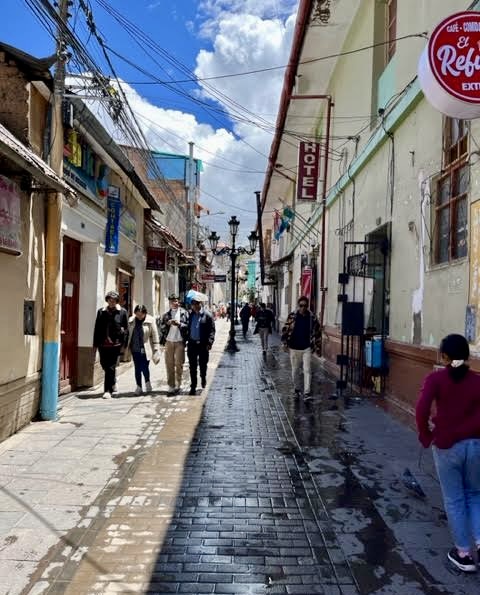
We had the option of staying on one of the floating islands with a family, but our timing did not work out (we arrived in Puno late, and would be leaving too early), so we stayed in the city. Aside from the stunning main plaza, Puno is not that attractive, but we did find a peaceful oasis in our hotel just a couple of blocks up this street.
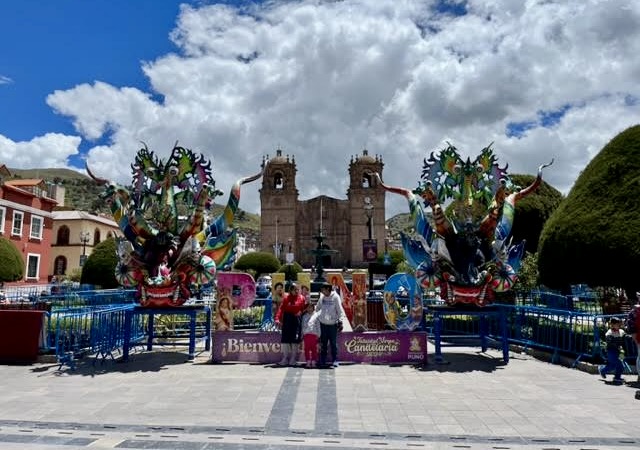
Carnaval was winding down while we were in Puno and hundreds, if not thousands of photos were taken in the plaza, all decorated for the big event.
When we told people we were going to Puno, the reaction was exactly the same as when we told them we were from Canada. “Ah, frio! (cold),” with arms clasped protectively around shoulders in a pantomime of shivering.
And Puno is cold – we wandered through a sea of puffy jackets and toques in our inadequate attire of rain jackets and dollar-store stretchy gloves.
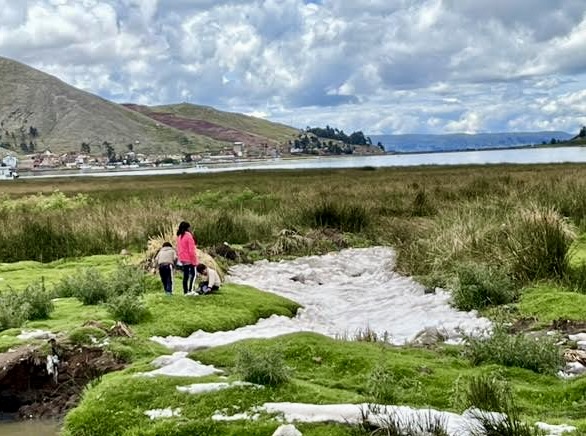
These little kids, impervious to cold, were playing in the remnants of the hailstorm from the night before. “Granizo” in Spanish – such a perfect word.
We are here in the rainy season, which means the odds of a sunny day are less than even. However, the weather gods were with us when we set out on our day-long tour of the lake and the islands. The day before was mixed and the day after was raining, but we were blessed for weather – bundled up and freezing in our boat at 8:00 am, and basking in warmth and sunshine an hour later.
Our boat was fully covered, equipped with an open deck on top and our enthusiastic guide Cesar, who moved between Spanish and English to his audience of Spaniards, Peruvians, Calgarians and Vancouver Islanders.
So first, a little about Lake Titicaca. It is the largest freshwater lake in South America, and at 3,810 metres a.s.l., it is the highest lake in the world. It covers 8372 sq. km. and extends from northwest to southwest for 190 km. It is 80 km. wide at its widest point.
Just to give a little context though, Lake Superior is the world’s second-largest largest freshwater lake and at 82,100 square kilometres, it is 10 times the size of Titicaca.
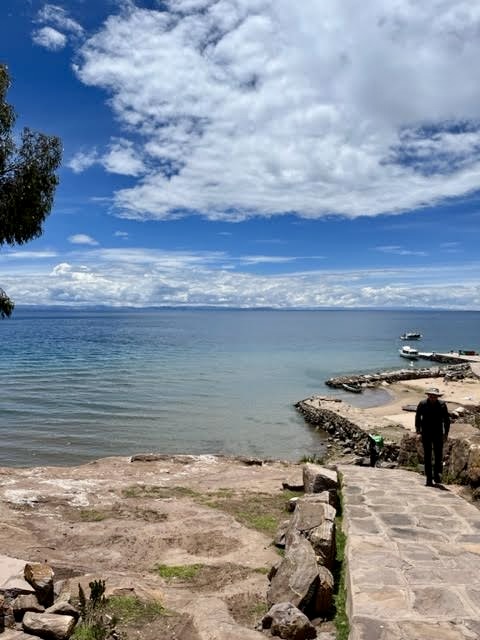
Still, Lake Titicaca is huge and can take hours to navigate from one point to the next. Forty percent of Lake Titicaca spans Bolivia and 60 percent spans Peru.
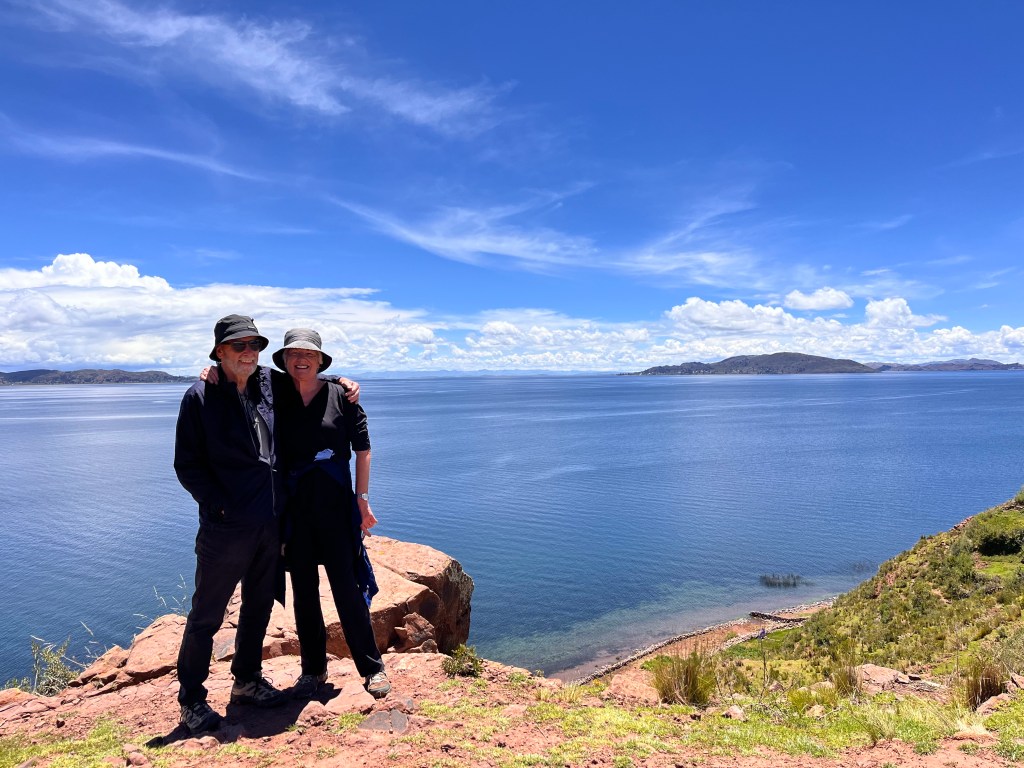
In this photo, if you look straight across the lake to the middle of the horizon, that marks the border between the two countries.
Our first stop was one of the larger Uros islands. The Uros islands are floating islands, made of Totora weeds that grow in abundance in the lake. The Uros people are believed to be descendants of the Pukara people (1500 BC) – the first inhabitants of Lake Titicaca. They were a passive people and created their villages on the lake to avoid mainland conflicts. Today, most of the islands are within a half-hour boat ride of Puno, with between 60-70 islands.
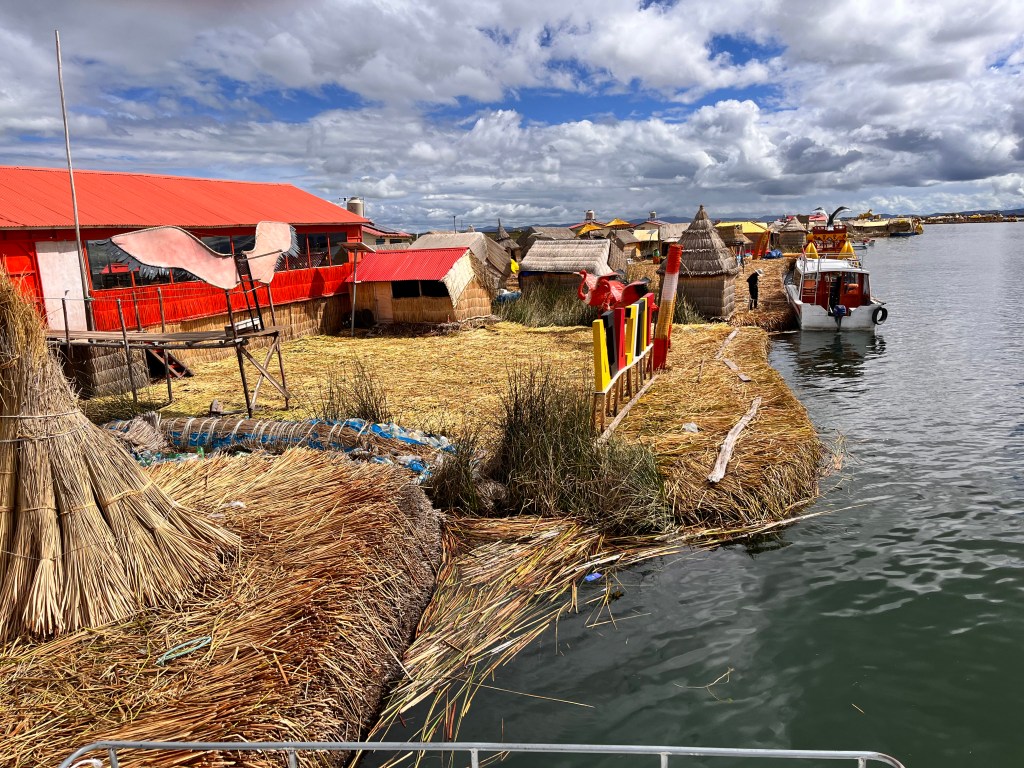
After a devastating storm in 1986 that destroyed some of the outlying islands, most of the outlying islands are now much closer to Puno. Where once they were self-contained and isolated, easy access to Puno has helped them to develop a thriving tourist business, comprised of homestays, day tours and sales of their crafts.
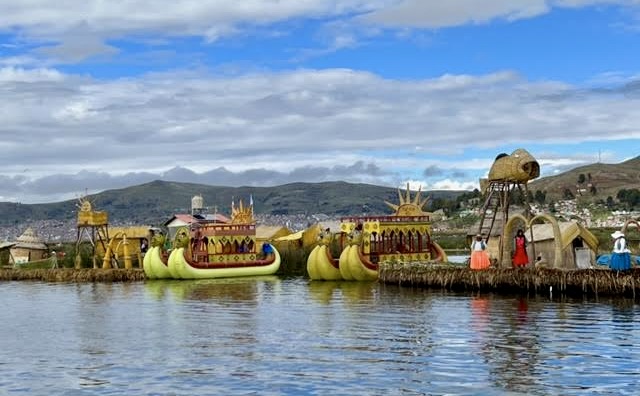
And therein lies the somewhat queasy question of authenticity and exploitation. For example, for about $10, you can take a brief ride out on one of their elaborate boats. The intention of visiting the islands is to learn about their way of life, but in reality, how much insight can anyone glean in a half-hour?
The visit began with a dockside welcome and demonstration about the fascinating construction of the islands, led by the current president of the island, Annette, who serves a one-year term before handing the reins to another inhabitant.
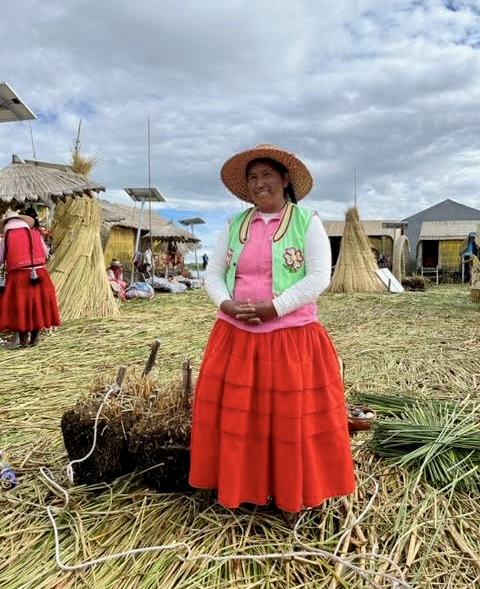
She explained how huge blocks of earth (an example by her feet) would be towed to the appointed spot, then bound together with rope. Thick sticks inserted into the blocks would serve to hold the many, many layers of reeds ( 15 metres, in fact) that are piled on top and then the whole structure is anchored to the bottom of the lake.
On this particular island, there are seven families who have created a communal existence with common showers and bathrooms and a common kitchen.
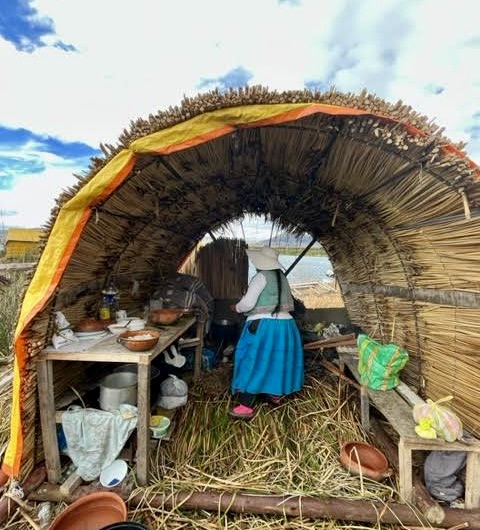
The men fish and the women create handcrafts.
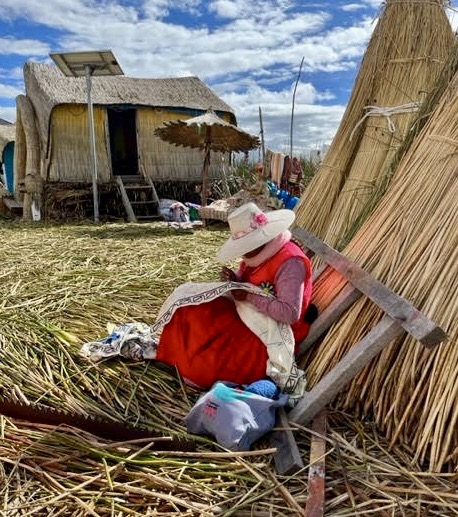
It is summer right now, but in three weeks, little children will go to a local primary school.
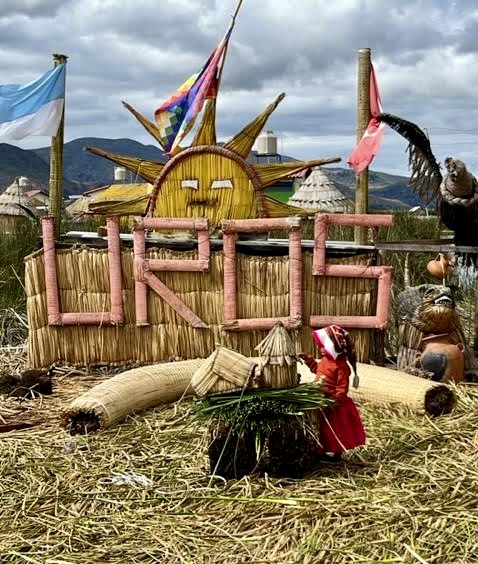
Each small house is very rustic, with just a bed and perhaps a chair. Each house does have a solar panel though, which allows them to watch TV and have basic electricity.
There are currently about 4000 inhabitants on the Uros islands, but those numbers are dropping. Older kids have to go to Puno for high school and university and most of them stay, as they discover other opportunities in the wider world. It is anticipated that in another 40 years, these islands may be largely uninhabited.
What we witnessed was real – this way of life is legitimate and their lives are extremely simple. What has changed though, is the addition of tourism to their hunting, fishing and communal life. As we arrive by the boatload, bringing our cameras and our dollars, something shifts. They provide a performance of sorts and we reward that performance by buying stuff from them and taking photos of them. Where is the authenticity in that?
We were all divided up and led by one of the inhabitants to their respective houses. My heart sank as our host, Lucy, encouraged us to try on traditional costumes for photos. We declined, so her next tactic was to lead us back outside to her table filled with goods – “money for her son“, as she explained.
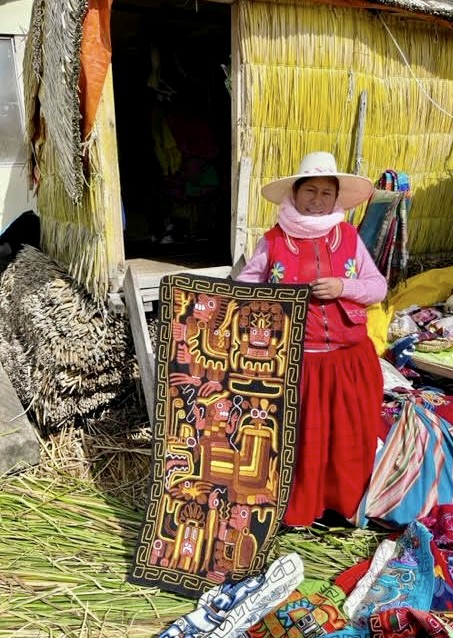
Before we knew it, we had purchased this hanging. I happen to really like it and I’m pretty sure it is handmade, judging by the rough finish on the back and it was only $40. Still, both Stephen and I seem vulnerable to the hard sell and we always feel a bit annoyed with ourselves afterward.
Lucy, with our new hanging.
Our next stop was Taquille Island. It was about a two-hour boat ride from the Uros Islands and a world apart. As our guide Cesar explained, “Uros Islands are touristic, Taquille Island is for the locals.”
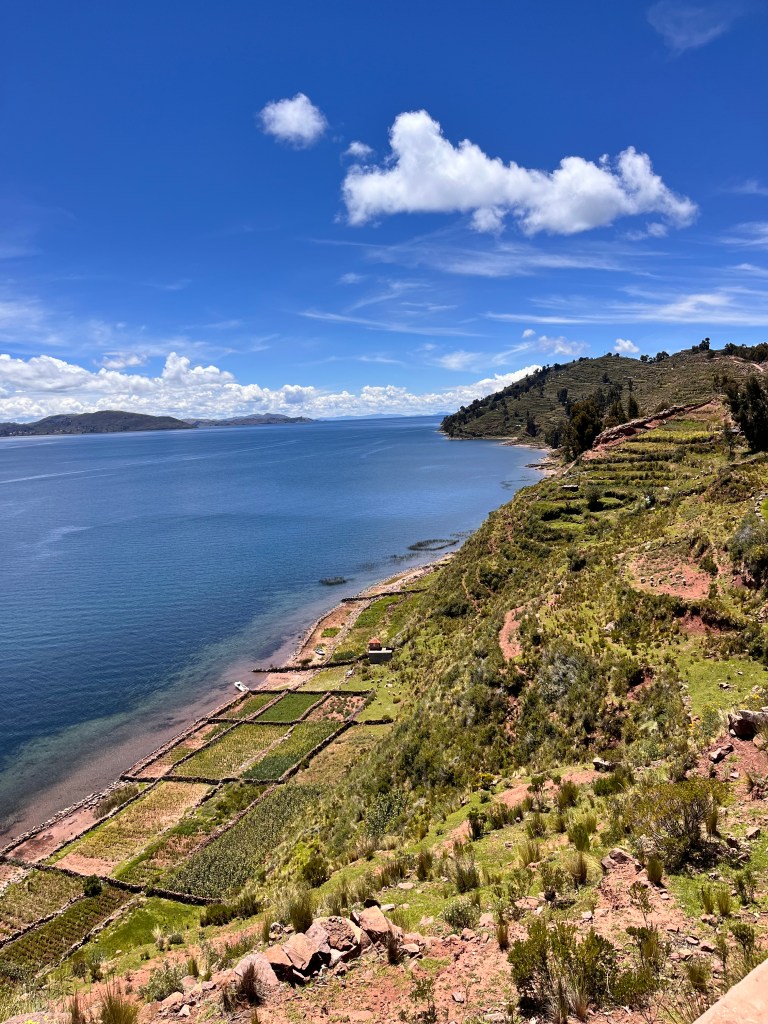
Taquille Island is remote and wild and gob-smackingly beautiful. Every corner brings a view like this.
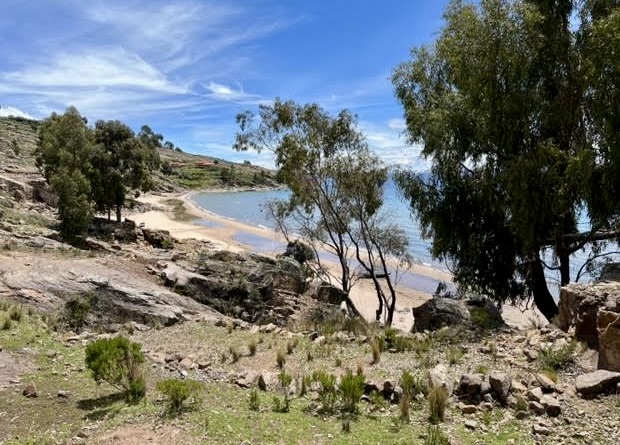
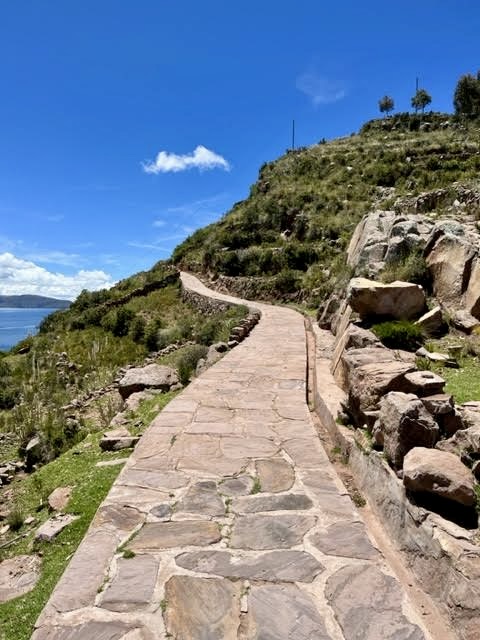
Taquille sits at 12,959 feet a.s.l. at lake level and climbs to 13,287 ft. at its highest point. There is a lot of climbing involved, made a little easier by the construction of these beautiful stone paths that criss-cross the island.
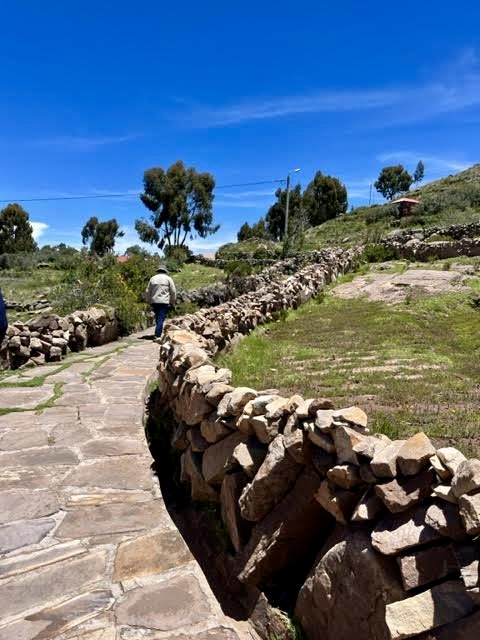
Our first stop was to the central square where we were given a number of demonstrations about the Taquille way of life. While these folks are definitely benefiting from tourist dollars, they are also very self-sufficient and exhibit some interesting social contracts.
The 2,200 inhabitants have created a peaceful, crime-free communal existence and have created a sustainable tourism model that does not have a negative impact on their way of life.
They live by an admirable moral code – “ama sua, ama llula, ama qhilla” – which is Quechua for “do not steal, do not lie, do not be lazy.”
No-one would accuse them of being lazy. They walk everywhere on their hilly 5.72 sq. m. island., grow, catch or hunt all their own food, and make their own clothes.
This last comment was meant to be a bit flippant. The women are famous for their weaving; in fact the collective of Taquille Island weavers have won international weaving competitions. In addition, their weaving has been recognized by UNESCO.
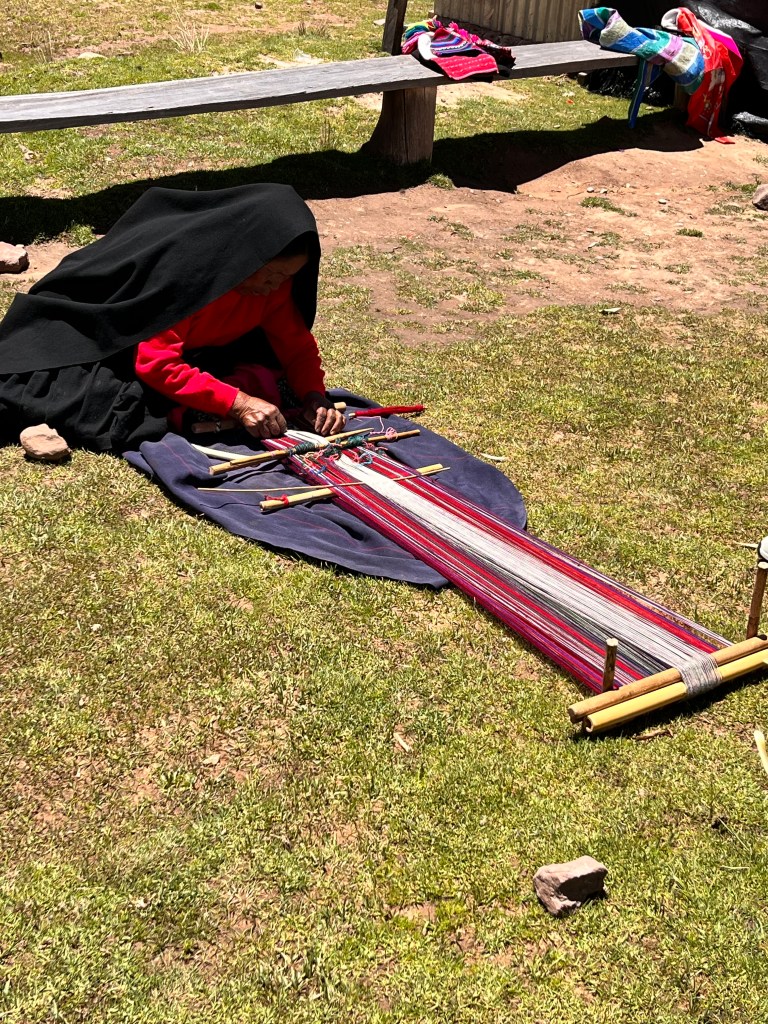
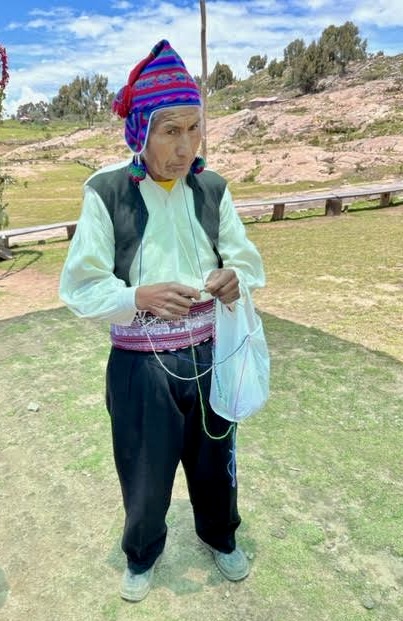
Taquille Island is also famous for its knitting men, who are the exclusive knitters on the island and whose work is regarded as being some of the finest in Peru.
This gentle soul explained how he is never without his knitting, which he appears to be able to do without squinting at a pattern. I’m assuming he knit his hat. I love the quality and intricacy of the pattern, but I’m afraid these hats mainly suit little kids or the young backpackers who will be heading to Patagonia after they’ve finished the Inca Trail. This hat, on me, in Nanaimo – not a good idea.
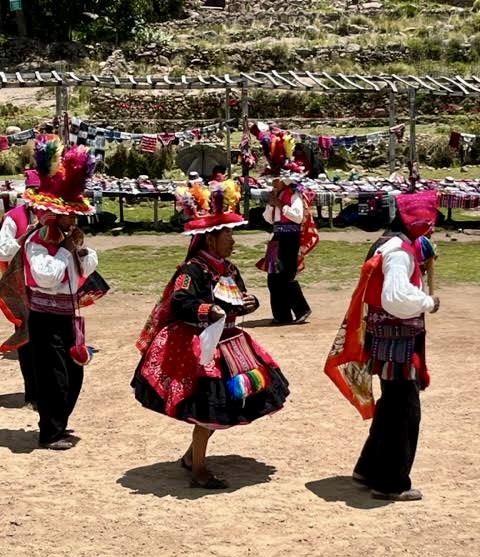
We were then treated to a traditional dance; another big part of Taquille Island life.
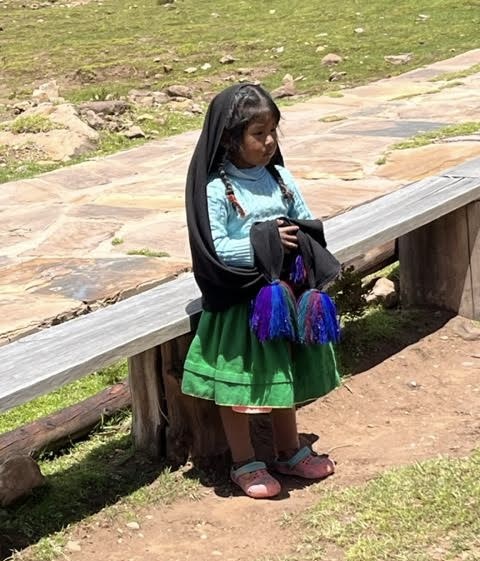
This little girl watched from the sidelines.
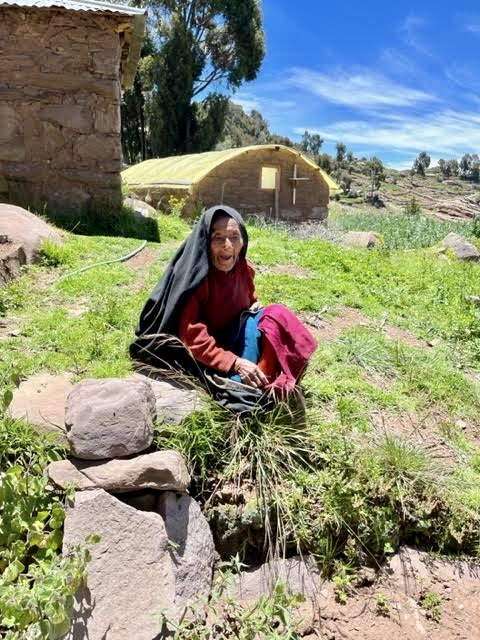
Cesar explained to us that the Taquille Island inhabitants are known for their longevity. Presumably a life that is filled with community spirit, an absence of the stresses of competitiveness and aspiration, combined with fresh air, exercise and clean fresh food contributes to becoming aged.
We were introduced to Mercedes, who at 103 is the island’s oldest inhabitant. We walked up to her home and she came out to greet us and shook all our hands. She spoke and smiled and seemed quite pleased to have visitors, but once again, I experienced a twinge.
In the highly unlikely event that I live to 103, would I want to be visited by strangers on a regular basis? Strangers, many of whom don’t speak my language and are casting an appraising eye over my ancient person? I don’t have a ready answer for that, as obviously anyone who reaches 100 years and beyond is a subject of interest.
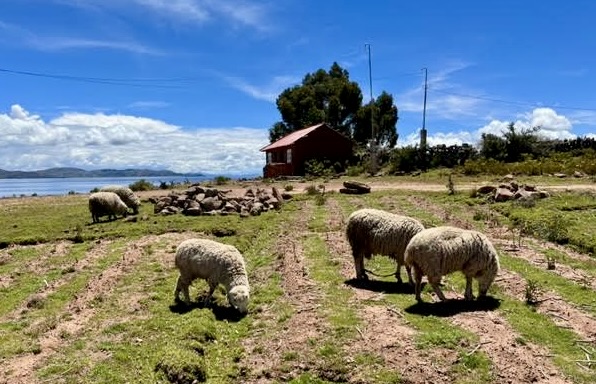
As we walked toward the other end of the island, we passed by sights like these ones.
A familiar site on the way to our restaurant.
After a delicious lunch of soup, fresh trout and vegetables, and hot tea made with fresh local herbs for digestion, we headed back to our boat.
While this experience was curated and could not provide a totally accurate understanding of the Taquille Island way of life, that’s probably not even the objective. It was a privilege to have a glimpse into that productive, content and peaceful existence that many of us claim to want but have difficulty finding.
Now we are in the Amazon – see you again in a few days.
 Leaving Ourselves Behind
Hi guys , nice to hear from you .Hope your having a gre
LikeLike
Hey Vikki – someone ate your comment! we are having a fabulous time – back the end of March, so hope to see you soon after that.
LikeLike
That tapestry is cool so no regrets. Glad to see that our lake is still Superior!
LikeLike
Nicely done! How is your time in Mexico – are you totally relaxed and enjoying the warmth and sun and colour?
LikeLike
We are relaxed! Doing yoga twice a week above Paty’s resto. Our flat is about 40 stories above the shoreline so we are always in a lather by the time we get back.
LikeLike
Wow! So very interesting. Ginny, this is one place we need to compare notes on when you two return. Your comments on what tourism has done to this area, for me, is sad. Your photos, as always, are beautiful.
LikeLike
Yes, we are really looking forward to seeing you guys – are you back in Canada again, or in San Juan?
LikeLike
well once again a beautiful well written blog of a gorgeous trip. This one was especially interesting. Sorry I haven’t written in awhile as I’ve been very busy and now in Oaxaca. Hope you continue your wonderful journey and we hope to see you when you return.
LikeLike
I love Oaxaca - are you there for a while? Yes, for sure we will get together this spring or summer.
LikeLike
this is my third time and Tony’s second. We love it also. We’re here for a week and it’s really hot. Looking for some nice places to see that we haven’t already seen. Like the petrified waterfall.
enjoy your beautiful time away
Sharon y Tony
LikeLike
Wonderful photos and commentary Ginny. Thank you for taking us along on your ph so magnificent travels. xoxo
LikeLike
Thanks, my friend – glad you are along for the ride. See you before too long.
LikeLike
We loved Lake Titicaca way back when
one man on Tranquille island told us that the had to learn to knit before he could propose!
wonder if John would have likes that idea!!
Enjoy Peru and its great people
LikeLike
We’re really loving Peru and their people. They have a nice mix of discretion and curiosity about us and pride in their country.
LikeLike
Thankyou for more beautiful photos! I loved these. Even though you felt your trip was a bit ‘touristy’ you certainly captured something meaningful about these islands and the people who live on them. Sad that it is a disappearing way of life since their is much that is beautiful about their seemingly simple lifestyle close to the earth, creating beautiful things. lovely weaving and knitting.
LikeLike
I don’t think I would last on a floating island, but there is a lot to be said for a life devoted to community and creating beautiful things and cranking back the pace.
i could relate to Taquille Island much more than to the floating islands – I guess it was the sense of space, room to roam and real sense of belonging.
LikeLike
I was fascinated reading about the floating islands, their homes, their dress, their crafts, and their way of life … a world apart from our own! Glad you had a chance to see for yourselves, even if the tour was curated.
LikeLike
So many ways to live and be in the world, and I imagine that when the tourists aren’t around, their lives are quite similar to what we were shown.
LikeLike
I don’t know why, but I was surprised to see that the tops of the floating islands were bare straw – somehow I was expecting decking or carpets. It makes sense though – if you’ve only known straw all your life, why not? It’s really not that different than hardwood or linoleum, and it seems to work for them!
LikeLike
That’s funny – that crossed my mind as well – where are the area rugs? The reeds are surprisingly soft on the feet, so perhaps they are like wall-to-wall carpeting.
LikeLike