We were excited to arrive in Cusco for a full week; so much history, culture, ruins, architecture, churches to absorb. Would one week even be enough?
Well, one week in any interesting place is rarely enough time, but our carefully-planned itinerary was completely thrown off-kilter since a) we had both come down with head colds, accompanied by the most astonishing amount of mucus imaginable and b) I succumbed to altitude sickness.
The former was easily solved with analgesics and a roll of toilet paper that travelled everywhere with us, but the latter was a leveller. After having spent the past few weeks at altitude, including three days in Puno at 12,560 feet a.s.l., we both felt impervious to its ill-effects. Possibly it was our four-day drop to 600 feet a.s.l. of the Amazon that changed my equilibrium, but boy, I went down hard. We held it together long enough to get checked into our Airbnb, go out to buy groceries and make dinner.
An 8:00 pm bedtime, nursing shattering fatigue and what felt like a pulverizing hangover, I slept for 12 hours, then slept again most of the rest of the next day. Ventured out to have a bowl of soup and buy some altitude meds, which worked like a charm.
Stephen was fine the entire time and the poor guy had a rather lonely time of it for our second full day here, but luckily Cusco has no shortage of things to do.
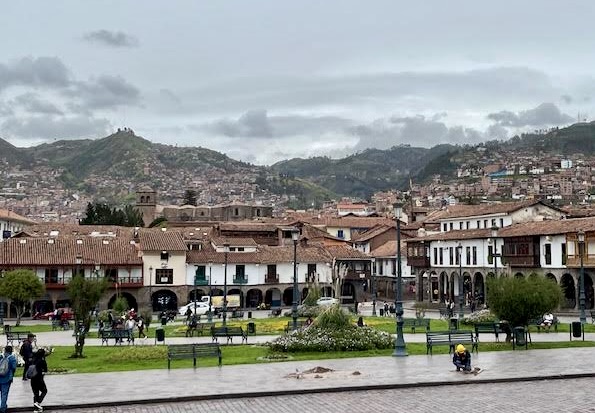
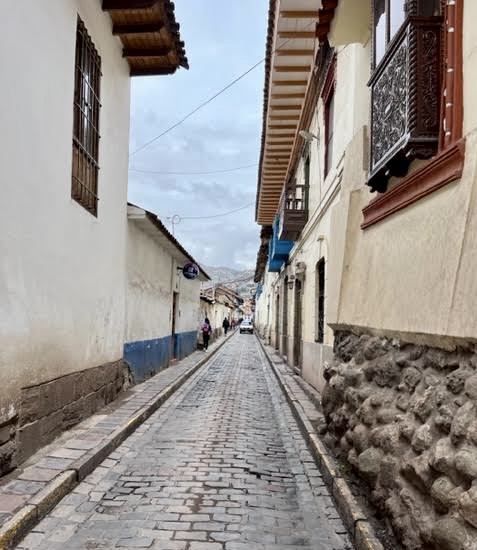
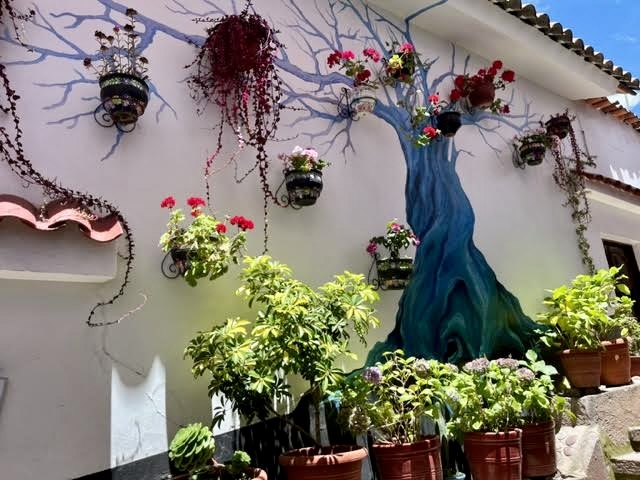
Cusco is quite simply, a stunning city, filled with narrow streets, steep hills, elaborately carved wooden balconies, fine architectural details, and bright pots of flowers to set off the tile roofs and the white-washed walls.
Many of its streets are narrow one-way cobblestone paths that require a level of finesse and agility to navigate – hop onto the tiny sidewalk while the cars pass, then hop back down onto the road until the next car comes along. It works well if you happen to be walking against traffic.
As beautiful as Cusco is in its own right, it is also a hub for everyone heading to Machu Picchu and the many points of interest in the nearby Sacred Valley. There are 10 archaeological sites within a two-hour drive of Cusco and the government has created the popular “Boleto Turistico” to streamline the process.
There are a few options, ranging from a one-day boleto, costing 70 soles ($25 CAD) to 10-day costing 130 soles ($48 CAD). It is mandatory to buy a boleto for any of the sites and since each site costs 70 soles, it very quickly becomes a much more economical option to buy the 10-day ticket – it paid for itself with two visits.
We spent one glorious day in Pisac, a village about an hour outside of Cusco and we will be going from here to Ollantaytambo for a couple of days before landing in Machu Picchu, so we’ll report on both those ruins in the next posting.
Cusco, which was once the capital of the Inca empire, was founded in 1100 and is now a city of around a half million people. The main streets are all paved, but many of the smaller pedestrian streets and alleyways around Centro Historico are cobblestoned, often with quite ornate patterns.
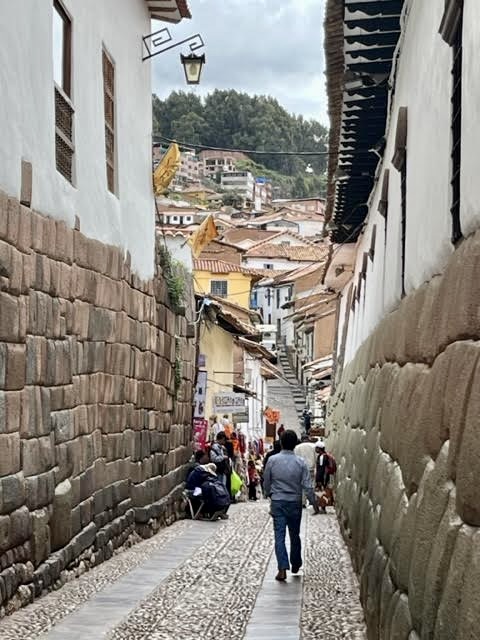
Cusco made me feel like an old lady – between my altitude-related breathlessness and slightly wonky balance, I realized I was picking my way carefully uphill and downhill, puffing all the while. Stephen had no such issues and was striding out as confidently as the young man in the photo.
The two main neighbourhoods in Cusco that most people visit are the Centro Historico, where most of the major sites are located, and the charming, hilly, artistic community of San Blas.
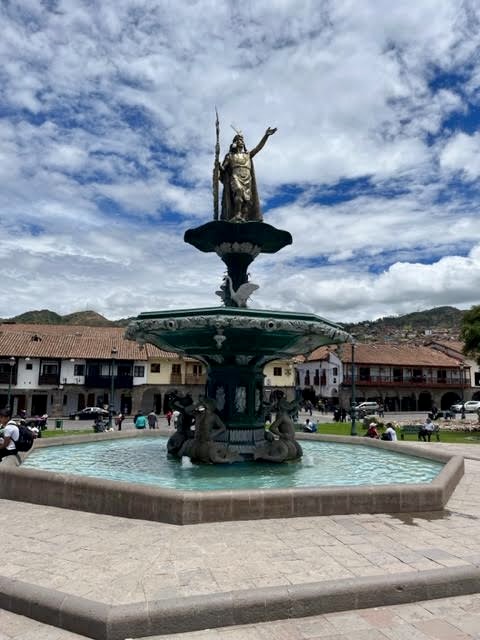
The central focus of the historic centre is the magnificent main square, Plaza de Armas, flanked by two baroque cathedrals and the Statue of Pachacuti, the Emperor of the Inca Empire.
The Church of the Company of Jesus, was begun in 1571 and completed in 1671 – it took 100 years to complete.
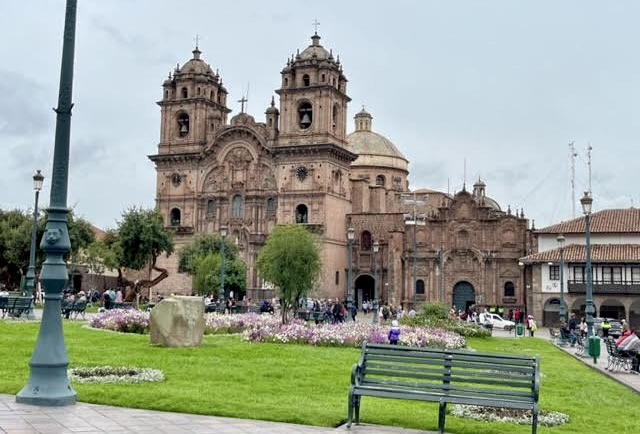
The Cusco Cathedral, also a 100-year endeavour (between 1559 and 1654), was built over an ancient Inca palace; it is impossible to adequately describe the grandeur within. (Even more impossible since photos are not allowed.)
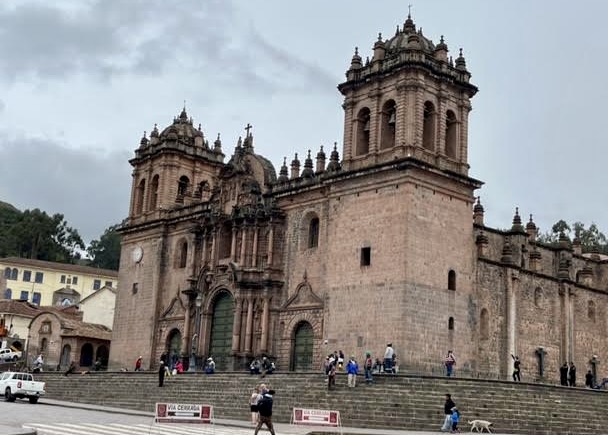
A simple visit on any given day would be overwhelming. This cathedral, a remarkable example of Renaissance, Baroque and Gothic styles, is massive in scope. Fourteen pillars support 24 arch roofs, and not one square inch of the interior is unadorned. Ornate wooden carvings, thickly crusted gold altars, a towering organ, fourteen side chapels, painted ceiling frescoes, walls lined with paintings (including a rendition of the Last Supper with guinea pig served on the platters) – this is without a doubt the most staggering cathedral we have ever visited.
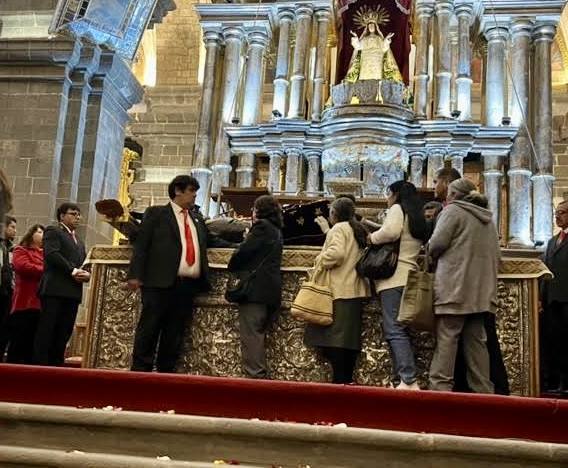
That alone would have been worth the visit, but as luck would have it, there was a procession underway. A statue of Black Jesus on the Cross, also named “Lord of the Earthquake” was being moved from his spot on the side of the cathedral to the front altar, in preparation for the Holy Monday procession.
We watched several gentlemen carry the statue along the side aisle, while the faithful tossed flower petals.
As everyone seemed to use this special occasion to ignore the “no photo” rule, we followed suit. Once Black Jesus was in place in front of the altar, a long line of worshippers began to file up past the statue, many of them visibly moved. I also felt moved by the ceremony and the ritual, and look forward to the Holy Week celebrations we will be experiencing in our last stop Ayacucho.
As we exited the cathedral, we were abruptly brought back into the secular world. A protest was taking place on the steps of the cathedral, presumably over the same issue that happened in January and caused Machu Picchu to be closed for a few days. The government was going to outsource the sale of entry tickets to Machu Picchu to a private company, thereby affecting hundreds, if not thousands of Peruvians currently working in the tourism industry. The government backed down after fierce protests, but clearly the issue is not over.
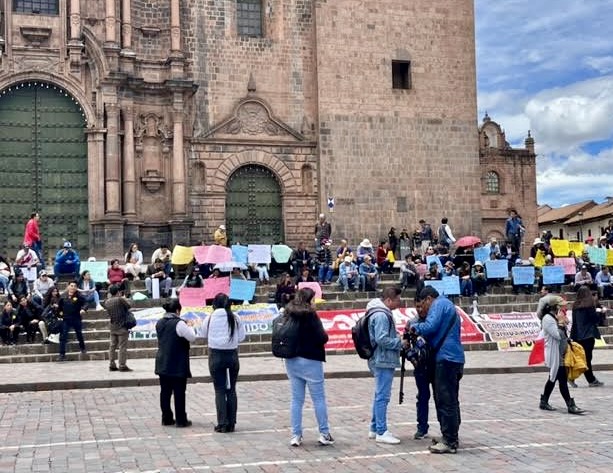
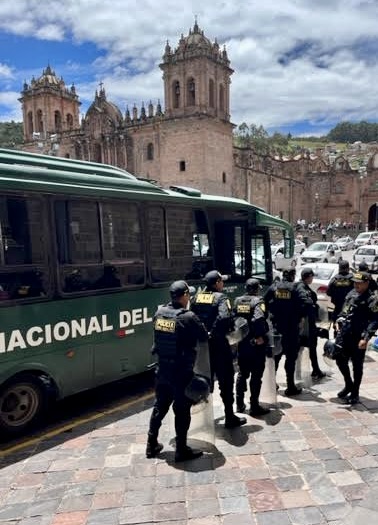
Protests are a daily occurrence in Peru and it is common to see police lined up in full riot gear in central plazas, just maintaining a presence. This protest appeared to grow in intensity and numbers and before too long, reinforcements were called in. There was no violence or clashes that we were aware of.
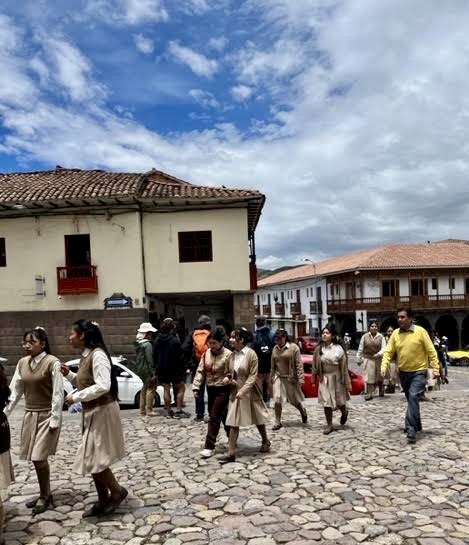
On a sweeter note, school resumed a week ago in Peru, and like kids everywhere – they have the joyful end of day camaraderie on the street – looking for snacks and hanging out with their buddies. Love the uniforms.
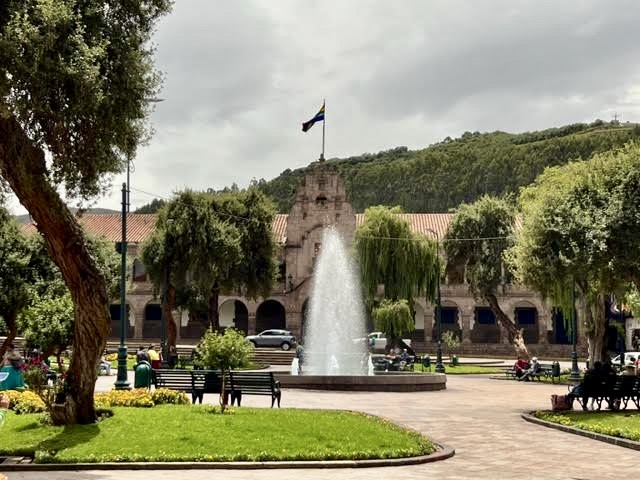
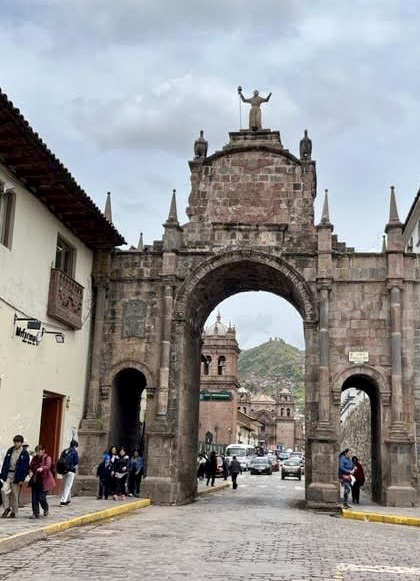
We didn’t check out museums or art galleries; we mainly enjoyed wandering the streets and discovering what lay around each corner.
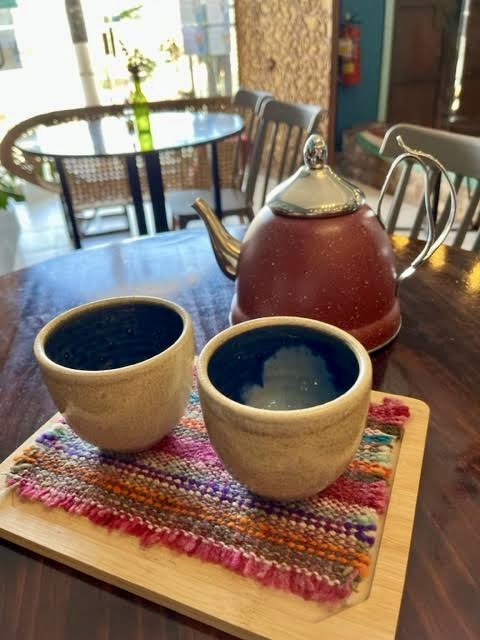
Tea infusions and specialty tea shops are big in Cusco. We popped by this lovely little spot for tea and a light lunch. It was my first outing after being so sick and the woman very kindly made a brew of lemongrass (for iffy tummies), coca leaves and muna leaves (for altitude). As delicious and soothing as the tea was, I loved the presentation more.
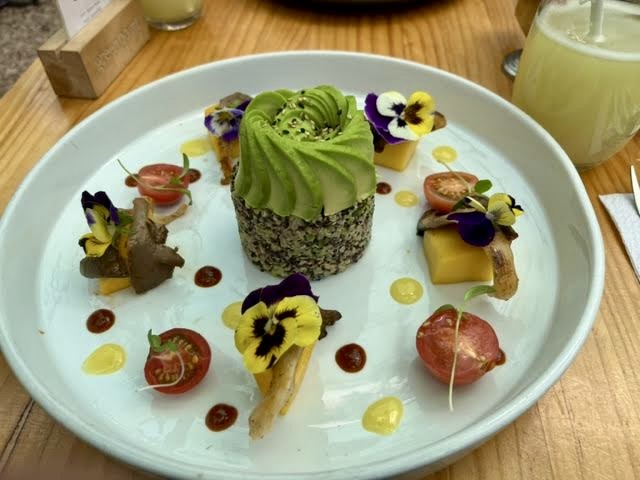
And the food! We have eaten extremely well in Cusco – there is real care taken to use local ingredients and subtle spicing. We stopped by a highly rated vegetarian restaurant and I ordered a quinoa salad, in part because I wanted something fresh and healthy and in part because quinoa is such a big deal in Peru. I may try and bring some back – it is so tasty. This is what my quinoa salad looked like:
The handcrafts here are nearly irresistible – pottery, jewellery, weaving, folkloric objects, knitted goods, and at very reasonable prices. The challenge is that each street is lined with shops selling virtually the same things and there are vendors on every corner. We have decided not to buy anything until our last stop – Ayacucho, which is well-known for its handicrafts and far less touristy.
Our other challenge with shopping here is that the vendors on the main square are so numerous, so persistent and so aggressive that a simple stroll is not possible. Without one word of exaggeration, in one minute, you will be accosted by people selling double-decker bus rides, trips to Sacred Valley, jewellery, dolls, knitted hats and massages. Laminated menus for restaurants are thrust in your face and young men carrying briefcases filled with identical stacks of “paintings” entreat you to “look at my work.” In one minute, you may well be accosted by 30, 40 or even 50 vendors, many of them coming at you at the same time.
It is overwhelming, exhausting and infuriating and so detracts from just being able to enjoy the city. Most of the vendors are located right in the square, so it is possible to walk a couple of blocks and find peace, and most of the vendors give up quite quickly.
In one particular case, though, after I had said, ” no gracias” for the hundredth time, I was approached yet again by a young man selling hemp jewellery. I responded in the negative and then I heard him mimic me to his friend, ” no gracias.” I whipped around and took his photo, which was preferable to what I felt like doing.
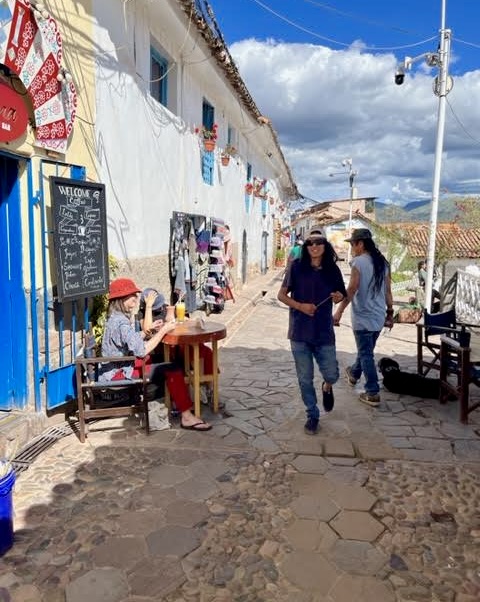
With aggressive vendors being the only aggravation in Cusco, (and we did not encounter this anywhere else in Peru), let’s go back to the delightful aspects of this city – wandering the neighbourhoods.
San Blas is often described as “bohemian” but it also feels like a neighbourhood that is close-knit and takes full advantage of its hillside sight-lines. Basically, if you are in the main square of Cusco and you start climbing up the hill, you will walk right into San Blas. It is defined by steep hills, tiny perfect shops, great restaurants, and tons of flower pots.
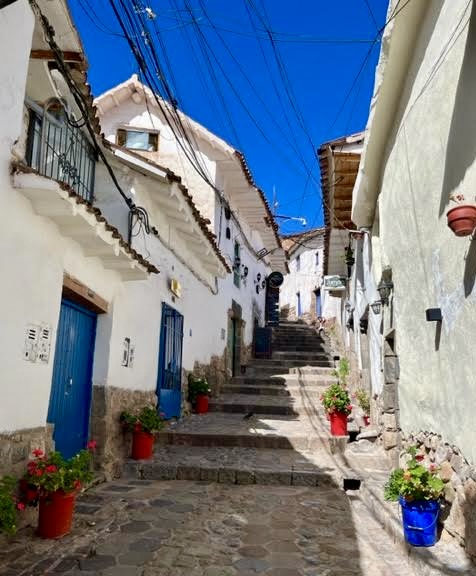
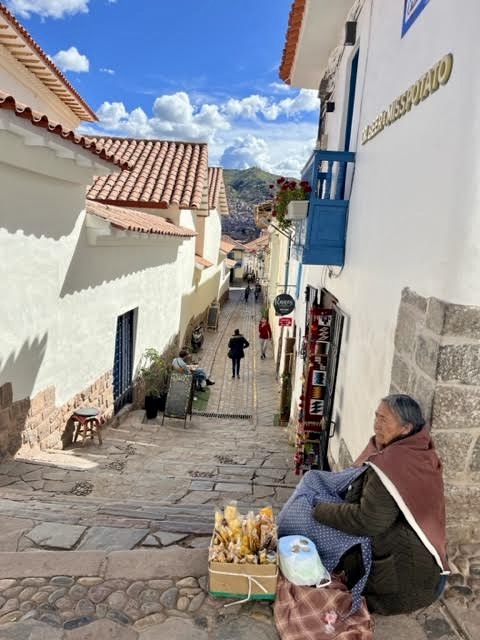
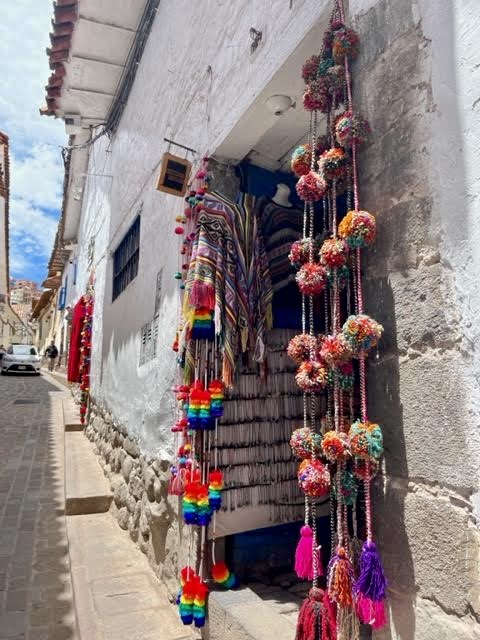
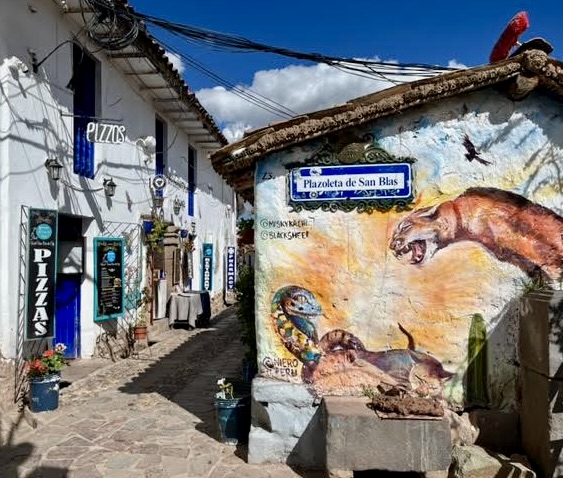
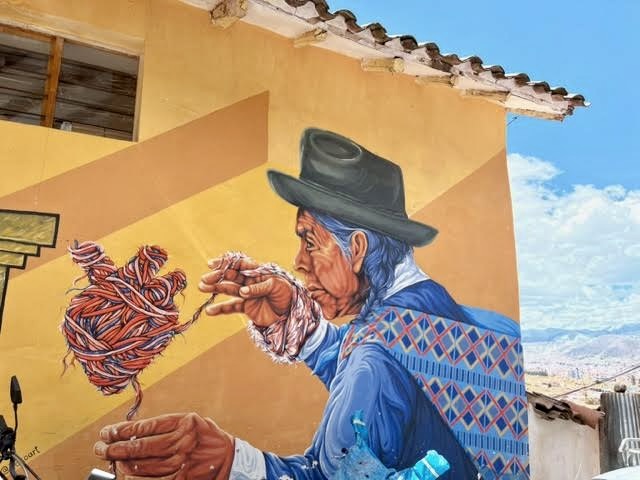
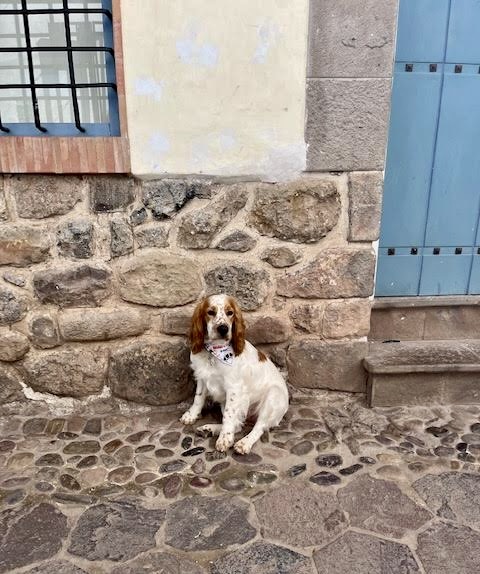
Maxie, the neighbourhood dog.
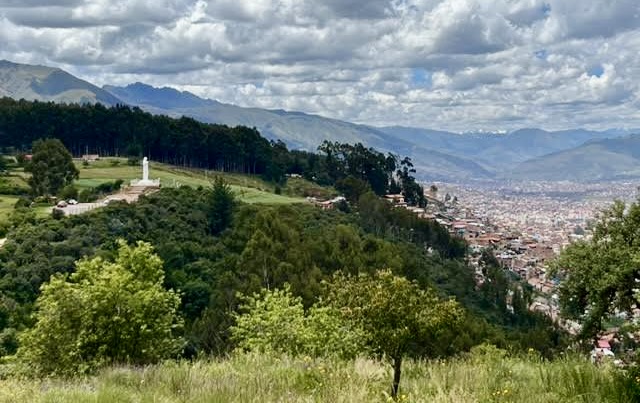
And finally, with just today left to explore Cusco, we headed to Sacsayhuaman (pronounced Sexy-Woman), a 15th century citadel built by the Incas on the hill overlooking the city. This site, along with the city of Cusco, was declared a UNESCO World Heritage site in 1983.
The truly remarkable thing about this site is the construction of the massive stone walls. The stones used are the largest in pre-Hispanic America and the walls measure 400 metres long and six metres high. What is confounding is how these massive rocks were so precisely carved, moved and put into position and held in place without mortar. Their fit is so tight, it is said you cannot fit a credit card between stones ( we didn’t try).
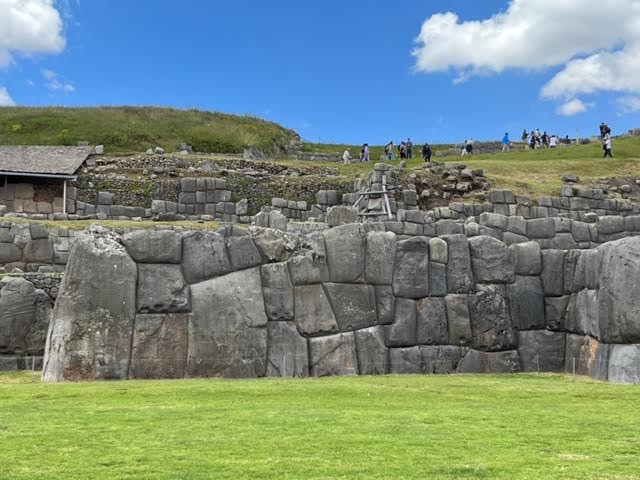
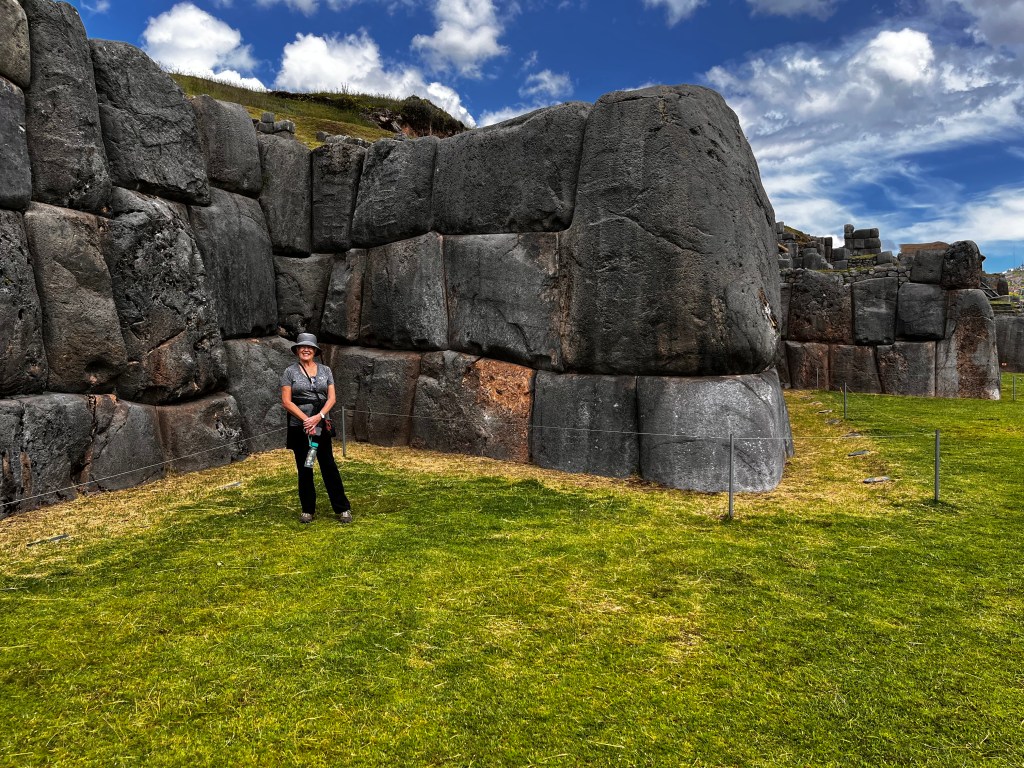
Signs everywhere are worded a little more forcefully than the usual “Please do not touch.” They advise visitors that “Touching stones is forbidden.”
Walking the grounds does feel like a sacred place.
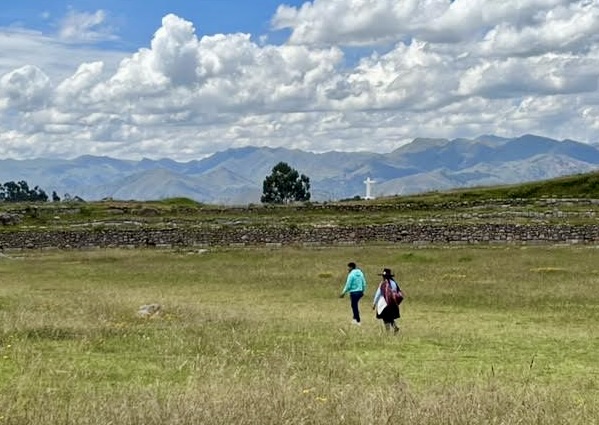
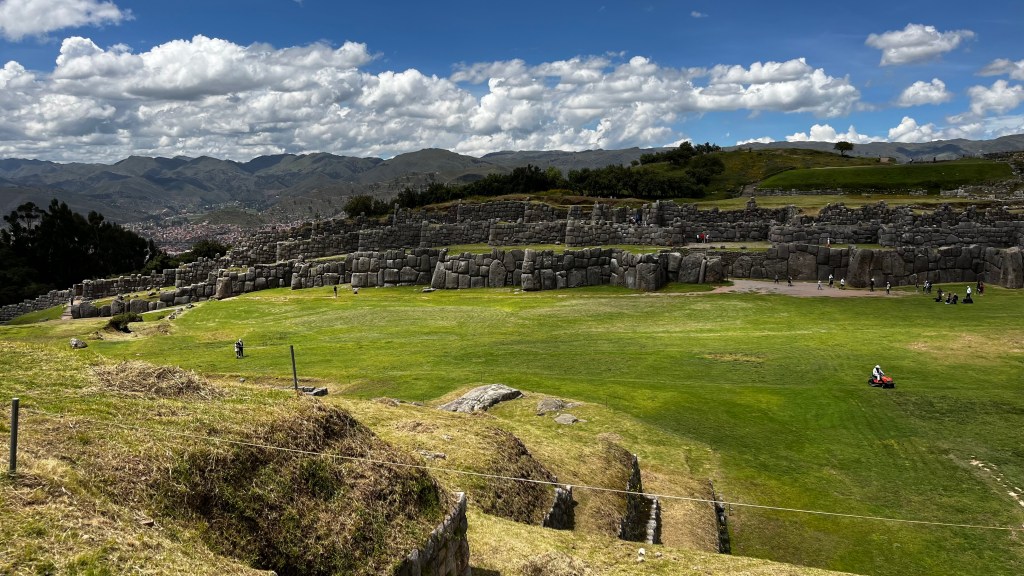
The Grand Plaza is large enough to hold thousands of people and serves as a special location to gather on Winter Solstice, every June 24.
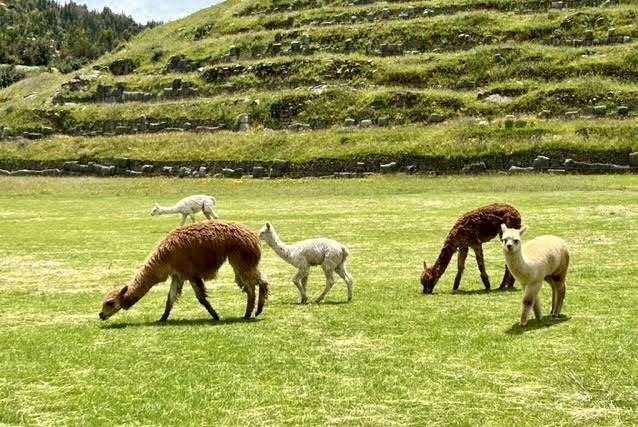
Resident llamas. (or alpacas?)
And so quickly – our time in Cusco is over. Tomorrow we grab a collectivo for the two-hour ride to Ollantaytambo, where we will stay for two days to visit the ruins there. Then, the train to Aguas Calientes on March 18 for an overnight, to join the hordes at the crack of dawn the next day to see Machu Picchu.
I’ll try and get a posting about the Sacred Valley ruins, including Pisac and Ollantaytambo within the next couple of days.


Just reading about your bout of altitude sickness makes me queasy all over again. It sure can put a damper on things, but fortunately it sounds like you managed to get yourself moving again (albeit slowly) to take in the sights of beautiful Cusco. We found our little cozy spot was Ollantaytambo….I hope that you will love it too….Quieter, cozier, and emptier ruins make it a special place.
Enjoy the absolute jaw dropping majesty of Machu Pichu!!
We can’t wait to hear all about your experience when we meet up in Vic 👍
LikeLike
I was so lucky Kris, because the altitude meds are designed to open up the lungs a little and allow more oxygen in – that’s really all there is to it. Coca leaves and tea do a similar thing, but not nearly as quickly or effectively. There is also an essential oil called Agua de Florida (imported from New Jersey) that is on every pharmacy shelf – a few drops on the hands, rub together and breathe deeply – we have it with us at all times, as I can still get breathless.
We are now in Ollantaytambo - oh so beautiful – I can see why you loved it so much.
LikeLike
I’m glad your altitude sickness lifted, Ginny. And that tea sounds heavenly! With you on the presentation. Your posts are making me itchy to travel. They are a real gift to all of us following you two. Enjoy Machu Pichu!
LikeLike
Thanks Shelagh – yes, I feel so grateful that it didn’t linger.
The rainy season in Peru is just starting to lift – I guess this would be their September, with the seasons in reverse. There are plenty of tourists, but not crazy. I would think April-May would be ideal in Peru, before the onslaught of the summer travellers.
I’m guessing though, you currently have a lot on your plate? Well I guess you always have a lot on your plate. :>)
LikeLike
It’s no fun being ill when you’re traveling. Hope you’re feeling better now. Interesting to know that you can get altitude sickness after you have been traveling at such heights. We have always been fortunate not to have experienced it. We are now in Japan, one of our favorite places.
Looking forward to hearing about Machu Picchu.😘
LikeLike
Sheila when the young’uns were feeling sick and vomiting in the Colca Canyon, I was fit as a fiddle! I guess I got cocky and paid the price.
All better now though, except for bouts of breathlessness that I imagine will be with me until we’re in Canada again.
You put the Japan bug in our ears before, so we’re watching your trip with great interest.
LikeLike
with you on the vendors. We swore off Cabo for that reason. Hope you’re feeling better!
LikeLike
All better now, Pete – thanks. I shouldn’t let the vendors get to me – at one point I was crying, much to the consternation of Stephen, who wondered what in the world was wrong with me.
LikeLike
of course Kath tried to make friends with all the vendors. I just kept on walking!
LikeLike
Wow, what a place! So much beauty everywhere! Sorry to hear you were sick and unable to see as much as you would have liked. I loved the glimpses inside the Cusco cathedral and the video of the procession you were fortunate to witness. I was particularly drawn to your photos of San Blas because of all the colours. Thanks for sharing Cusco with us!
LikeLike
Heather, we often pop into cathedrals and churches and sit for a bit, just to experience the peace and beauty. But honestly, this cathedral was like no other and yes, we felt very fortunate for our timing.
We’re so looking forward to the Easter Week celebrations in Ayacucho – considered to be the most extravagant and meaningful in Peru.
LikeLike
Cusco sounds lovely (vendors in the main square aside!). When you can enjoy just roaming the streets for hours, you know you’re in a nice place.
Glad to hear you’re feeling better!
LikeLike
Such a relief that it only lasted a couple of days, although the breathlessness is hanging around.
Yes, any place that has nooks and crannies and hidden corners is my kind of place. I always leave feeling I’ve missed a lot.
LikeLike
So sorry to hear you were fighting a cold and worse altitude sickness. There should be a law against getting sick on holidays. Nevertheless, from your informative notes and gorgeous pictures you did not let sickness stop you from exploring this fascinating city.
Our favourite pictures, although we liked them all, were of the beautiful tea presentation sitting on the colourful placemat, the murals were unique and professional but we thought the one that captured the local man wrapping wool around his hand/fingers.
We are off to Victoria for a week for Bill’s Bird photography course. I am tagging along to visit friends, including, of course, Pippa and Penny’s, explore on my own and do some shopping.
We look forward to your homecoming so stay well and enjoy the last part of your trip.
Hugs, Bill and Julie
LikeLike
Traipsing around Victoria on your own sounds like heaven. We are always so focused in our trips there; ditto for Vancouver.
have fun – and say hi to Penny & Pippa for us.
See you soon!
LikeLike