When we were travelling a few years ago through the desert regions of California, I imagined there would be little difference between Joshua Tree, Death Valley and Anza Borrego. I couldn’t have been more wrong; the differences were pronounced. A desert is not just a desert.
Such is the case with the many ruins that encircle Cusco and into the nearby Sacred Valley of the Incas.
This breathtakingly beautiful area that runs about 60 kilometres between Pisac and Machu Picchu is richly fertile land that began with maize production in the time of the Incas and still produces corn to this day. It is also home to a number of important ruins – the big three being Pisac, Ollantaytambo and Machu Picchu.
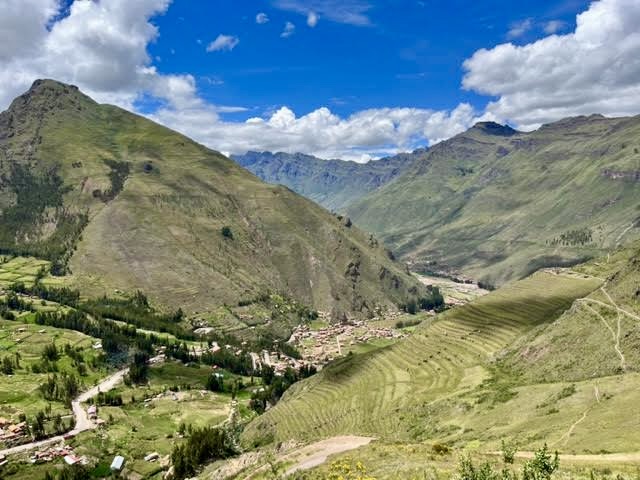
We visited Pisac while we were still in Cusco. About an hour’s drive out of the city, this was the sight that greeted us as we made our final twisty climb to the entrance.
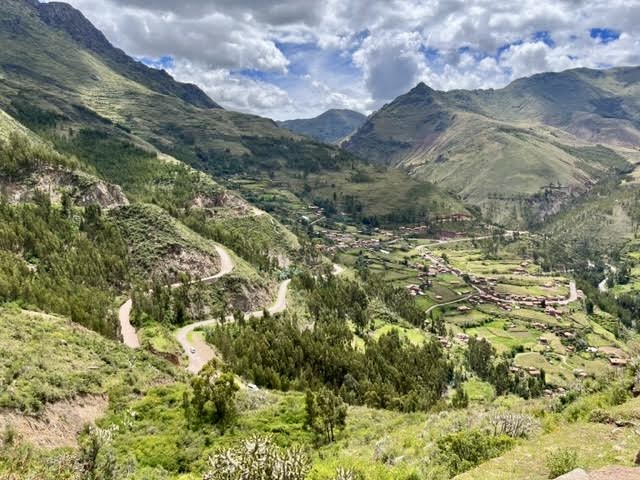
Pisac is a small charming village in the Andes that appears to have replaced its ancient Inca medicines with a more New-Age approach to the healing arts. Jungle remedies, ayurvedics, interpretive dance, yoga and wellness clinics (all posters in English only) are among the offerings. The surroundings certainly lend themselves to frazzled foreigners who are in the area for more than a day trip to Machu Picchu. The whole valley has a mystical vibe and Pisac has honed in on that. It would have been fun to stay here for a couple of days.


As well as the curative attractions in Pisac, there are many really great restaurants and cafes to choose from. We ate here – at La Placita – and watched the action in the square from upstairs.

But…this was a day trip and the main attraction were the ruins that lay just above the town, accessible by a three-hour uphill walk or a 20-minute taxi ride. We chose the latter.
At 3347 m. high, about 500 m. higher than the town, we took our time to enjoy the drop-dead views and avoid breathlessness. Pisac, considered one of the most important sites in the Sacred Valley, was built both as a defence post to guard Cusco and as an important agricultural sector. It is estimated to have been built no earlier than 1440, since it was not inhabited pre-Inca.
It covers seven kilometres and includes temples, terraces and burial grounds. The settlements were built upon row upon row of finely constructed stone terraces.
It is yet another extraordinary example of engineering and Inca ingenuity to see the precision of the terraces, between eight and 10 feet high, that have survived intact all these centuries.

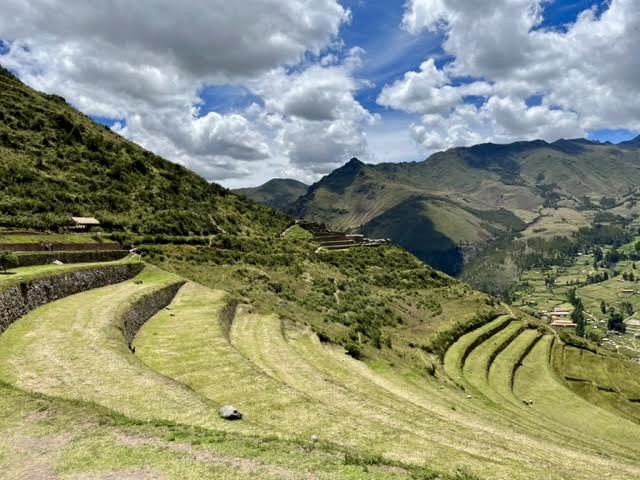
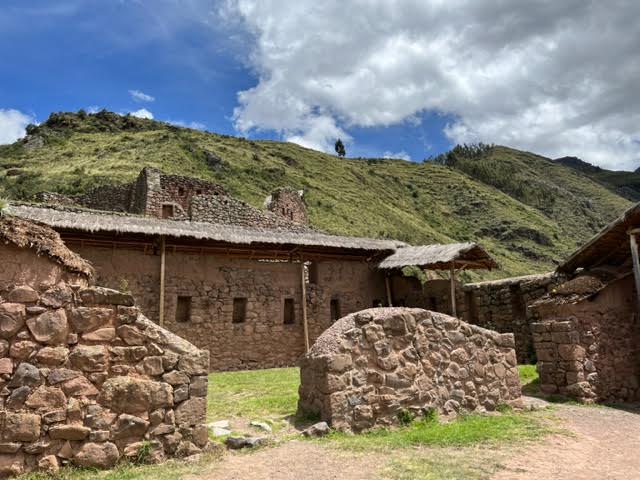
Several of the buildings were still fairly intact.
At times we were teetering on what felt like shaky and steep rock paths; other times, we were well protected by sturdy flat paths lined with rock walls.
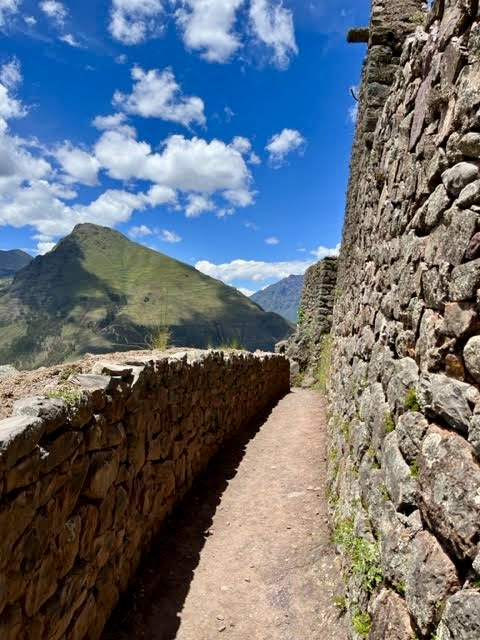
Unlike Sacsayhuaman, whose ruins were less clearly defined, Pisac felt a little bit better preserved and the pathways were easier to navigate.

And the views! Considering we are travelling in the rainy season, we have been extremely lucky with weather and with long vistas.
These llamas thoughtfully added a distinctly Peruvian touch to their photogenic backdrop.

And now we are in Ollantaytambo, an hour and half from Cusco. As with Pisac, we arrived here by collectivo – that tremendously efficient form of transportation in Latin America that we wish could function in Canada. A fleet of minivans (anywhere from 8-15-seaters) buzz around the city and beyond, stopping to pick up and drop off passengers pretty much wherever they please along a prescribed route.
Normally you are crammed in, with total disregard for safety, seatbelts or comfort, but the price is right. In the case of outlying towns, there are still no seatbelts, but luggage can be stored in the back and everyone gets a proper seat. For our hour and a half trip, we paid 15 soles each ($5.50 CAD) and had fun watching the three Peruvian ladies in front of us gab the entire time and instruct the driver to pull over to a roadside stand for sweet bread and juice.
We’re here for two nights, staying at a hotel right in front of the ruins. Our hotel is just down the little laneway on the left – we can see the ruins from our window.

Ollantaytambo, known as “Ollant” lies in the Sacred Valley about 72 kilometres northwest of Cusco. This gorgeous little village is an Inca-era grid of cobblestoned streets and adobe buildings. It is the only town that has preserved its ancient Inca urban design that continues to be inhabited. Known as “Inca Living City“, the inhabitants maintain some of their ancestors’ ancient traditions.
Now, this may not be an “ancient” tradition, but it is one I have seen all over Latin America. The gentleman, whether he be a macho thug, or a tender old soul, carries his partner’s handbag.
While this lady is more than capable of carrying her own purse, there is something so old-fashioned and caring about the gesture – I find it very touching. I also can’t imagine either Stephen or I adopting the practice. I’m travelling about with a black nylon PacSafe with multi-zip pockets and slash-proof straps – hardly the accessory that provokes male gallantry.

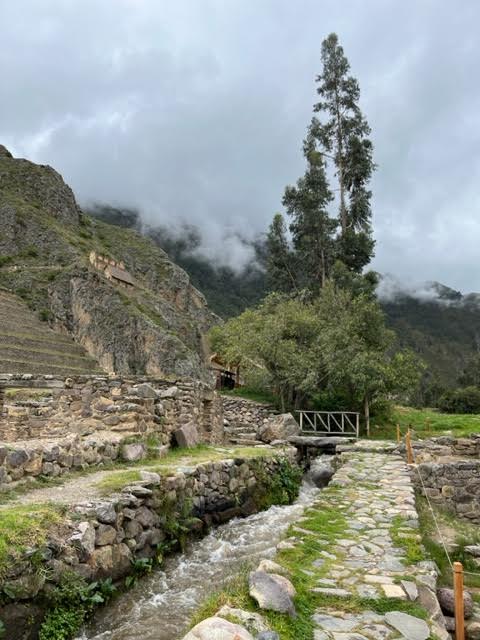
The archaeological complex merges with the town in that many of the canals are still in use. A mad torrent of water rushes through them from the mountains to the valley below, and they are still in use on most of the town’s streets.

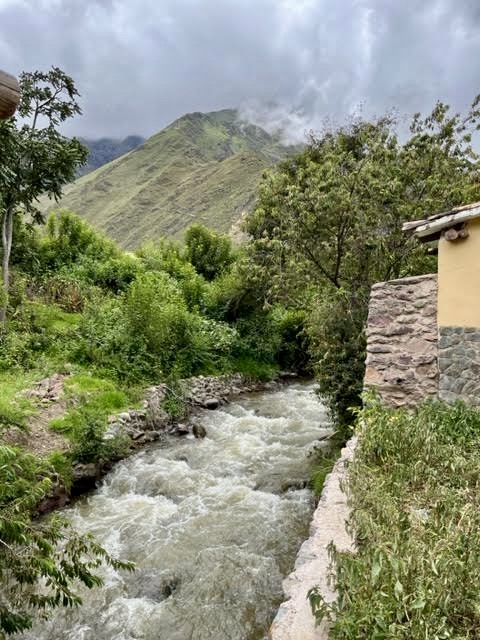
One of the many canals running through the archaeological site.
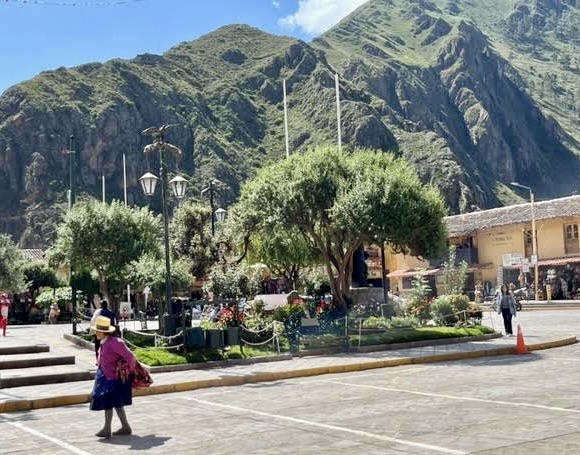
Ollantaytambo’s main square.
Pretty, narrow laneways spoke off the main square.
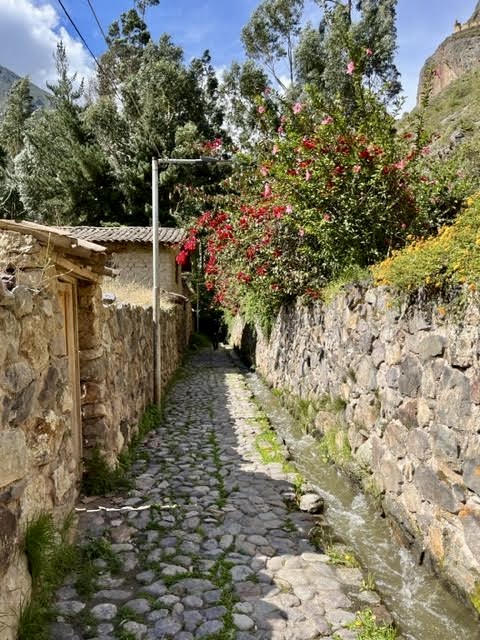
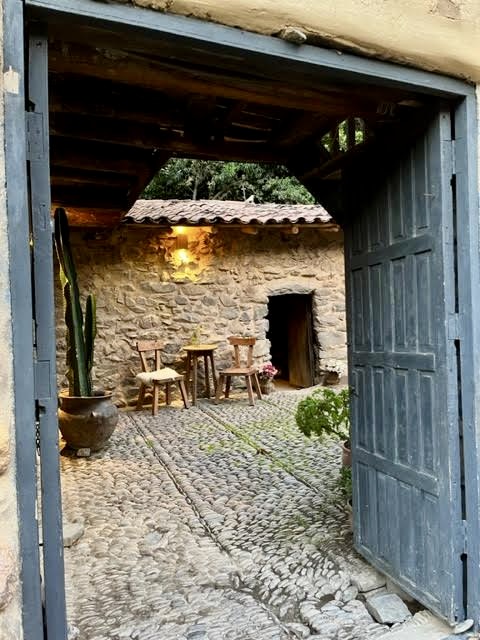
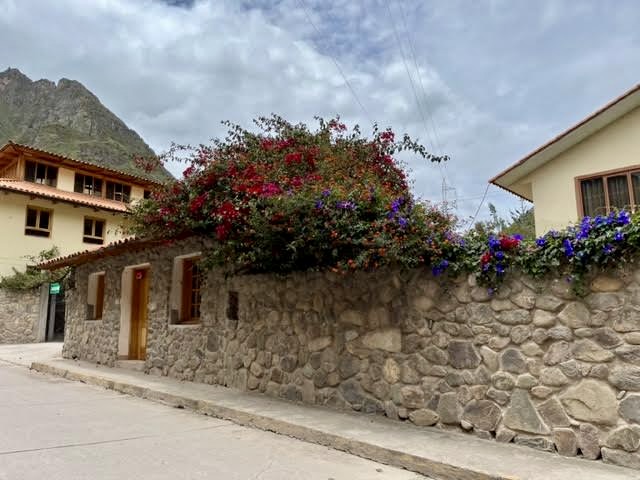
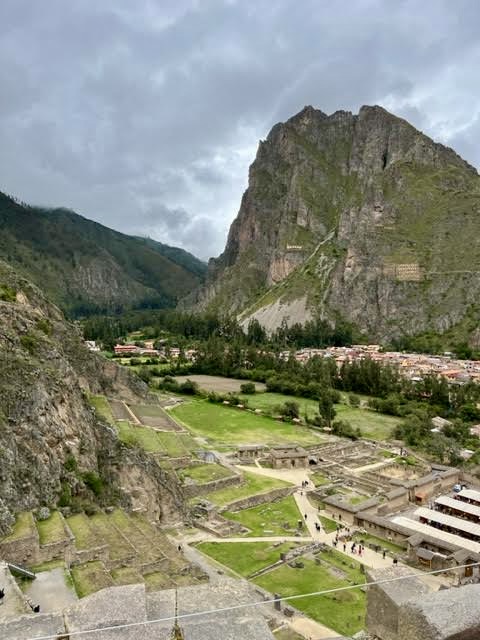
Ollantaytambo’s archaeological complex functioned as an important military, religious and agricultural centre. During the Spanish invasion in the 16th century, it was a fortress for the Inca army until its defeat when many buildings were destroyed.
What is remarkable about this site are the 17 very large terraces that have remained intact and that are oriented toward the town.

Once you have climbed the steps leading up beside the terraces, there are numerous sites to see and wonder at. Once again – so many unanswered questions – how is any of this possible? How did that little house get there? Who hauled those mammoth stones hundreds of feet up the hill, and then carved and positioned them? (well, I guess the Incas obviously did, but how?)
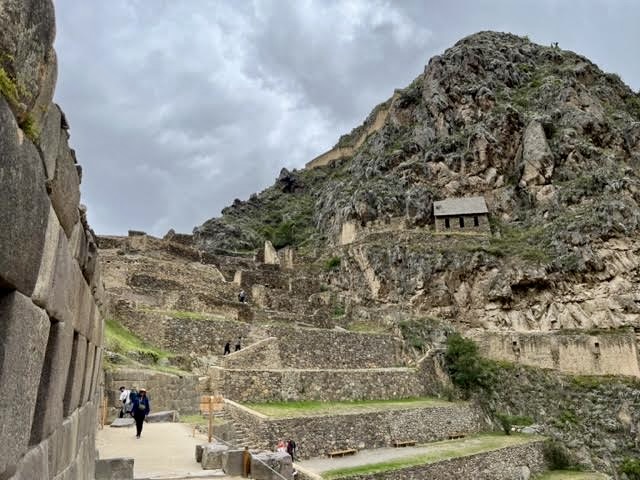

This important structure, The Temple of the Sun, is made of six monolithic rocks that are perfectly aligned.

Speaking of alignment, I read that Ollantaytambo is geographically aligned with several other important ancient sites such as Machu Picchu, Easter Island , Petra and the Pyramids of Giza. There is a 40,000 km. line that links these sites in a circumference around the wolrd that is within 30 degrees inclined to the equator.
Whatever the significance of that means, I’m not sure, but the spiritual and mystical pull here is undeniable.
If you look closely at this mountain, you will see a number of structures that were used to house maize, and if you are so inclined, it is still possible to climb up the steep little goat path that leads to the buildings.
While we were wandering around the lower levels, we had a young Peruvian girl approach us to practice her English. Her name is Marta, she and her family were visiting from Puno and before I knew it, a photo op was being organized. Her little sister came and grabbed my hand, and just like that …another warm and touching encounter with Peruvians.

This has been such a an incredible glimpse of the Sacred Valley – it would have been wonderful to have stayed in this area for another few days and explored other small communities. We leave tomorrow morning to take the train to Aguas Caliente – the little town that is close to Machu Picchu.
 Leaving Ourselves Behind
beautiful pics. Yes, we paid 13 MX pesos to ride the bus in Zihua.
LikeLike
You photos are amazing. We are reading this on a ferry from Kyushu to Shikoku. I still find it hard to wrap my mind around this. Peru is so photogenic. We are so enjoying your blog.
LikeLike
The Sacred Valley fills me with awe! How blessed you are to have walked its ruins. It has always boggled my mind how the Incas accomplished such feats (says me who struggles with a bag of groceries!)
LikeLike
Such a magical area of the world. Hugs you two xo
LikeLike
So beautiful. Do you and Stephen stop to hit each other in the shoulder every time you round a corner to discover some new vista? I’m guessing not – you wouldn’t be able to lift your arms by now!
LikeLiked by 1 person
You know me, Mike – I hit for emphasis, so yes, Steve’s arm is fair game. On the other hand, we’re often so far apart from one another as we poke along in our own little worlds.
LikeLike