When we were planning our trip, we knew we would be in Peru for at least part of the Easter celebrations, and we wanted to find a place that went all out for pomp and pageantry.
Ayacucho kept coming up as “one of the top places in Peru to celebrate Semana Santa (Easter)” and once we started to investigate this city we had never heard of, we were hooked.
A small city (under 200,000) set in the Central Highlands and just a 45-minute flight to Lima, Ayacucho is best known for three things – 33 churches (one for each year of Jesus’ life), a centre for handicrafts, and the aforementioned Semana Santa hoopla.
The Plaza Mayor is the beating heart of the city; a lush central plaza surrounded by three portals and the showpiece 17th-century Cathedral.
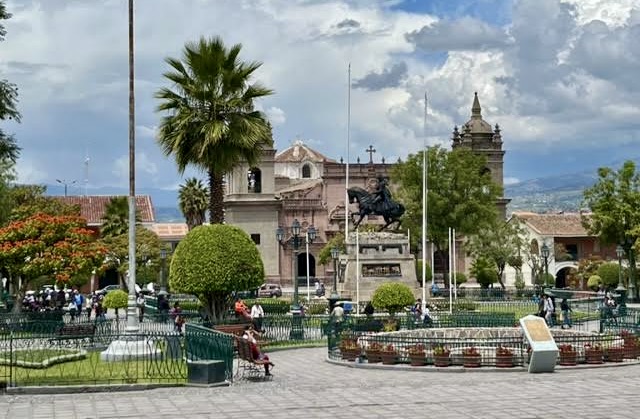
The interior of the Cathedral is characterized by a magnificent central altar and 10 altarpieces bathed in gold leaf.

Nearby churches are equally impressive; each has their own distinctive style and features.
Church of Santo Domingo:
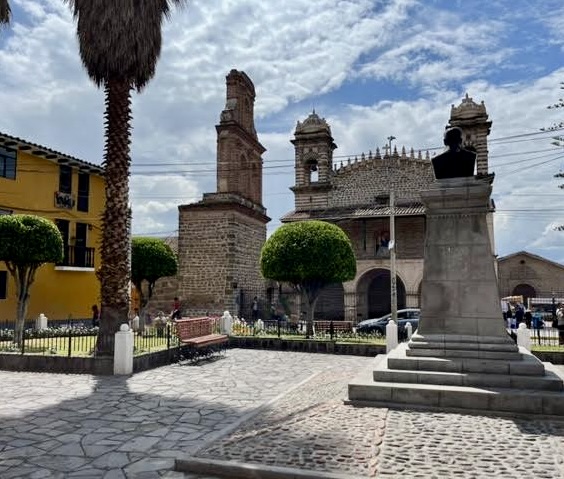
The Compania de Jesus Temple, situated on a pedestrian-only street.

This street provided no end of entertainment for us. People are out in force, including some innovative vendors. For 50 centavos (about 20 cents), we could attempt to “Control our Weight” or at the very least be aware of the damage. As it turned out, we were both pleasantly surprised; possibly all the walking has paid off.

You cannot walk very far in Peru without tripping over food vendors – freshly squeezed juice, popcorn, fresh fruit, roasted corn.
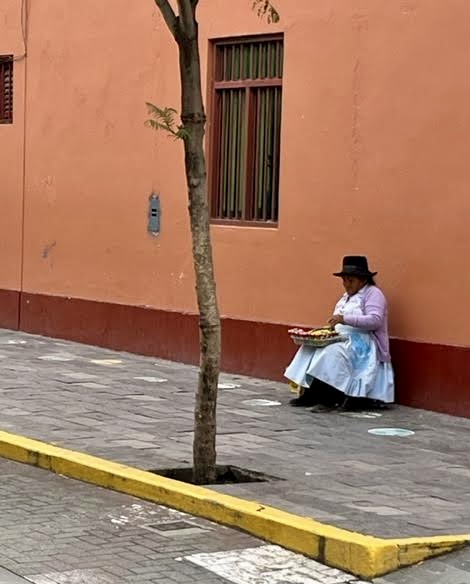

We saw candy apples everywhere – great flat wheelbarrows of them and it seemed the whole city was excited about them. Maybe they are a seasonal treat, we don’t know. We didn’t try one; Stephen is not a fan and I have just had dental work done that I’m hoping to preserve.
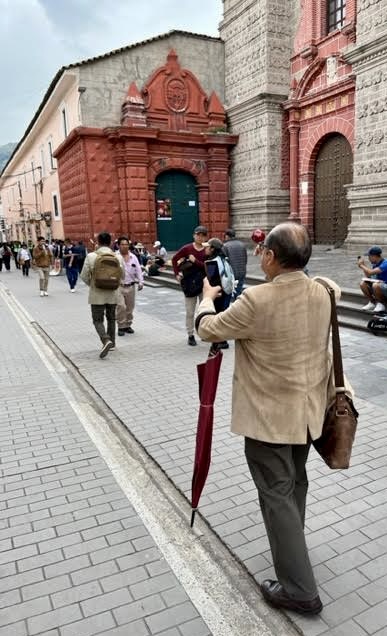
We caught the eye of this gentleman as he was walking nearby and enthusiastically exclaiming over his candy apple; holding it aloft so his friend could admire it.
Although Ayacucho is renowned for its handicrafts, there were very few stores selling local wares. We had assumed Ayacucho would be a smaller version of Cusco, in terms of variety and selection. Ayacucho has been described as offering handicrafts that are more authentic and cheaper, so we were putting off all purchases until now. We have such limited room in our cases and the plan was to wait until the end of the trip, ditch a few clothes we have grown tired of and free up space for souvenirs and gifts.
In particular, I was interested in weavings, hangings and pillow covers (all easy to pack). First we visited the Shosaku Nagase Artisanal Market, a beautiful complex made possible by its Japanese benefactor.
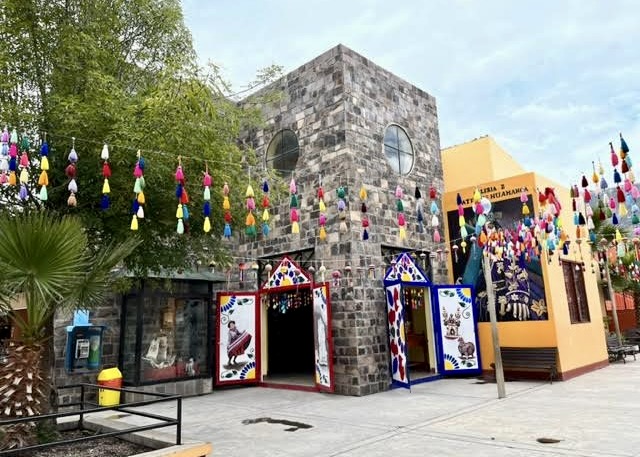
Inside, we found about two-thirds of the stalls empty and the existing vendors understandably anxious for a sale. Although many of the items were beautiful, we did not want fragile ceramics, or heavy stone sculptures, or 6×9 area rugs.
Another day, we took a tuk-tuk to the noted Santa Ana neighbourhood, home to many artisan workshops.
The tuk-tuk( or moto-taxi) is the workhorse of many Peruvian towns and cities. Its three-wheeled construction is ideal for navigating tight turns and steep hills.

We were delivered in front of a church in a very old neighbourhood, with nobody around but a benchful of curious old gents. Since the shops were supposed to be on all four sides of the small plaza, we walked without finding a single one open. (A later search on Tripadvisor confirmed a similar experience with another tourist). This is low season, but we were still confounded that artists would not want to take advantage of a city full of Easter tourists.
We did find this statue, commemorating the tenor of the neighbourhood.
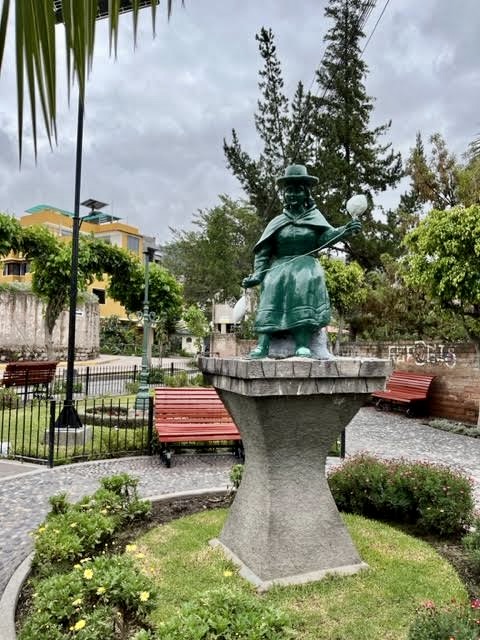
Our walk back downtown, over the aptly-named “Rio Seco” offering little sustenance for the stray dogs.

Ayacucho is very much a city for Peruvians. It is well off the tourist track and there is almost no English spoken here. There is very little tourist infrastructure; a few hotels, no hostels that we could see and no bilingual tours. My Spanish was fine to get us through the basics, but totally inadequate for any questions or deeper discussions. It was a bit lonely at time to be the only foreign tourists. Only on Palm Sunday did we see a family of three Germans and my encouraging smile in their direction was not returned.
Part of the reason for the lapse in foreign tourism here is Ayacucho is still playing catch-up after their devastating years between 1980 and 2000 under the influence of Shining Path, the radical Marxist-Maoist regime.
While this period affected all of Peru, this was the homebase for the regime’s leader, Abimael Guzman. Ayacucho was caught in the middle; with impoverished peasants the main victims of the regime and the Peruvian army’s brutal counter-attack. Over 70,000 people were killed or disappeared during this period.
We visited the Museum of Memory, which documents that time, and included several photos and testimonies of affected families.
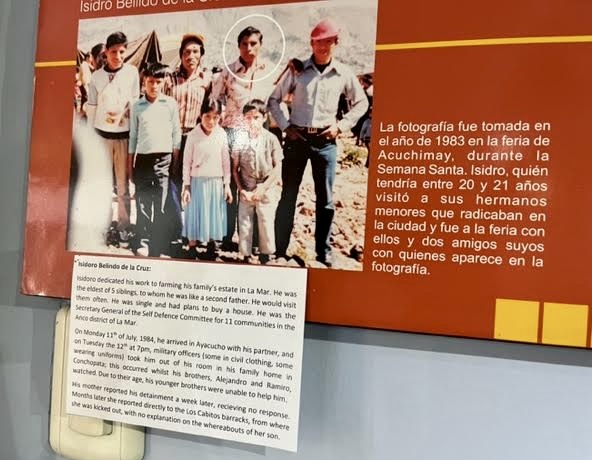
As is the case in all conflicts, journalists are particularly vulnerable. This photo shows the journalists while they were still alive, and their bodies after their murders.

While The Shining Path has largely been dismantled and Peruvians no longer live in fear, there are still rumblings and factions that threaten. It is hard to know where to find the good guys.
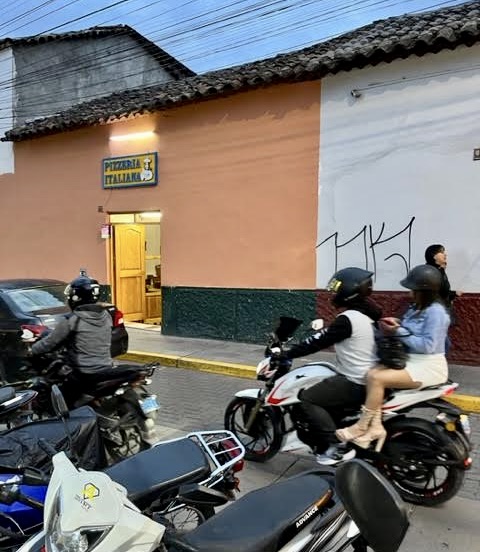
Meanwhile life carries on. There are other concerns, like crossing the street without being hit. There must be a system, but aside from those streets that have lights, it appears to be “whoever-gets-there-first-goes”. Cars, trucks, buses and tuk-tuks all barrel toward each intersection and then proceed with little hesitation and nothing but a continuous stream of honks to warn oncoming traffic.
So, in the middle of this bumper car rally, we are impressed to witness the insouciance of this rider. What better place to put on your sensible shoes and check your texts?
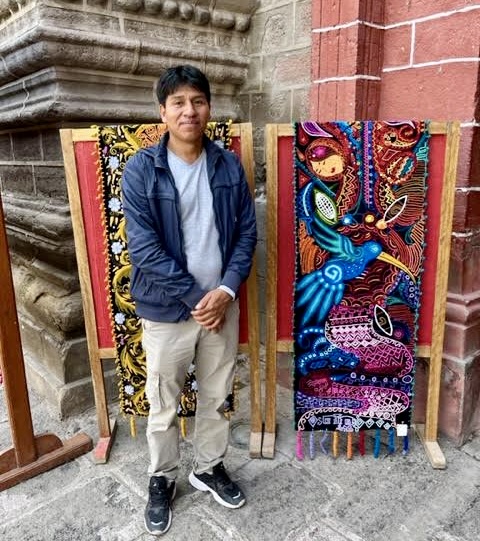
And yes, we finally did find the perfect Ayacucho souvenirs. This gentleman (whom we assume is a teacher) was selling the hangings, bags, and pillow covers produced by his students. They learn the process from the carding of the wool, to the dying, the weaving, and the embroidery – all done in the old traditions. We bought a few pieces – so beautifully done and at such reasonable prices.
And now – the main event – Semana Santa. In Ayacucho, celebrations last for 10 days, but while we saw a few processions and fireworks leading up, the kickoff is really Palm Sunday.
On Saturday morning, the streets around the Plaza Mayor were cleared of traffic, and artists began their work of creating the flower carpets. These carpets take hours to create, and feature everything from religious scenes, nature, political statements – all made of chalk, sawdust, flowers, fruit, rice, pine cones.
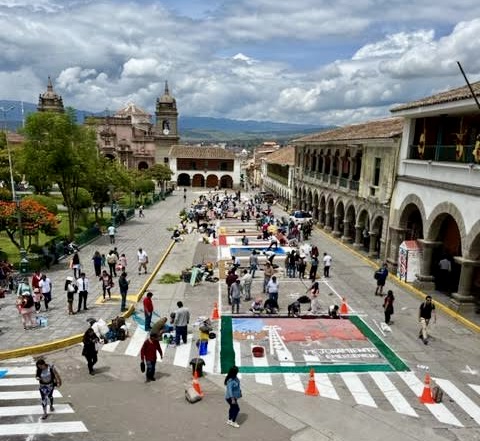
A couple of the incredible carpets. Saturday night we walked around the square, admiring the beauty and scale of these carpets. So much effort and time had gone into their creation, and we assumed they would be up for the duration of Semana Santa.


The next morning, we walked back down to the square to take part in the Palm Sunday celebrations and we were dumbfounded to see this.

All the flower carpets gone! Not so much as an errant flower petal left. Without a backward glance it was on to the next event.
There were noonday parades and bands, but everyone was concnetrating on the main Palm sunday procession, beginning at 4:00 p.m. The streets were lining up by 2:00, and incredibly we found a front -row, second-floor table at a small restaurant overlooking the square. We could not believe our luck and we staked out there the entire time.
The parade began with a lineup of Quechuan ladies in their beautiful dresses and hats.
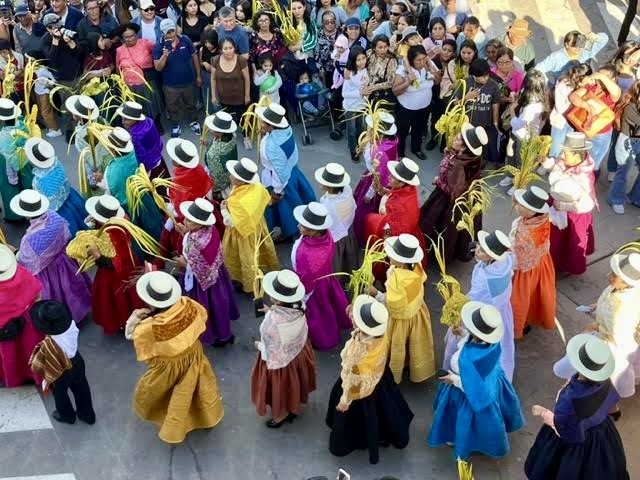
Loads of bands – some high school, some more professional.
This acrobatic team really captured the crowd. The boys took turns doing back flips, never missing a beat.

There were horses! Donkeys! Ladies riding in high heels!

Llamas may not have figured in biblical times, but we are in the highlands of Peru, so they were given equal time.
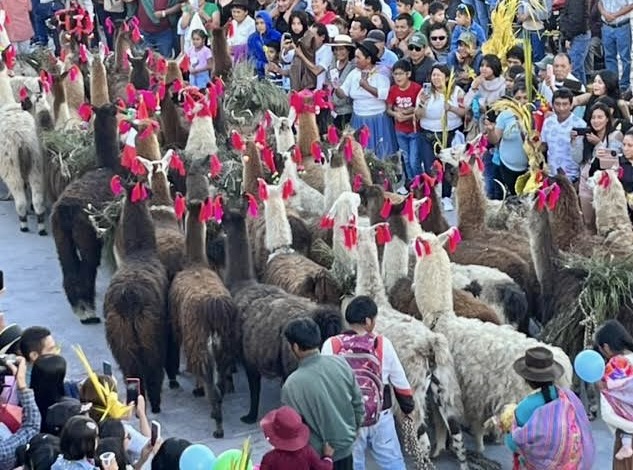
A long shot of the parade.

The parade, which lasted over an hour, culminated with the appearance of two important figures: The Archbishop walking alongside a statue of Jesus on a donkey. The crowd went wild.

Then…after all the excitement, the crowds, the pomp…as the Monsignor and Jesus passed halfway down the street, this happened:

Somewhat akin to wiping the crumbs from your mouth after an exquisite meal, the wait staff blew in and began clearing the table, vacuuming the carpet and stacking the chairs. It felt both a letdown and hilarious, and then we noticed this:

Police, arms linked, creating a barrier to keep the crowds back. “Back from what?” we wondered.
The party, not quite over, was now given over to the Peruvians. Armed with their palms, they began their march toward the square. In the thousands. It was quite an unbelievable sight, and made me happy to be on our balcony and not in the crush.
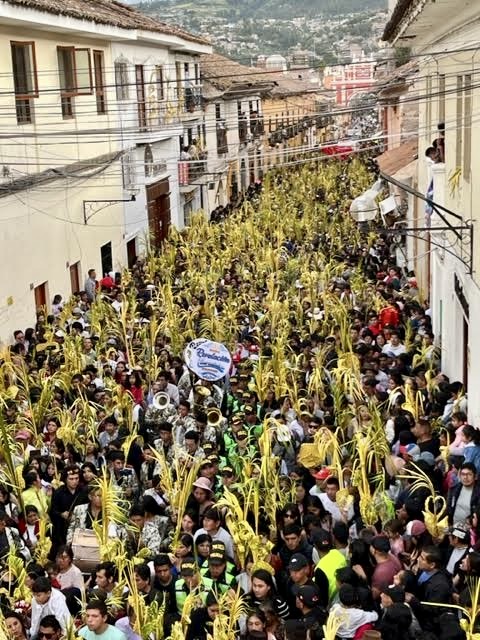
And thus ended our Semana Santa celebration in Ayacucho. The best is yet to come of course – this week leading up to Easter Sunday will be filled with processions, reenactments, candlelit services and religious devotion.
In a way, we felt like interlopers – two non-religious foreigners taking part in the holiest of Catholic holidays, so perhaps it is best we were only there to observe and enjoy the most joyous of the celebrations.
Now we begin our long trip back – 28 hours after our flight to Lima we’ll be opening the door to our own home.
it has been an eventful, exciting and fascinating journey and we thank you so much for coming along with us. It means more than you can imagine to have your company. Until the next time…
 Leaving Ourselves Behind
What a fascinating journey you both finished en grandeur !
can’t wait for the next trip!!
Danielle
LikeLike
Peru was such a diverse and interesting place – we feel very lucky to have been there.
LikeLike
Thank you for taking us into the festivities from the relative calm of our homes. Those flower carpets were amazing -heart-breaking that they got quickly swept up. I guess it gives new meaning to the journey being more important than the destination. Hopefully we will see you in a couple of weeks and you can re-live the trip for us.
Linda and Jon
LikeLike
The short life and death of those flower carpets was a mystery to me – less so when it was obviously the parade route, but still. I can’t imagine being the artist crouched over the creation for hours; knowing it would be just a memory in mere hours.
See you both soon!
LikeLike
Absolutely fascinating! It will be so much fun comparing notes. Can’t wait to see you.🥰 Jeanne
LikeLike
Can’t wait to see you both, as well!
LikeLike
Amazing! Lucky to have experienced it all from the inside. What a wonderful trip you have had. Safe travels home!
LikeLike
It was a great trip, Christine! I look forward to hearing about your Spanish immersion. As I continue to limp along in Spanish, I think that might be the only solution to real improvement and progress.
LikeLike
Thank you sooo much for bringing us along on this fabulous journey! Peru, the Andes and all the places, people and events…. could be on my bucket list. But, hae’ me doots if I would be able to do it as you did. So, Thank you!
LikeLike
You never know! Peru demanded a lot of stamina – possibly because of the altitude and the effort required to travel great distances around the country. We mainly flew, but did tack on a few 6-8 hour bus trips.
We do know we are no longer built for 10-hour overnight bus trips, but it was fun listening to the younger backpackers talk about the relative merits of different journeys. That is a way of travelling through South America that has its own charm.
LikeLike
It’s been over 15 years since we were in Peru, so through your blog we were able to relive some of our memories.🥰
LikeLike
Joy, it will be fun to meet up with you and Oscar and swap tales – I bet not a whole lot has changed.
LikeLike
Hello! Though I haven’t inserted any comments ’til this one, it has been a pleasure to follow you on this journey. The world is indeed an incredible place and the resilience and creativity of people demand our absolute respect. Thanks for capturing that so well with your observations and lovely photos. I imagine you might feel both a little sad to see the journey end (for now) and a little relief to get back home – all part of the experience! Bonne rentrée!
LikeLike
Shelley! So nice to hear from you! You are so right – the end of the trip is always a little bittersweet. I know the gears have shifted when I start thinking about doing little projects at home, and look forward to those small domestic tasks. Then, of course, after I have a bit of dusting and a few loads of laundry under my belt, that novelty has worn off!
Still, lovely to be home – I get a little choked looking at the glorious beauty here and feeling grateful to be breathing in such cool, fresh air.
Hope to see you and Tom before too long.
LikeLike
I was amazed at the carpets and the march of the Peruvians towards the square waving their palms! What a sight that must have been. As always, it has been a treat to follow the two of you on your journey. We’ve learned so much!
LikeLike
Thanks Heather! It was an incredible sight to see the thousands of Peruvians celebrating in the street – such a sense of celebration and joy.
LikeLike
Great shots!
LikeLike
Thanks Peter!
LikeLike
Thanks so much for taking us with you on your travels – you’re proof that a winning smile and a few words of the language can go a long way with the locals. I’m looking forward to seeing where you go next!
LikeLike
You know, there were days when I almost felt like I was getting the hang of the language and then other days I would be busily conjugating verbs in my head and mispronouncing words and would be met with blank stares and/or amused smiles.
The Peruvians, and most Latin Americans, are immensely patient and appreciative of efforts to speak Spanish.
LikeLike