
Saffron, which is the delicate stamen of the saffron flower, is harvested in this area in October. Back in Canada, a few threads protected in a tiny plastic case, costs about $10. Here, saffron is featured in everything from tea to Turkish Delight; it is Safranbolu’s parsley. We did as all tourists do – posed in front of the town’s namesake statue.
Safranbolu is known for other things besides saffron. This 17th century UNESCO World Heritage Site has over 2000 traditional Ottoman houses, 800 of which are protected by the government. The town is a walker’s dream, with streets winding up the hillsides lined with very similar buildings.
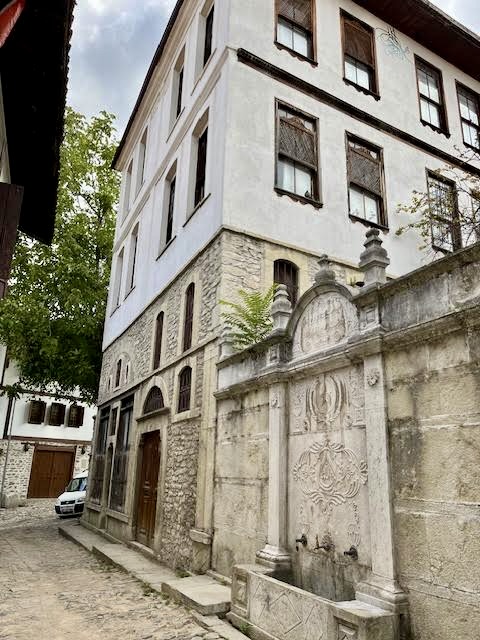
Ottoman homes are three-storey structures characterized by stone and wood and remarkable woodwork outlining the doors and windows.
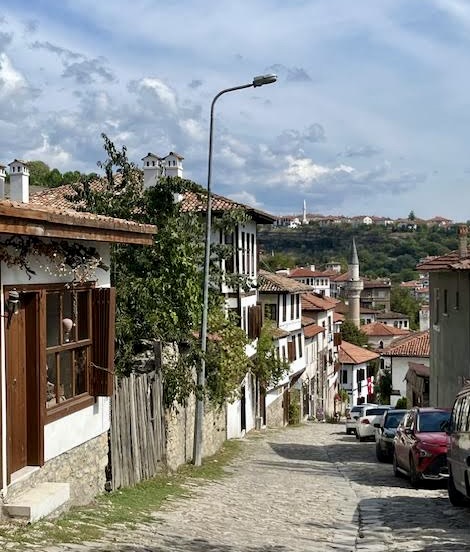
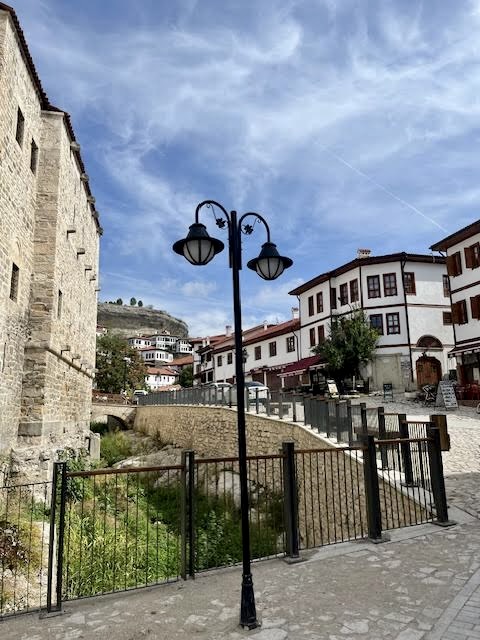
This is the exterior of our hotel.

While most of the homes are in good repair, there are a number that have been abandoned for a while. We’re not sure at what stage they are deemed unsalvageable, but we stopped to admire the handiwork of the house on the left below. The owner was busy working on a restoration, and although he spoke no English (and we speak no Turkish), he understood our enthusiastic smiles and passed us some grapes from a nearby vine!
The house on the right is quite dilapidated – we wish we could find someone to tell us more about these homes and their fates once the windows are broken and the roof starts to leak.

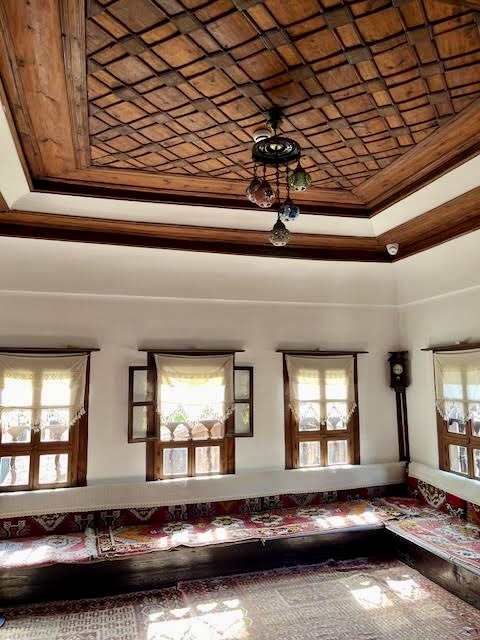
We visited the mansion that belonged to a wealthy merchant family and is now a museum. Safranbolu was a major stop during the Silk Trade, and these rooms showcased life in the 19th century. Men and women did not mix publicly; these rooms depicted typical activities, clothing and decoration. The mannequins looked a little ghoulish, but we got the idea.


The intricately carved woodwork is typical of Ottoman homes. Our hotel room has a similarly fabulous ceiling – no spray-on popcorn finishes here.
Turkish bathhouses are very important throughout the country and in Safranbolu, the Cinci Haman features prominently. We will definitely try a bathhouse before our trip is over, but we could not find out information easily about this one. Men and women enter by different entrances and on different days, and there was no one to give us information.

Before our trip we read that outside of Istanbul, English is not widely spoken and that is indeed the case. The Turkish language does not resemble any other language I am familiar with, although words like “Servis” and “Polis” are easy to figure out. Thank goodness for Google Translate, and the incredible hospitality of the Turkish people we have met so far.
Although Turkiye is a secular country, it is almost entirely Muslim and this translates differently depending upon the region. Safranbolu appears to be quite conservative; the vast majority of women have head coverings and are modestly attired. A few times a day the mosques ring out with the call to prayer on a loudspeaker that resonates throughout the valleys and hills of the town. I quite like the sound of it, even at 6:30 am. Needless to say, there is no alcohol.
Instead, we drink tea and coffee. Although Turkish coffee is well-known, the population runs on tea and the cafes are filled with people sipping beverages and smoking. The smoking is unbelievable – everyone smokes – men, women, even little old people who defy all odds by still being alive. I am one of those annoying ex-smokers who can’t stand to be around it any more, but I’m seriously outnumbered and a guest in their country, so nothing to be done but try and ignore it.
This fancy service is typical of a Turkish cafe experience. Coffee, water, juice and a small cookie, all beautifully served on a gold tray – about $4.00.
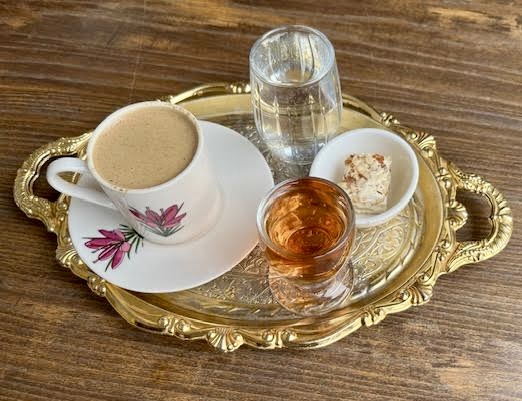
We experienced this lovely coffee service at the Cinci Han Caravanserai, which was commissioned in 1645 to serve traders on the Silk Road with food and lodging. It was one of the main caravanserais in Turkiye, and today houses a hotel, restaurant, cafe and coffee museum.

Since we’re on the subject of food, it must be said that vegans would be hard-pressed to eat here. Meat, bread, pastas and all manner of starches are a big part of the Turkish diet, and it will take a concerted effort on my part to watch what I’m eating for the next six weeks to avoid buying a new wardrobe.
I ordered a bowl of soup and a dish of yogurt yesterday and I’m quite sure they talked about me in the kitchen. The old couple in front of us polished off about six dishes, and then lit up a smoke. While the food is delicious, the quantities are overwhelming.

The Turkish breakfast is a whole other thing – I keep forgetting to take photos – I’ll post one in another blog. It is a spread that includes bread, eggs, relishes, olives, vegetables, fruit, jams, honey, yogurt, French fries, meat and cheese. It could easily feed a hungry family of four. I can’t stand the food waste and this morning I asked our host to leave out the Fresh fries, but we still left a lot of food behind.
This cheerful fellow made Stephen work for his ice cream cone. I kept thinking how delighted our grandkids would be to watch the performance. He dipped and swirled and made the cones disappear and waved it within inches of Stephen’s hand and then…poof – it was gone. Eventually, we walked away with a cone of chocolate ice cream and a few good laughs.

Safranbolu’s Market Bazaar was so much fun. We had to walk through it daily to get to attractions and restaurants, and while the merchants offered everything from clothing to spices to Turkish Delight, they were not at all pushy. It was a pleasure just to stroll and admire everything.
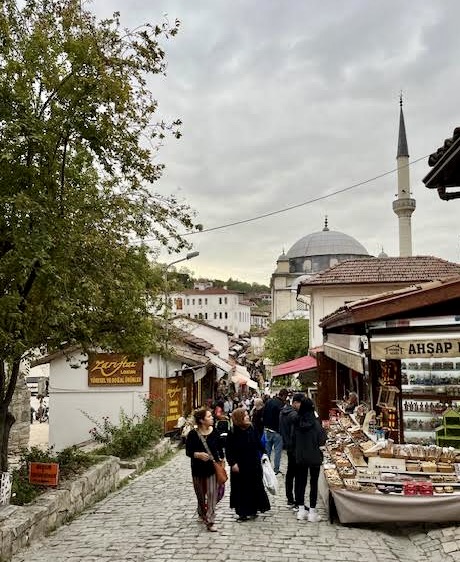
Typical outdoor cafe.
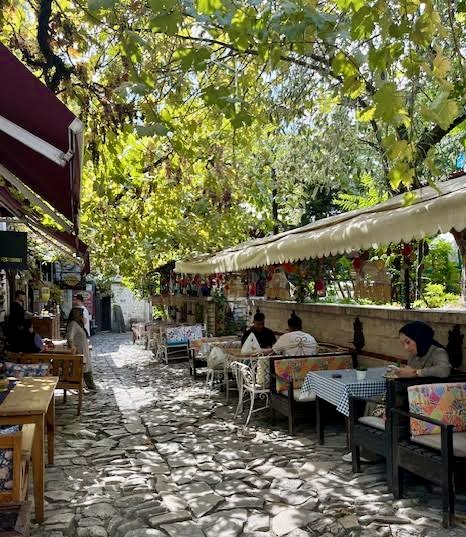
There are dozens of fountains in Safranbolu, some of them still in use.
And of course, the mosques claim a rightful place on the landscape. Their distinctive domes and minarets stand out, much like cathedrals in Latin countries.

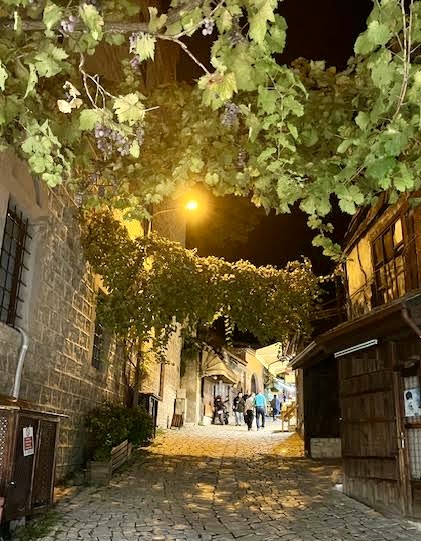
Some night scenes.

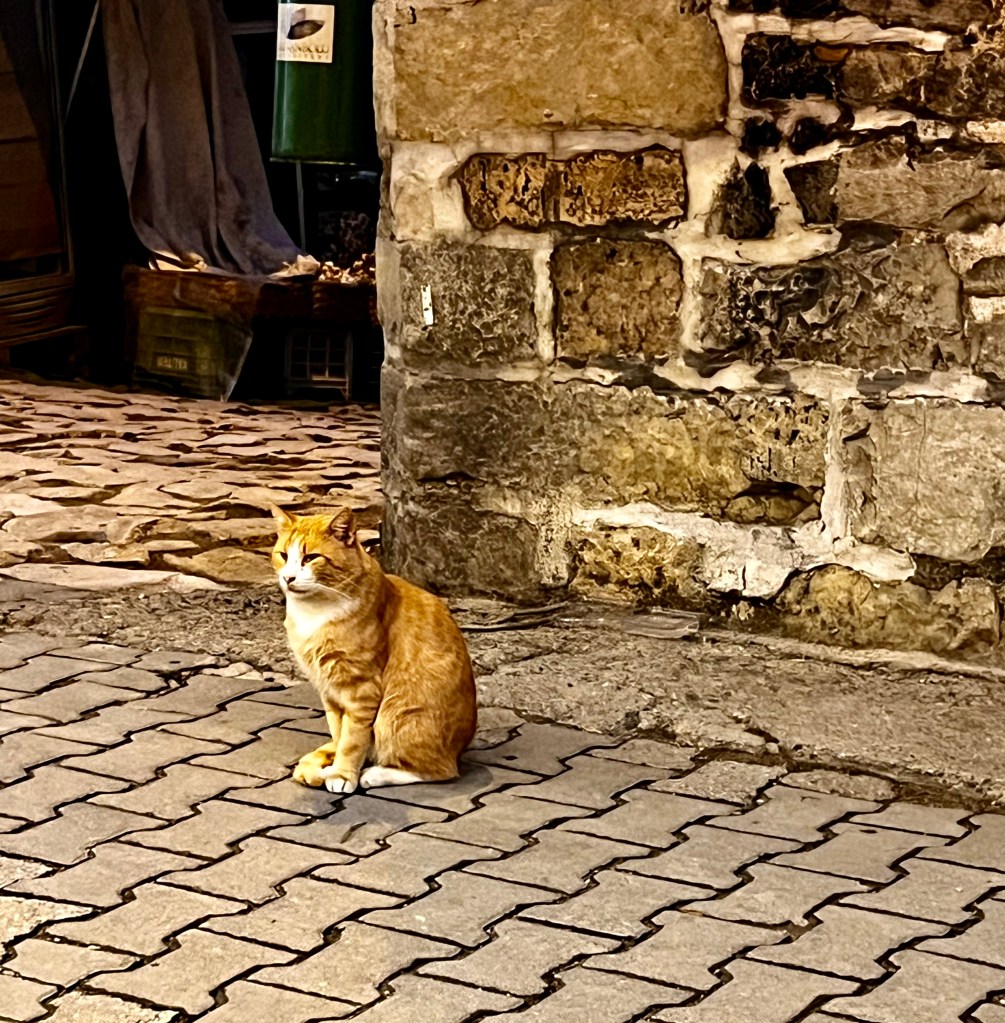
And… the Turkish mascots – the thousands of cats that appear to belong to no-one and everyone, and are cared for by soft-hearted citizens who leave food and water.
This little one eyeballed me for a few minutes until she figured out that no food was forthcoming.
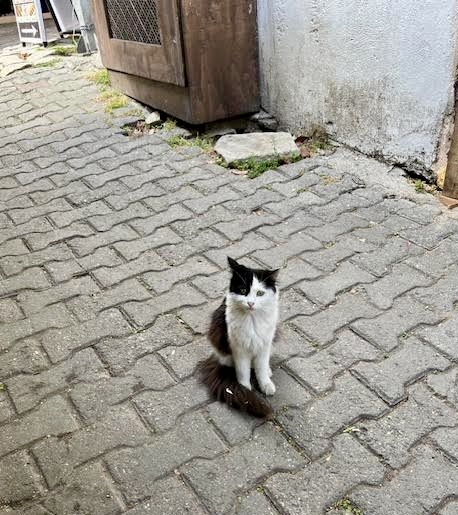
This one, (who we named Archie) seldom deigned to look at anyone. He sat or stretched or curled up on the ground, confident that food would be coming his way.
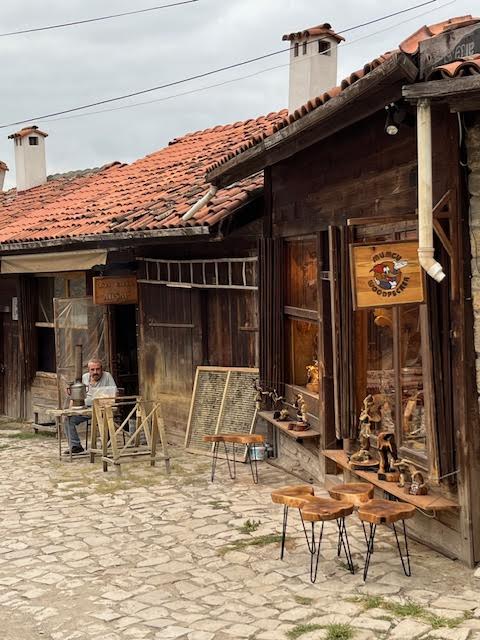
Safranbolu’s history revolves around the trades – leather, saddle-making, confectionary, metal-working and woodworking. One whole street was devoted to shops selling hand-turned wood products.
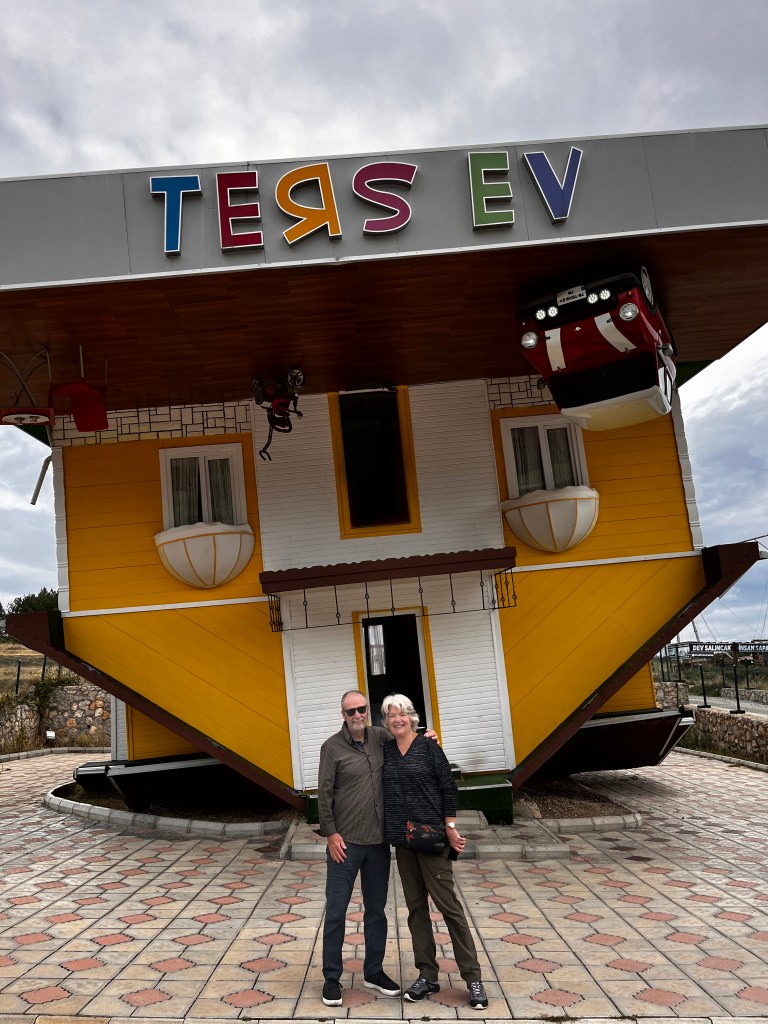
There were a number of sites to visit just outside of Safranbolu, and we spent a good day exploring the most-marketed ones. Honestly, they were all fairly underwhelming. The Upside-Down House sounded like a tourist trap to us, and it was, but it was also strange and fun.
Built by entrepreneur Bilal Ozdemir, who currently lives in Istanbul, this gravity-defying house was built with the idea of bringing tourist dollars to his home town. It is decorated with items from his home in the ’80s – the bed, the fridge, the sofa – all retro furnishings…and all fastened to the ceiling. The house is also on an angle, so after a few minutes I was feeling slightly vertiginous.
This is the house from the outside.
Some inside scenes. So how do we appear upside-down in the photos? (Hint: the guide took photos with our phones, then rotated them.)

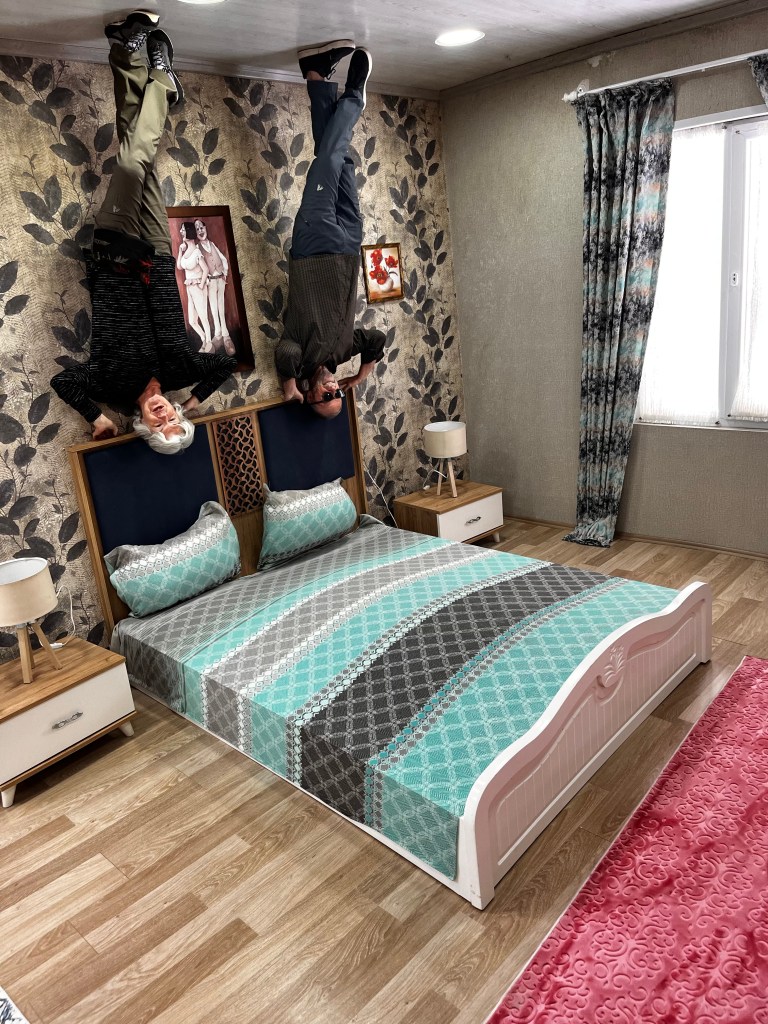
The photo before it was flipped, to give you an idea of the crazy layout.

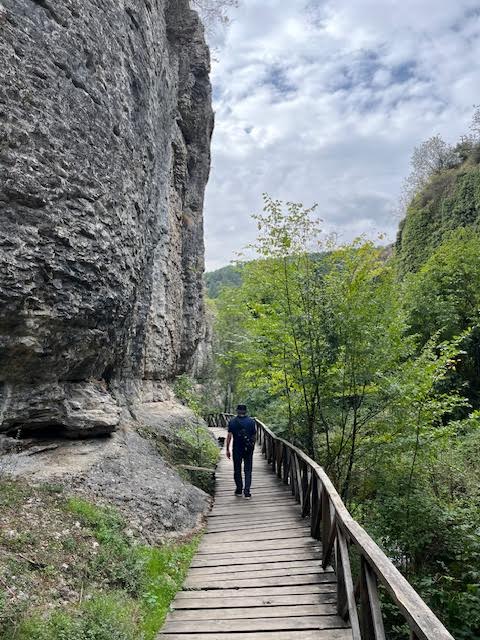
Next stop was the Incekaya Aqueduct and the Tokatli Canyon.

We walked down to the bottom of the canyon, which was pretty, but not spectacular. A nice walk with a lot of stairs!
Finally, we drove to the Bulak Caves. When I researched the caves, one of the reviews was a rather uncharitable observation that they were okay but not like ones she had seen in the Congo. Well…we’re not talking apples and oranges here, but I have to agree with her – these caves were a disappointment. We had seen such mind-blowing caves in SE Asia and in Mexico, and we were both expecting a variation on those. Instead, we walked along a slippery and poorly-lit metal walkway for 450 metres, saw nothing exciting, then walked back. Also, photos were forbidden and although we both snuck a couple they didn’t turn out.
Still, it was a fun outing, and Stephen got to test his driving skills on narrow cobblestone roads and I got to test my navigational skills and ability to keep gasping/grabbing the door handle to a minimum. I’ve never been a good passenger – something to work on.
Tomorrow we have a five-hour drive to Cappadocia and will spend five nights there. See you in a bit.
 Leaving Ourselves Behind
WOW GRE
LikeLike
Flo – looks like the WordPress fairy ate your comment!
LikeLike
Very interesting! Comments about the large portions of food did not expect? Upside down house seems like fun. Smart business man! Cute pics of you guys.❤️
LikeLike
Entrepreneurship is alive and well in Turkiye – as our host said to us, and is so true of tourism everywhere – tourists are a blessing and a curse!
LikeLike
Great blog report but watch what you day about those ” spray-on popcorn ceilings!”
LikeLike
*say
LikeLike
You know someone is going to be offended! I think even the owners of spray-on popcorn ceilings hate them.
LikeLike
Great post! We’re encountering a lot of french fries here in Greece too. And potato chips…
LikeLike
Starch! This morning a new guest asked our host if he had any gluten-free bread (you know the answer to that one), and I wondered how she was navigating food in Turkiye. Maybe she’s living on French fries.
LikeLike
But, did you buy saffron?
LikeLike
NO!!! Foolishly I figured that any saffron would be last year’s batch and I would wait until closer to the end of our trip to have the 2024 saffron available to me. Don’t ask me where the logic is in that, as they may still be picking flowers as we leave this country.
Oh well, I’ll grab some in the markets in Istanbul.
LikeLike
Grabbing the door handle? I would think Steven’s driving would be well honed after pulling an RV around Mexico.
LikeLike