Many people come to this area for just a couple of days, with the primary attraction being a ride in a hot air balloon. Now, one can certainly see the attraction of climbing into a wicker basket and lifting off at sunrise over an otherworldly landscape. The romance, the bucket-list box ticked, the celebratory champagne after an hour of serenity and magic in the company of at least 100 other balloons.
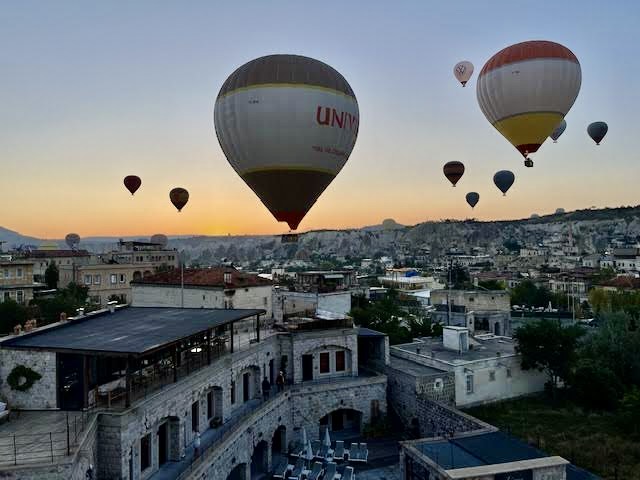
We very likely would have signed on but the price of romance and magic was just a tad out of reach. A ride is going for €380 per person, or CA $1142 for the two of us – for one hour.
Friends of ours had a horrific experience years ago, where a gust of wind grabbed their balloon, forced a hard landing and their basket skidded sideways across a potato field. Their sister balloon was not so lucky – it landed on rocks and the occupants had to go to hospital. Now apparently the balloon pilots have rigorous training and their safety record is considered among the best in the world, but still. Terra firma.
We didn’t miss out on the magic entirely – every morning at 6:00, we would go up to our hotel’s rooftop terrace and watch the balloons soar overhead. One of the balloons came so close, we could wave at the occupants.

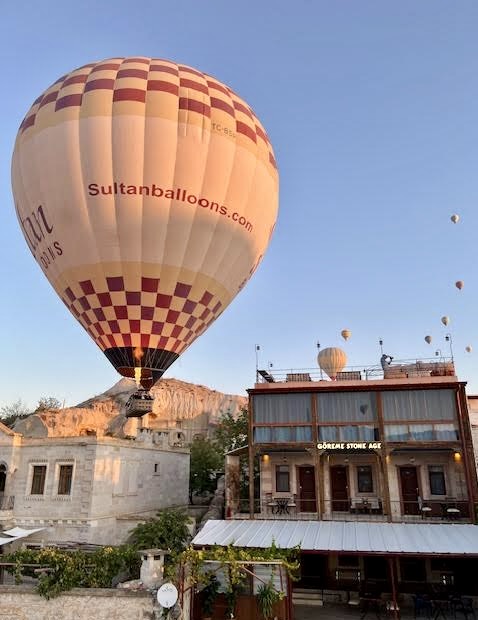
Apparently a number of the local residents consider the balloons both a blessing and a curse. A blessing because they bring lots of tourists and a curse because many of the tourists do not stay long enough to appreciate the beauty and grandeur of the area. It feels offensive to the Turks to have this unique part of Turkiye reduced to an amusement park.
The Cappadocia region covers the town of Goreme (where we stayed), Uschisar (a town close by) and several smaller towns that include the geology peculiar to the area – a geology that has been almost 400 million years in the making.
In the past 16 million years, a series of volcanic explosions occurred in the mountains and the cooling of the yellow-white ash filled the region with “tufa” layers. These layers eroded and produced fantastical conical shapes; some small and stand-alone and some large enough to create cave houses, hotels and monasteries.
The town of Goreme is quite monochromatic in colour, but highly original in layout. Streets wind around stone formations, up steep hills and around winding corners.
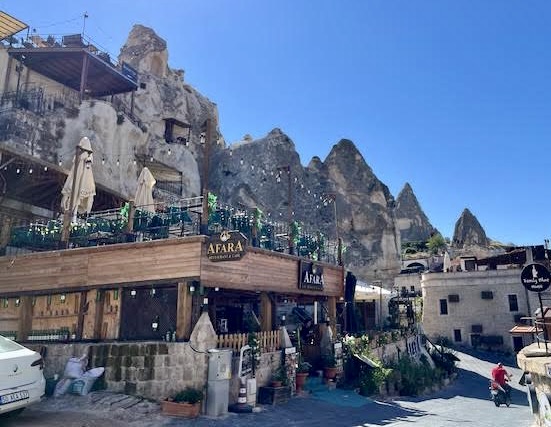

Cave hotels are a huge draw. Many of the hotels are built into the side of the cliffs, with the rooms literally being “a cave.” We were quite interested in trying this out, but several reviews talked about the experience being unquestionably unique, but also dark and damp. We talked to a couple who moved after their first night because their clothes were wet and musty-smelling. Some examples of cave hotels:


This lovely cave hotel has probably figured out the “musty” problem.

We lucked out with our choice, the Hotel Pashahan. Three stories, just 10 guestrooms, a glorious rooftop terrace, and a fabulous Turkish breakfast spread. Our multi-lingual host Sergio, who herded his Canadian, French, Italian, Hungarian, Brazilian and Korean guests like a Turkish border collie, was definitely a highlight of our stay. There was nothing he would not do for any of us, including driving us to the trailhead of the Love Valley and then picking us up afterward.
While this region has produced stone formations that resemble mushrooms, animals and chimneys, one of the most visited area is the coyly-named Love Valley. It would be fun to giggle over giant forever-erect penises, but as adults, let’s just agree that these monoliths are impressive and leave it at that.

A variation on a theme.

You have to work a bit to get down to the valley. A slide down a steep path, followed by a few keen balancing acts and then…the beginning of the valley unfolds.
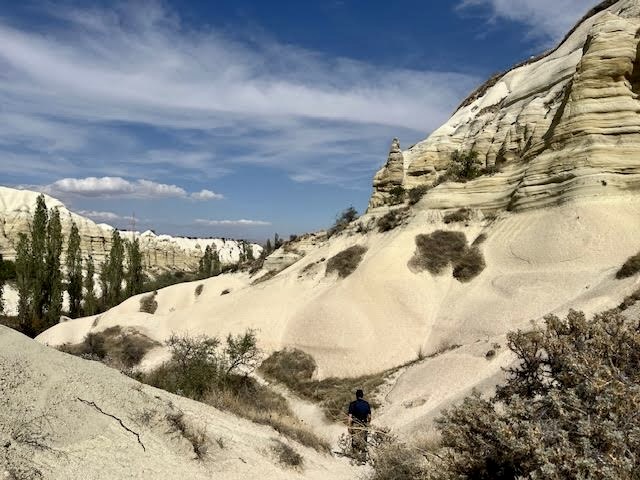
Our first glimpses of the whimsy of Cappadocia.
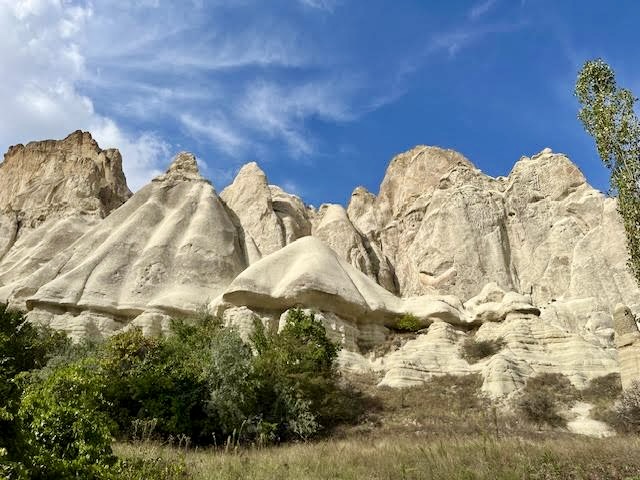
See the house on top of this hill, with its reinforced stone retaining wall? How did it get there? How was any of this created by manpower?

A couple of hours of fascinating hiking through this mystical landscape took us past stone formations, oasis-like groves and out to the end of the trail, where a small caravan of camels waited. Although camels were never used in Cappadocia, they are another fun way to experience the area.

There are a number of underground cities in the Cappadocia region and Derinkuyu is the largest – it goes down 280 feet over several rooms and passages and could hold up to 20,000 people and livestock. It began in the Byzantine era and over the centuries housed persecuted populations.
It must be said I am not 100% in my comfort zone being in small, cramped places, so I spent much of our time trying not to think about what would happen if there was an earthquake and we would be trapped underground. As a result, I just put one foot in front of the other and took very few photos.
This was the entrance:

Once we entered the first floor and poked around a number of rooms, we took turns climbing down narrow stairs that ran for several floors in one go. It was only one-way traffic – a group of us would go down and when it was all clear, those waiting at the bottom would climb back up.
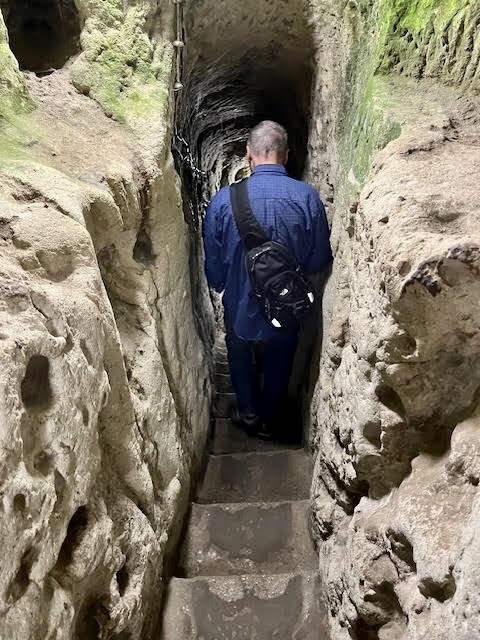
To make matters worse, there were several points in which the tunnel closed in, forcing all of us to crouch through, almost bent in half as we inched forward.

I had been looking forward to this, particularly since one of our fellow guests just raved, but by the time we finally emerged back into daylight, I was minutes away from breathing into a paper bag. Stephen was just fine.
A very interesting part of Cappadocia’s history is that Greek Christians and Turkish Muslims co-existed in the village of Mustafapasa (about 40 minute drive away from Goreme) quite peacefully for centuries. Today Turkiye is 99% Muslim. After the Lausanne Treaty in 1923, there was a compulsory exchange of population between the Muslim Turks living in Greece and the Orthodox Greeks living in Turkiye. This tremendous upheaval of up to two million people was regarded by some as a form of ethnic cleansing, but the village of Mustafapasa still has a mixed heritage and Christian churches and monasteries have been preserved.
The town itself was charming and walkable.
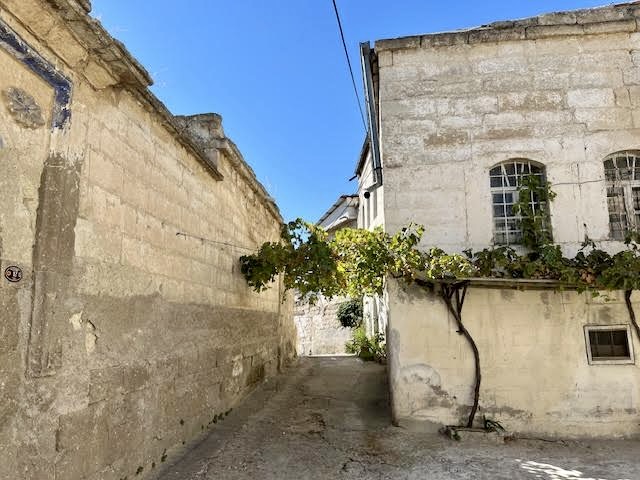

Constantine-Helena church. Built in 1729 and currently used for cultural events.
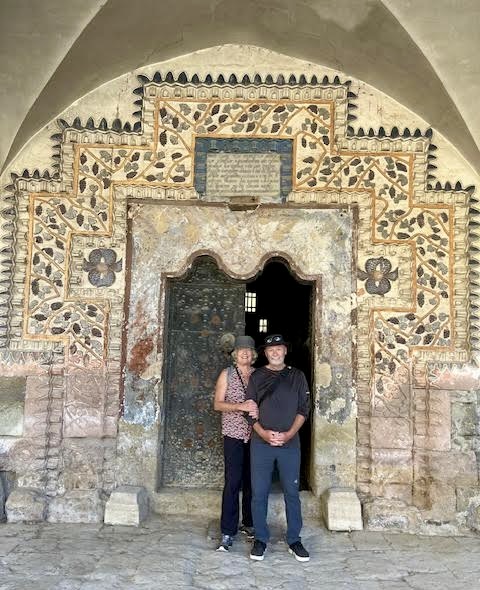
The St. Nicholas Monastery, recently restored in 2021, was part of a pilgrimage route.
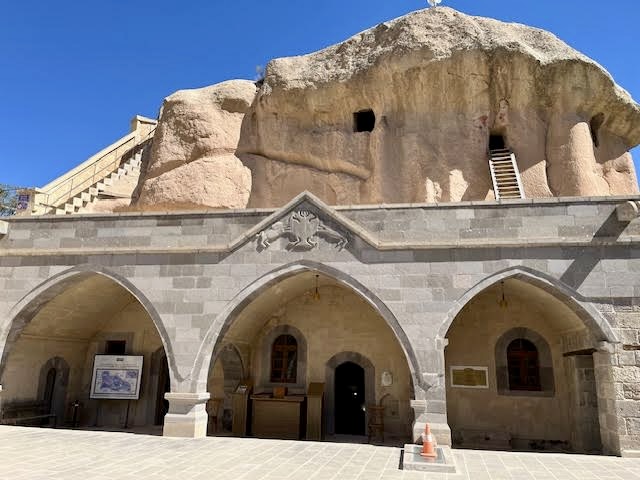
The Selime Monastery, located about an hour southwest of Goreme, was quite incredible to explore. This massive rock-cut construction dates back to the 8th or 9th century BC, housing various religious groups. In the 10th or 11th Century, it became a caravanserai for travellers on the Silk Road.
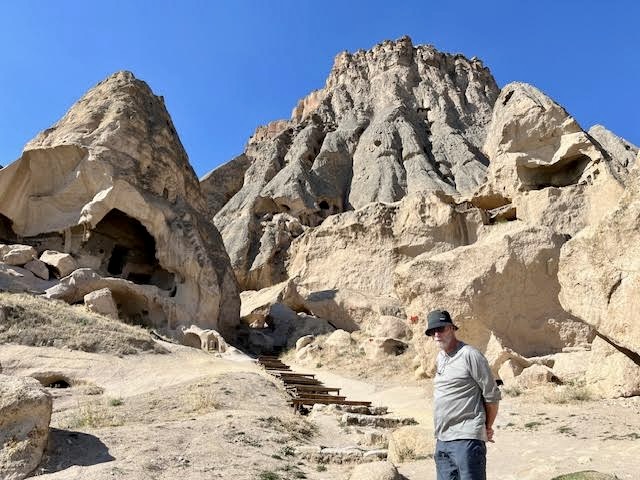
The word “monastery” might seem a bit confusing, but in addition to kitchen and living areas, there was indeed a chapel inside.
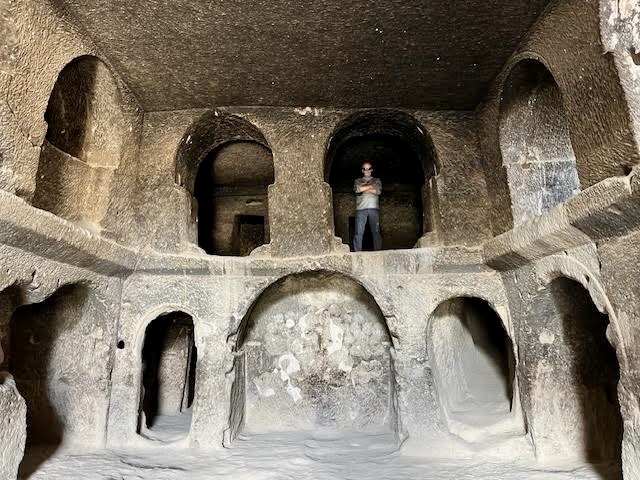

Lots of places to peer out at the valley, unseen from the enemy.

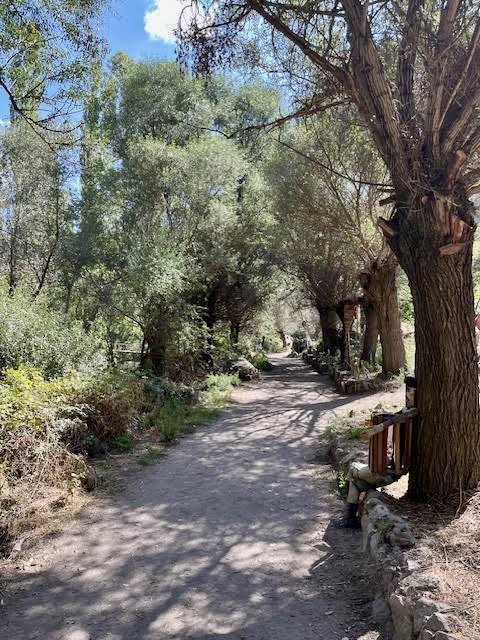
A nearby 3-km. hike through the Ilhara Valley. Peaceful, shady and beautiful.
Naturally, the lure of buying a Turkish carpet is strong. Each shop has hundreds, if not thousands to choose from; each shop has piles of carpets five and six feet high. How in the world to choose a carpet? How to know you are buying quality and getting a fair price? We could not make up our minds and figured it was a bit early in the trip anyway, so we settled on three beautiful pillow covers (about $16 each), and a unique wall hanging.
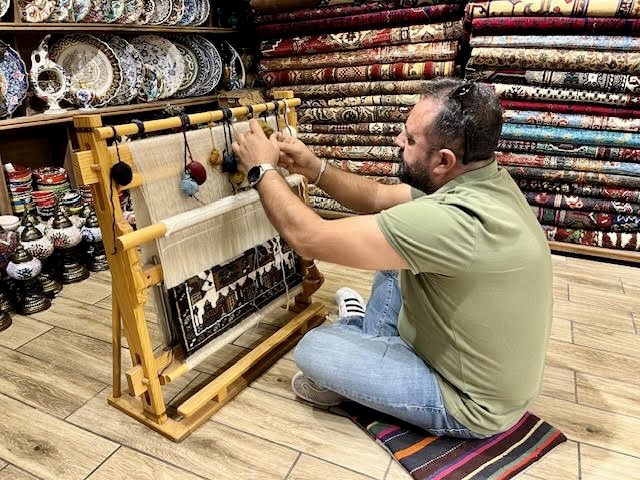
This gentleman was patient and kind with us, and showed us how he weaves rugs on his loom.
Some nights shots of Goreme – it is truly a magical place to wander around when all the lights are on and the call to prayer is echoing, and it feels so very different from home.


Goreme at sunset. We climbed up the incredibly steep hills, gasping and wheezing, to watch the sunset. After the sky went pink, then orange; this was our reward.

We leave this beautiful little part of the country tomorrow morning and head to Konya, about a three-hour drive from here. Konya is the birthplace of the poet Rumi and home to the spectacle of The Whirling Dervishes. According to the somewhat unreliable information online, this weekend is also supposed to be the annual Sufi Music Festival and we’re hoping that is the case. I can’t imagine a more unusual experience.
 Leaving Ourselves Behind
Great evening shot of the town!
LikeLike
Stephen took it after he was experimenting with time lapse shots. The time lapse didn’t really work, but he took a number of great stills that captured that moment.
LikeLike
We didn’t go on a hot air balloon either. I had looked at pictures from people who had gone and they weren’t that nice. The pictures of the balloons flying around the hoodoos, we thought, were much nicer. But sounds like you loved Cappadocia as much as we did. Maggie
LikeLike
We really did like Cappadocia a lot. They are falling prey to over-tourism, but there’s still lots of opportunity just to enjoy the surroundings.
When you talk about the hoodoos – I’m guessing you mean the ones close to Banff? When we lived there years ago, that was a favourite little getaway from work – just grab a coffee and park at the hoodoos.
LikeLiked by 1 person
I meant the fairy chimneys but I guess hoodoo comes to mind sooner. 😊
LikeLike
Ginny,
I trust that you always carry that little brown paper bag in your pocket, good for you!
LikeLike
If I ever go into a cave again, I will be prepared. I actually love large caverns, it is just a problem when the spaces get squishy.
I met a spelunker many years ago – he was French actually. He was a cave explorer – lowering himself into tiny spaces and crawling through on his belly with a blowtorch to fend off the rats, while he discovered larger spaces. There is zero chance I would ever be able to attempt such a thing.
LikeLike
But I thought you learnt to love rats in India?
LikeLike
thank you for taking us on your adventures ♥️🤗♥️
LikeLike
Been thinking about you, Wendy! Hopefully we can get together once we’re back home again. xo
LikeLike
Thank you much for sharing. I love reading your travel blogs! What an amazing part of the world. Karen
LikeLike
Is this Karen Jones? How great to hear from you. Are you retired yet? Travelling? Lots to catch up on.
LikeLike
Hi Ginny and Steve
Yes it is Karen Jones. I plan to retire from teaching at the end of this school year (June 2025). The summer before last a friend and I cycled in Lithuania, Latvia and Estonia. We loved it. This past summer Bob had to have open heart surgery for a second time. He is doing much better now. Once you’re back let’s have a phone visit. Take Care Karen
I do love your writing and would love to have a chance to talk with you and Steve about retirement travel Or countries/places to stay for longer.
LikeLike
Oh you two, this is just magical! Couldn’t believe it would cost $1142 dollars for an hour long ride. I think seeing them from your rooftop would have been as beautiful, good for you. The hikes & rock formations are like fairy tale sets! So nice you didn’t opt for the in & out visit & spent time in the surrounding towns as well. We are so enjoying your blog & look forward to the next one. Thank you for taking us along with you. Love the pics! The one of the two of you….frame able backdrop with your new cushions!
LikeLike
Wow what a fascinating place; I loved the caves! As for the underground city you visited, I would have remained at the entrance and relied on Stephen for a recap!
Sent from my iPhone
>
LikeLike
well I finally got to read your first blog as we’ve been away and just got home. You both are amazing and your blogs get more interesting as you go along. What a trip this one is. Love all the pictures and commentaries. Keep having fun. Tony and Sharon
LikeLike
Thanks Sharon! Great to hear from you – I guess you and Tony will soon be heading to Mexico?
We keep saying we will have to meet up again when we’re all in Canada at the same time – for sure we will make that happen this spring.
LikeLike