If you aren’t a history buff or a big fan of Homer’s epic poems, you might never find yourself in the modern city of Canakkale. Described as being “a small vibrant port city“, it is conveniently located to both the ancient city of Troy and the battlefields of Gallipoli, and probably the only reason most tourists would travel here.
Canakkale is very much a Turkish town and parts of it are still “emerging“. We found ourselves in the “emerging” area of town; our hearts sinking as we drove up to our hotel. The hotel itself is simply beautiful, an artistic showpiece, with gorgeous rooms and delightfully warm and welcoming staff.
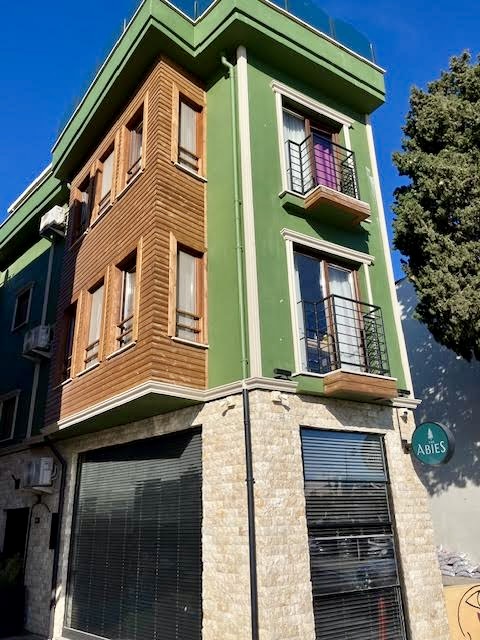
This is the street right behind the hotel.

Still, for all that this looks a bit dodgy, we never felt unsafe. It was a 10-minute walk to get into the centre of town and there were always plenty of people about. On the subject of safety, a few people have asked about Turkiye and we have never felt one bit unsafe here. People are unfailingly kind and helpful and/or they simply leave you alone and go about their own business. No clutching of purses, or backward glances over shoulders – this has been a completely relaxed trip so far.
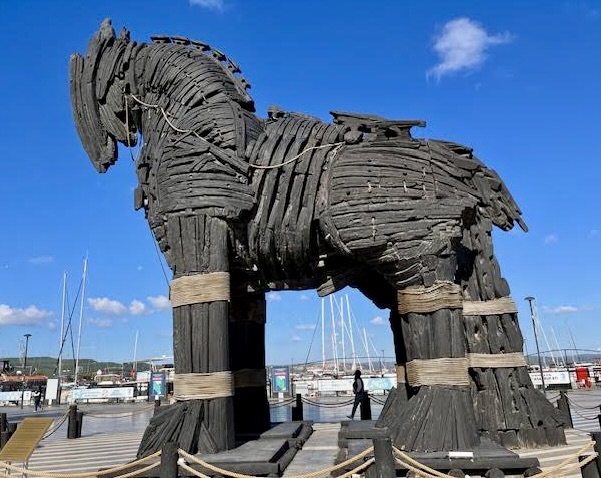
Canakkale is not without its own charm though. It has a beautiful wide boardwalk along the harbour that, among other draws, is the site of the Trojan Horse donated from the 2004 movie “Troy.” (Brad Pitt as Achilles.)
We have no clue about the significance of this statue; a man in a somewhat stern posture pointing out something to two children. There are a number of statues along the boardwalk that are similar – open to interpretation.

Fishing is a favourite pastime, although it does not appear to be taken too seriously.

Çanakkale has the distinction of being the second city in Türkiye that has a toe in both Asia and Europe – Europe being the Gallipoli Peninsula across the Dardanelles Strait. I had mistakenly thought that Türkiye was part of eastern Europe. In fact, with the exception of the Gallipoli Peninsula and a portion of Istanbul, the vast majority of Türkiye is on the Asian continent.
This is the Dardanelles Strait, looking across to the Gallipoli Peninsula.

So, now about those wars. The Trojan War was real, as was the city of Troy, but the reasons for battle and the length of attack (10 years) may have been a delicious fabrication handed down over the years by oral history.
When Homer got his hands on the stories and put pen to paper with his epic poems The Iliad and The Odessy, it is possible that liberties were taken and myths were made.
Homer’s epics are the earliest surviving works of western culture, and while The Illiad encompasses the famous 10-year siege, it is thought that perhaps the battles were of far shorter duration. It is also believed that the Trojan Horse was a myth.
Still, a visit to the ancient ruins of Troy and to the modern-day museum are a must.
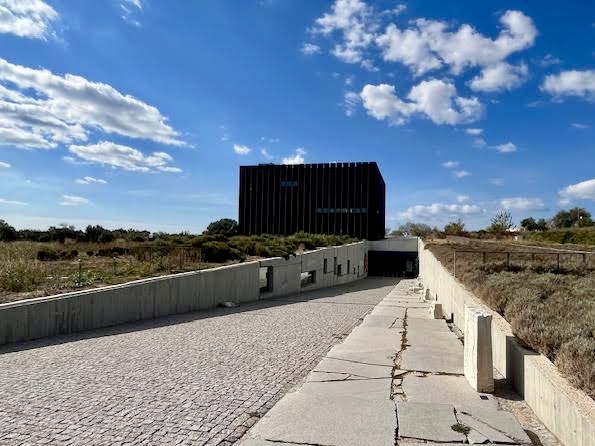
The museum has a stunning exterior and is beautifully displayed inside.
On the day we visited, it was awash with school kids on field trips. The school groups, in the best tradition of such things, had a few studious types taking in all the treasures, and a number of other students either taking selfies, checking their makeup or pushing each other around.
I didn’t take any interior photos but it was extremely interesting, and helpful that all the signs were in Turkish and English.
The actual ruins are about 700 m. up the road from the museum and the first site after you enter the grounds is this:
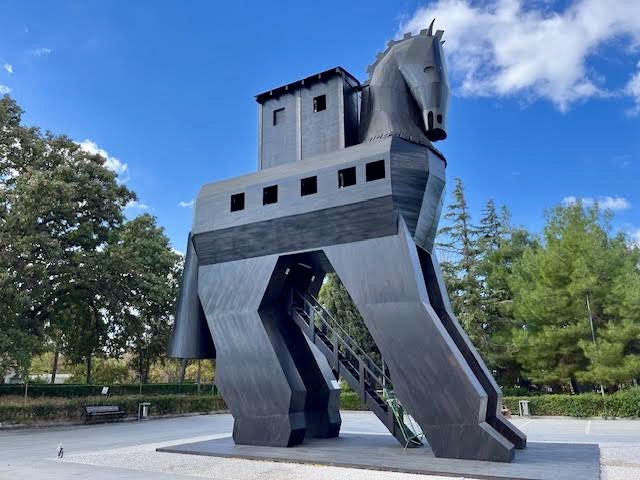
You almost wish the Trojan Horse had existed; it makes such a compelling story.
There were many stages of the excavation of Troy and this illustrates the time span from the mid third millennium BC to Roman imperial times.
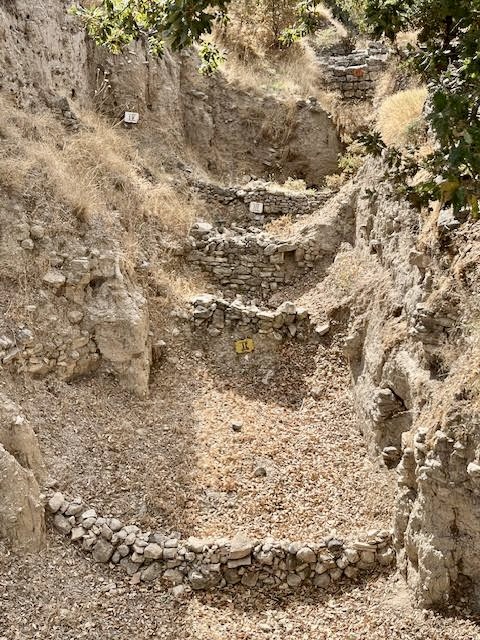
Certainly the Trojan ruins are in nowhere near the same level of preservation as Ephesus; they are for the most part a semblance of what once was.
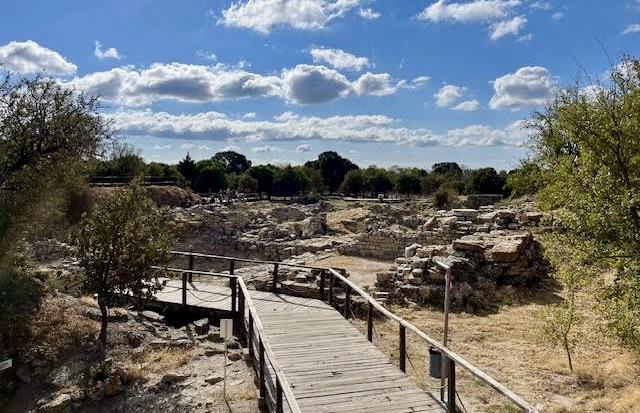

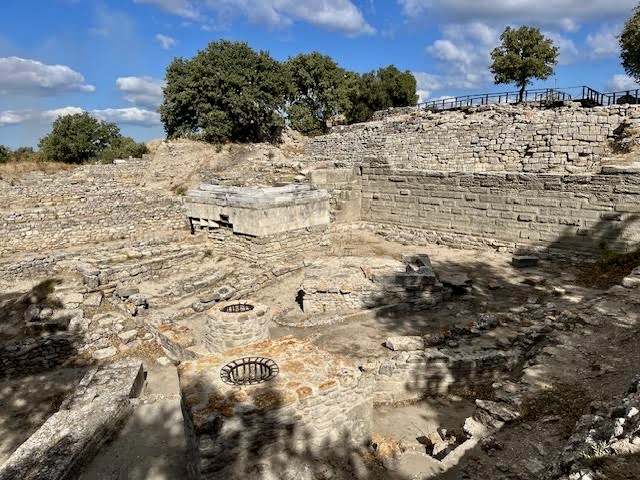

While we spent a most enjoyable day at Troy, it was our trip across the Strait to Gallipoli that was hugely impactful.
This famous, wildly ill-fated and tragic attack on Türkiye happened between March 18, 1915 to the ultimate withdrawal of Allied troops on January 2016. The Allied objective was to capture Istanbul, force Turkiye into war and secure an ice-free sea supply route to Russia.
The first attempt in March by the British and French was unsuccessful, and then on April 25th, 16,000 Australian and New Zealanders landed on Anzac Beach. By nightfall, over 2000 of them were either killed or wounded.
The casualties on all sides were horrific and there are 31 cemeteries, with over 22,000 graves.
We found it difficult to get concise information about how to tour Gallipoli Peninsula Historical National Park. We were under the impression that we would enter a park and go from there. In fact, the entire area of Gallipoli where battles were waged is part of the park, and there are dozens of cemeteries, markers and monuments.
Honestly, it would have been better to go with a small guided tour and have the benefit of a guide and a narrowing down of the essential sites. We did figure it out, but our advice to anyone planning to visit would be to either do a lot more research than we did, or go with a tour.
Our first stop was the Akbas Martyr’s Memorial, where 1213 Turkish soldiers are buried. This was also the site of a Heavy Wounded Hospital.
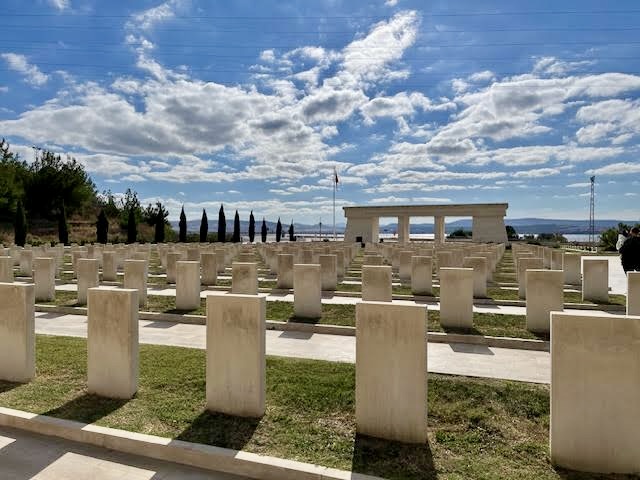
There was a Turkish family visiting at the same time: the young man wiping his eyes as he walked past the headstones. We chatted and I discovered he was 31, the same age or a bit older than many of those buried here.
A statue at this site.

Lone Pine was one of the main cemeteries where the Australian and New Zealand soldiers were buried. So-named for the single pine seedling planted there, which is now a dominant feature.
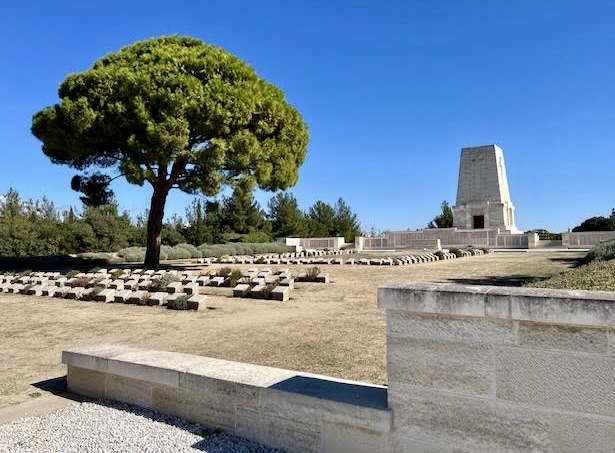
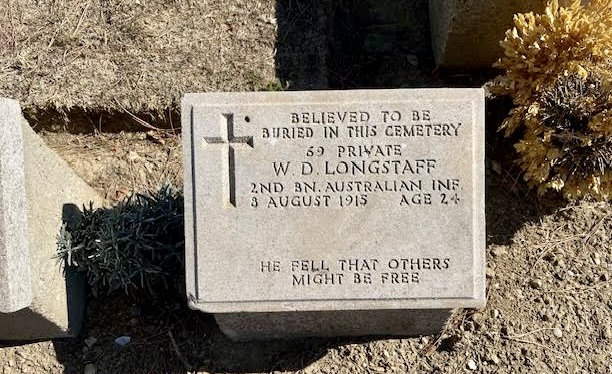
The cemetery had three sections – the unnamed soldiers, the positively identified soldiers and the soldiers who were identified as” believed to be buried in this cemetery.“
This headstone was a wrenching reminder that most young soldiers had barely a chance to live their lives before they were lost.
This cemetery was a tough one. All Turkish fallen soldiers were referred to as “martyrs”, but this particular cemetery, The Kile Bayiri Martyrdom was in honour of the soldiers who were buried where they fell – their remains unidentified, still in their bloody uniforms.
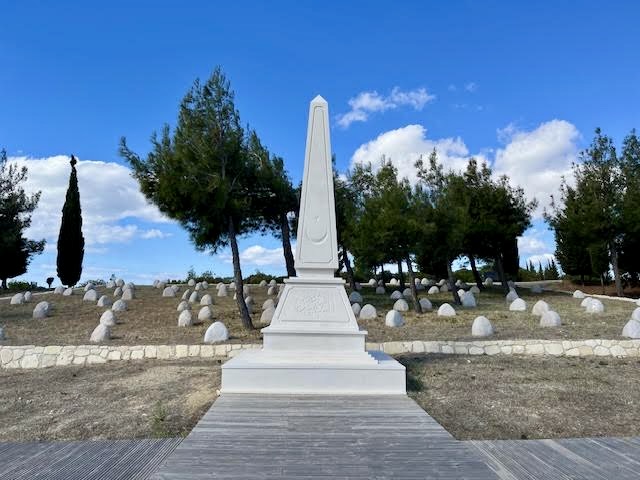
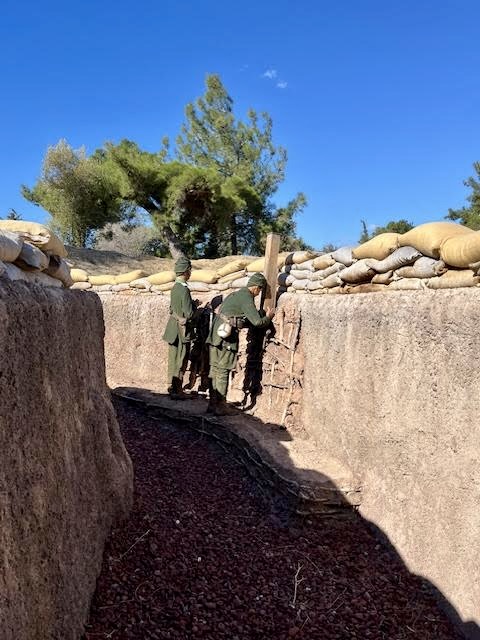
You can see the remains of trenches here – this was a battle of trench warfare.

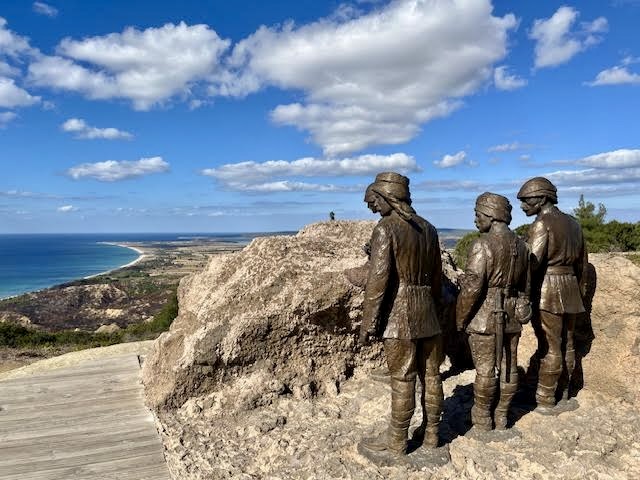
The 57th Infantry Regiment, led by Colonel Mustafa Ataturk prevented the advance of ANZAC forces on April 25, 1915, although 1817 Turkish officers lost their lives.
This statue shows Ataturk and his men overlooking ANZAC Cove.
A monument in honour of the 57th Infantry Regiment.

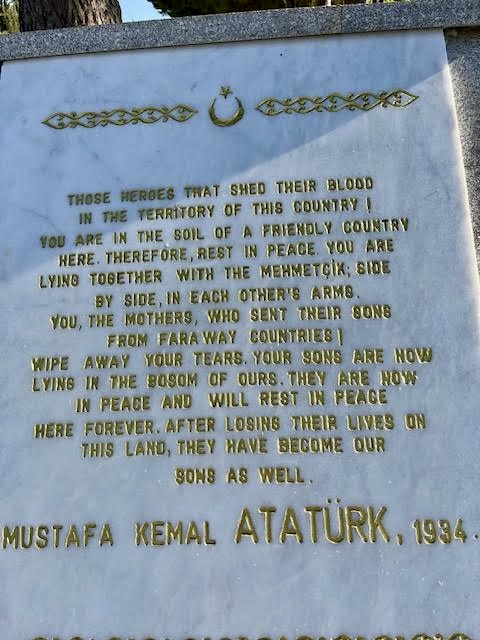
A particularly touching sentiment from Ataturk toward the fallen foreign soldiers, in spite of the death and destruction that was wrought.
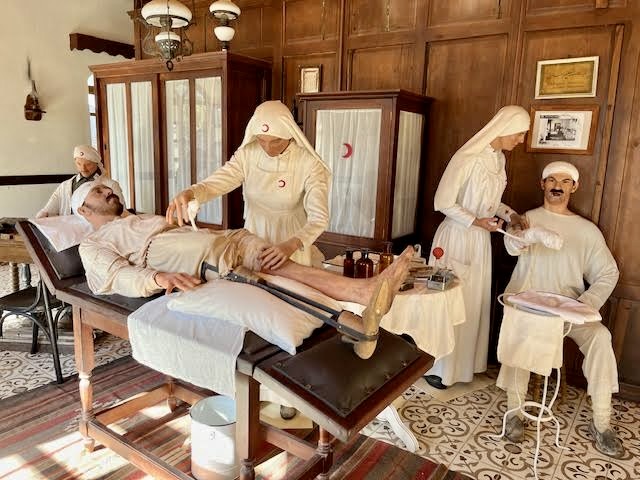
Another impactful part of this tour was our visit to the Hilal-i-ahmer Hospital; a re-creation of the actual hospital built in 1906 and the founder of the Red Crescent Movement (Red Cross), internationally recognized at the request of the Ottoman Empire.

The re-enactments were incredibly lifelike – just look at this scene portrayed inside the hospital.
We were led through the trenches, which I have to say felt a bit terrifying. Sounds of gunfire flying overhead, men screaming, overall war chaos – it was so disturbing.
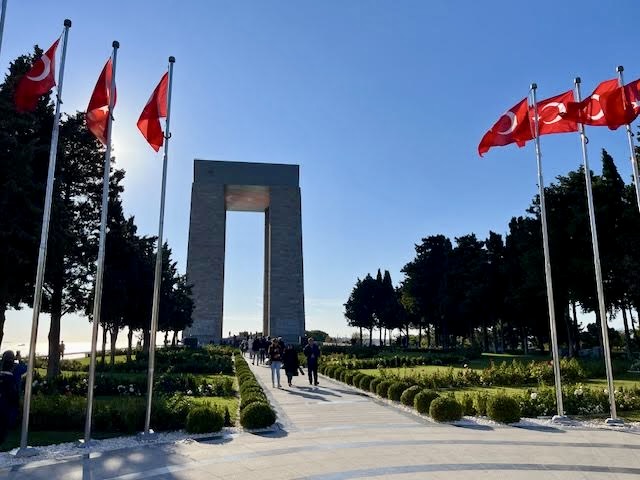
Our last stop was the staggering Canakkale Martyr’s Monument – dedicated to soldiers of WW1.
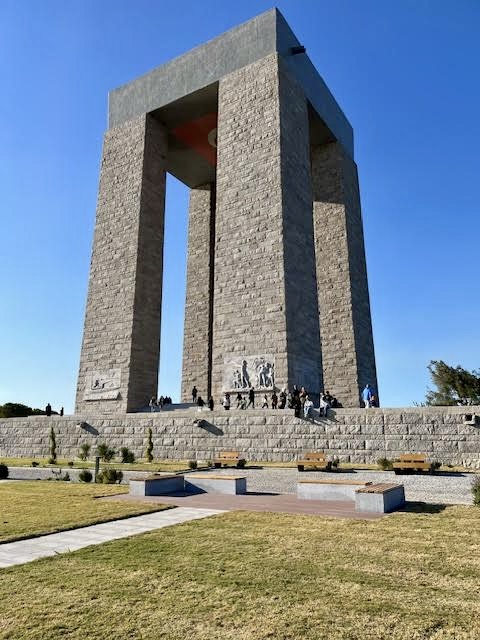
Well, we obviously don’t have enough sense to say, “never again” and it wouldn’t seem we’ve learned any lessons. Visiting Gallipoli during this particularly fragile and scary time in our world was perhaps even more powerful than it otherwise might have been. It sure doesn’t feel like ancient history.
We are now in Istanbul. We drove over the world’s longest suspension bridge and after a harrowing journey in which we missed having two accidents by literally a split second, we arrived at the Istanbul Airport and gratefully handed over our rental car. Stephen did a stellar job of doing all the driving, I tried to do my part with navigating and we are both pleased to not be driving right in Istanbul – crazy! We are now ensconced in our delightful Airbnb and ready to hit the bricks tomorrow.
 Leaving Ourselves Behind
Fascinating!
LikeLike
It is always fascinating when you read about a place and then see it with your own eyes – usually proves that my imagination is never big enough!
LikeLike
Amazing! I love love love your missives! 😊
LikeLike
Diane! You’re still reading my blog postings – thank you! Hope all is well in your world. xo
LikeLike
I don’t think I would recover well from the trenches experience. I read too many books and heard horror stories as a kid from the very few soldiers who came back….
LikeLike
Trench warfare? I used to get traumatized watching high school fights – I’m deeply horrified by violence.
I can’t imagine how you ever recover from living with the sights, the sounds, and the fear.
LikeLike
However, Atatürk words were stunningly powerful!
LikeLike
He is much-loved in Türkiye, and obviously saw human beings as one and the same.
LikeLike
Absolutely wonderful reading about your adventures & experiences! What a trip! We are enjoying it over coffee in bed & exclaiming what a wonderful way to start our day. So happy you are driving all over doing your own thing, good for you! We do sense your relief in not driving in Istanbul, can imagine how insane it must be. Really like that you have felt so safe & have had no reason to feel fear. Love all your pics of the villages, restaurants & shops! Very informative history lesson on the wars. The Memorial placque definitely had the tears flowing.😢 No doubt you as well the Mother of two boys. Such senseless slaughter & like you said, we have not learned a thing! Continue to enjoy the rest of your trip, be safe & enjoy. Can hardly wait to hear more when we are together in person.
As Ever
Linda & Gary
LikeLike
Linda – every part of Türkiye has been completely different – and each one has offered so much. This is a captivating country.
Although Gallipoli was in the end a triumph for the Turks, it came at such a cost. Ataturk’s words did move me to tears, as did wandering the cemeteries and reading the headstones.
We would love to see you and Gary when we get back – hope you are both well.
LikeLike
Hi Stephen and Ginny,
Your pictures and words regarding Gallipoli Historical Park are haunting. Your comments related to the phrase “never again” are disturbing true.
Heather
Sent from my iPad
>
LikeLike
It’s so true, Heather, and boy, we have our fingers crossed for November. So much at stake – we probably don’t know the half of what we could be facing.
LikeLike
Compared to Ephesus and many other places that you’ve visited, the Trojan ruins are a bit underwhelming – you wonder if Troy would still be remembered without the stories of Helen, the Horse and Brad Pitt attached to it. Still, seeing proof of 5,000 years of human activity does help to put some perspective on what’s happening today – it’s all been done before.
LikeLike
I think you are right, Mike. Türkiye is filled with ruins and all of them meaningful – they were people’s homes and lives at one point.
Troy attracts for probably the same reason so many Greek ruins draw the crowds – we’ve heard the stories before.
And Gallipoli. Would the average non-war-history-buff have even heard of that battle if it were not for the movie?
LikeLike
The “man in a somewhat stern posture pointing out something to two children” is Atatürk, the commander who saved Çanakkale from being invaded by the allies. He later went on to establish Modern Turkey.
LikeLike
Ah – thank you! It might have helped if I had read the plaque at the front of the statue, which I’m sure identified Ataturk.
LikeLike