Istanbul has had a centuries-long love affair with cats. Revered for their rodent-control abilities and regarded as community pets, most street corners have bowls of water and food out for their beloved felines. They number anywhere from several thousand to over a million, in Istanbul alone. The cats are remarkably healthy, with shiny coats and rather sweet dispositions. Everyone seems inclined to want to pet them (and yes, they do sit on cafe tables, which is not my favourite thing).

This lady seemed quite unfazed by having her handmade feather earrings batted at by the neighbourhood cat.

There is even a cat museum just down the street from our Airbnb. It is filled with cat art and all types of cat merch – 50% of the profits go to cat charities.

We know a certain daughter-in-law who would arrive empty-handed, but might go home with a cat or three. Even Stephen, not the most ardent animal-lover, has been reaching down to give these beautiful creatures some love. Apparently veterinarians are not on board with the city-wide feeding practices; citing the spread of disease as a potential threat. That sentiment goes entirely ignored.
One of the most unusual and interesting sites we have seen so far is the Basilica Cistern. It is the largest of several hundred ancient cisterns built in the 6th century; covering almost 10,000 sq. m., with 336 marble columns supporting the ceiling and capable of holding a staggering 80,000 cubic metres of water.
What could possibly be so compelling about visiting a cistern, I wondered? It was completely mesmerizing.
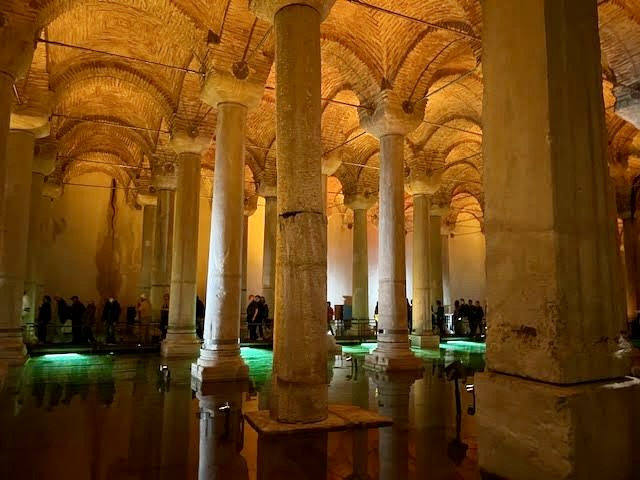
Even though we were packed in like sardines to visit, it never felt crowded. We all had the benefit of space, a light show, and strategically placed glass objects, to add interest.
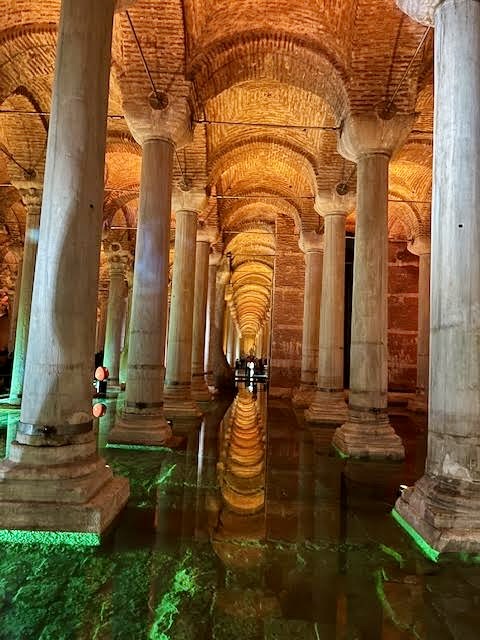
Medusa heads were found in the cistern and two are used as bases of columns. They have also placed a Medusa sculpture for a clever shadow-puppet effect.

We spent an enjoyable visit there, appreciating the intricacies of the brickwork, the mammoth structures of the columns and as always, marvelled at the age and integrity of the cistern.
If you were Suleyman, the 4th Sultan of the Ottoman empire, and wanted to create a mosque to reflect your fabulous self, you would call it Suleyman The Magnificent – and you wouldn’t be wrong.

In a city filled with mind-blowing mosques, Suleyman is right up there. It has four minarets, is covered with blue Iznic tiles, mother-of-pearl inlay and intricate ceiling frescoes.

We left through a side door to face a rather imposing group of women, whom I foolishly identified in my mind at first as nuns!
Muslim is the predominant religion by far and it is common to see women in burkas. It is also quite common to see a group of young female friends together who are wearing everything from headscarves to miniskirts. There does not appear to be religious segregation.

We visited Saint Stephen’s Bulgarian Orthodox Church in the neighbourhood of Fener, built in 1898, and one of the world’s only surviving cast iron churches. It was as impressive on the outside as it was on the inside.

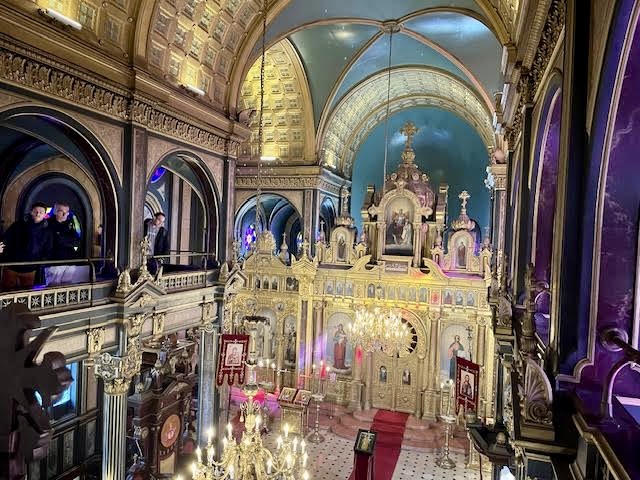
We were in the neighbourhood of Fener ( better known as Balat & Fener), as these are two of the oldest areas in Istanbul and have fascinating histories.
Fener & Balat run into one another and have both been awarded UNESCO designation.
Fener has been around since 1600, when it was a thriving and prosperous Greek community. After the population exchange of 1924, the demographics changed. The area was taken over by migrants who could not afford the upkeep of the stately homes and the decline began.
Balat was developed in 1492 when Jews persecuted under the Spanish Inquisition were rescued by the Sultan. This became the largest district of Sephardic Jews in what was then Constantinople. This population dwindled after the creation of the State of Israel, but today there are still three active synagogues.
In both cases, the neighbourhoods fell into disrepair and it was not until the early 2000s that restoration of the once-beautiful old buildings began. So far, over 100 homes have been restored, but there is much work left to do. It makes the area that much more interesting – it is highly walkable (albeit with really hilly streets). The house on the right may well be beyond help.

A bit of a tilt, but still standing.
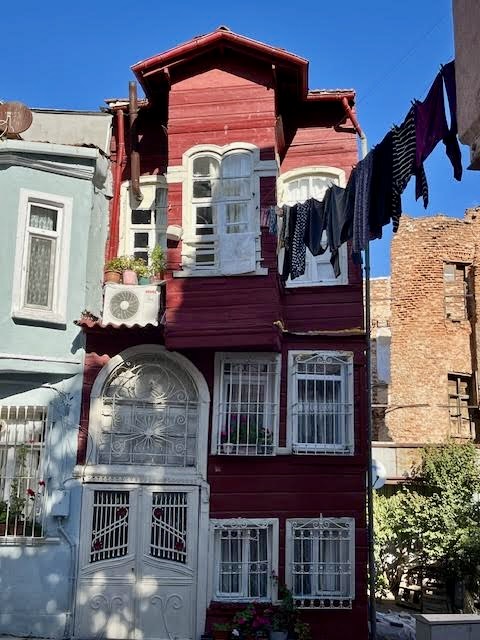
The Colored Houses of Balat – a few streets that make an Instagrammer’s heart beat a little faster.
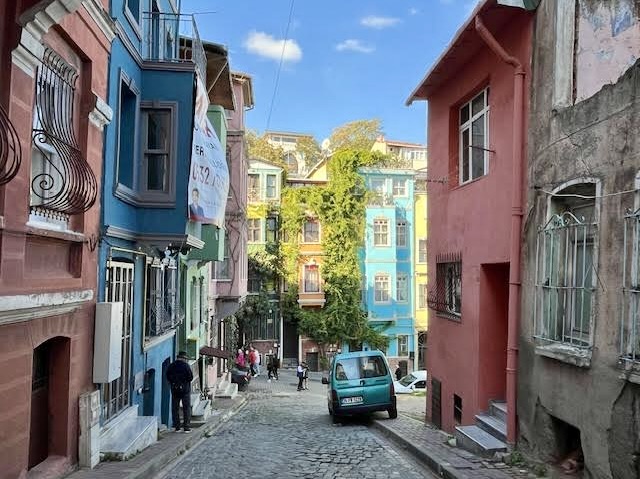
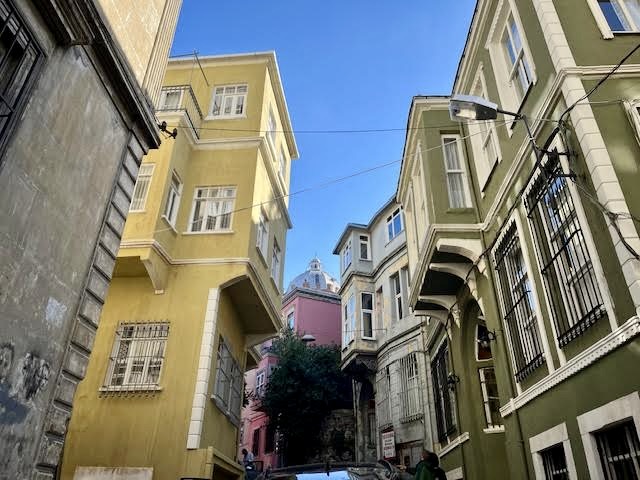
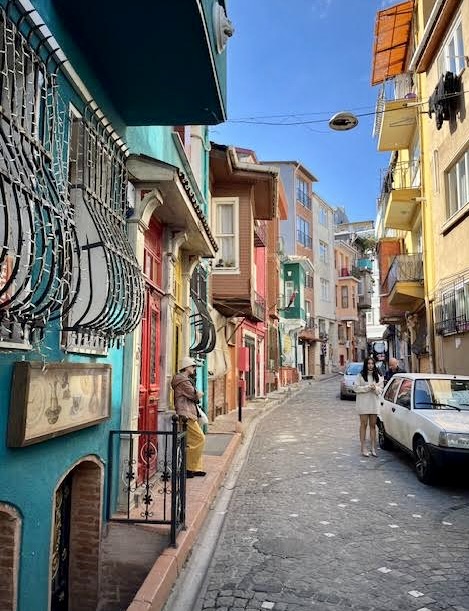
There is a main street in Balat where the cool kids hang out. This translates into a large number of great little cafes and a smaller number of incomprehensible shops.
This one, for example. Unless this man is outside waiting for a shipment of goods to arrive, his shop seems to consist of two barber chairs and an unclothed mannequin. His insouciance is part of the allure – possibly this is an art installation.

Or this Turkish version of “Hello, Kitty“; filled with teensy little must-haves that no-one seems to want.

Istanbul is so cosmopolitan; it is the most-visited city in the world. And shopping is a big part of the allure of such a city. But my heart actually breaks just a little bit when I see legions of young people minding the store; staring at their phones for hours until their shift is finally over and they can go home.
And, to end – a couple of examples of street art.

This one less obvious – someone’s front door and windows festooned with ribbons.

A big part of the charm in Fener and Balat is that it is not so uniformly polished that it has lost its authenticity. Artists live here and people of modest means and eccentrics. We really loved the atmosphere.
One last photo and story. This is the Phanar Greek Orthodox High School – a magnificent brick edifice that is the oldest serving Greek Orthodox school in Istanbul. It was built in 1454.
Amazingly, it is still functioning as a school, although with just 50 students. Their curriculum includes Greek language, literature and religion.

So there we are for now – one last instalment to come before we fly home Thursday.
 Leaving Ourselves Behind
Another amazing adventure, thank you Annie
LikeLike
Thanks for always following along, Annie! I see you have a pretty amazing adventure happening in your life – that precious gift of being a grandmother.
LikeLike
To dear Ginny and Steve….We have visited many of the places you went to in Turkey including Ephesus, Cappadocia and Istanbul but , as ALWAYS, have learnt so much more about those places after reading your leavingourselvesbehind websites….thank you for your in-depth research , observations and photographs ……Exploring all those places was challenging in my wheelchair but, funnily enough, Ephesus in 2011 (we didn’t have to contend with the crowds you had) was wonderfully easy to roll around on with roads paved with marble .
LikeLike
Pippa – leave it to you to tackle Türkiye in a wheelchair, especially Istanbul, which does not seem to have one flat street nor one paved road. You must have had your challenges, for sure.
A beautiful and fascinating country, isn’t it?
LikeLike
Hi Ginny and Stephen,
I was intrigued by your pictures of the cistern, loved the coloured houses, but the cats – not so much! (Alanna would not be surprised by this!)
Heather
Sent from my iPad
>
LikeLike
You’re not a cat fan? :>) I do love them, but it makes me feel a bit sad to see so many who don’t have a home and someone to really look after them. Even cats need people they can then choose to pay attention to or ignore. This would be a dangerous place for our Alanna.
LikeLike
If Istanbul is the city of 50 hills, it seems like most of them are in Fener & Balat – you must both be getting quite fit!
What a beautiful district.
Speaking of the weather, does it ever rain in Türkiye, or have you just been very lucky? The sky in every photo this trip has been an amazing cerulean blue.
LikeLike
Mike, if we stopped eating bread and ice cream, all our efforts might be showing, but I do have to say I can go up and down hills now without huffing and puffing. Plus, our apartment is on the 3rd floor ( no elevator), so we get our steps in.
And yes, our weather has been amazing – I think we have had just one rainy day the whole time. Like almost every other place in the northern hemisphere, the rain begins to set in in November – that dreary month.
LikeLike
Thanks for another great story and photos of Istanbul, and safe travels home! love Rohana
LikeLike
Rohana – good to hear from you! I’ve been thinking about you – I’ll be in touch soon to get together.
LikeLike