It’s been just over a year since we’ve browsed travel sites, booked flights, planned itineraries and figured out packing and boy, does it feel great to be “on the road” again.
Mind you, we put travel aside for a very good reason – we were house-hunting and attempting to create more balance in our lives and we’ve very luckily done just that.
We found a house in Nanaimo we love, we’ve spent more time with family and friends and our travel plans have been scaled down from being away six months a year to planning a couple of trips that will take us away for about four months.
So…first up – six weeks in Japan. Wouldn’t you know it – everyone else seems to have had the same idea and we left with a bit of trepidation. Would we be adding to the dreaded over-tourism that is plaguing so many parts of the world? Well yes, of course. Would we be welcomed or attacked with water guns, as has happened in Spain? So far, we do feel very welcome and not a water gun in sight.
What we have noticed are many signs reminding us of how to behave. The Japanese are quiet, respectful, thoughtful of others and orderly, and tourists had better follow suit. Since these sign are in English, I’m assuming tourists are their target market.
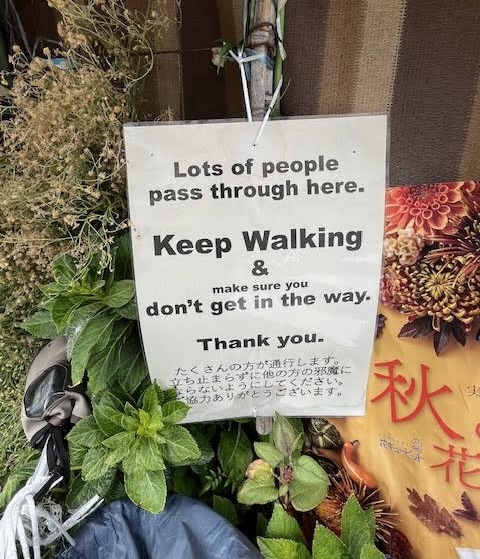
This sign was amusing – probably erected in frustration as “the store across the street” was a high-end restaurant that did not appreciate having the fast-food patrons loitering by their door.

One of the first things we’ve noticed about Japan is how clean and quiet it is – and we’re in Tokyo, with a population of over 37 million people. To put that in perspective – greater Tokyo has just 5 million fewer people than all of Canada.
Traffic is as busy as you might expect, but there are so many electric vehicles here that the noise factor barely registers. There is zero garbage on the streets; even more incredible because there are almost no garbage cans anywhere. Walking on the street with food or drink is frowned upon. Locals walk in conversation with others or solo with their ear buds in; and mercifully, no-one, but no-one talks on their phones in public; a bit of etiquette that we are reminded of via loudspeaker on the subway!
We had just finished commenting on the fact that we barely saw dogs or cats anywhere (another source of potential street messes), when along came this pretty trio. Their owner was happy to show them off.

Then, just around the corner, we met this foxy little Japanese breed, the Shiba Inu. Her owner was using her to entice people into her “doggie” cafe, but when I asked if I could pat her, I was cheerfully told I would have to wash my hands first!

After three days in Tokyo, we are finally lifting out of our jet lag fog and are pleased to report that we have joined the long line of newly-minted Japan fans. This is an extremely easy country to be in, as it makes so much sense. Everything works well, trains and buses are on time, the people are friendly and accommodating and most signs are in Japanese and English. But it is still foreign and exciting and every corner brings something new to discover.
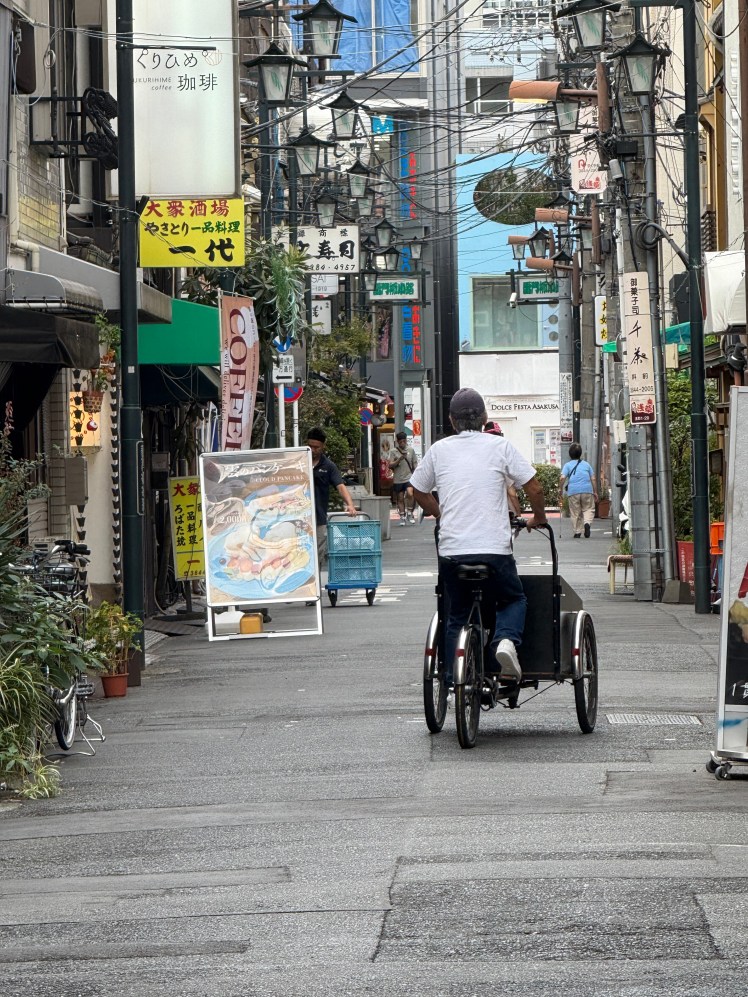
We are staying in Asakusa – an historic neighbourhood that has a good mix of older buildings, ancient shrines and modern attitude. We are beginning our trip with four nights in Tokyo and will be ending it in November with another five nights. In between, we have a cross-section of destinations that we’re hoping will give us a good first-time overview of the country.
One thing that is distinctive about Japanese hotels is the diminutive room size, compared to North American hotels. Ours is a walloping 11 square metres; cramped even by Japanese standards. We honestly could not swing a cat in our room. But it is in an ideal location, offers breakfast, laundry and as many toothbrushes, razors, combs, and cotton pads as we could possibly need. Japanese hotels are all about the amenities.
I love Japanese fashion and Tokyo is a candy store, both in terms of shopping (insane) and street fashion. Men and women alike favour a look that is monochromatic, casually elegant and drapey. Pants are wide, sweaters hang loosely, fabrics are natural, colours are black, charcoal, white and beige. Not a sofa floral print nor a rayon sundress to be found.
With the exception of a few young girls with teensy midriffs exposed, fashions tend to be a little covered up.

Unless you are a young girl who dresses like you just stepped off the pages of an anime cartoon.
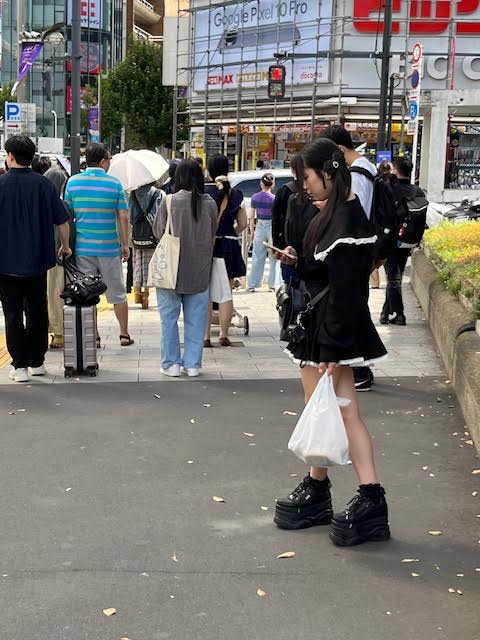
Notice the shoes? Japan is not the land of stilettos – this is a country whose women go for fluffy slippers in public, sensible low heels, running shoes and fantasy platforms. Navigating city streets with step stools attached to your feet is simply not an issue here.

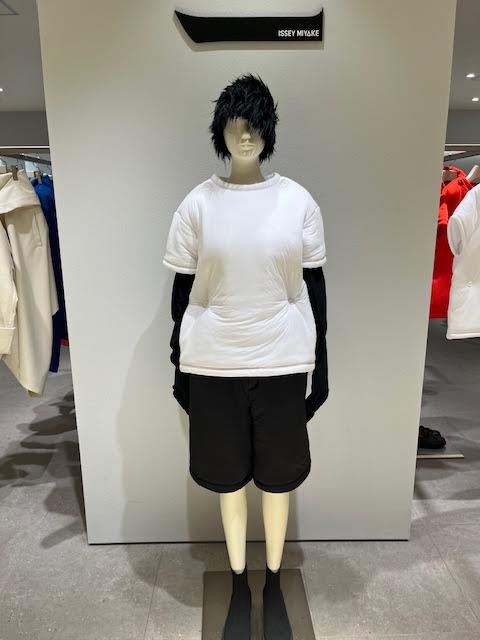
We visited Tokyo’s oldest department, Isetan Shinjuku, in business since 1886. Today, it is an uber-luxury, multi-floor emporium for shoppers with deep, deep pockets. Note to self for any future visits – don’t enter this store wearing Merrell hikers and Eddy Bauer pants – you should know better. Nonetheless, it was loads of fun to have a peek at all the goodies, and appreciate the finer things for a bit. And the sales staff were not one bit snooty.
What was Issey Miyake thinking? No matter that the top looked like it was made of packing material and the shorts looked like grampa’s favourite loungewear, this will sell on brand name alone.
The food floor was a treat – row after row of specialty items being snapped up and carried off with scarcely a glance at the price tag. Never mind that these grapes cost $65 (per package). Here’s the photo of the farmers who grew them.

The architecture of Tokyo seemed surprisingly banal to me. Possibly many of the original buildings did not survive WWII, but in Asakusa, there is still a number of older buildings that have a distinctive look.

These apartment buildings are quite utilitarian.

A lot of whimsy in Tokyo – who wouldn’t want to have a tea cup for a balcony?

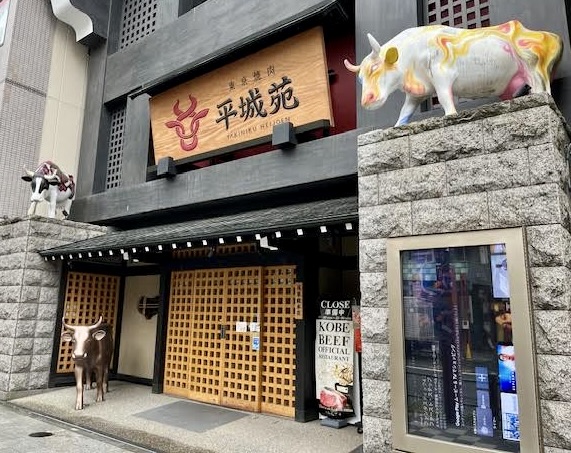
If you are looking to sample Japan’s famous Kobe steak, the three steers might be your first clue you’ve come to the right place.
Some street scenes – the Skytree building is one that dominates the skyline in our neighbourhood.

Cyclists rule in Tokyo – they zip in and out of traffic and nary a helmet to be found. (My anti-helmet brother would be delighted).

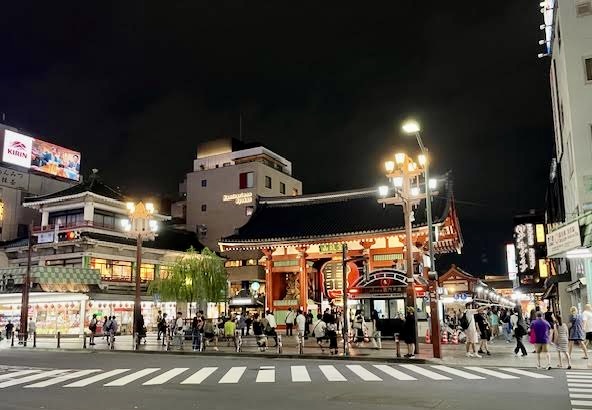
Shrines and temples! We will no doubt come across hundreds of shrines and temples in our travels, but the Senso-ji Temple, built in AD 645, is the oldest Buddhist temple in Tokyo.
You approach the temple by entering first through the gate of Kaminarimon.
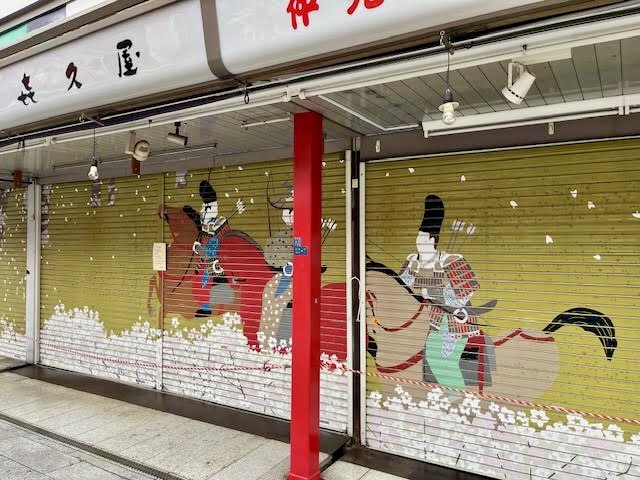
In between this gate and the temple runs Nakamise Street; an historic shopping street. Today the small shops sell souvenirs and food, and their metal storefronts are painted with murals depicting their history of several centuries.
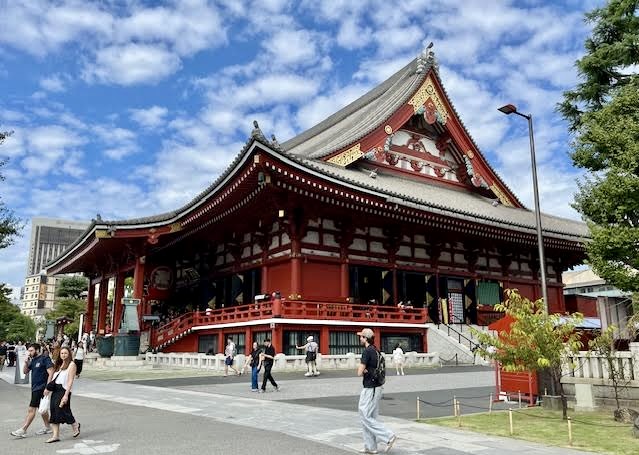
The Senso-ji Temple
A monk preparing for service inside the temple.

A “geisha” peeking outside the temple. In fact this geisha was in costume, posing around the grounds, accompanied by a photographer. It is also quite popular to rent kimonos and swan about town, taking numerous selfies.

We visited the Tokyo National Museum, which is the oldest and largest of Japan’s top-level museums. It features Japanese archeological artifacts, explains Buddhist and Zen principles and offers the history of samurai warriors, kimonos, and painted screens and scrolls.
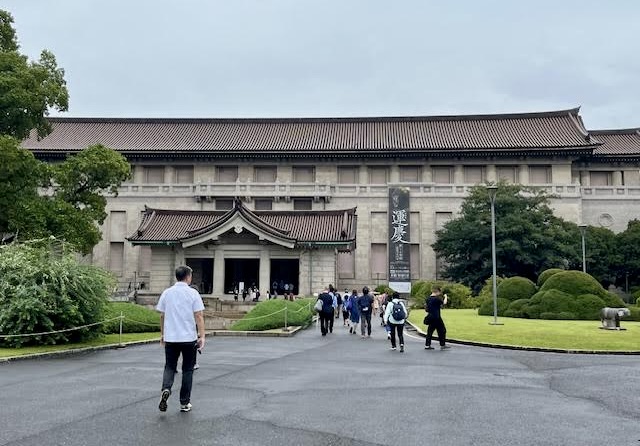
It also explained the history of netsuke.

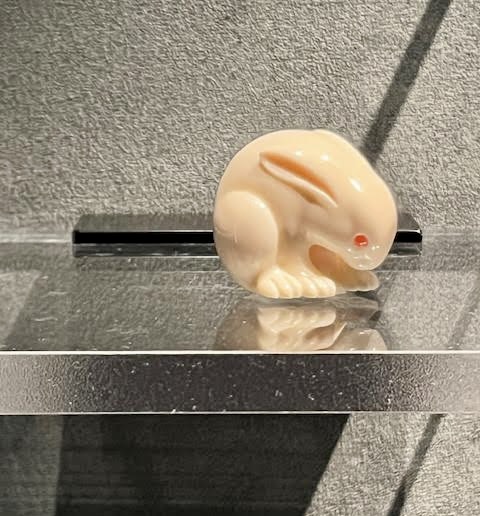
Netsuke, which were miniature sculptures originating in 17th century Japan, featured prominently in one of my favourite books, The Hare with the Amber Eyes, a biography by Edmund de Waal. It told the story of a wealthy Jewish family who had all their art confiscated by the Nazis, but their collection of netsuke was hidden and saved.
This collection in the museum, featured several intricately carved pieces…including a hare with amber eyes.
From ancient temples to precious artifacts to modern skyscrapers – all symbols of Tokyo.
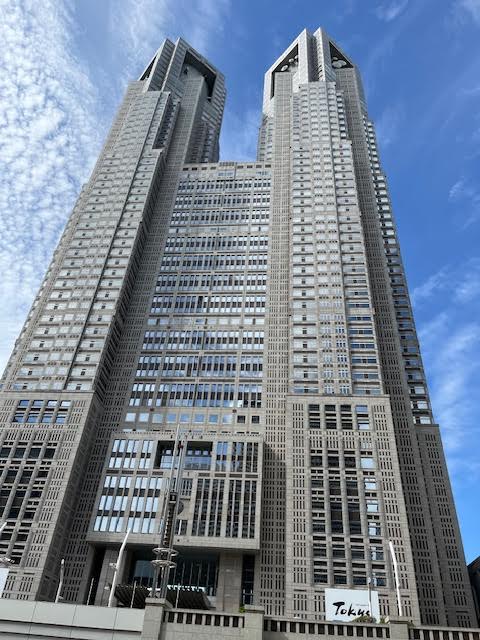
The Tokyo Metropolitan Government Building is a huge tourist draw, as it has observation decks on the 45th floors of both its towers, with 360 degree views of the city, and it is absolutely free.
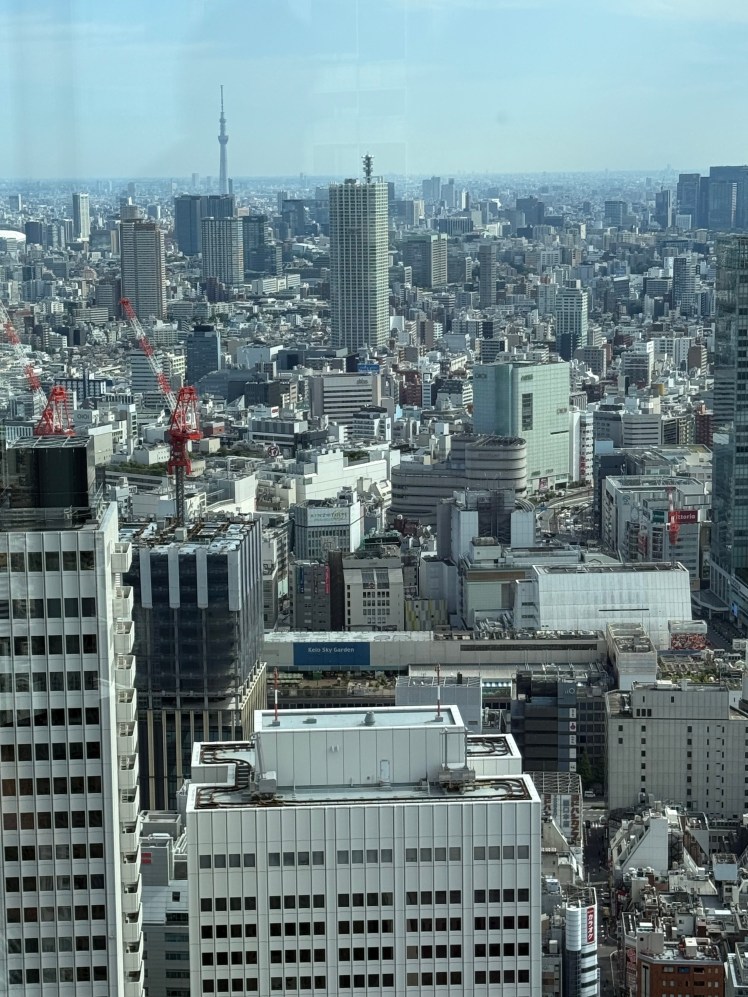
This vantage point really gave us a sense of the magnitude of greater Tokyo, as well as the density.

Luckily for Tokyo residents, there are a number of outstanding greenspaces to escape the concrete jungle. The nearby Shinjuku Gyoen National Garden is a treasure – 146 acres of tranquility.

And no, I did not forget to mention food. So far, we have had pretty flawless meals. We’ve eaten stellar ramen at a tourist place (first night), unbelievably tender and fresh sushi, and today we discovered a 10-stool hole-in-the-wall specializing in onigiri; rice balls wrapped in seaweed. If that doesn’t sound appealing, then imagine fresh sticky rice filled with pork kimchi, salmon and pickled plums, made to order, served with miso soup, filled with silky tofu. Incredible. Please forgive the slightly out of focus photo, which come to think of it, does not do this food justice at all.

Finally, just because these two were the cutest.

So, our brief intro to Tokyo has been wonderful and we look forward to returning to discover more. Next up is Kanazawa, a coastal city three and a half hours away by the famous bullet train, the Shinkansen.
 Leaving Ourselves Behind
Great to have you back …. and Steve’s pix on IG!
LikeLike
Thanks, Pete! It is wonderful to be picking up the travel thread again. Do you and Kath have plans for the winter?
LikeLike
Going back to Zihua for a month December 1. We had planned for March 2026 but Annie is pregnant! Due late January early February. Want to be around to help out. Also, Kath was diagnosed with breast cancer in the spring. Coming back now post surgery and radiation. December will be a good opportunity to feel her best.
LikeLike
glad you made it safe and sound …love the photos !!!!
LikeLike
Vikki – how you would love it here – land of a million paintings.
LikeLike
Thank you for this wonderful narrative and photos on the start of your trip to Japan!! Japan is on my travel list as well but, as you mentioned, over-tourism there makes me wonder if the supposed crowds are survivable, or perhaps just choosing a less crowded season to travel there would be a better option. In any case, what a spectacular country to visit!! Can’t wait for your next stop! Cheers Michelle & Olga
LikeLike
Hi Michelle – we thought travelling here in the fall would be slightly less crowded, but it brings the same number of tourists – only for the fall foliage. I imagine winter here would be simply beautiful.
Still, although there are lots of tourists, it doesn’t feel crazy. I think the difference is that tourists are instinctively falling into line, as far as not being loud and pushy. When you wait for a bus or subway, everyone stands in orderly queues, so you don’t feel anxious. I think the Japanese are onto something! (Good manners).
Say hi to Olga!
LikeLike
So happy to read your blog again Ginny and follow you on the road again!
LikeLike
Hi Laurence – I’ve been thinking about you guys! It feels great to be here, and although I was wondering how we would navigate the subways and trains (it’s an unbelievable maze of lines and gates), Google Maps has accurate and helpful, and there is always someone to ask for help. The Japanese people are so friendly and seem to be happy to help – hopefully we tourists are adding, not subtracting.
LikeLike
Wow! What an interesting place to visit! I’m looking forward to reading more when you return.
Enjoy your stay, Heather and Mitch
Sent from my iPhone
>
LikeLike
Hi Heather and Mitch
Tokyo was much more manageable than I had imagined. I guess like all huge international cities, the part that tourists visit is relatively small and the transit system runs like clockwork, which makes getting around (once you figure it out) extremely efficient.
LikeLike
Welcome to Japan. Love your first observations.
Looking forward to your future blogs.
Gambatte!
LikeLike
Thanks Sheila! We’re pretty excited to be here. We’ve been enjoying your blog postings very much, although I was a bit confused – I thought you guys were heading to Osaka World Fair shortly after you arrived. The north looks beautiful.
LikeLike
Welcome to Japan. Love your first observations.
Looking forward to your future blogs.
Gambatte!
LikeLike
WOW! Thanks so much for sharing. As always I love the photos and the information as well as insights you share. Enjoy and I can’t wait for your next post. Karen
LikeLike
Thanks Karen! It feels great to be here – every day an adventure. I’m curious about your travel plans this year.
LikeLike
It sounds like you are off to a great start and that you are, most definitely, happy to be “on the rode again”. I will look forward to reading about your travel in Japan.
LikeLike
Thanks Jeanne – we’re dealing with a bit of rain now – the tail end of typhoon season, I guess. Kanazawa is beautiful and very walkable, so we just join the legion of plastic see-through umbrellas on the streets, and sightsee between downpours.
LikeLike
Yay.. so happy you are on the road again! Such wonderful pics & descriptions! Love travelling along with you.♥️ We too were so impressed with the cleanliness & order of Tokyo with such masses of people. Public Restrooms as clean as in one’s home. Like you said, no eating on the streets & no garbage anywhere. When we asked people how this is even possible the answer was “it is in our nature”. Simple! The safety factor.. we would see young women out jogging late at night fearless of any type of incident . Can you imagine this in any of the inner cities of NA??
Keep enjoying & absorbing. Look forward to the next post. Hugs to you both. ♥️
LikeLike
Linda – nice to hear from you! Right now, we’re sitting in the lobby of our hotel in Hiroshima and there are about 6 or 7 other people here – just reading, or checking their devices or talking very quietly to one another. No screeches of “Hey dude”, no loud and obnoxious behaviour – just peace and respect and safety and it must be said, great food. It’s pretty great.
Go Jays! Stephen spent our last day in Kanazawa checking scores as we walked about sightseeing, and obviously everyone is happy with the outcome.
LikeLike
You are great, I feel like I am with you in Tokyo. All the best, Piotr 👍😉
LikeLike
Piotr! I can’t tell you how many times we have thought of you and Ela, especially since the recent “invasion” of Portland, and the potential for invasion of Poland.
Dear friends, these are quite scary times, and we can only hope that things don’t go in the wrong direction.
I’ll send you an email with photos and our news.
Much love,
Ginny & Stephen
LikeLike