Tokyo belted us between the eyes: Kanazawa gracefully beckoned us, “Relax, take in the beauty of the gardens, the temples, the historical districts.” And so we did, walking everywhere in this beautiful, accessible city that sits mid-country, bordered by the Sea of Japan and the Japanese Alps.

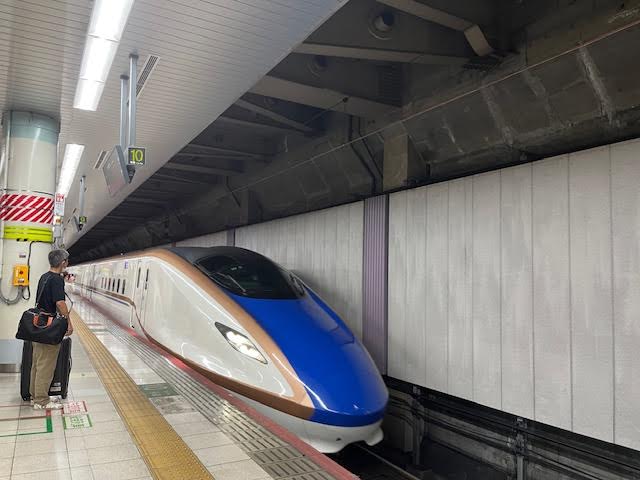
We arrived here in just under three hours from Tokyo by Shinkansen, or bullet train, which was everything we had imagined it to be – clean, fast, spotless and on time to the minute.
Everyone queues in an orderly fashion, takes their reserved seats and for the duration of the ride, there is scarcely a peep. People speak quietly among themselves, or not at all. They take their garbage with them when they leave and, in accordance with the multi-language directions, they return their seats to the upright position.
We arrived in Kanazawa Station, billed as one of the most beautiful train stations in the world. Not a lot of argument there – soaring ceilings, immaculate tile floors, pristine washrooms, delightful food kiosks, well-stocked tourist information outlet and clear signage. We walked out the doors to this stunning entrance.

Kanazawa’s main attractions revolve around a number of historical areas that were former samurai and geisha neighbourhoods. In the latter, geisha (or geiko) are still present for performances and to serve tea ceremonies. While bumping into geiko strolling on the street would be about as likely as seeing a unicorn, the Higashi Chaya district and the Nishi Chaya districts are steeped in romance and unique architecture.
It poured rain for two solid days so many of our photos include shiny streets and herds of umbrellas.
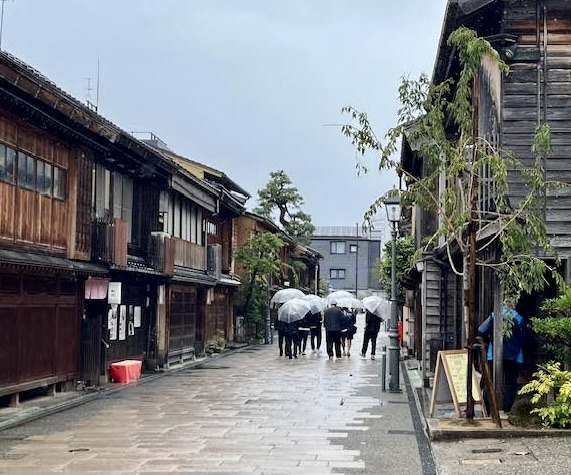
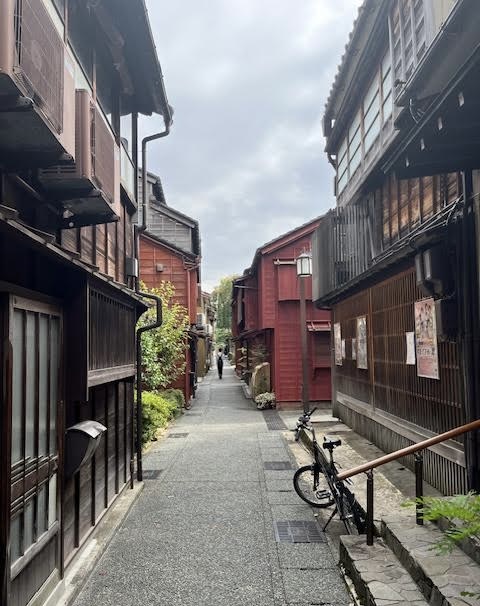
The Nagamachi Samurai district is characterized by narrow streets with buildings made of earthen walls with high stone foundations. Where once samurai districts covered 70% of Kanazawa, this is now the only surviving samurai district in the city.

Kanazawa is a city of irrigation canals, built during the samurai period, that criss-cross the city, providing water for gardens, domestic use and in case of fire. As well, they provide an air of calm and esthetic appeal – it’s pure pleasure to walk beside them.

Temples and shrines abound in Kanazawa (and obviously all of Japan) and rather than attempt a temple show-and-tell, I’m going to try and bring out a few features that were interesting to me.
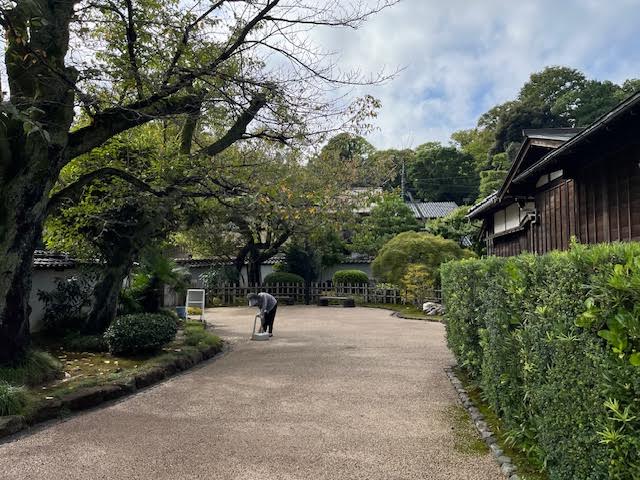
If cleanliness is next to godliness, then people like this woman are on hand to clear away any debris or stray leaves from the property.
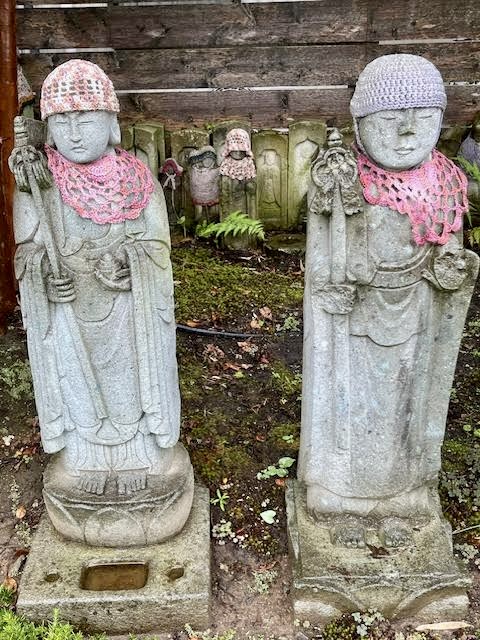
These small statues are to be found throughout the city and I discovered the meaning of their red bibs. These are called Jizo statues, meant to represent children who have died. Their crocheted bibs are to show care and comfort to grieving families.
I felt quite emotional looking at them and more so when I later discovered their relevance.
What I loved about Kanazawa is the mix of modern and historical, tossed together with abundant greenspace, an excellent transit system and loads of amenities. Such a livable city for the locals and ideal for tourists.
I never did discover what this building is, but I liked the architecture.
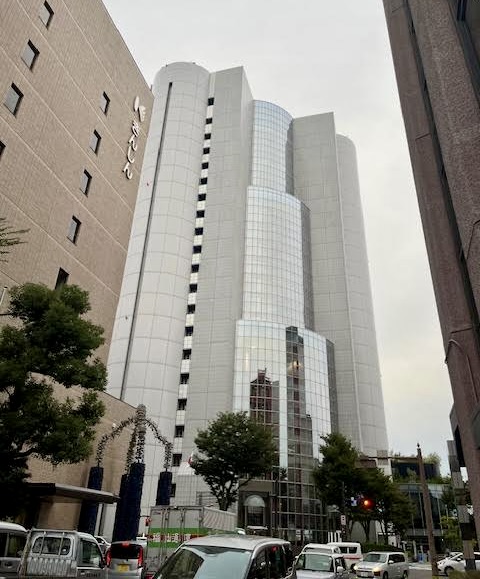
A block or two away, this place. The city is like this – historic old home right beside a modern apartment or office building.

A modest Pride Parade, but a parade nonetheless, followed by hundreds of supporters in rain gear. The parade went by our hotel and this woman and I waved madly at one another until she was out of sight.

A community centre for performances and lectures.

Gold leaf has been created here since the Edo period; producing 99% of Japan’s total production. It is used to produce jewellery and ceramics and is incorporated into food and cosmetics. This skin care store specializes in products with gold leaf.
I’m not sure if all Japanese women use gold leaf on their faces, but they’re doing something right – they have flawless skin.

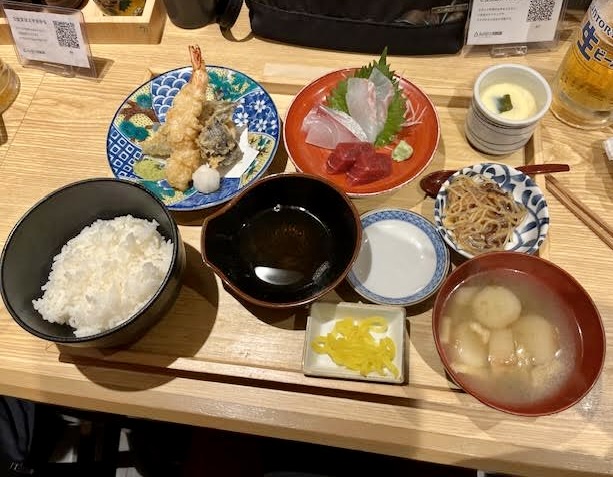
Possibly eating a lot of fish is also good for the complexion. Being right on the sea means an abundance of fresh fish – the sushi is almost as good as you’d find back home. :>)
Here, one of my favourite “sets” – sweet and sour noodles, tofu in miso, fluffy sticky rice, tempura, sashimi.
Our hotel is close to a fabulous market that specializes in fresh fish. Snow crab season is here and stall after stall offers the freshest crab imaginable; some at mind-boggling prices. Now I don’t know if that price is per crab, or by the pound, but yes, folks, you might be paying somewhere between $140 – $255 CAD for a single crab. ( 100 yen – $1 CAD). If you want two, that’s over $500 for dinner, before you toss a salad or pour a glass of wine.

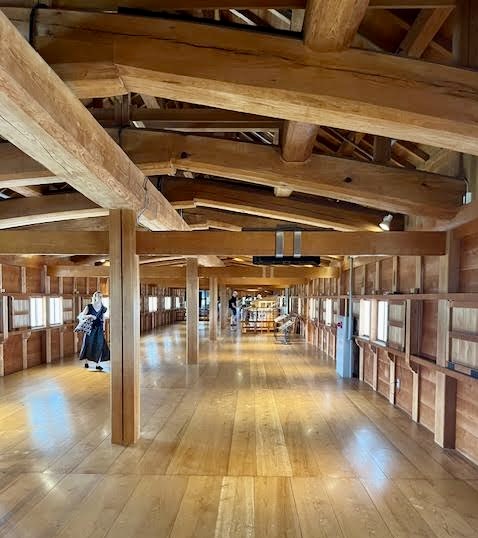
The main attraction in Kanazawa is the Kanazawa Castle Park and the nearby Kenrokuen Garden. While the original castle, established in 1583, has suffered many fires over the generations, the current site, built in 2001 has been faithfully reproduced to the original.

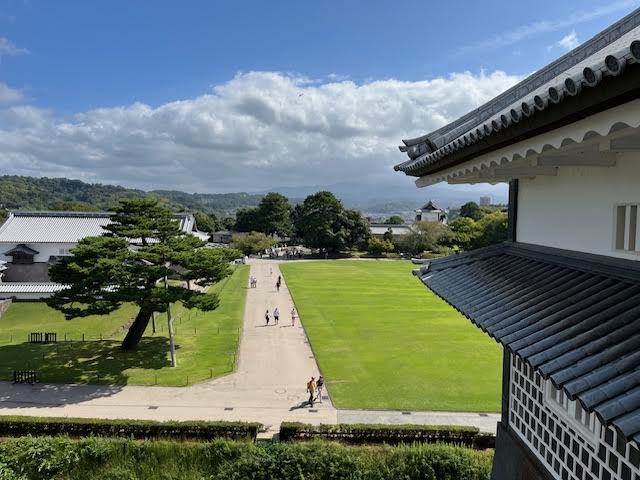
The interior of part of the castle illustrates the outstanding use of wood construction without nails.
Kenrokuen Garden dates back to 1676 and has been open to the public for the past 150 years. It is one of Japan’s top three gardens, possessing the six attributes: spaciousness, seclusion, artifice, antiquity, water features and scenic views. It is spellbinding.
If you think “Japanese Garden“, this is it.

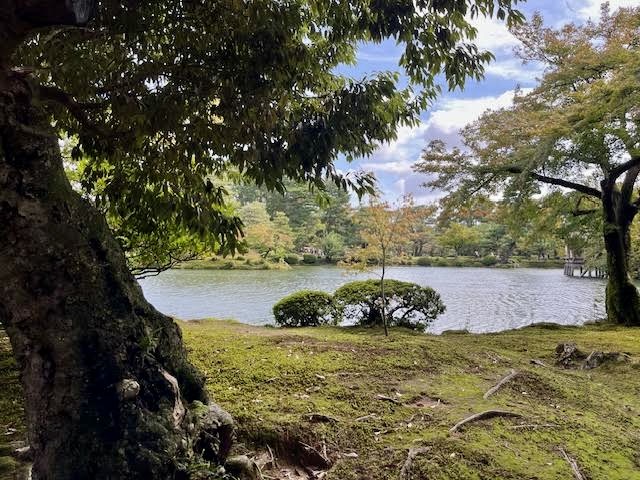
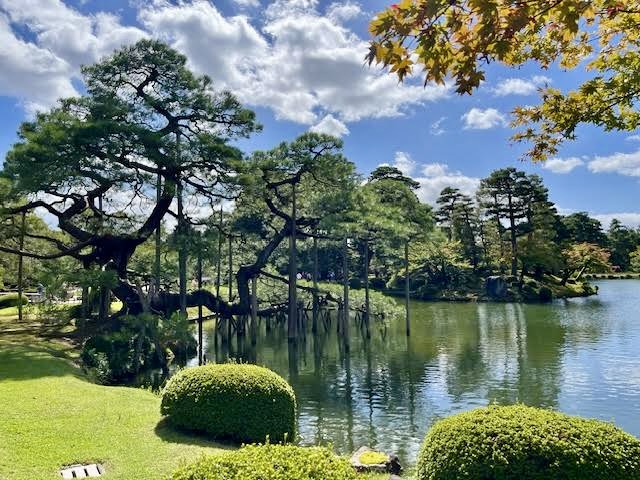
Many of the trees are supported by massive beams, so the weight of their branches won’t break off.
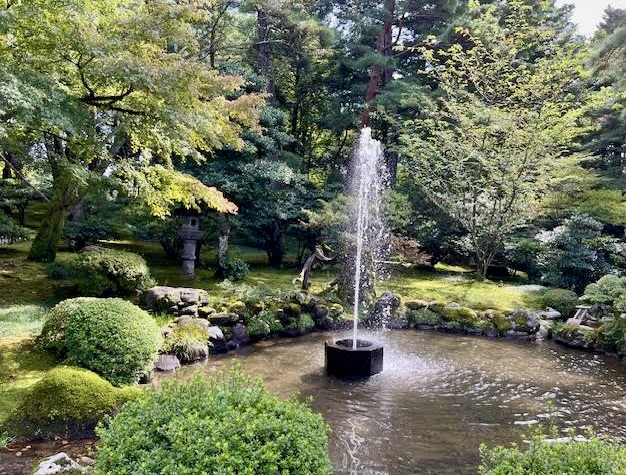
Japan’s oldest fountain. While not much to look at, it is remarkable by the fact that there are very few fountains in Japan.
We had planned to do a couple of day trips from Kanazawa, but the weather was not cooperative. We did get to Shirakawa-go, a small village just over an hour away in the mountains, that is recognized as a UNESCO World Heritage site for its examples of gassho-zukuri thatched roof houses. This area receives some of Japan’s highest snowfalls and the steep roofs (also called Praying Hands) are designed to avoid buildup.
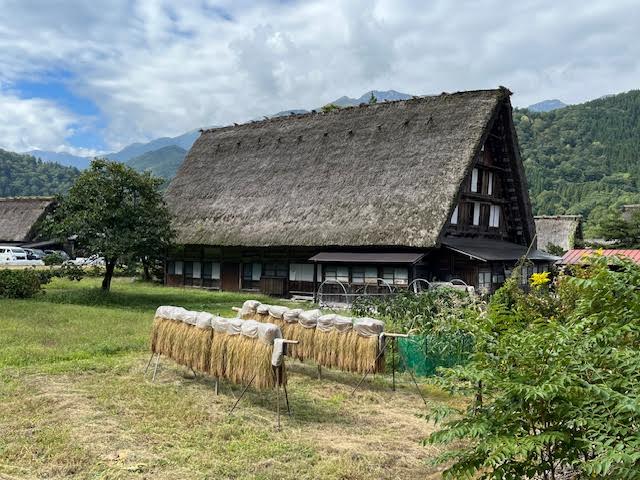
It is exquisite – the village is set in the mountains, beside a river and is comprised of two main sightseeing areas – the village itself, where roughly 500 residents actually live and the Heritage Open-Air museum across the river that features 25 examples of the gassho houses that have been preserved and moved to this location.
In the village, tourists are free to wander and take photos, but many homes have “Do Not Enter” and “Private Property” signs posted, since some tourists have not behaved respectfully.
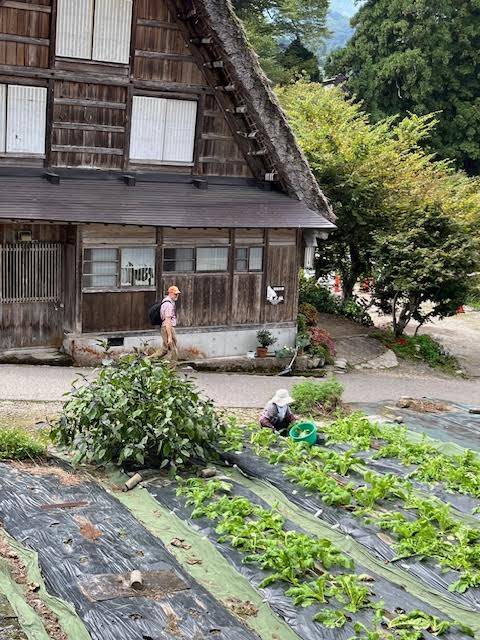
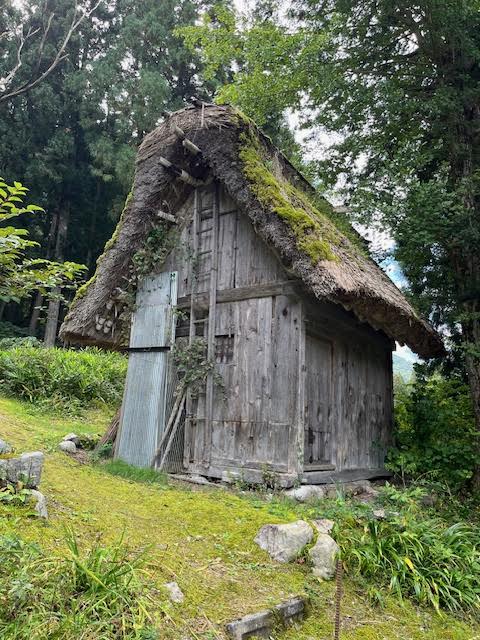
A small abandoned building, clearly in need of a new roof.
Roofers installing a roof – Shirakawa-go style – by chainsawing off the layers, bit by bit.

The river separating the village and the open-air museum.

The open-air museum. Fascinating and educational.

And then the rub. Over-tourism, the bane of so many beautiful spots on earth, is so graphically illustrated here. I try to imagine how I would feel if I lived in a small village and every day thousands of people clogged the streets; tour groups gawking in windows, benches filled with tourists eating ice cream. At five o’clock every day they leave, but every.single.day. this scenario is repeated.

We counted over 40 tour buses, with each of them carrying 80 tourists – that is 3200 people, plus the ones who drove, plus the ones who, like us, arrived by city bus. Probably over 5000 tourists descend on this village every day. And we were part of it.
It is hard to justify our desire to see different cultures and different ways of life when our understanding of those cultures on a 3-hour visit is so superficial. We read the plaques, we take the photos and we leave a bit of money behind, but this experience didn’t sit well.
How to be a good tourist – that is the question.
Up next – we take three trains tomorrow to reach Hiroshima. See you again a in few days.
 Leaving Ourselves Behind
Lovely to see some of our favourite places in Japan. It’s been 31 degrees in Osaka but now we are in Hokkaido where it is a balmy 18 degrees which suits us much better. We are heading to the mountains tomorrow and hopefully will see some fall color.
LikeLike
Sheila – we just met a couple who had the same disappointing experience in Osaka at the World’s Fair. They cut their losses, left early the first day and just toured around Osaka the second day.
You will love the north, I’m sure – it looks so romantic. Next time!
LikeLike
Lovely to see some of our favourite places in Japan. It’s been 31 degrees in Osaka but now we are in Hokkaido where it is a balmy 18 degrees which suits us much better. We are heading to the mountains tomorrow and hopefully will see some fall color.
LikeLike
This makes mecwantbto be a tourist in Japan!😁
LikeLike
Huguette – I saw someone walk by today with a memorable T-shirt – “Japan Addict.” There’s lots to love here.
LikeLike
I’m loving all you have to show us of your trip so far and Kanazawa is no exception! Love the contrast between the old and the new in the buildings and I could almost feel the peace and serenity looking at the pictures of the Kenrokuen Gardens. A final note: I suspect you are very “good tourists” if only others were the same.
Sent from my iPad
>
LikeLike
thanks Heather – we sure do try to be respectful tourists, but maybe reading between the lines a bit will help to figure out what places simply are overwhelmed and then avoid adding to their tourism woes.
LikeLike
Now you have our attention! Tokyo was a bit over the top, but Kanazawa sounds lovely. The old architecture and gorgeous gardens must be wonderful for wandering. We could learn a lesson in cleanliness and politeness from the Japanese…love that there are no overflowing garbage cans (or any public garbage bins at all for that matter). Amazing & interesting that the generations all abide by the rules. Love seeing your blogs once again, Ginny.
LikeLike
We can’t help but marvel at the teenagers here. There are the girls with their micro-mini skirts and sky-high boots and they’re fun to watch. But mainly the girls and boys walk around the streets as though they have avoided the plague of adolescence entirely and are now young adults. The little kids sit with their parents in restaurants and they’re quiet as can be. No toddler meltdowns, no annoyed parents – they glide through life with grace. Is this mass obedience or are the Japanese more evolved?
LikeLike
2 days of rain and you still sound like a very appreciative visitor. I cannot imagine you and Steve being anything but gracious guests in their city.
LikeLike
Thanks Jeanne! I think we are gracious tourists, which is no big challenge since everything works so well, and you feel safe and well cared for here.
One tiny fly in the ointment – Stephen got a cold the first day here, and now I have it, but no big deal. We feel lucky.
LikeLike
Thanks for sharing your wonderful travel blog – I just love it !!
Rob Ross
LikeLike
Great to hear from you Rob! I’m so happy you’re following along.
LikeLike
Hi Ginny and Steve I’m enjoying your blogs so much, you guys are amazing and I’m so glad you are out doing what you love. For some reason I can’t reply on your blog site so I just wanted to let you know that I am getting them and enjoying them immensely.
Keep doing what you love, life is so short so fill it to the brim.
hugs from Tony & Sharon
LikeLike
Hi Ginny and Steve I loved the photos of the train, food and tour buses. What a story they tell. And yes Steve I know you would ask me to say tour again. So enjoying your blog. Kj
LikeLike
Such a beautiful visual tour of Kanazawa. Your photos are stunning and your reflections on travel are so thoughtful. Definitely inspired to visit now!
LikeLike