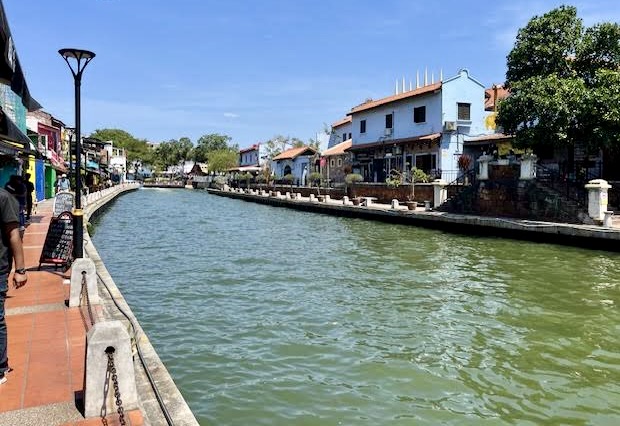
After the clang and clamour of Kuala Lumpur, it has been a welcome respite to spend a few days in the beautiful coastal city of Melaka. The Melaka River bisects the city and is both representative of its trading past and its tourism future.
Back in the 14th century, Melaka began as a major trade hub with other Asian countries due to its strategic position on the Straits of Melacca, with the river leading inland.
After Portuguese occupation for 130 years, followed by Dutch rule for 183 years, then the Brits from 1824 -1957, with a few years off during the war when the Japanese took over, Melaka has had less than 70 years to be independent. Now it proudly declares its status as a UNESCO World Heritage site, earned in part by its multi-cultural background, beautiful historic centre and photogenic surroundings.
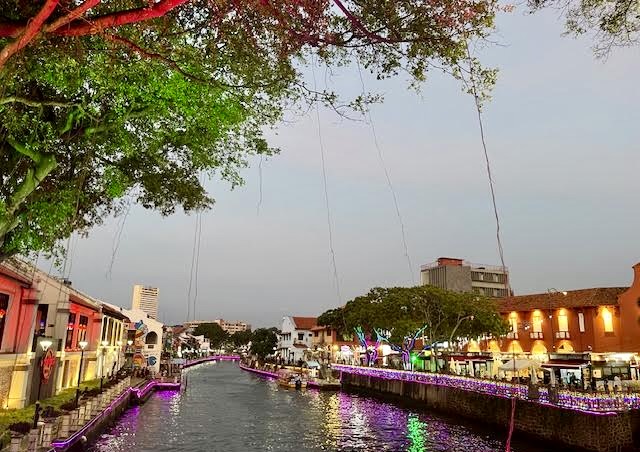
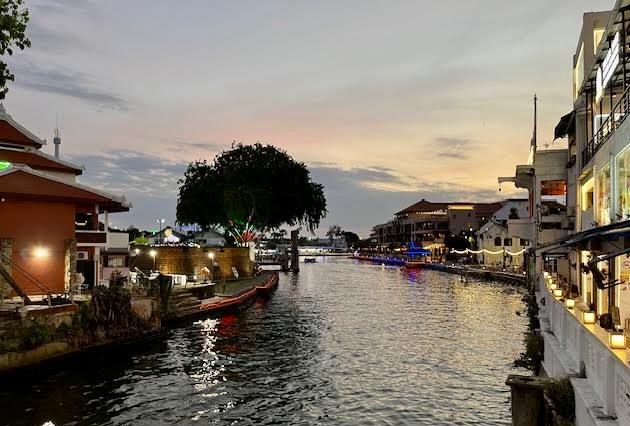
Back to the scenic and well-developed river. It runs for about 25 miles, with its mouth in the Straits of Melacca and a river walk on either side that runs for about 4 miles. There is a short stretch where one must run the gauntlet of the “Happy Hour” exhortations, but otherwise, it is a blissful pastime to stroll along at all hours of the day or night.
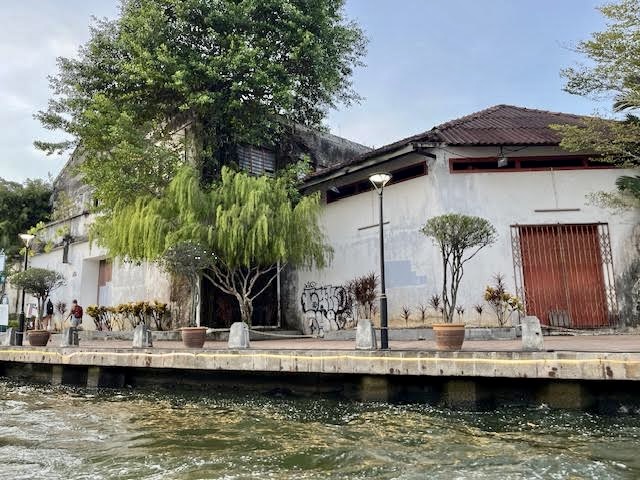
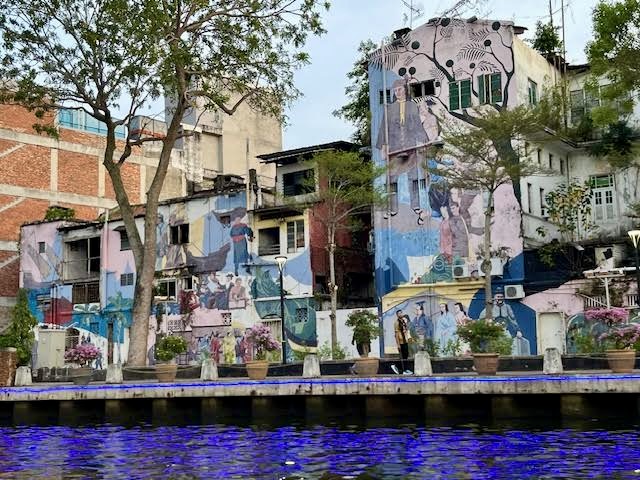
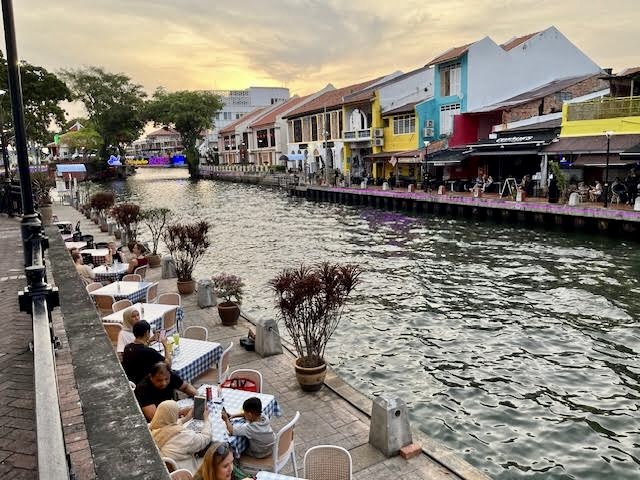
We took an evening river cruise, priced at a very reasonable $12 each and lasting about 40 minutes. It was a great way to see more of the city, just beyond the walkable historic centre. Some of the scenes along the way.
We were told to be in Melaka during the weekend, in order to be part of the Jonker Street Walk – the lively night market. Lucky us – we made it and got to experience the full-on explosion of colour, noise, food, and all the made-in-China junk one could possibly want.
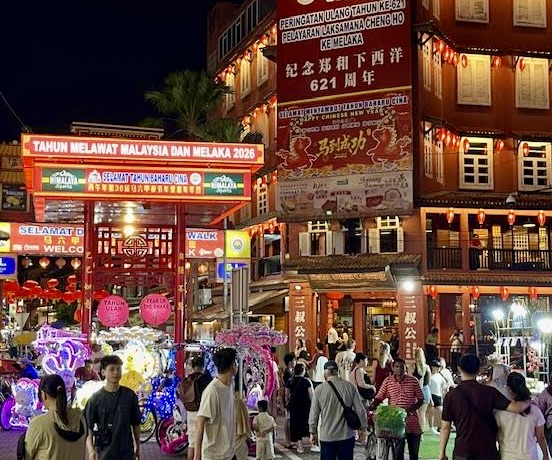
It was fun, but as night markets go, it lacked a certain something. It was very crowded, but a bit tame. Not that I’m looking for danger, but it felt safe and tourist-y. Still, loads of fun to be out on a warm evening and part of a huge crowd.
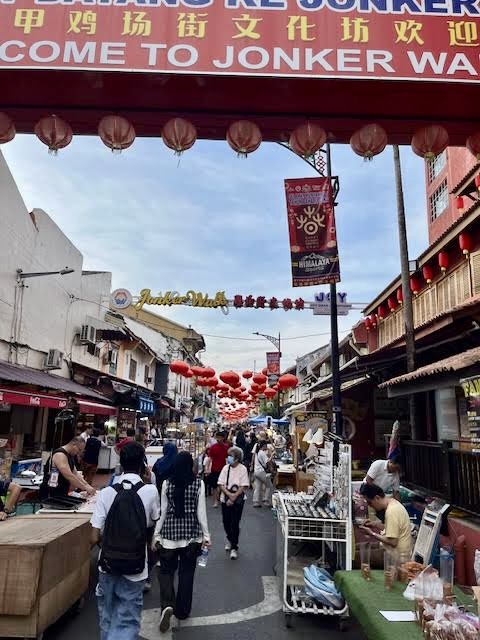
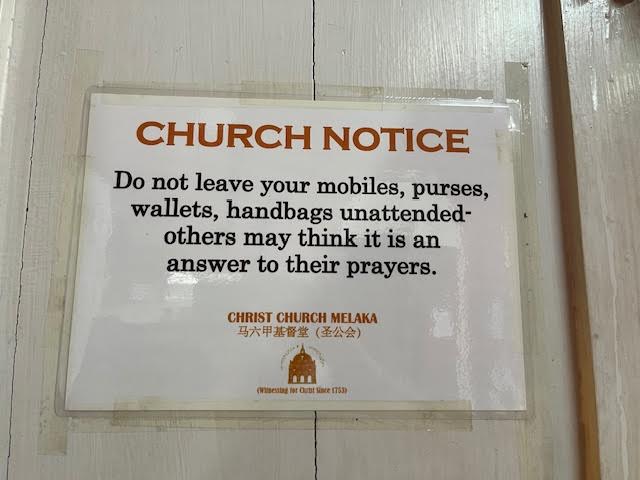
As for safety – Malaysia is not Japan, but that’s not saying it is dangerous. There are signs warning people to keep an eye on their belongings, but that does not equate with being unsafe. We keep an eye on our stuff in Canada. Otherwise, it is very relaxing here and while there are a number of people on the street who are obviously not well-advantaged, there is no threat to either tourists or locals.
I thought this sign was clever. Posted on the door of the Christ Church, no less.
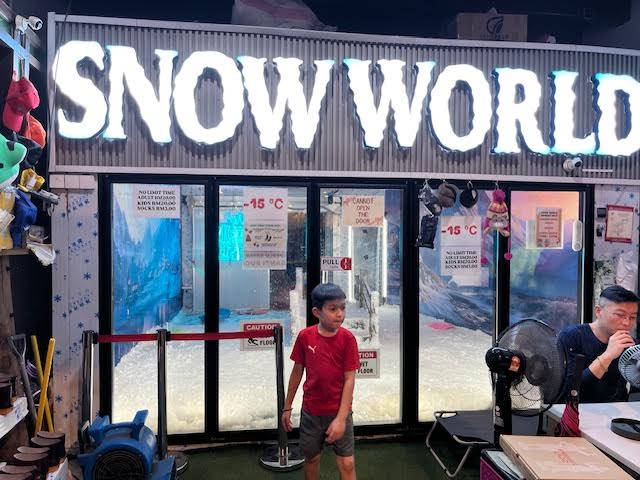
Melaka is extremely walkable, but due to the high heat and humidity, we tried to get a lot of sightseeing done in the morning, then again in the late afternoon and evening. We were quite struck by the ingenuity of this small business – Snow World. Catering mainly to kids, there is a lineup of puffy jackets on one side and a row of boots on the other.
The small Malaysian child then enters the -15 degree room (I think that is an exaggeration) filled with snow, snow shovels, sled, etc. We watched this little boy trying to decide if he was going to join his brother (already inside and labouring under the weight of a wheelbarrow filled with snow.)
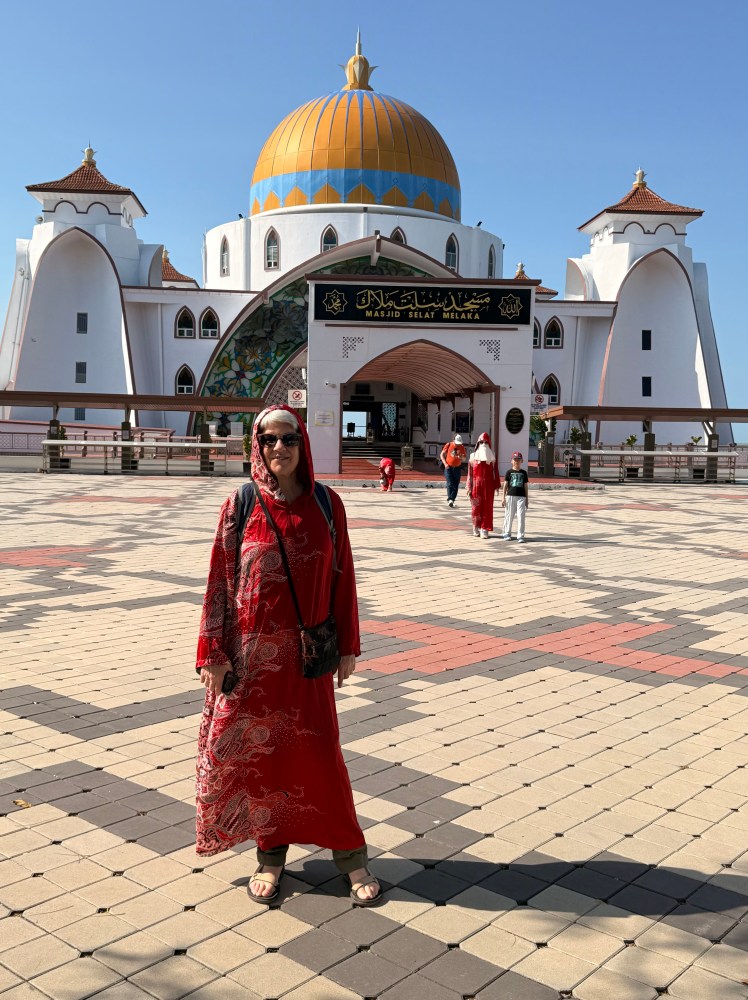
Religion is well represented here – Muslim, Buddhist and Christian, mainly. We headed first to the gorgeous Melacca Straits Mosque, set picturesquely on the coast. All women, regardless of their dress, rent full-length cloaks, probably to avoid any subjective discussion about appropriate cover. It was surprisingly light and cool.
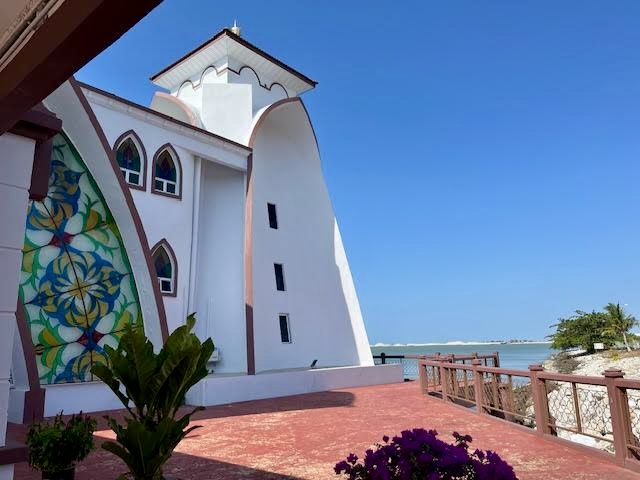
This mosque is only 19 years old, but what it lacks in history, it makes up for in beauty.
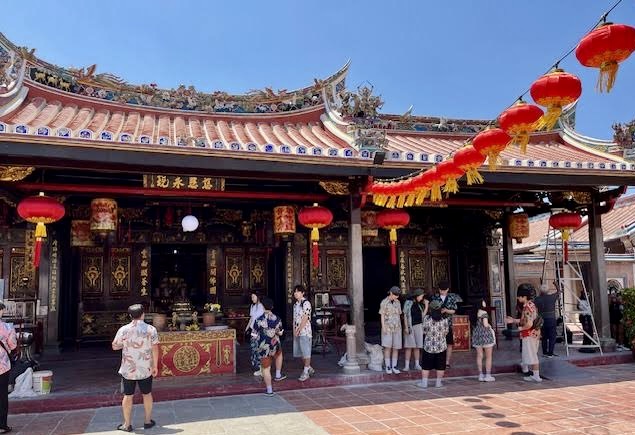
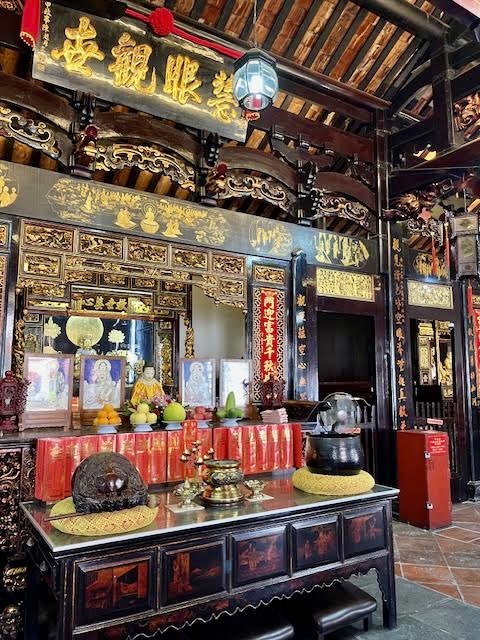
Next up was the Cheng Hoon Teng temple, practising Buddhism, Confusianism and Taoism. It was built in 1645 – the oldest temple in Malaysia.
I had a funny exchange with the security guard, as I was digging out my scarf to cover my shoulders. He told me it wasn’t necessary, “only for sexy, Madam.” “Are you telling me I’m not sexy,” I asked and he had a great laugh.
And finally, we visited Christ Church Melaka, right in Dutch Square. It was built in the 18th-century and is the oldest functioning Protestant church in Malaysia.
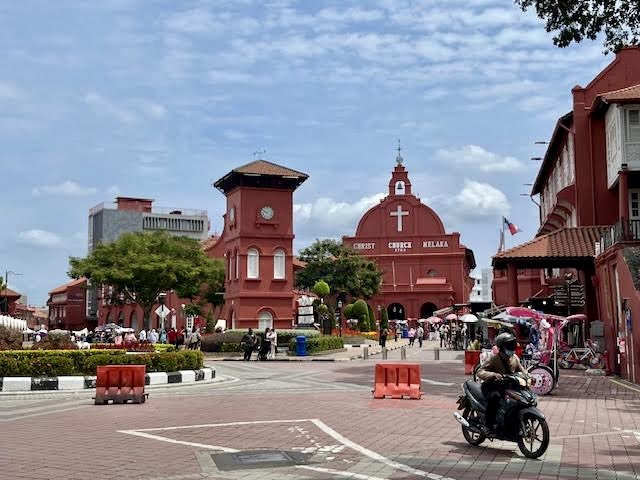
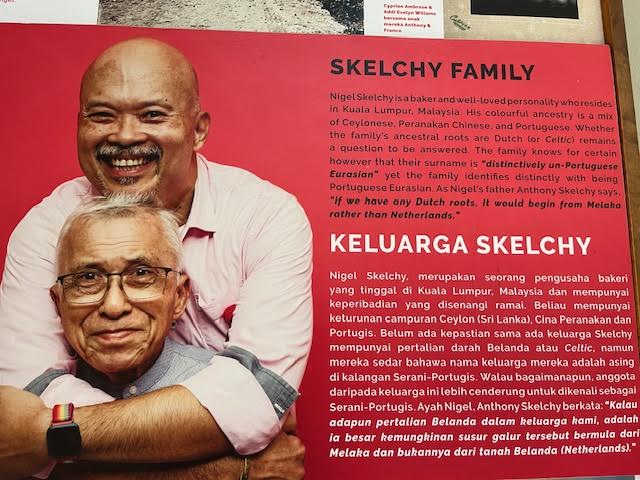
The red brick buildings in Dutch Square are emblematic of when the Dutch were in control, and today, their buildings house a post office, museum, several shops and restaurants. We visited Stadthuys, which was an administrative building during Dutch reign, and is now a museum. Very interesting and informative, it traces the history of Melaka from its earliest days right up to independence, with an emphasis on how inter-marriage over the centuries has produced the present-day Eurasian population.
This was one example of a family whose roots probably came from the Portuguese.
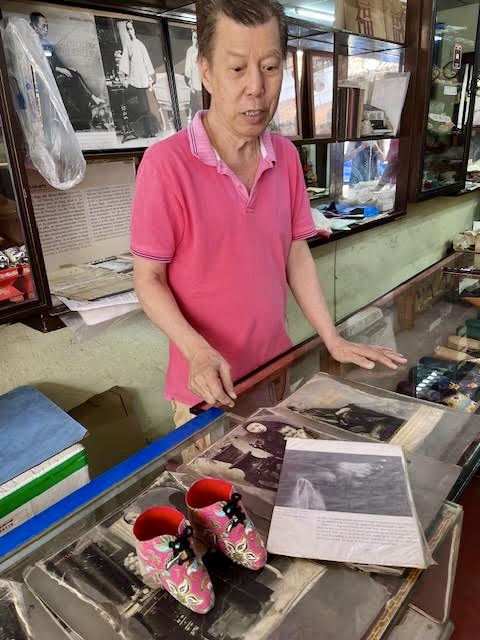
History is alive in Melaka. We were drawn to this shop by the window display of shoes for high-born Chinese women whose feet were broken and bound to show signs of wealth. This gentleman is a present-day shoemaker who creates delicate jewelled shoes for modern women, but he has also created these replicas that are sold as souvenirs.
They are just three or four inches long, and he showed us a photo of the incredible deformities that resulted after binding that began at the age of three. This practice went on for centuries and was outlawed in 1912.
Melaka is well-known for its street art. I couldn’t add all of the many ones we saw, but here are a few of my favourites.
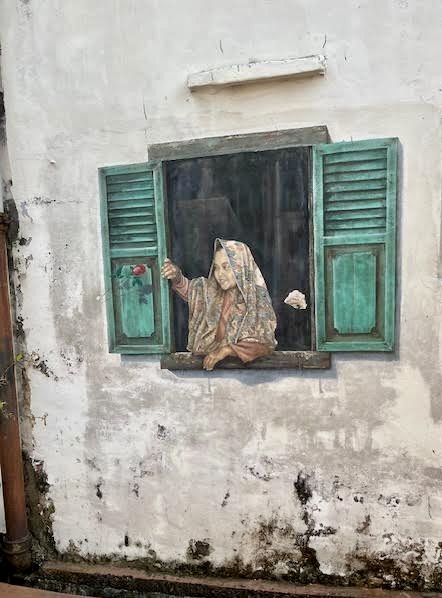
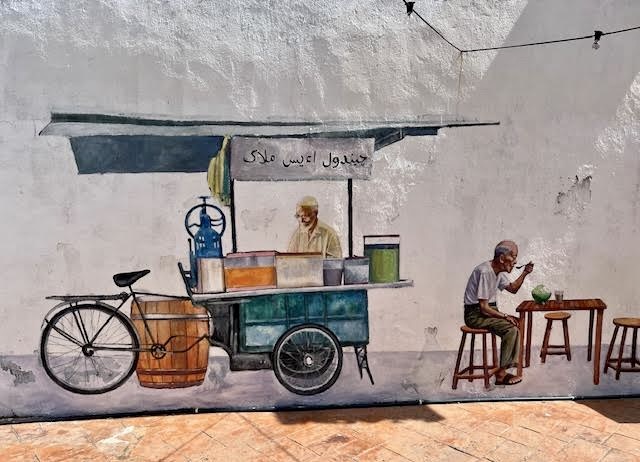
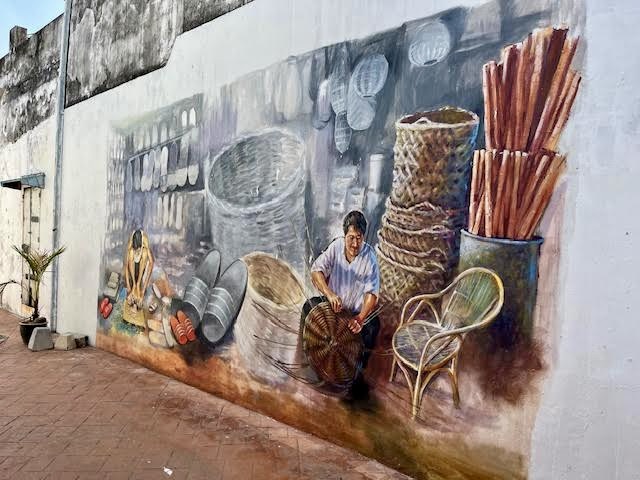
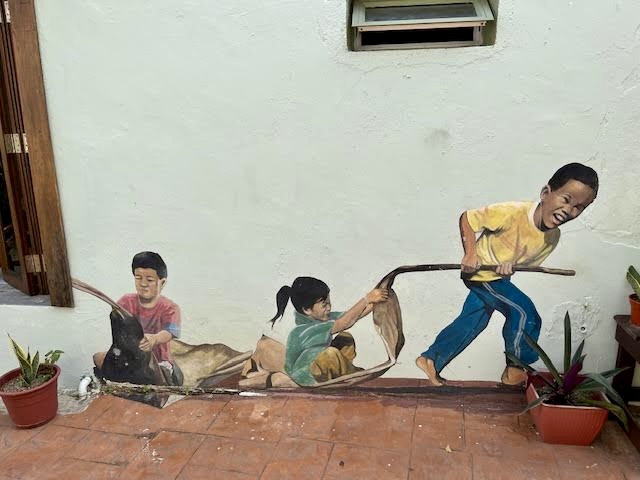
Life imitating art. This young woman spent at least five minutes twirling her parasol this way and that.
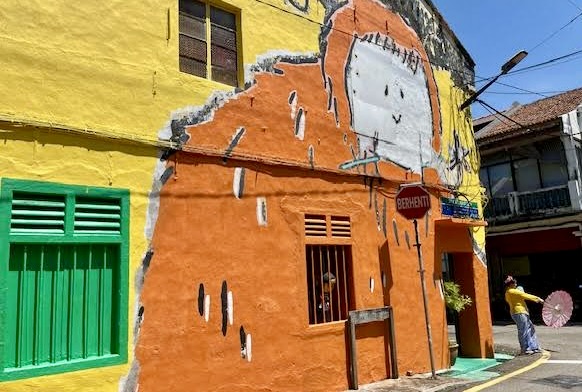
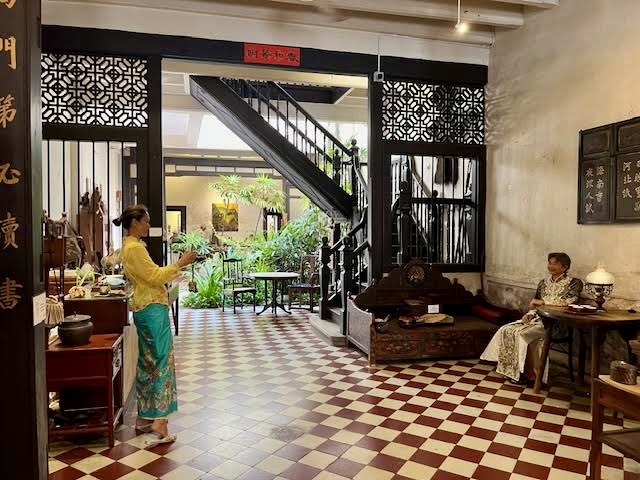
This couple did likewise. After a costume rental down the street, we encountered them in Malaqa House – an exquisite museum that showcases the Baba-Nyonyu culture of the past century. Although the house was almost empty, we found ourselves in close proximity to their many, many photo ops.
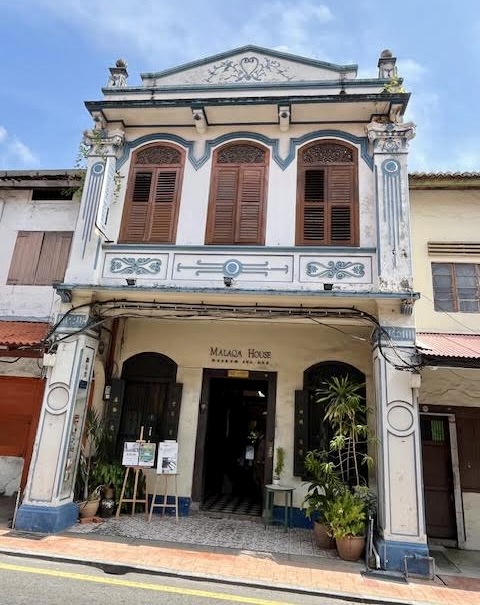
The exterior of Malaqa House. While it does not look extravagant from the outside, we were told that all of the houses on that street were similar – large gracious townhomes exist behind the outer facades.
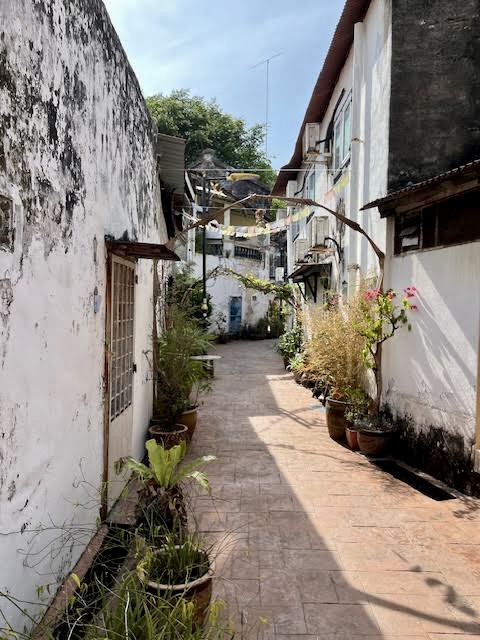
Of course, there are lots of buildings that could use a scrub – we walked down many an atmospheric alley.
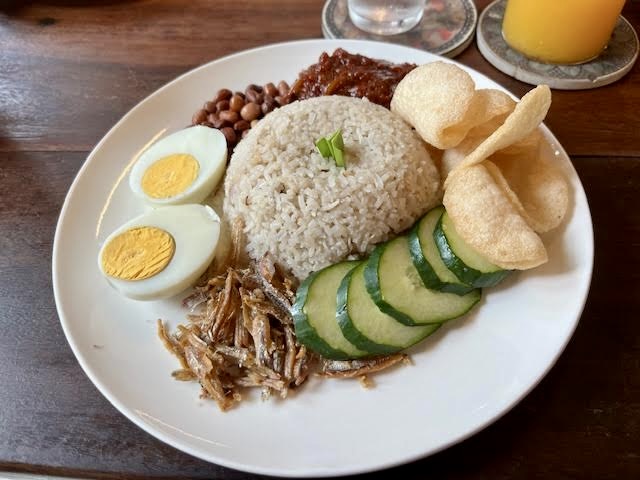
What am I forgetting? Oh right – food. Malaysian food is a delightful mix of cultures and Nasi Lemak is one of the national dishes. This non-meat version has coconut rice, shrimp puffs, crispy anchovies, peanuts, eggs and cucumbers. You mix the whole thing up with a spicy sambal sauce and whoa – so good. This plate cost less than $4.
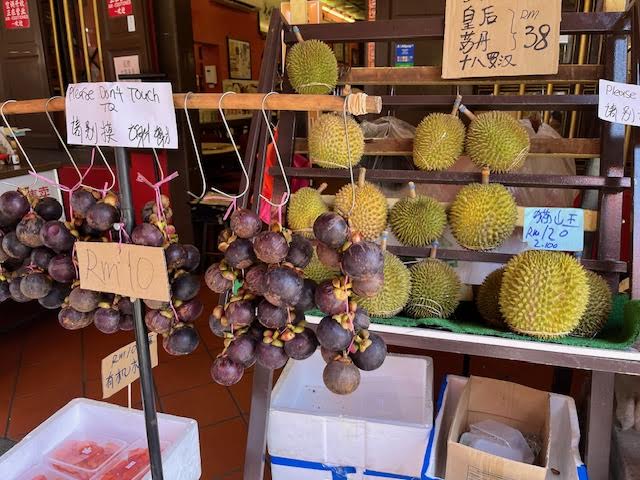
Fruit of all kinds are abundant and delicious in Malaysia, but two standouts are the durian and the mangosteen – both of them banned in many hotels. The durian is apparently incredibly stinky- I have heard it compared to armpits. Since I probably won’t try it, I can’t vouch for that comparison.
As for the mangosteen, we have our friend MyLinh to thank for introducing us to this delectable fruit, but it is banned in hotels due to its easy-to-stain, hard-to-remove juices.
And there we have it – our wonderful stay in Melaka has come to an end, and tomorrow we are back to the clang and clamour of a huge city – Singapore!
 Leaving Ourselves Behind
I would so love to visit this place, amazing cross cultural influence! Thanks Ginny and the food makes me hungry !!!
LikeLike
Laurence, you would be among your countrymen(women) here. Most of the tourists we meet are either Asian or French. I had an embarrassing chat with a couple from Toulouse who asked if I spoke French, to which I replied, ” je parle un petit peu.” They smiled and the conversation continued in English.
Food is fabulous.
LikeLike
Melaka has really changed since we visited in 2009. It looks so much more vibrant. We have always avoided durian fruit but on our last visit to China we ate pizza with durian on top and it was delicious. I think you should give it a try!!
LikeLike
I would like to try it, but it seems hard to buy just a small slice. The packages of durian are about $25, and way too much to eat, especially if we don’t like it. But there is so much wonderful fruit here – the dragonfruit and jackfruit and beautiful mandarins.
If I have the chance, I will give it a try though – all the food here is so delicious.
LikeLike
Hi Ginny and Stephen.
You ‘re absolutely right; Melaka is quite a contrast from Kuala Lumpur and Singapore where you’re headed next!
I’m particularly drawn to rivers and the Melaka River looks lovely, particularly at night with the many colours reflected in the water. A river tour is a great way to get a different perspective of the city.
Cheers, Heather
Sent from my iPad
>
LikeLike
I love rivers – I guess because they suggest movement and hidden beginnings and endings. It was so nice to just sit and watch the world go by slowly – a different perspective, as you say.
LikeLike
Hi there sexy madam. I had a good chuckle when you told that story Ginny. I would say you are definitely sexy madam. What a beautiful place to visit. I could just imagine the two of you walking along that river. I think this town has Paris beat for sidewalk cafes. What do you think? Keep on enjoying an sending those wonderful blogs our way.
Hugs,
Lyn Morris, Langley, B.C.
LikeLike
The last thing I feel here is sexy – trudging along in my walking shoes and sweating buckets, but bare shoulders in a shrine or temple are a big no-no. I guess my modest sleeveless top didn’t offend anyone. :>
The outdoor cafes by the river looked lovely, but you are more or less in the path of all oncoming foot traffic. I think Paris’ reputation is safe.
Now we’re in Singapore, having a fabulous time – loads of stories to come.
LikeLike