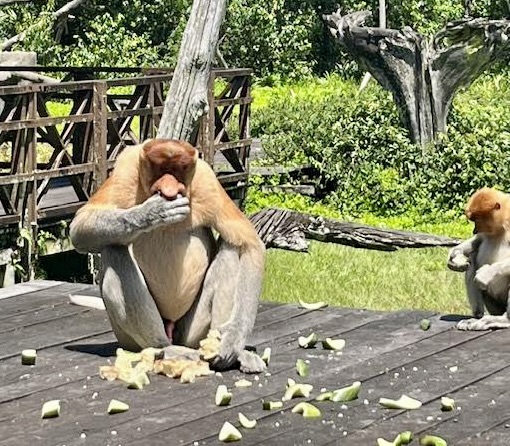
Borneo is well-known for its incredible wildlife, with a number of animals that are endemic, endangered and totally engaging. They are probably one of the main reasons tourists make the trek here. Let’s start with the proboscis monkey. This arboreal old-world monkey looks to have been a collaboration between Salvador Dali and a group of eight-year-old boys.
Dali, because this is exactly what Dali would do with a nose.
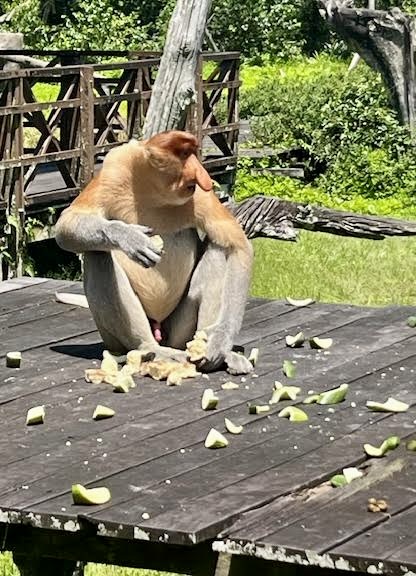
And who but a group of young boys would take great delight in giggling over big red penises? Well okay, perhaps red penises and black scrotum are an arresting sight for most people. This display is meant to suggest male dominance over other males and sexual vigour to attract females, but during our viewing of the monkeys, the only attraction appeared to be the food.
Their penises (also known as red rockets) are almost always erect, but everyone needs a break sometimes. This poor fella appears a bit downcast.
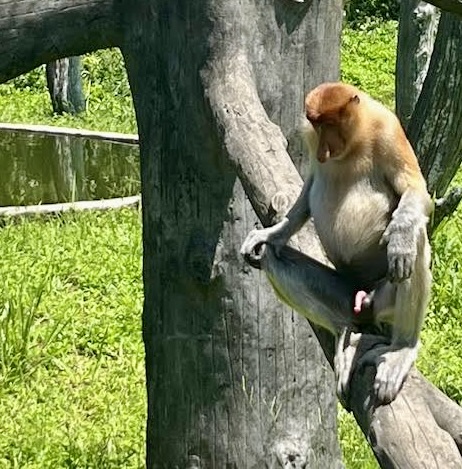
Proboscis monkeys form families of one adult male, several adult females and their offspring. They live alongside one another in overlapping groups, with very few territorial spats, but there’s no question the males are in charge. They weigh 35-50 pounds and live 20-25 years.
The adult males are the only ones to possess the distinctive droopy nose; the females and juveniles have noses that are upturned and pointy.
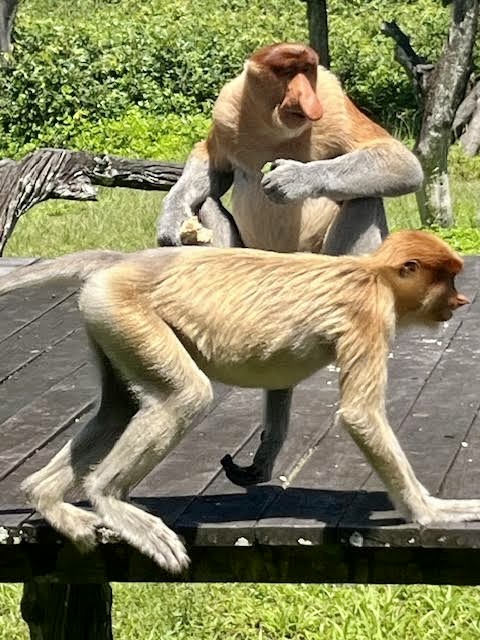
While proboscis monkeys can be found in the wild, we visited the Labuk Bay Sanctuary for the 11:30 feeding time; a 400-acre coastal mangrove reserve that is home to about 300 monkeys.
Several platforms are set up with multiple viewing stations, and like clockwork, at 11:25, the monkeys began to swing out of the trees and into view. Soon, about a dozen or so monkeys were happily munching away on cucumbers.
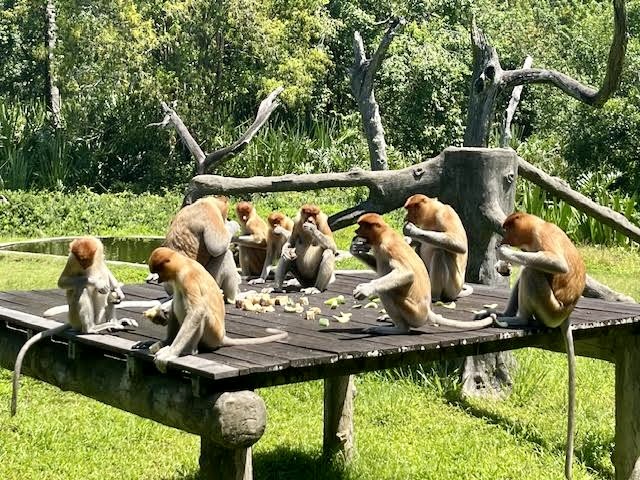
While there was more than enough food to go around, the little ones had to be quick, as the alpha male would snarl at them if he thought they were stealing his food.
Borneo is the world’s third-largest island, made up of three distinct countries – 74% Indonesia, 1% tiny Brunei and 23% Malaysia. Just to clarify, we are only visiting the Malaysian part of Borneo. Our flight from Kuala Lumpur took two and a half hours to the eastern city of Sandakan.
The city itself is not the reason to be here, although it has its historical points of interest (more on that in a bit), but primarily we wanted access to the wildlife.
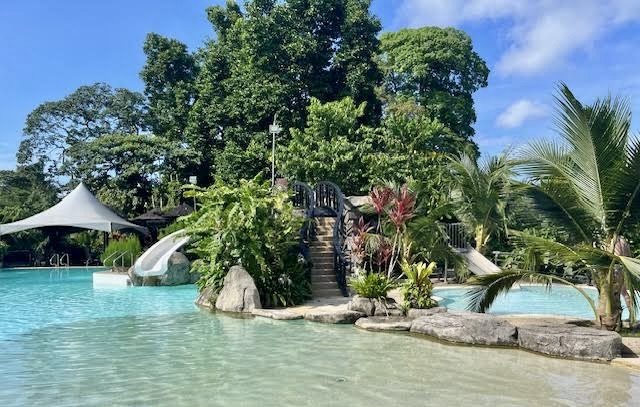
Our hotel was a delight – a four-storey colonial style building surrounded by jungle and a fabulous pool.
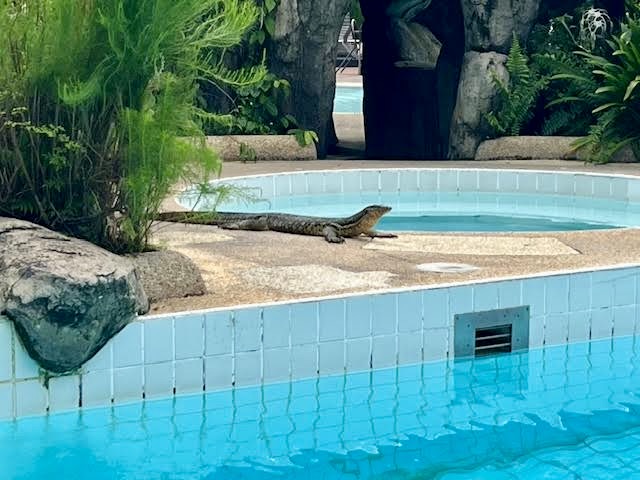
We shared our pool most days with a 4-foot-long monitor lizard, who would periodically be shooed away by staff.
The main wildlife reserves are on the outskirts of town and the best plan is to hire a driver for the day, rather than try to navigate buses and taxis. We had a wonderful, informative man named Bidi to take us around and he made a huge difference in our enjoyment of the day and our understanding of what we were about to see.
First up was the outstanding Sepilok Orangutan Rehabilitation Centre, which has been in operation since 1964. The orangutans, found only in Borneo and Indonesia, are now critically endangered; their numbers having been threatened by poaching and deforestation due to palm oil and logging.
There are 60-80 orangutans at Sepilok, with the goal being to release them into the wild again, if possible. The males grow to about 165 lbs and the females about half that size, and coincidentally – they share about 95% of human DNA.
The reserve is spread out over 43 sq. km., with walkways leading visitors between the main feeding stations and the nursery for the orphans.
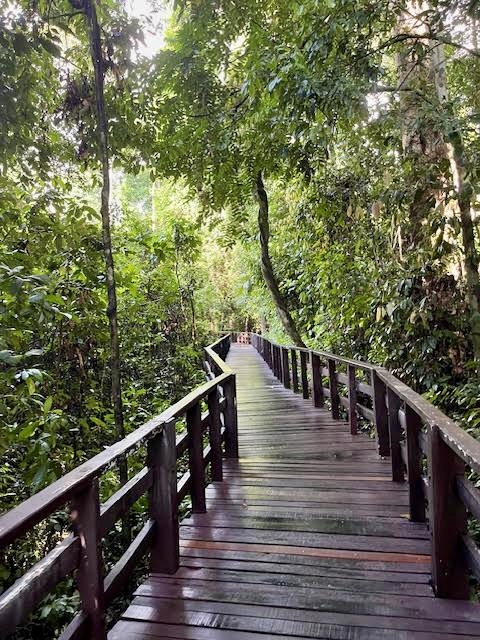
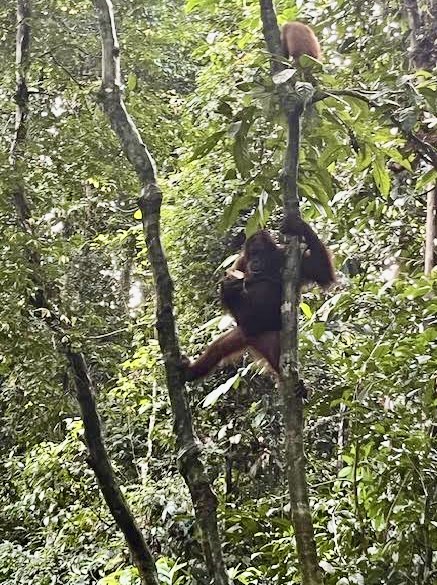
We actually saw an orangutan in the trees as we were walking along, which was a thrill.
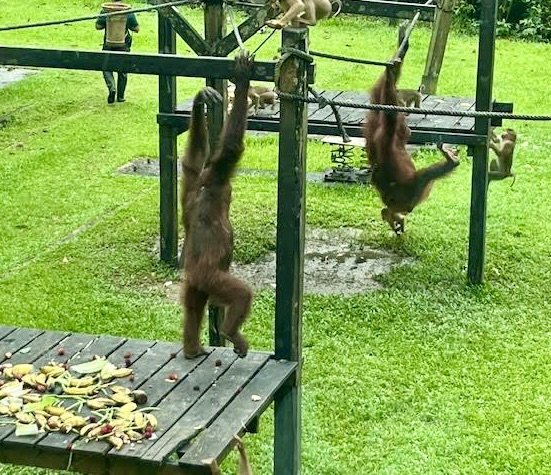
At the feeding station, it was the same story as with the monkeys. The orangutans began to swing into sight just as the food was arriving.
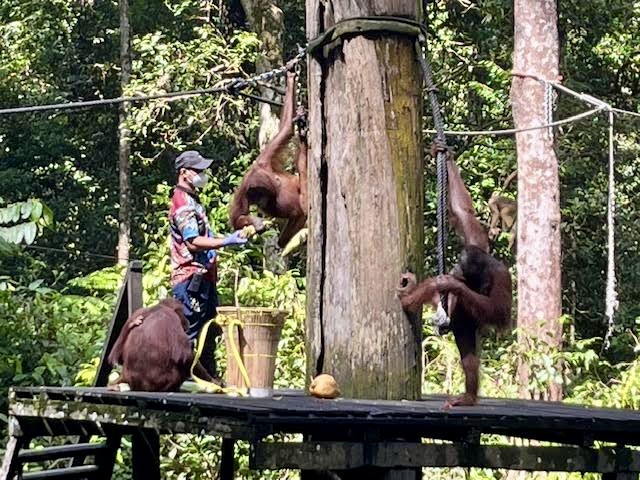
What made the show even more entertaining was the antics of the macaques. They would sneak in behind the orangutans and grab food, then scamper away to avoid getting a swat.
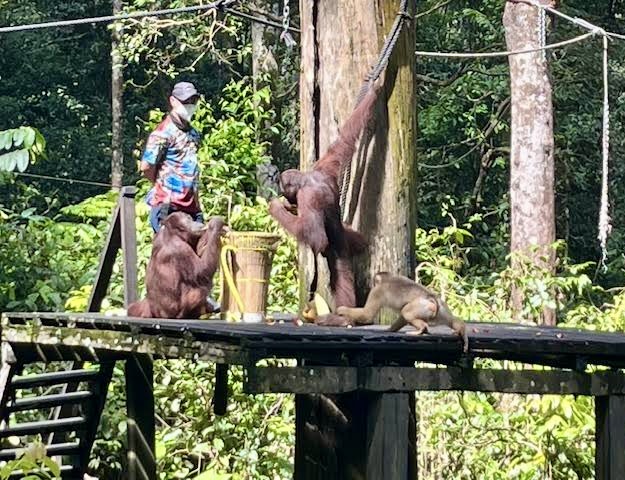
This little family having their own picnic.
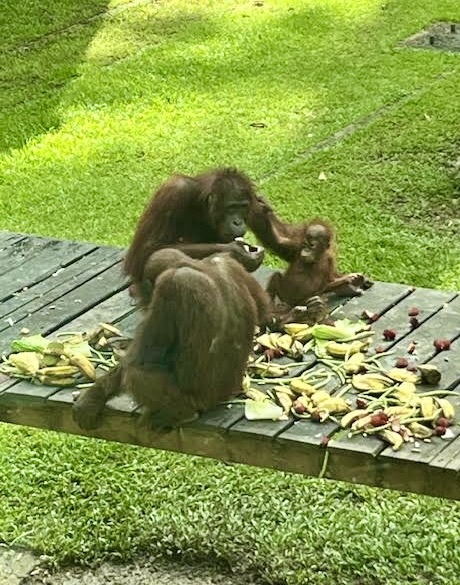
Ape acrobatics. And then, just like the proboscis monkeys – as soon as the food was gone, they all climbed back into the jungle and the show was over.
The Borean Sun Bear Conservation Centre is close by to the orangutan reserve, so we popped by to check out the “world’s smallest bear.” He’s the little guy on the right, at the very end, found only in Southeast Asia.
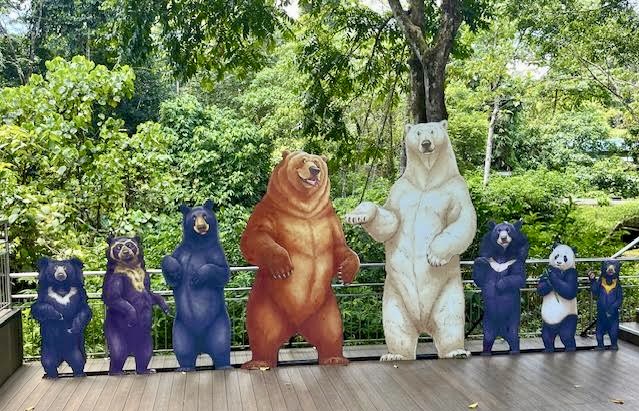
Although, he is still a bear and highly aggressive. As we were approaching the observation decks, we heard the most fearsome roaring – a truly frightening sound.
This centre was opened to the public in 2014, after local efforts to save these little bears became more widely known and better funded. Sun bears, like many bears in Asia have been poached for their gallbladders, and were also captured as cubs for pets. They are classified as “vulnerable” and this centre now houses 43 bears for their protection.
Unfortunately, we arrived here at mid-day, and the bears were mostly in hiding. We did see one bear climb about in a tree, then settle down for a nap.

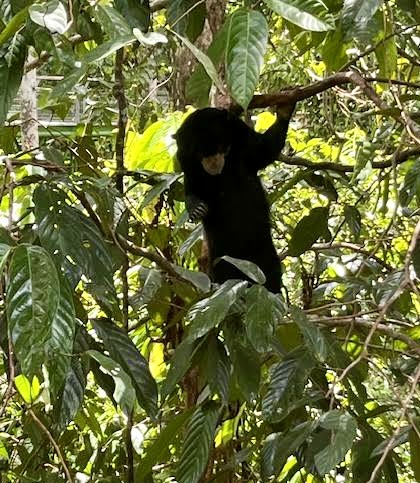
From our vantage point, he looked to be about the size of a Labrador retriever, but apparently their weight ranges from 44-154 pounds.
We felt very fortunate to have seen as much wildlife as we did, but we also learned a little about the history of Sandakan, much of it tied to the tragedies of WWII.
Sandakan was the former capital of British Borneo and most of the city was burned to the ground by the British during WWII, in advance of the Japanese invasion.
Among the prominent citizens of pre-and-post-war Sandakan were American writer Agnes Keith and her British husband Harry Keith. She chronicled life in Borneo, as well as the harrowing tales of their imprisonment and rough treatment at the hands of the Japanese during the war. After stints in Libya, and back again in Sandakan, they finally settled in Victoria, BC.
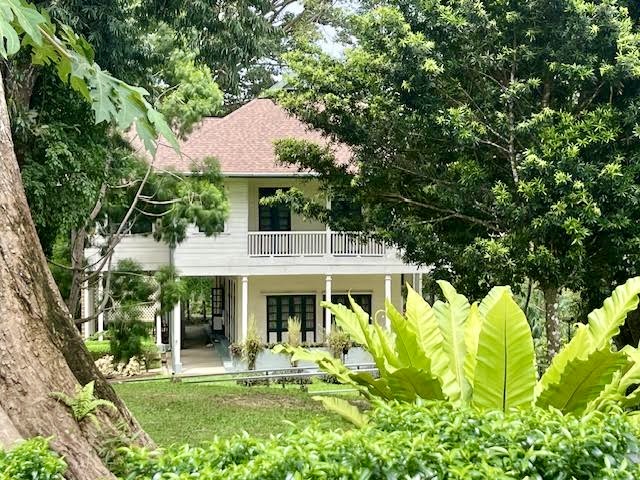
Their beautiful home, which was destroyed during the war, was rebuilt and is now a museum.
A photo of Agnes Keith, with a sentiment from one of her books, that seems so impossible to believe in these days.

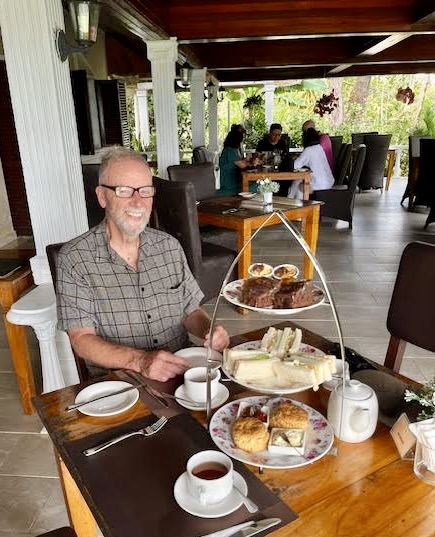
After our visit to the Agnes Keith Home, we maintained our toehold in colonial British Borneo and scooted across the lawn to enjoy an English Tea.
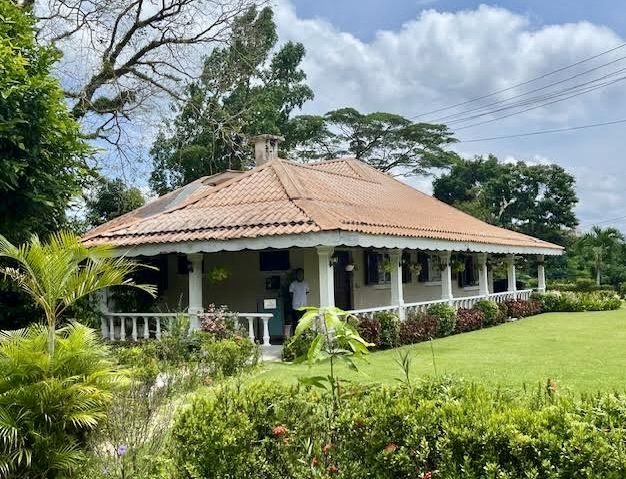
As we nibbled on tea sandwiches and scones and gazed out to sea, we listened to music from the 30s and 40s and imagined what that life might have been like back then.
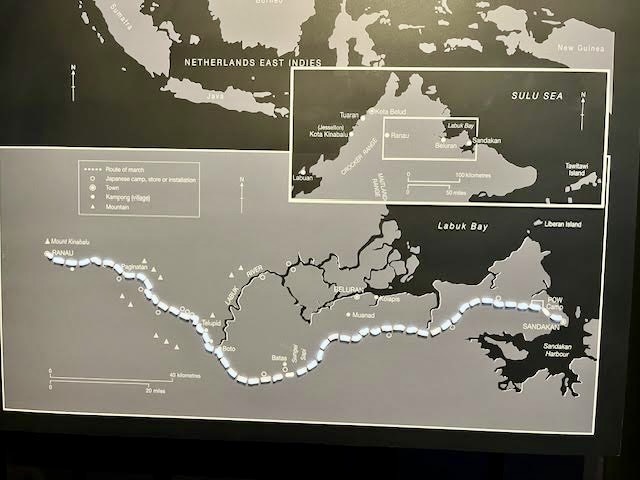
A visit to the Sandakan Memorial Park was a sobering one. It marks the site of the Japanese POW camp, and the starting of the infamous “death marches.” Over 2000 British and Australian soldiers were forced to march 260 km. from Sandakan to Ranau, in the heat and without food, water or medical attention.
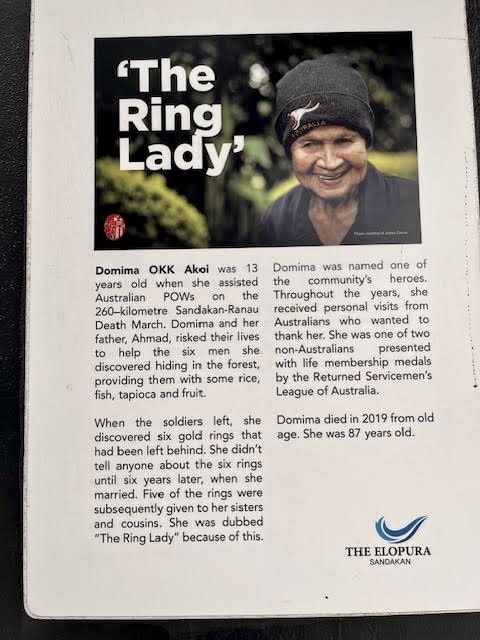
Only six of them survived, by escaping and being sheltered by locals. This story tells of “The Ring Lady”, who, along with her family, helped to save their lives.
The Sandakan Memorial Park commemorates this loss, which was considered the worst atrocity suffered by Australian servicemen during WWII.
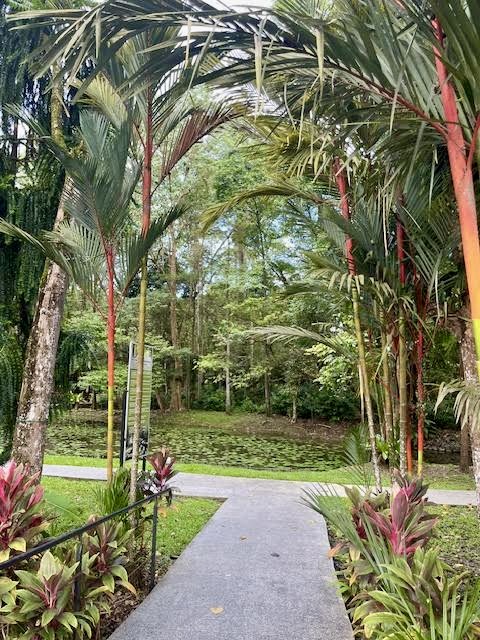
We have changed our travel plans a bit. Tomorrow we go to the Kinabatangan River for a day and night in the heart of the jungle. We will be staying at a riverfront lodge, fans, mosquito nets, little wifi, and like everyone else, hoping for sightings of the pygmy elephants, orangutans, crocodiles, proboscis monkeys, as we sail along the river in the early evening and early morning. We are very excited about this journey and hopefully, our wildlife luck will be with us.
Originally we had planned to come back here for another four nights, but we realized we’ve done everything we want to do here, so we’re flying to the west part of Borneo – to Kuching for four days. A whole other perspective to discover.
 Leaving Ourselves Behind
If I saw those monkeys on Facebook I would have thought they were photo shopped. Amazing trip again for you and Steve. Lorne and I are enjoying your adventures from the comfort of our couch.❤️
LikeLike
My friend – I can’t tell you how happy we are that you and Lorne are safely home. Looking forward to a good catch-up chat when we get back.
LikeLike
Hi Ginny and Stephen,
Those Red Rockets are quite something! Their noses are something out of this world. Makes a person less likely to complain about the shape of their own nose!
Hope you get lucky on the river! Heather
Sent from my iPad
>
LikeLike
Heather, it is so funny that you should mention being less likely to complain about their noses! I have always disliked my nose, but I have a way to go yet to compete with the Proboscis.
LikeLike
Very interesting choice to visit Borneo. I enjoyed reading about your visit there.
I spent some time in Kalimantan about 20 years ago and it was fascinating. My spiritual practice (called SUBUD) has a community there, and we were able to stay there in comfort and visit the local Dyaks, go on a river trip, see some of the local sights and visit the city of Palankaraya. I remember how hot it was! Such a different culture with an interesting history. safe travels!
love from Rohana
LikeLike
Borneo does feel like such a different place, and in fact Sabah and Sarawak are so different from one another. I would love to visit the Indonesia part of Borneo one day. Rich cultures.
LikeLike